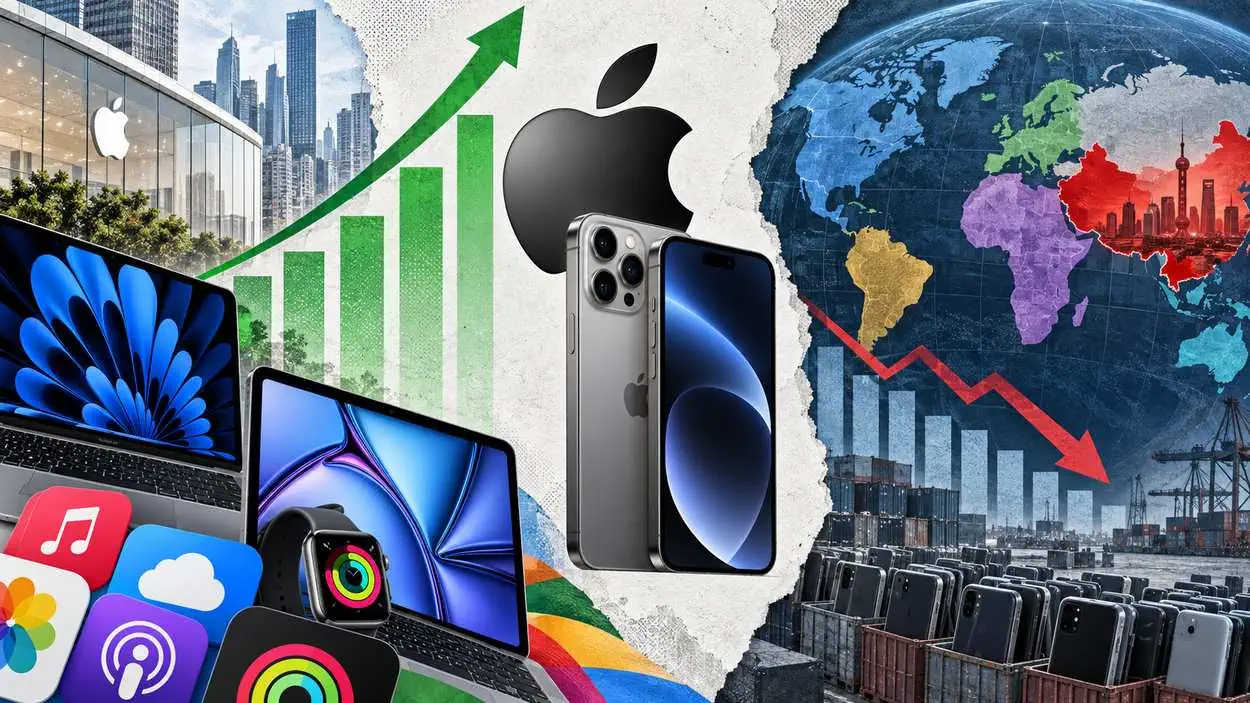






Apple closed a record fiscal year with revenue reaching $416 billion, then grew by double digits in each of the next three quarters. Net sales hit $143.8 billion in the December 2025 quarter, $111.2 billion in March 2026, and $109.4 billion in June 2026, each one a record for its calendar position.
The Apple sales statistics below come from the company’s own Form 8-K filings with the SEC. Those filings break net sales down five ways by product and five ways by region. What makes the run unusual is its backdrop: IDC forecasts worldwide smartphone shipments to decline 13.9% year-on-year in 2026, the steepest annual contraction in smartphone history.
Key Takeaways
- iPhone contributed $196,515 million of Apple’s $364,357 million in nine-month fiscal 2026 net sales.
- Greater China reached $64,839 million across the first nine months of fiscal 2026, above the segment’s full fiscal 2025 total of $64,377 million.
- iPad slipped to $6,191 million in the June 2026 quarter, from $6,581 million a year earlier.
- Gross margin reached 50.1% in the June 2026 quarter, including a favorable impact of approximately 2 percentage points from tariff refunds.
- IDC puts 2026 worldwide smartphone shipments at 1.09 billion units, down 13.9% year-on-year.
- Apple’s installed base now has more than 2.5 billion active devices.
- In China, Apple took 18.1% of second-quarter 2026 shipments against 13.9% a year earlier, in a market down 4.3%.
Editor’s Choice
- Fiscal 2025 revenue: $416,161 million, against $391,035 million in fiscal 2024.
- Largest quarter reported: $143,756 million in the three months ended December 27, 2025.
- Biggest iPhone quarter: $85,269 million, against $69,138 million a year earlier.
- Services all-time high: $30,976 million in the March 2026 quarter.
- Fiscal 2025 net income: $112,010 million, up from $93,736 million.
- Fiscal 2025 diluted earnings per share: $7.46, against $6.08.
- Smartphone average selling price: a record $550 in 2026, up $100 from last year.
Apple Sales Statistics by Product Category
- iPhone generated $209,586 million in fiscal 2025, against $201,183 million in fiscal 2024.
- Services became the second-largest line, at $109,158 million in fiscal 2025.
- Wearables, Home and Accessories was the only fiscal 2025 category to fall, to $35,686 million from $37,005 million.
- Mac and iPad both grew, reaching $33,708 million and $28,023 million.
- Products and Services split the year at $307,003 million and $109,158 million.
- Total net sales came to $416,161 million against $391,035 million the year before.
| Category | FY2025 net sales ($ millions) | FY2024 net sales ($ millions) |
|---|---|---|
| iPhone | 209,586 | 201,183 |
| Services | 109,158 | 96,169 |
| Wearables, Home and Accessories | 35,686 | 37,005 |
| Mac | 33,708 | 29,984 |
| iPad | 28,023 | 26,694 |
Source: Apple SEC Form 8-K, fiscal 2025 fourth quarter
The annual split is the number most people quote, and it hides the shape of the year underneath it. Apple’s quarters are not smooth, and the fiscal 2026 ones diverge sharply from the fiscal 2025 baseline.
Apple Quarterly Revenue Trend Through Fiscal 2026
- The December 2025 quarter set an all-time company record at $143.8 billion, up 16% year over year.
- March 2026 followed with $111.2 billion, up 17% year over year.
- June 2026 came in at $109.4 billion, up 16% year over year.
- The September 2025 quarter that closed fiscal 2025 reached $102.5 billion, up 8% year over year.
- Diluted earnings per share moved from $2.84 in the December 2025 quarter to $2.02 in June 2026, up 29% year over year.
By the numbers: Apple’s four most recent reported quarters total $466,823 million in net sales, against $416,161 million for all of fiscal 2025. Three straight double-digit quarters have lifted the run rate $50,662 million above where the last full fiscal year closed.

Recent Developments
- July 30, 2026: Apple reported June quarter records for total company revenue and EPS, with iPhone, Mac, and Services revenue setting new June quarter records.
- August 13, 2026: IDC recorded worldwide tablet shipments of 33.6 million units in the second quarter of 2026, down 12.3% from a year ago.
- July 14, 2026: IDC’s China tracker put Apple at 18.1% of China smartphone shipments in Q2 2026, against 13.9% a year earlier.
- June 2026: Apple raised the entire iPad line globally, with multiple models costing an additional 20% or more, explicitly citing memory costs.
- May 26, 2026: IDC revised its 2026 smartphone forecast down to a 13.9% decline, from a February forecast of a 12.9% decline.
- April 30, 2026: Apple posted March quarter records for total company revenue, iPhone revenue, and EPS.
iPhone Sales Revenue by Quarter
- iPhone’s largest quarter in the series was $85,269 million, against $69,138 million a year earlier.
- The June 2026 quarter reached $54,252 million, up from $44,582 million.
- March 2026 iPhone revenue came in at $56,994 million, against $46,841 million.
- Across nine months of fiscal 2026, iPhone generated $196,515 million, against $160,561 million in the same period of fiscal 2025.
- That works out to 54% of Apple’s nine-month net sales.
Is the iPhone 17 selling well?
Apple’s own filings point to yes. Tim Cook attributed the March 2026 quarter’s iPhone record to such extraordinary demand for the iPhone 17 lineup. IDC credited the phenomenal success of its latest iPhone 17 series in a year forecast to reach a record 247.4 million units. Our iPhone sales data tracks the same cycle at model level.
Apple Mac, iPad and Wearables Sales Trends by Quarter
- Mac set a June quarter record at $10,352 million, against $8,046 million a year earlier.
- iPad fell in the same comparison, to $6,191 million from $6,581 million.
- Wearables, Home and Accessories peaked at $11,493 million in the December 2025 quarter, below $11,747 million a year earlier.
- Across nine months, Mac reached $27,137 million and iPad $21,700 million.
- Wearables across the same nine months came to $27,277 million, against $26,673 million.
View the data
Mac and iPad have traded places. The Mac line, long treated as the mature one, produced the strongest hardware growth of the June 2026 quarter, while iPad went backwards in a quarter when everything else set records.
Apple Services Revenue by Quarter
- Services reached an all-time high of $30,976 million in the March 2026 quarter.
- The June 2026 quarter came in close behind at $30,739 million, against $27,423 million.
- December 2025 Services revenue was $30,013 million, up 14% from a year ago.
- Nine-month Services revenue totaled $91,728 million, against $80,408 million.
- Services cost of sales stayed far below product cost, at $7,494 million on $30,739 million of June 2026 revenue.
Services is the smoothest line in Apple’s model, and it feeds the ecosystem effects tracked in our Apple customer retention data. Subscription products such as Apple Music subscriber data sit inside this number rather than in any hardware category.
Apple Sales by Geographic Segment
- The Americas produced $178,353 million in fiscal 2025, against $167,045 million in fiscal 2024.
- Europe reached $111,032 million, up from $101,328 million.
- Greater China fell to $64,377 million from $66,952 million.
- Rest of Asia Pacific came to $33,696 million, up from $30,658 million.
- Japan reached $28,703 million, up from $25,052 million.
Greater China Sales Quarter by Quarter
- Greater China bottomed at $14,493 million in the September 2025 quarter, below $15,033 million a year earlier.
- The very next quarter reached $25,526 million, against $18,513 million.
- March 2026 held at $20,497 million, up from $16,002 million.
- June 2026 came in at $18,816 million, against $15,369 million.
- Nine-month Greater China net sales reached $64,839 million, against $49,884 million, which is $462 million more than the segment’s entire fiscal 2025 total.
Why it matters: Greater China shrank in fiscal 2025, to $64,377 million, and then produced $64,839 million in nine months of fiscal 2026. A segment that read as Apple’s structural problem in October 2025 had become its fastest-growing region by the following summer, which no annual figure would have shown.
Regional Sales Growth in Fiscal 2026
- The Americas reached $149,403 million across nine months, up from $134,161 million.
- Europe came to $95,596 million, up from $82,329 million.
- Rest of Asia Pacific reached $30,151 million, up from $25,254 million.
- Japan grew more slowly, to $24,368 million from $22,067 million.
- Apple posted double-digit revenue growth in every geographic segment, with Cook noting double-digit revenue growth across iPhone, Mac and Services, and in every geographic segment.
Apple Sales Against a Shrinking Smartphone Market
- IDC forecasts worldwide smartphone shipments to decline 13.9% year-on-year in 2026 to 1.09 billion units, the steepest annual contraction in smartphone history.
- The 2026 forecast was cut from a 12.9% decline in IDC’s February forecast.
- IDC expects a second consecutive decline of 1.1% in 2027, with a 5.5% rebound forecast in 2028 as memory supply normalises.
- Smartphone average selling price is rising to a record $550, up $100 from last year.
- IDC’s December 2025 forecast put calendar 2025 shipments at 1.25 billion units, growth of 1.5% year-on-year.
- Apple’s own 2025 shipments were forecast to grow 6.1% year-over-year, crossing 247 million units.
| Year | Worldwide shipments | Year-on-year change | Average selling price |
|---|---|---|---|
| 2025 | 1.25 billion units | +1.5% | Not stated |
| 2026 (forecast) | 1.09 billion units | -13.9% | $550 |
| 2027 (forecast) | Not stated | -1.1% | Not stated |
| 2028 (forecast) | Not stated | +5.5% | Not stated |
Source: IDC Worldwide Quarterly Mobile Phone Tracker, December 2025 and May 2026
IDC’s Nabila Popal framed the squeeze bluntly: For consumers, it means the era of ultra-cheap smartphones is over. Apple’s revenue mix sits at the premium end that IDC says every vendor is retreating toward, which is how a company can grow 16% inside a market forecast to shrink. Our global smartphone ownership statistics show how narrow that premium band actually is.
Apple’s Share of China’s Smartphone Market
- China shipments came in at roughly 66 million units in the second quarter of 2026, down 4.3% year over year and the fifth straight quarter of decline.
- Apple held 18.1% of the market, against 13.9% a year earlier, on 24.4% year-over-year growth.
- Huawei led at 22.6%, up from 18.1%, on 19.4% growth.
- Xiaomi fell hardest among the top five, to 12.4% share on -21.7% growth.
- Overall smartphone sales during the “618” shopping festival fell close to 15% year over year.
| Vendor | Q2 2026 share | Q2 2025 share | Year-over-year growth |
|---|---|---|---|
| Huawei | 22.6% | 18.1% | 19.4% |
| Apple | 18.1% | 13.9% | 24.4% |
| OPPO | 16.0% | 17.3% | -9.7% |
| vivo | 16.0% | 17.0% | -11.4% |
| Xiaomi | 12.4% | 15.1% | -21.7% |
| Honor | 11.3% | 11.9% | -9.5% |
Source: IDC Quarterly Mobile Phone Tracker, July 2026
Worth noting: IDC marks the Q2 2026 China figures as preliminary and subject to change. OPPO and vivo both sit at 16.0%, and IDC lists them at the same rank, so the order among the chasing vendors is effectively level.
iPad Pricing and the Tablet Market Contraction
- Worldwide tablet shipments fell to 33.6 million units in the second quarter of 2026, down 5.2% from the prior quarter and 12.3% from a year ago.
- Apple raised the entire iPad line globally in June, with multiple models costing an additional 20% or more.
- Samsung moved first, raising list prices $40 to $280 across nearly its entire Galaxy Tab lineup in April.
- Consumer shipments absorbed most of the damage, falling 13.5% year over year, while commercial held up far better at -5.9%.
- United States tablet shipments collapsed 31.6% year over year, even as they rebounded 7.1% sequentially off a depressed base.
| Measure | Q2 2026 value |
|---|---|
| Worldwide tablet shipments | 33.6 million units |
| Quarter-over-quarter change | -5.2% |
| Year-over-year change | -12.3% |
| Consumer segment change | -13.5% |
| Commercial segment change | -5.9% |
| United States change | -31.6% |
Source: IDC Worldwide Quarterly Personal Computing Device Tracker, August 2026
This is the clearest place to see the memory shortage land on Apple’s own price list. The company raised iPad prices in June and reported lower iPad revenue in the quarter that followed, which is the trade every vendor in the category made this year.
Apple’s Nine-Month Fiscal 2026 Scorecard
- Total nine-month net sales reached $364,357 million, against $313,695 million in the same period a year earlier.
- Products accounted for $272,629 million of that, with Services at $91,728 million.
- Gross margin across nine months came to $178,782 million, against $146,860 million.
- Nine-month net income reached $101,464 million, up from $84,544 million.
- Research and development spending rose to $34,035 million from $25,684 million.
| Category | Nine months FY2026 ($ millions) | Nine months FY2025 ($ millions) |
|---|---|---|
| iPhone | 196,515 | 160,561 |
| Services | 91,728 | 80,408 |
| Wearables, Home and Accessories | 27,277 | 26,673 |
| Mac | 27,137 | 24,982 |
| iPad | 21,700 | 21,071 |
Source: Apple SEC Form 8-K, fiscal 2026 third quarter
Apple described the installed base as more than 2.5 billion active devices, and CFO Kevan Parekh said it reached a new all-time high across all major product categories and geographic segments. That base is what the App Store revenue statistics ultimately monetize.
Are Apple sales dropping?
Apple’s sales are not dropping. Net sales rose in every fiscal 2026 quarter reported so far, by 16%, 17% and 16% respectively, on top of a fiscal 2025 that closed at a record.
The one genuine decline sits inside the product mix rather than at the top line. iPad revenue fell year over year in the June 2026 quarter, to $6,191 million from $6,581 million, and Wearables, Home and Accessories was the only category to shrink across fiscal 2025 as a whole. Unit shipments are a separate question, because Apple’s filings report revenue rather than units, so every unit figure in circulation comes from a tracker such as IDC.
Is Apple doing financially well?
By the measures in its own filings, yes. Fiscal 2025 net income reached $112,010 million, against $93,736 million in fiscal 2024, and diluted earnings per share moved from $6.08 to $7.46 across the same two years.
Margin held up through fiscal 2026 as well. Gross margin reached 50.1% in the June 2026 quarter, including a favorable impact of approximately 2 percentage points from tariff refunds. The memory-cost pressure IDC documents across phones and tablets has shown up in Apple’s pricing before it has shown up in its profitability.
Conclusion
Apple’s record $416 billion fiscal year turned out to be a floor rather than a peak. The first nine months of fiscal 2026 delivered $364,357 million in net sales, iPhone supplied 54% of it, and Greater China alone contributed more than it had in the whole of the previous year. Three numbers are worth watching: the iPad line, still falling; the Greater China quarterly series; and gross margin, which has absorbed the memory shortage through pricing rather than profitability.
The wider category is moving the other way. IDC expects a 13.9% decline this year and a further 1.1% decline in 2027, with a 5.5% rebound in 2028 as memory supply normalises. Investors, analysts, and anyone modeling the premium device market get more signal from Apple’s regional splits than from its headline total, because that is where the divergence between one company’s growth and its industry’s contraction actually shows up.