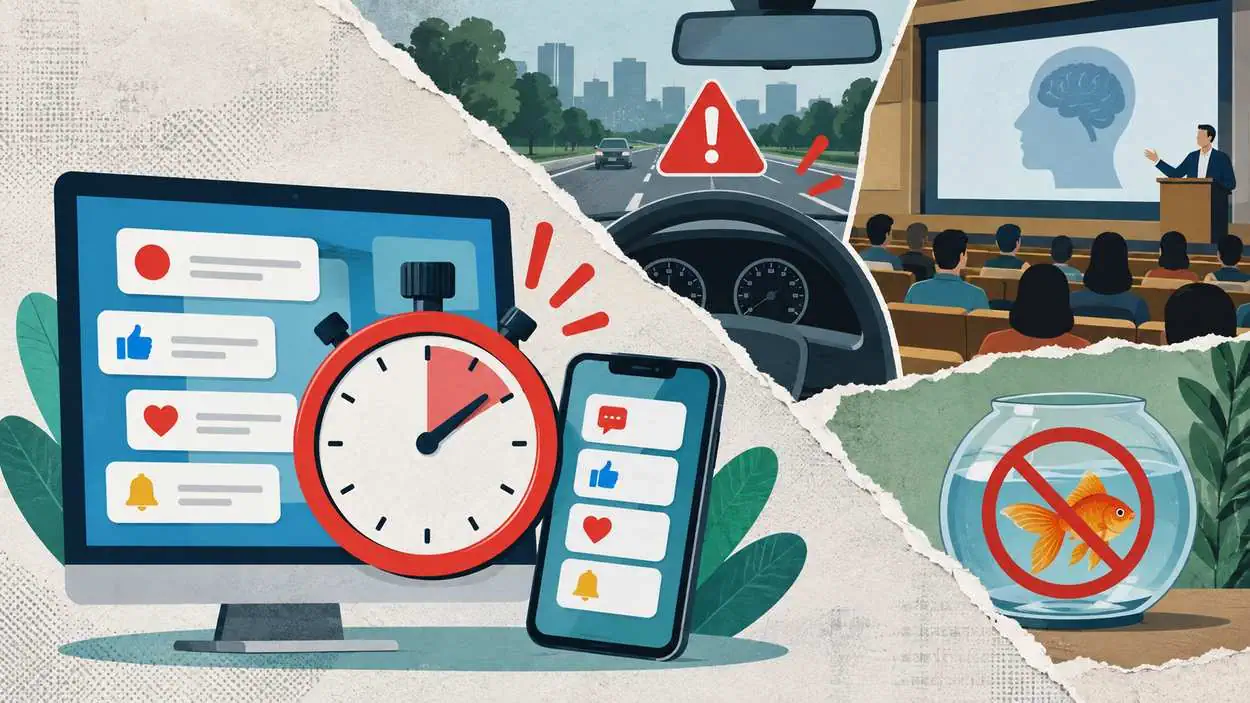






Adults hold their attention on a single screen for an average of 47 seconds, according to informatics research from the University of California, Irvine. That figure anchors the attention economy, yet the most viral claim about focus, an eight-second span said to trail a goldfish, is a myth with no scientific basis. Attention behaves differently behind the wheel, in a lecture hall, on a web page, and inside a workday full of interruptions, and the sourced numbers below map each context.
Key Takeaways
- Screen attention has fallen from two and a half minutes on any screen in 2004 to 75 seconds by 2012, per University of California research.
- Teen drivers aged 15 to 20 carry the largest distracted share of any age group in fatal crashes; 7% of drivers 15 to 20 years old involved in fatal crashes were reported as distracted, the largest proportion of any age group, per NHTSA.
- The classroom “10 to 15 minute” attention limit is not supported by the primary data, which do not support the concept of a 10- to 15-minute attention limit, per a 2016 physiology-education review.
- Web readers finish half a page’s words only when it runs 111 words or less, according to Nielsen Norman Group.
- Phone habits compound the pattern: 89% of Americans say they check their phones within the first 10 minutes of waking up, per a 2023 Reviews.org survey.
- A naturalistic study estimated distraction in 29% of all crashes, resulting in 10,546 fatalities, per NHTSA’s 2023 research note.
- School policy has responded: 26 states have laws or policies requiring local school boards to ban or limit cellphone use in K-12 classrooms, 22 of them enacted in 2025, per Ballotpedia.
Editor’s Choice
- Average screen attention is about 47 seconds, with a median of 40 seconds, meaning half of all measurements were 40 seconds or less, per UC Irvine’s Gloria Mark.
- Distracted driving killed 3,275 people and injured an estimated additional 324,819 people in motor vehicle traffic crashes involving distracted drivers in 2023, according to NHTSA.
- Distraction-affected crashes accounted for 8% of fatal crashes in 2023, per NHTSA.
- Web visitors read at most 28% of the words during an average visit, and 20% is more likely, per Nielsen Norman Group.
- Americans check their phones 144 times per day and spend 4 hours, 25 minutes each day on their cell phones, per a 2023 Reviews.org survey.
- Refocusing on an interrupted project takes about 25 and a half minutes, per University of California research.
- Cellphone-related distraction was tied to 397 people who died in crashes involving at least one driver engaged in cellphone-related activity in 2023, per NHTSA.
Attention Span by Context: The Cross-Domain Numbers
- On screens, attention now averages about 47 seconds, replicated by other researchers within a few seconds, per the American Psychological Association’s interview with Gloria Mark.
- On the road, distraction was a factor in 8% of fatal crashes, an estimated 13% of injury crashes, and an estimated 13% of all police-reported motor vehicle traffic crashes in 2023, per NHTSA.
- On web pages, users read at most 28% of the words during an average visit, with an average visit lasting approximately 25 seconds, plus an additional 4.4 seconds per 100 words, per Nielsen Norman Group.
- In the workplace, people spend about 10 and a half minutes on any project before switching, per University of California research.
- In lecture halls, measured attention showed waxing and waning throughout the lecture, with no discernible downward trend, per a 2016 review.
- The often-quoted 8-second human attention span is found only in a visual source to Statistic Brain, per Temple University’s evidence review.
| Context | What is measured | Figure |
|---|---|---|
| Single screen | Average attention before switching | 47 seconds |
| Web page | Words read per visit | 20% to 28% |
| Web page | Average visit length | ~25 seconds |
| Driving (2023) | Share of fatal crashes distraction-affected | 8% |
| Workplace | Time on a project before switching | 10.5 minutes |
| Workplace | Time to resume after interruption | 25.5 minutes |
Source: NHTSA, University of California (Gloria Mark), Nielsen Norman Group, 2023
By the numbers: Nielsen Norman Group instrumented 45,237 page views and found users read at most 28% of a page’s words, with 20% the likelier share. Half of a page’s words get read only when the page runs 111 words or fewer, a ceiling most articles blow past in their opening paragraph.
Screen Attention: The 47-Second Workday
- Gloria Mark’s team clocked screen attention at two and a half minutes on any screen in 2004, per University of California research.
- By 2012, that average had dropped to 75 seconds on any screen before switching, per the same research.
- In recent years, the average settled at about 47 seconds, per the American Psychological Association interview.
- The median runs lower still, at 40 seconds, meaning half of all the measurements were 40 seconds or less, per Gloria Mark.
- Switching carries a cost, since it takes about 25 and a half minutes to pick up that original interrupted project, per UC Irvine.
The trajectory from 150 seconds to 47 is a change in behavior rather than proof of a broken brain. The interval between self-interruptions keeps shrinking even as the underlying cognitive capacity holds, a pattern our Gen Z social media data tracks most sharply among younger users.

Recent Developments
- California’s Phone-Free Schools Act requires that school districts, county offices of education, and charter schools develop and adopt a policy to limit or prohibit the use of smartphones by pupils no later than July 2026, effective for the 2026-2027 school year, per the Office of the Governor of California.
- Nationwide, 26 states have mandated full bans on phones being used in schools, per Newsweek’s January 2026 tracker.
- Of those, 22 laws were enacted in 2025, with the most recent put in place in Oregon through an executive order, per Ballotpedia.
- Earlier in the wave, 11 states had passed statewide policies that ban or restrict cellphone use in schools as of April 30th, 2025, per KFF.
- Legislative momentum was broad, with 17 states having introduced statewide legislation and education departments in seven states issuing recommended policies or pilot programs, per KFF.
Distracted Driving: Attention Behind the Wheel
- Distraction-affected crashes killed 3,275 people in 2023 and injured an estimated additional 324,819 people, per NHTSA.
- Distraction touched 8% of fatal crashes, an estimated 13% of injury crashes, and an estimated 13% of all police-reported crashes in 2023, per NHTSA.
- Among drivers, 5% of all drivers involved in fatal traffic crashes in 2023 were reported as distracted, per NHTSA.
- Nonoccupants bore part of the toll, with 611 nonoccupants killed in distraction-affected crashes in 2023, per NHTSA.
- Phones specifically figured in 369 fatal traffic crashes reported as having cellphone use as a distraction, per NHTSA.
- Accounting for underreporting, a naturalistic study found distraction was involved in 29% of all crashes, resulting in 10,546 fatalities, per NHTSA’s citation of Blincoe et al.
Why it matters: The official 3,275 distracted-driving deaths in 2023 likely undercount the problem. The naturalistic estimate cited in the same NHTSA note puts distraction behind far more crashes than police reports capture, because drivers rarely admit to looking away from the road.
The Lecture Attention Myth: 10 to 15 Minutes Debunked
- A review of the primary literature shows a data set that is far from supportive of a 10-15 minute attention span, per Neil Bradbury’s 2016 analysis.
- The most-cited source for the claim did not address attention at all, but rather focused on note-taking, per Bradbury.
- That distinction matters because note-taking is not a valid indicator of attention, per the same review.
- When attention was measured directly with clickers, researchers saw waxing and waning of attention throughout the lecture, with no discernible downward trend, per Bradbury.
- The bottom-line reading of the evidence: The available primary data do not support the concept of a 10- to 15-minute attention limit.
| Claim about lecture attention | What the primary evidence shows |
|---|---|
| Attention collapses after 10-15 minutes | Data far from supportive of a 10-15 minute limit |
| Most-cited source proves the decline | Source studied note-taking, not attention |
| Note-taking tracks attention | Note-taking is not a valid indicator of attention |
| Attention falls steadily through a lecture | Attention waxes and wanes, no downward trend |
Source: Advances in Physiology Education (Bradbury), 2016
How Little People Actually Read Online
- On an average web page, users read at most 28% of the words during an average visit, and 20% is more likely, per Nielsen Norman Group.
- The finding rests on 45,237 page views drawn from browser instrumentation of 25 users’ natural web activities, per Nielsen Norman Group.
- Readers finish half a page’s words only on those pages with 111 words or less, per the same study.
- Visit length scales slowly, running approximately 25 seconds, plus an additional 4.4 seconds per 100 words, per Nielsen Norman Group.
| Web reading metric | Figure |
|---|---|
| Words read per visit (upper bound) | 28% |
| Words read per visit (likely) | 20% |
| Page length where half the words get read | 111 words or fewer |
| Base visit length | ~25 seconds |
Source: Nielsen Norman Group, 2008
Reading attention tracks the same downward pull SQ Magazine has documented across social media screen time statistics, where scanning has replaced sustained reading on almost every surface.
Workplace Interruptions and the Cost of Task-Switching
- Knowledge workers stay on a project for about 10 and a half minutes before switching, per University of California research.
- Recovering the interrupted thread takes far longer, at about 25 and a half minutes to pick up that original interrupted project, per the same research.
- The screen-level rhythm is faster still, averaging 47 seconds on any screen before switching in recent years, down from two and a half minutes in 2004, per UC Irvine.
| Workplace attention metric | Duration |
|---|---|
| Time on a single screen | 47 seconds |
| Time on a project before switching | 10.5 minutes |
| Time to resume after an interruption | 25.5 minutes |
Source: University of California, Irvine (Gloria Mark), 2023
Key finding: Per University of California research, workers switch screens roughly every 47 seconds but need about 25 and a half minutes to fully resume an interrupted project. The arithmetic is brutal: the recovery window is longer than dozens of the switching intervals it has to survive.
The 8-Second Goldfish Myth, Debunked
- The claim that human attention dropped to eight seconds is found only in a visual source to Statistic Brain, per Temple University’s evidence review.
- Independent measurement contradicts it, with one Wall Street Journal expert stating there is no real evidence that attention span has changed since it was first reported in the late 1800s, per the same review.
- The underlying figure was thin, since the Statistic Brain claim was based on only two sources, one of which was an analytics report about 25 people who quickly left websites they did not like in 2008.
- Longitudinal work points the other way, as University of Chicago psychologist Edward Vogel, who measured college students for 20 years, said attention has been remarkably stable across decades.
- Even the animal benchmark fails, because there is no science for the goldfish-at-9-seconds claim either, per Temple University.
| Attention claim | Origin | Verdict |
|---|---|---|
| Humans have an 8-second attention span | A Statistic Brain figure in a 2015 Microsoft report | No supporting science |
| Attention has collapsed since 2000 | Statistic Brain, two weak sources | No evidence of change since the 1800s |
| Goldfish focus for 9 seconds | Unsourced comparison | No science behind it |
Source: Temple University Advocacy and Evidence Resources, 2024
The takeaway: The viral 8-second statistic sits on a fabricated foundation, yet the measurable shifts are real elsewhere. Screen-switching intervals and web-reading depth have both fallen, which is why the honest framing is behavioral change under a redesigned environment, not a shorter human attention span.
Phone Habits: Attention in the Palm of Your Hand
- Americans check their phones 144 times per day and spend 4 hours, 25 minutes each day on their cell phones, per a 2023 Reviews.org survey.
- The habit starts early in the day, with 89% of Americans checking their phones within the first 10 minutes of waking up, per the same survey.
- Self-perception matches the behavior, as more than half of Americans, 56.9%, told Reviews.org that they are addicted to their cell phone.
- The survey drew on 1,000 American adults aged 18 and older, with a margin of error of plus or minus 4% and a confidence level of 95%, per Reviews.org.
| Phone habit (2023) | Figure |
|---|---|
| Daily phone checks | 144 |
| Daily time on phone | 4 hours 25 minutes |
| Check within 10 minutes of waking | 89% |
| Self-report phone addiction | 56.9% |
Source: Reviews.org 2023 Cell Phone Usage Survey
Is the human attention span really only 8 seconds?
No. The 8-second figure appears only in a visual sourced to Statistic Brain, and independent researchers found no science behind it. A Wall Street Journal expert said there is no real evidence that attention span has changed since it was first reported in the late 1800s, and University of Chicago psychologist Edward Vogel, who measured college students for 20 years, said attention has been remarkably stable across decades. Measured screen attention averages about 47 seconds, a behavioral figure shaped by environment.
How long does it take to refocus after an interruption?
About 25 and a half minutes, according to University of California research led by Gloria Mark, whose team measured about 25 and a half minutes to pick up an originally interrupted project. Because workers spend about 10 and a half minutes on any project before switching and changing screens far more often than that, the recovery window rarely completes before the next interruption lands. That mismatch, rather than any innate limit, explains why fragmented workdays feel unproductive even when tasks technically get finished.
Conclusion
Attention holds steady inside the skull, yet it fractures across every environment humans have built around it, from the 47-second screen to the 25 and a half minutes it takes to pick up an interrupted project. The cross-domain data tells a consistent story: driving distraction killed 3,275 people in 2023, web readers absorb 20% of a page’s words, and the 8-second span appears only in a visual sourced to Statistic Brain with no supporting science.
Readers, educators, safety regulators, and product teams all benefit from separating the measured shifts from the manufactured ones. This year’s wave of school phone policies, with California’s mandate live and 26 states committed, is the clearest sign that the response to fractured attention is moving from panic to policy, one context at a time.