


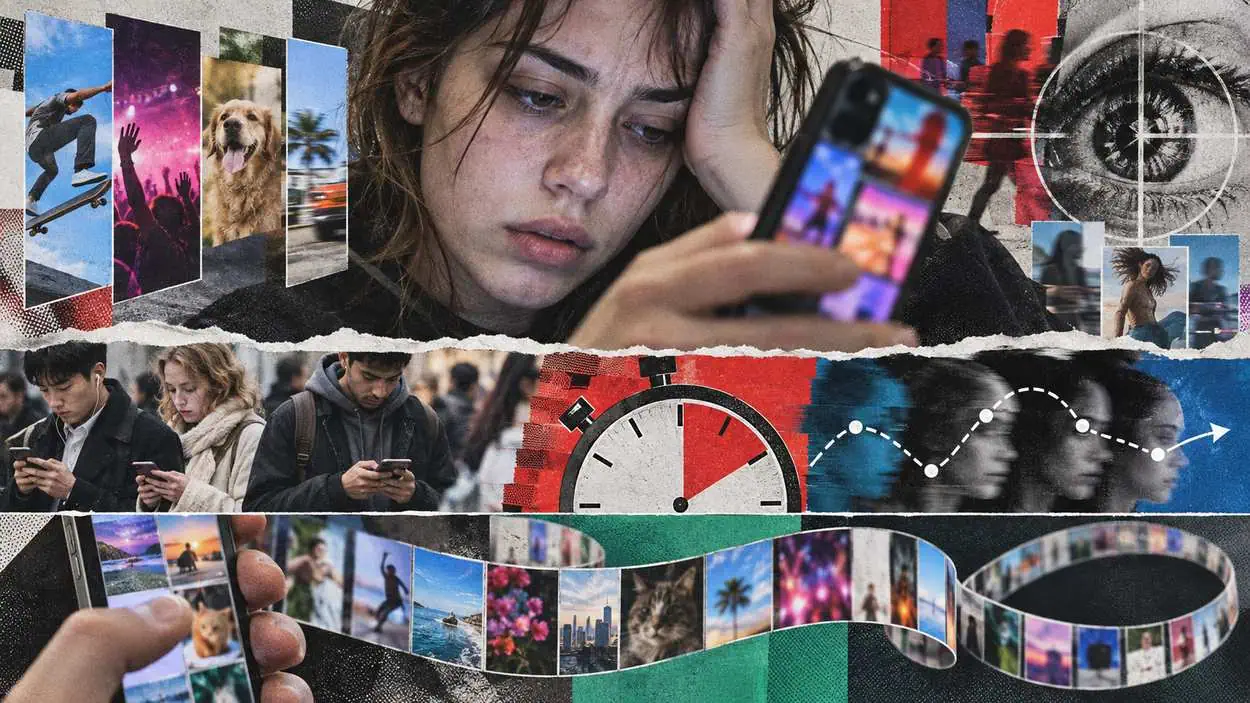






Attention on a screen lasts about 47 seconds on average, down from two and a half minutes in 2004, according to computer-logging research run by Gloria Mark at the University of California, Irvine. The same work puts the median at 40 seconds, meaning half of all measured attention periods ran 40 seconds or less. Those figures count screen switches, a different quantity from how long a brain can concentrate. The social media attention span statistics below cover that research, the short-form video literature, teen platform use, workplace interruption telemetry, platform disclosures, and the regulatory case attached to infinite scroll.
Most readers arrive holding a different number. The popular claim says the average attention span has fallen to eight seconds, below the nine-second attention span of a goldfish, and it traces back to a 2015 report by the Consumer Insights team of Microsoft Canada that cited a separate source called Statistic Brain rather than its own research. Checking your own average human attention span starts with knowing which figure came from a measurement.
Key Takeaways
- Screen attention averages 47 seconds, with a median of 40 seconds, and the measure has held steady over the last five to six years.
- Short-form video use correlates with weaker attention at r = -.38, one of the two strongest cognitive associations alongside inhibitory control at r = -.41, in a meta-analysis of 71 studies.
- 36% of US teens use at least one of five major platforms almost constantly, with about one-in-five saying it is TikTok.
- 25% of UK adults correctly identify the eight-second attention span claim as false, while half of them wrongly believe it is true.
- Knowledge workers face 275 interruptions a day, roughly one every two minutes during core work hours, per Microsoft 365 telemetry.
- Facebook video time spent grew 9% globally year over year in the same quarter the attention-decline narrative peaked.
- Brussels can now fine a platform up to 6% of total worldwide annual turnover over addictive design.
Editor’s Choice
- Average screen attention span: as little as 47 seconds, measured across more than 20 years of research.
- Meta-analysis scale: 98,299 participants across 71 studies.
- Teens on TikTok: 21% say they are on it almost constantly, up slightly from 16% in 2022.
- Meta family daily active people: 3.60 billion on average for June 2026.
- Channels publishing Shorts: over 10 million every day as of March.
- Workplace message volume: 153 Teams messages and 117 emails per weekday.
- UK adults who feel their attention has shortened: 49%, against 23% who disagree.
Social Media Attention Span Statistics: How Long Attention Lasts on a Screen
- Average attention on any screen measured two and a half minutes in 2004.
- The average fell to 75 seconds around 2012, measured with logging techniques.
- Over the last five to six years, the average settled at about 47 seconds, a result others have replicated within a few seconds.
- The median sits at 40 seconds, so half of all observations ran 40 seconds or shorter.
- Gloria Mark has studied attention spans for more than 20 years as a chancellor’s professor of informatics, and restated the same trajectory in an August 2026 interview.
- Between 2004 and the current measurement window, average screen attention contracted by roughly 69%.
| Measurement period | Average attention on a screen |
|---|---|
| 2004 | two and a half minutes |
| Around 2012 | 75 seconds |
| Last five to six years | about 47 seconds |
| Last five to six years (median) | 40 seconds |
Source: University of California, Irvine research reported by the American Psychological Association, 2023, and SciLine, 2026
About This Data
Thirteen sources back these figures: six Tier 1 primary disclosures (company quarterly results, earnings-call transcripts, Microsoft 365 telemetry and a European Commission release), six Tier 2 sources (a peer-reviewed meta-analysis, Pew Research Center and King’s College London survey research, and expert interviews) and one Tier 3 news investigation, spanning March 2017 to August 2026. Selection required freely visible primary data with a stated methodology. Teams comparing platforms at scale often license social media data instead.
The steady state matters more than the decline: a measure that stopped moving years ago describes settled behavior, not a curve heading toward zero. The same shape runs through social media engagement data, where sessions shorten while session counts climb.

How Short-Form Video Use Tracks With Attention
- A meta-analysis pooled data from 98,299 participants across 71 studies of short-form video use, published in Psychological Bulletin by researchers at Griffith University.
- Increased short-form video use was associated with poorer cognition at a moderate mean effect size of r = -.34.
- Attention (r = -.38) and inhibitory control (r = -.41) yielded the strongest associations of any cognitive domain measured.
- Mental health showed a weak mean effect size of r = -.21, with stress at r = -.34 and anxiety at r = -.33.
- The findings held across youth and adult samples and across different short-form video platforms, a set that spans TikTok and YouTube Shorts.
- Short-form video use was not associated with body image or self-esteem, a null result the authors attribute to the diversity of content and creators.
Key finding: Griffith University researchers pooled 71 studies covering 98,299 people and found attention and inhibitory control carried the strongest associations, at r = -.38 and r = -.41. Every association here is correlational: heavy feed use and weaker attention travel together, with no direction established.
Recent Developments
- 10 July 2026: The European Commission preliminarily found Meta in breach of the Digital Services Act for the addictive design of Instagram and Facebook.
- 29 July 2026: Meta reported 3.60 billion family daily active people for June 2026, an increase of 3% year over year.
- Second quarter of 2026: Instagram global time spent grew double digits year over year, driven by Feed and Reels recommendation changes.
- Second quarter of 2026: Over 1.7 billion unique viewers watched World Cup-related videos on YouTube during the FIFA World Cup 2026.
- 4 August 2026: SciLine interviewed Gloria Mark, who put the average screen attention span at as little as 47 seconds.
- 29 April 2026: The Commission adopted preliminary findings on Meta’s age assurance measures for minors below 13 years old.
How Often Teens Visit Each Platform
- Roughly three-quarters of US teens say they use YouTube every day, making it the most visited platform in the Pew Research Center’s set.
- 61% of teens visit TikTok daily and 55% visit Instagram daily.
- Just under half (46%) visit Snapchat every day, while far fewer, 20%, say the same of Facebook.
- The equivalent 2024 survey put daily YouTube use at 73% and daily Facebook use at 20%, so the ordering has barely moved.
- These figures come from an online survey of 1,458 US teens conducted from Sept. 25 to Oct. 9, 2025, through Ipsos.
- Pew’s platform set leaves out Pinterest and Twitter (X), so those audiences sit outside this comparison entirely.
Teens Who Say They Are on a Platform Almost Constantly
- About one-in-five teens describe their use of TikTok and YouTube as almost constant.
- 12% describe their Instagram use as almost constant and 12% say the same of Snapchat, while just 3% say it of Facebook.
- Across those five platforms, 36% of teens use at least one almost constantly.
- TikTok’s almost-constant share ticked up slightly to 21% in 2025, from 16% in 2022.
- Teen boys are more likely than girls to be on YouTube almost constantly, at 20% against 13%.
- The comparable 2024 figure was one-third of teens across the same five platforms, and nearly half of teens said they were online almost constantly.
Constant use and compulsive use are different measurements, and survey frequency questions cannot separate them. The research on social media addiction uses clinical scales for the compulsive half.
What the Public Believes About Attention Spans
- 49% of UK adults feel their attention span is shorter than it used to be, against 23% who disagree.
- 66% believe young people’s attention spans are worse than in the past, including 58% of 18 to 34-year-olds.
- 47% say deep thinking has become a thing of the past, roughly double the 23% who disagree.
- 51% believe tech companies and social media are ruining young people’s attention spans.
- 67% correctly recognize that switching attention between social media, smartphones, tablets, TV and radio harms performance on simple tasks.
- UK adults think they check their phones 25 times a day, when studies suggest the reality is up to 80 times a day.
- The survey covered 2,093 UK adults aged 18 and over, fielded between 24 and 26 September 2021.
Worth noting: A lack of long-term studies means nobody can say for certain whether attention spans have actually declined. The 49% who feel their own attention has shortened are reporting an experience, and an experience is not a measurement.
Where the Eight-Second Attention Span Claim Came From
- The popular claim holds that the average attention span fell from 12 seconds in the year 2000 to eight seconds, below the nine-second attention span of a goldfish.
- Every trail leads to a 2015 report by the Consumer Insights team of Microsoft Canada, which surveyed 2,000 Canadians and studied the brain activity of 112 people.
- The shrinking-attention figure did not come from Microsoft’s research; it appears in the report with a citation to a separate source called Statistic Brain.
- The listed sources, the National Center for Biotechnology Information and the Associated Press, could not find any record of research backing the statistic.
- I don’t think that’s true at all, said Dr Gemma Briggs, a psychology lecturer at the Open University, who studies attention in drivers and witnesses to crime and says the idea of an average attention span is pretty meaningless.
- There is also no evidence that goldfish, or fish in general, have particularly short attention spans or memories.
| Element of the claim | What the trace shows |
|---|---|
| 12 seconds in 2000 falling to 8 seconds | No traceable study; sourced to Statistic Brain |
| Microsoft Canada 2015 report | Surveyed 2,000 Canadians, studied 112 people’s brain activity |
| Statistic Brain’s own sources | NCBI and Associated Press could not confirm the figure |
| Goldfish at 9 seconds | No evidence fish have short attention or memory |
| UK adults who believe the 8-second claim | 50% believe it, 25% identify it as false |
Source: BBC More or Less investigation, March 2017, and King’s College London, 2022
A statistic that cannot be traced to a study is not weak; it is not a statistic. The measurable question is how long attention lasts before a switch, and the answer to that one is 47 seconds.
How Often Work Attention Is Interrupted
- Employees are interrupted every two minutes during core work hours, 275 times a day, by meetings, emails, or chats.
- The average worker receives 153 Teams messages per weekday, with messages per person up 6% year over year globally.
- The average worker also receives 117 emails daily, most of them skimmed in under 60 seconds.
- The interruption figure is based on the top 20% of users by ping volume received, calculated as a rolling 28-day sum of pings per unique user per workday.
- All of it draws on aggregated and anonymized Microsoft 365 productivity signals ending February 15, 2025, with education and European Union tenants excluded.
The methodology qualifier matters here. The 275-a-day headline describes the most-pinged fifth of users, and coverage that drops that qualifier turns a segment measurement into a universal one.
How Fragmented the Workday Feels
- Nearly half of employees (48%) and more than half of leaders (52%) say their work feels chaotic and fragmented.
- 40% of people online at 6 am are reviewing email for the day’s priorities.
- Nearly a third of active workers (29%) are back in their inboxes by 10 pm.
- 57% of meetings are ad hoc calls without a calendar invite.
- Meetings after 8 pm are up 16% year over year.
- The survey, half of the research, covered 31,000 knowledge workers across 31 markets, fielded between February 6 and March 24, 2025.
Professional feeds pull on the same hours, which is why LinkedIn engagement data belongs beside workplace telemetry rather than beside consumer platform figures.
Time Spent on Meta’s Apps Is Still Rising
- Facebook video time spent increased 9% globally year over year and over 10% within the US and Canada, driven by ranking improvements.
- Instagram global time spent grew double digits year over year in the quarter.
- Family daily active people reached 3.60 billion on average for June 2026, up 3% year over year.
- Ad impressions across the Family of Apps increased 14% year over year, with the average price per ad up 12%.
- Every public Reels and Feed post on Instagram is now automatically processed through a large language model and analyzed across dimensions from topics to tone.
- Threads sits inside that same Family of Apps total, so its usage is not broken out in the quarterly disclosure.
| Metric | Second quarter of 2026 |
|---|---|
| Family daily active people | 3.60 billion |
| Facebook video time spent, global | up 9% |
| Facebook video time spent, US and Canada | up over 10% |
| Instagram time spent | up double digits |
| Ad impressions | up 14% |
Source: Meta second-quarter 2026 results and earnings call, July 2026
Shorter attention per unit of content and more total time on the apps sit together comfortably. Systems serving shorter items need more of them per session, so falling dwell time per post and rising time spent describe one product working as designed.
YouTube Supply and the Shorts Feed
- Over 10 million channels now publish Shorts each day, a milestone reached as of March.
- US viewers watch over 200 million hours of YouTube content daily in the living room.
- Over 1.7 billion unique viewers globally watched World Cup-related videos during the FIFA World Cup 2026.
- More than 140 million users engaged with Ask YouTube on the watch page in June 2026, a Gemini-powered feature for jumping to moments inside a video.
- Audio competes for the same attention hours on a different surface, which the Spotify listening data measures in streams rather than views.
| Metric | Latest disclosed figure |
|---|---|
| Channels publishing Shorts daily | over 10 million |
| US living-room viewing | over 200 million hours daily |
| World Cup unique viewers | over 1.7 billion |
| Ask YouTube monthly users | more than 140 million |
Source: Alphabet first-quarter and second-quarter 2026 earnings remarks
By the numbers: Google disclosed over 10 million channels publishing Shorts every day and more than 140 million users of Ask YouTube in June 2026. Supply and navigation tools are scaling together, which raises the number of switching opportunities a viewer meets inside a single session.
Regulators Now Treat Infinite Scroll as a Design Defect
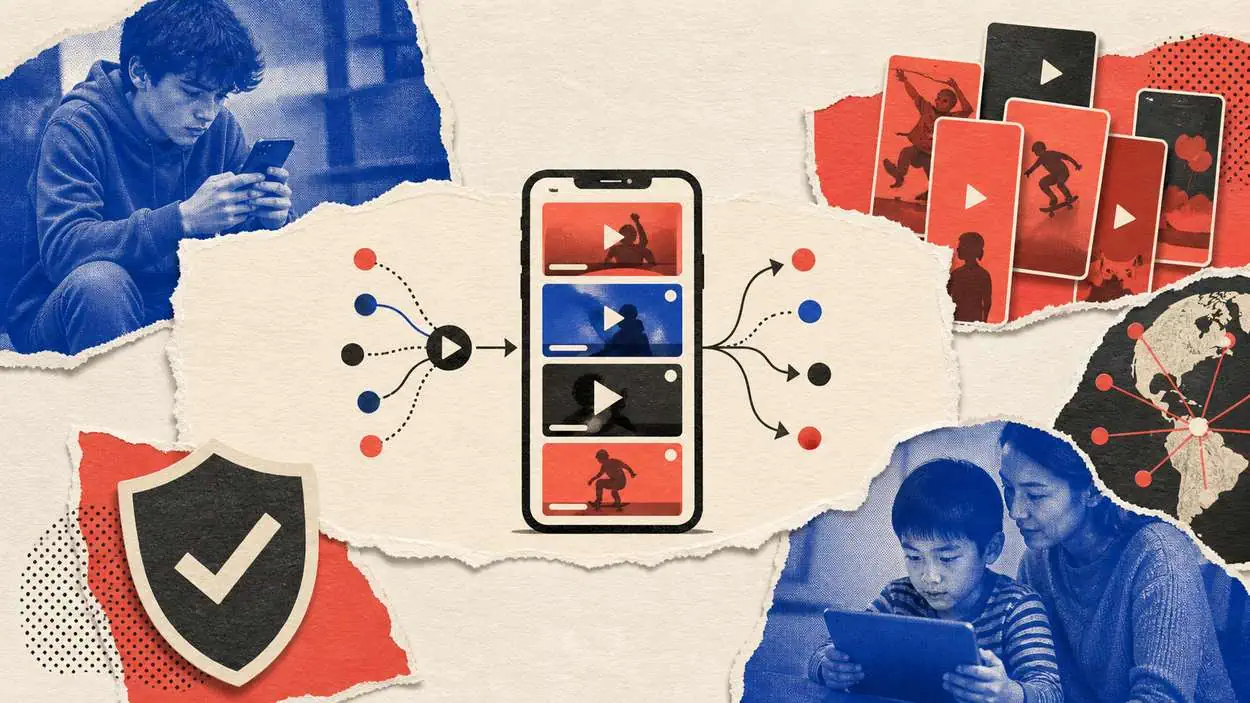
- The European Commission’s investigation focuses on infinite scroll, autoplay, push notifications and highly personalised recommender systems.
- The Commission found that Meta did not adequately assess the risks of its addictive design on the physical and mental wellbeing of users, including minors and vulnerable adults.
- Instagram’s and Facebook’s time management tools, including those activated by default for teens, can be easily dismissed and do not meaningfully reduce usage in the Commission’s assessment.
- The Commission wants autoplay and infinite scroll disabled by default, effective screen time breaks, and a recommender system that is less engagement-oriented.
- A confirmed non-compliance decision can trigger a fine capped at 6% of the provider’s total worldwide annual turnover.
- The proceedings were launched on 16 May 2024, and preliminary findings do not prejudge the final outcome.
The enforcement framing changes what the attention debate is about. A regulator asking for infinite scroll to ship off by default treats the mechanic as a product defect with a price attached, rather than as a question of user self-control. And the exposure is not limited to the minors the Commission names: the short-form video associations held across youth and adult samples alike, so the age split changes exposure rather than direction.
Is the average attention span 47 seconds?
The average attention span on any screen is about 47 seconds, with a median of 40 seconds, per computer-logging studies at the University of California, Irvine. That figure measures how long someone stays on one screen before switching, a narrower thing than the maximum time a person can concentrate. The same research recorded two and a half minutes in 2004 and 75 seconds around 2012, and the current measure has held at a steady state over the last five to six years.
Has social media affected attention span?
Increased short-form video use is associated with poorer attention across youth and adult samples alike, and the evidence stops short of showing which way the relationship runs. Researchers at Griffith University found attention associated with short-form video use at r = -.38 across 71 studies, among the strongest cognitive associations it measured, together with inhibitory control at r = -.41. Long-term studies are still lacking, so association language is the accurate register.
Conclusion
Screen attention averages about 47 seconds with a 40-second median, down from two and a half minutes in 2004 and steady over the last five to six years, while short-form video use correlates with weaker attention at r = -.38 across 71 studies and 98,299 participants. The eight-second goldfish claim, which half of UK adults still believe, traces to a 2015 report citing a source whose own listed references could not confirm the figure. Marketers, educators and product teams get more from the 47-second measurement than from the myth, because it describes a switching rate they can design around.
The next data point belongs to Brussels rather than to a laboratory. If the Commission’s preliminary findings are confirmed, Instagram and Facebook may have to disable autoplay and infinite scroll by default, with a fine capped at 6% of total worldwide annual turnover behind the request. It would put a regulated price on a feed mechanic that has so far been treated as a design choice.






EGEric Goldman
I am a Gen Xer and am proud to have read this article straight through, in one sitting, without being distracted by the pop-ups and autoplay videos surrounding it. I hope this isn’t the only comment you’ve received, since I doubt that many other people had the attention span to make it to the end of this long, but rich article!
Eric, a Gen Xer reading a long-form attention span article to completion without distraction is, appropriately, the best data point in the whole piece. Really glad it held your focus – and yes, you are one of the rare few who make it all the way to the end.