





Smartphones are now more than just communication tools; they serve as hubs for work, entertainment, and daily routines. For instance, retailers optimize mobile channels when the average user spends so many hours per day on a smartphone, and public-health campaigns shift to mobile outreach as platforms like apps and social media dominate. In manufacturing and logistics, companies embed mobile apps for field workers on the go, boosting efficiency. This article explores detailed statistics around smartphone usage today, offering clarity and insight into trends and their global impact.
Editor’s Choice
- Approximately 5.78 billion people globally use a smartphone in 2025.
- Over 7.4 billion smartphone devices are in use worldwide in 2025.
- The average daily online activity on smartphones among American adults is estimated at 4 hours 2 minutes in 2025.
- As of 2025, global average screen time across all devices is estimated between 6 to 7 hours per day, depending on age group and region, including smartphones, tablets, and PCs.
- Smartphones accounted for about 70% of digital media time in the U.S. at this point.
- Worldwide smartphone usage for internet activity averaged 3 hours 45 minutes per day in Q2 2024 (latest full data).
Recent Developments
- Global smartphone shipments in Q2 2025 grew by only about 3% year-on-year, showing signs of market saturation.
- Manufacturers increasingly focus on generative AI features in smartphones, shifting attention from form-factor innovations.
- There is growing regulatory and public-health interest in limiting recreational screen time; for example, a Japanese city proposed a 2-hour/day smartphone use guideline in 2025.
- Emerging markets show stronger growth in first-time smartphone adoption compared with mature markets.
- Supply-chain and tariff pressures have affected price points and device availability in some segments.
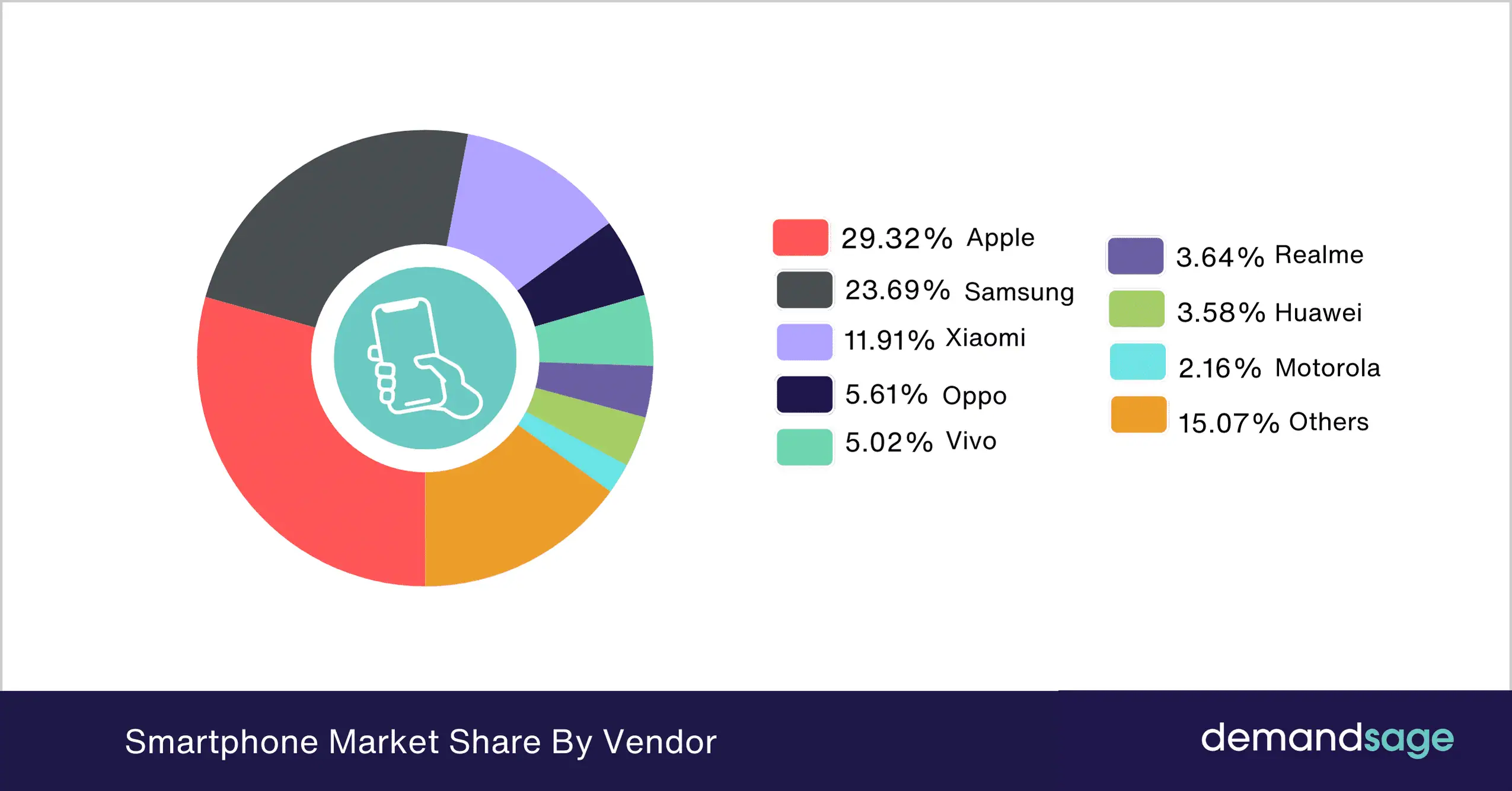
Smartphone Market Share by Vendor
- Apple leads the global smartphone market with a 29.32% share, underscoring its dominance in premium and mid-range segments driven by strong iPhone 15 and 16 series sales.
- Samsung follows closely at 23.69%, maintaining a strong foothold across both flagship and budget categories through its Galaxy S and A series lineup.
- Xiaomi secures the third spot with an 11.91% market share, propelled by aggressive pricing and high-performance devices in emerging markets.
- Oppo holds a 5.61% share, continuing to grow through innovation in camera technology and competitive mid-range offerings.
- Vivo captures 5.02% of the market, benefiting from solid sales in Asia and partnerships in local 5G network rollouts.
- Realme accounts for 3.64%, appealing to younger demographics through affordability and performance-driven phones.
- Huawei, despite regulatory hurdles, retains a 3.58% share, showing resilience through domestic sales and HarmonyOS integration.
- Motorola represents 2.16% of the global share, focusing on value smartphones and foldable innovations.
- Other vendors collectively hold 15.07%, reflecting the fragmented presence of regional and niche brands competing in local markets.
Average Daily Screen Time
- In the U.S., average screen time per day is about 7 hours and 2 minutes for adults.
- According to one source, the global average for smartphone-specific online activity is about 3 hours 45 minutes per day (Q2 2024).
- In the U.S., average daily smartphone internet usage among adults is projected at 4 hours 2 minutes in 2025.
- Some regional data suggest users check their phones 58 times per day on average.
- In youth (e.g., Gen Z), daily screen time (all devices) may exceed 9 hours in some countries.
- For U.S. adults, smartphone usage has risen gradually, from 3 hrs 38 minutes in 2021 to about 4 hrs 2 minutes in 2025.

Smartphone Usage by Region
- North America reports mobile device ownership at 97% of individuals in early 2025.
- Europe stands at around 93% mobile device ownership, with smartphone adoption growing steadily.
- Asia-Pacific shows smartphone ownership at approximately 86% of adults in some regions, and mobile phones overall are at 89% mobile penetration in 2025.
- Latin America reaches about 85% device ownership, driven in part by the greater affordability of smartphones.
- Sub-Saharan Africa’s mobile phone ownership has jumped to 74% in 2025, though smartphone penetration still lags.
- In the U.S., by early 2025, smartphone ownership in urban areas stood at 91% and in rural areas at 88%.
Smartphone Screen Time Perceptions & Reduction Intentions by Generation
- Gen Z tops the list, with 52% saying they spend too much time on their phones and 40% actively taking steps to reduce screen time. This shows growing digital self-awareness among the youngest generation.
- Millennials follow, with around 45% feeling over-reliant on their phones, while 35% are consciously trying to limit usage through apps, breaks, or digital detox routines.
- Gen X shows more balance, with roughly 35% admitting excessive phone time and 30% taking steps to cut down on usage, often driven by productivity or family-time concerns.
- Baby Boomers report the lowest overuse, with about 28% saying they spend too much time on phones, and 20% attempting to reduce screen habits, reflecting more moderate smartphone engagement overall.

Smartphone Ownership Rates by Country
- In the U.S., 91% of adults report owning a smartphone.
- Globally, about 68% of adults in developing economies own a smartphone, while 86% own a mobile phone of any type.
- In some smaller markets, smartphone adoption is complete; for example, Lithuania reports smartphone adoption exceeding 85% of adults in 2025.
- Countries in South Asia and Sub-Saharan Africa still show lower penetration, with the gender and rural/urban divide more pronounced.
- Smartphone ownership growth is slowing in mature markets as saturation nears, whereas some emerging markets still show double-digit growth.
Urban vs Rural Smartphone Penetration
- In the U.S., smartphone ownership for urban adults is about 91%, while for rural adults it falls to 88%.
- Globally, rural regions are catching up; one report shows that rural mobile device uptake year-on-year grew by 9% globally in 2025.
- Despite growth, rural areas often face slower network infrastructure and thus lower smartphone penetration compared to urban zones in many low-income countries.
- In some developing markets, urban smartphone penetration exceeds 80%, while rural areas might still be under 60%.
- The availability of broadband mobile internet is a key barrier in rural zones, affecting smartphone usage even when device ownership exists.
- Within the U.S., rural households also report higher dependence on smartphones as their primary internet device compared to urban households.
- Infrastructure investment continues to focus on extending 4G/5G coverage in rural terrain to close the usage gap.
Smartphone Dependency & Addiction
- Around 36% of Americans believe they spend too much time on their smartphones each day.
- In the U.S., 15% of adults are “smartphone-only” internet users (no home broadband).
- A recent global survey found more than half (52%) of Gen Z users say they spend longer on smartphones than they’d like.
- Four in ten (40%) U.S. smartphone users say they intend to reduce usage, while 27% don’t believe they will succeed.
- The average global smartphone screen session lasts about 1 minute 15 seconds per pick-up.
- Among users aged 18-29 in the U.S., smartphone ownership is 98%, and dependency concerns (self-reported) reach 76%.

Gender Differences in Smartphone Usage
- Women in low- and middle-income countries are 14 percentage points less likely than men to use mobile internet.
- Globally, female users are more likely than males to adopt premium smartphones such as the iPhone.
- Average smartphone screen time shows females use devices about 2 h 47 m, while males average 2 h 34 m.
- About 45% of female entrepreneurs in developing countries report lacking regular internet access due to high data costs.
- The mobile internet gender gap in South Asia and Sub-Saharan Africa is notably wide at 32% and 29%, respectively.
- Policymakers see closing the gender smartphone gap as crucial for economic inclusion, potentially increasing economic activity by $524 billion by 2025.
Social Media & Internet Usage on Smartphones
- The average U.S. adult spends 4 hours and 2 minutes per day on internet activities using a smartphone in 2025.
- Native apps (rather than browsers) account for more than 94% of smartphone usage time globally.
- In Q3 2024, mobile devices (including tablets) accounted for approximately 60–65% of global web traffic, with smartphones contributing the majority of that.
- Mobile-eCommerce transactions now account for over 70% of all e-commerce traffic.
- In the U.S., about 76% of adults have made a purchase using their smartphone in the past six months.
- Browsing and social networking on smartphones account for the lion’s share of data usage, with video-streaming dominating.
Leading Smartphone Activities
- 83% of smartphone owners use their device for email and photo-taking.
- 76% surf the Internet via smartphone.
- 73% rely on their smartphone for maps/directions.
- 71% engage in online shopping via smartphone.
- 67% check or post on social media using their smartphone.
- 66% listen to music or podcasts on their smartphone.
- 65% watch short video content (clips/messages) on their smartphone.
- 60% conduct online banking using their smartphone.
- 52% play mobile games (apps) on their smartphone.
- 85% of smartphone users browse the internet, 80% make voice or video calls, and 78% access social media via smartphone.

Mobile App Usage Statistics
- The average smartphone owner uses about 10 apps per day and around 30 apps per month.
- Nearly 49% of people open an app 11 or more times each day.
- In the U.S., mobile apps represent about 70% of all digital-media time.
- The Apple App Store offers approximately 1.96 million apps, while Google Play has about 2.87 million available downloads.
- Mobile apps revenue exceeded $935 billion in 2024.
- In many regions, app usage has overtaken web browsing as the primary digital engagement mode.
Smartphone Replacement & Upgrade Cycles
- Globally in 2025, the average smartphone replacement cycle is 2.4 years.
- In the U.S., that upgrade cycle is shorter, approximately 2.1 years.
- About 42% of users cite battery degradation as the top reason for upgrading their smartphone.
- The introduction of foldable phones prompted 18% of users to upgrade earlier than planned.
- Around 56% of users trading in old smartphones choose to recycle or resell them.
- Slowing growth in new-user markets and higher device prices in premium tiers contribute to longer replacement intervals.
- In Q1 2025, global smartphone shipments rose only ~0.2%, indicating slowing replacement demand.
5G Smartphone Adoption Statistics
- As of April 2025, global 5G connections reached 2.25 billion, growing four times faster than 4G did in its comparable phase.
- More than 90% of all new smartphones sold worldwide in 2025 will be 5G-enabled.
- 5G smartphone sales will hit 153.3 million units globally by 2025, with annual growth of ~35.6%.
- For Q1 2025, about 58% of global mobile phone users were actively using a 5G network.
- 5G support is increasingly standard even in mid-tier smartphones, reducing the cost difference between 4G and 5G devices.
- In North America, penetration of 5G among smartphone users has reached ~77% of the region’s population.
Impact of Smartphone Usage on Health & Well-being
- Excessive smartphone use (>3 hours per day) among children and adolescents is significantly associated with lower quality of life.
- Research indicates that among U.S. adults, smartphone use over four weeks had a negligible impact on mood, suggesting direct causation may be lower than expected.
- Approximately 65% of smartphone users keep their device on or near their bed, potentially impacting sleep behaviour.
- Limiting or blocking mobile internet access for a short period (e.g., two weeks) improved mental health and focus in 71% of participants in one experiment.
- Different age groups/weeks of usage patterns show that late-night smartphone sessions (e.g., after 10 pm) are more predictive of sleep disruption than total usage time alone.
Frequently Asked Questions (FAQs)
About 87% of mobile handsets worldwide are smartphones.
On average, around 58 times per day.
Approximately 4 hours 37 minutes per day.
By 2025, up to 72% of internet users in some emerging markets may rely primarily on smartphones for access, though this rate varies widely by country.
Conclusion
Smartphone usage continues to expand in both depth and breadth. People are using their devices for a broader set of activities, spending more time online, and embracing new technologies such as 5G. At the same time, upgrade cycles are lengthening, and the implications for health, well-being, and market dynamics are becoming more complex. As smartphone usage continues to evolve, the data suggest that how people use their devices matters as much as how many hours they spend on them. The coming years will likely focus more on the quality of interaction and the device’s purpose than mere ownership.