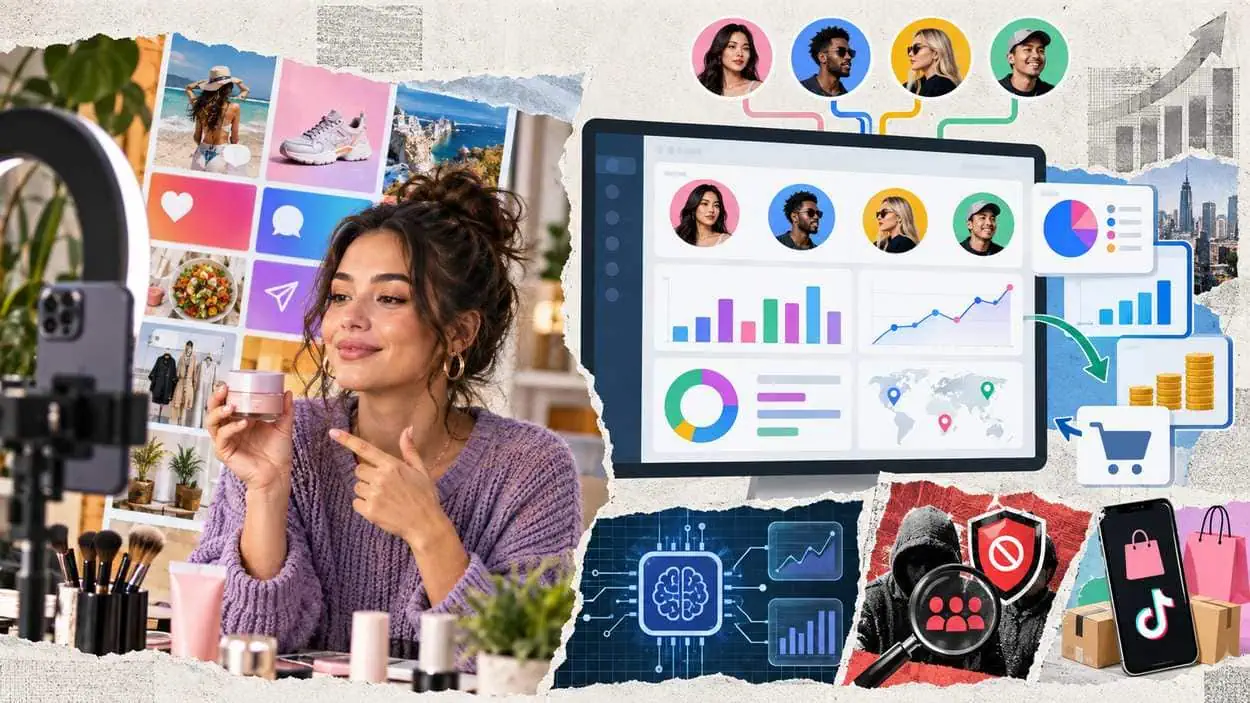






US influencer marketing spend reached $10.52 billion in 2025, according to EMARKETER, adding another $1.37 billion to the market in a single year. That money increasingly flows through a dedicated software layer, since 66.3% of brands now run their influencer programs entirely in-house, per Influencer Marketing Hub.
An in-house majority puts the spotlight on the platforms, dashboards, and discovery tools that make internal management possible. The figures below track that tooling layer: spend, ownership, platform anchors, AI, measurement, and fraud. For the wider market picture, our influencer marketing market data covers ROI and fraud in more depth.
Key Takeaways
- US influencer marketing spend hit $10.52 billion in 2025, up 15.0% year over year after a 23.7% jump in 2024, per EMARKETER.
- Program ownership has shifted to software: 66.3% of brands run influencer programs entirely in-house, with only 21.42% using agencies fully or partially.
- Budgets are climbing sharply. 87.49% of surveyed brands expect their influencer budget to increase, and 72.22% expect a rise of 50% or more.
- AI has entered the stack at the front end. Creator discovery leads AI adoption at 36.67%, far ahead of any other use case.
- Measurement still leans on manual tooling. Promo and discount codes are the top tracking method at 45.9%, ahead of affiliate links at 26.0%.
- Fake or bot followers dominate quality problems, accounting for 56.5% of all reported fraud and quality issues.
- Enterprise platforms have scaled. CreatorIQ reports being trusted by 1,300+ brands and agencies, including Google, Sephora, and Unilever.
Editor’s Choice
- The influencer marketing industry was projected to be worth $24 billion by the end of 2024, per Influencer Marketing Hub.
- US social media creator revenue will reach $21.10 billion in 2026 under EMARKETER’s broader definition, more than doubling since 2022.
- 85.8% of brands now dedicate a specific budget to influencer marketing, up from 37% in 2017.
- 31% of respondents included TikTok in their influencer plans, the single most-selected platform.
- 63% of brands planned to use AI or machine learning in their campaigns.
- 66.17% of social-commerce platform selections among adopters go to TikTok Shop.
- 65.9% of brands expect payback within one month, including 48.4% within two weeks.
Influencer Marketing Platform Market Size and Spend
US influencer marketing spend is the clearest hard number in a category full of estimates, and it anchors everything the tooling layer is built to serve.
- EMARKETER put US spend at $10.52 billion for 2025, a 15.0% increase that followed 23.7% growth in 2024.
- EMARKETER expects growth to tick up to 15.7% in 2026, roughly $12.17 billion in US spend for the year.
- Influencer Marketing Hub projected the industry at $24 billion by the end of 2024.
- EMARKETER’s broader creator-marketing definition reaches $21.10 billion in US revenue for 2026.
- Instagram and YouTube each attract over $1 billion more in influencer spend than TikTok.
- Brands spend an average of $6.16 per internet user on influencer advertising as of 2024.
| Metric | Figure | Period |
|---|---|---|
| US influencer spend | $10.52 billion | 2025 |
| US spend growth | 15.0% | 2025 |
| US spend growth (prior year) | 23.7% | 2024 |
| US spend growth (forecast) | 15.7% | 2026 |
| Global industry value | $24 billion | 2024 |
| US creator revenue (broad definition) | $21.10 billion | 2026 |
Source: EMARKETER 2025, Influencer Marketing Hub 2024.
By the numbers: Per EMARKETER, US influencer spend climbed to $10.52 billion in 2025 and is forecast to grow 15.7% in 2026, while EMARKETER’s wider creator-marketing measure reaches $21.10 billion as brands push budgets into retail media and connected TV beyond social feeds.
In-House, Agency, or Platform: Who Runs the Program
Program ownership is the statistic that defines the tooling market. Brands now keep influencer execution inside for the most part, which lands discovery, outreach, and reporting budget on software seats rather than agency retainers.
- Among brands answering Influencer Marketing Hub’s latest survey, 66.3% run influencer programs entirely in-house, while 21.42% involve agencies either fully or partially.
- The remaining 12.28% falls outside these two reported categories.
That in-house tilt tracks a wider pattern we see across our AI social media tools data: as software gets cheaper to operate, teams pull execution back inside and buy tools instead of services.

Budget Growth Signals Heading Into 2026
Budget intent is running hot across the platform market. Growth expectations point in one direction, and short payback windows explain the confidence behind them.
- 87.49% of brands expect their influencer budget to grow, 72.22% expect an increase of 50% or more, and only 5.55% expect a decrease.
- 65.9% of brands expect payback within one month, and 48.4% expect it within two weeks.
Why it matters: With 87.49% of brands planning budget increases and payback expected inside a month for 65.9% of them, per Influencer Marketing Hub, platform vendors face demand that is both growing and impatient, which pushes the roadmap toward faster attribution rather than deeper analytics.
Recent Developments
- EMARKETER projected that US influencer spend would surpass $10 billion in 2025, reaching $10.52 billion.
- EMARKETER’s February 2026 forecast raised US creator revenue to $21.10 billion, citing expansion into retail media and connected TV.
- Influencer Marketing Hub’s January 2026 benchmark found 87.49% of brands expect budget increases.
- EMARKETER expects more than half of US marketers to use influencer marketing on YouTube in 2025, a first.
- TikTok Shop accounted for 66.17% of social-commerce platform selections among adopters.
Platforms Brands Build Their Stack Around
Platform selection keeps concentrating, which shapes where most influencer tools focus their integrations.
- TikTok led influencer plans at 31% of respondents, with every other platform clustering in a narrow band of roughly 8-15%.
- Instagram and YouTube each pull over $1 billion more in influencer spend than TikTok.
- EMARKETER projects that over half of US marketers will use influencer marketing on YouTube in 2025, for the first time.
| Platform signal | Figure | Period |
|---|---|---|
| TikTok in influencer plans | 31% | 2026 |
| Other platforms (each) | 8-15% | 2026 |
| YouTube marketer adoption | Over 50% | 2025 |
Source: Influencer Marketing Hub 2026, EMARKETER 2025.
That gap makes TikTok the anchor most vendors build for, even as spend still favors longer-standing feeds. The split is worth reading alongside our TikTok versus Instagram comparison.
AI Inside the Influencer Platform Stack
AI has landed at the front of the workflow, not the back, and the adoption pattern points straight at the search-and-match problem.
- Creator discovery leads AI adoption at 36.67%, brief drafting follows at 13.89%, and 10.56% of respondents report not using AI at all.
- 63% of brands planned to use AI or machine learning in their campaigns.
Discovery is where the largest, messiest dataset lives, so it is the natural first target for automation. Our AI influencer marketing statistics go deeper on virtual creators and AI-generated content.
The takeaway: AI adoption inside influencer platforms is front-loaded, with creator discovery at 36.67% dwarfing later-stage tasks, per Influencer Marketing Hub. That reflects where the data volume is heaviest and the manual cost most painful, which is why vendors automate search-and-match before touching reporting.
Measurement and Attribution Tooling
Measurement is the weakest link in the stack, and manual tracking still outranks platform-native attribution.
- Promo and discount codes lead tracking at 45.9%, followed by affiliate links at 26.0% and native shop features at 25.0%.
- 70% of brands say they measure the ROI of their influencer campaigns.
That codes still beat platform-native attribution tells you the measurement layer has not caught up with the spend it is meant to justify.
Fraud Detection and Creator Vetting
Vetting tooling exists because fraud is concentrated and measurable, and follower fraud dominates by a wide margin.
- Fake or bot followers account for 56.5% of all reported fraud and quality issues, with inauthentic comments at 10.6% and fake or purchased engagement at 10.2%.
- Rising creator costs rank as the top overall challenge at 35.4%.
Worth noting: Fake or bot followers make up 56.5% of reported quality issues, per Influencer Marketing Hub, but no vetting tool eliminates fraud entirely. Audience-authenticity scoring helps reduce exposure to inflated reach; it does not guarantee a clean creator roster.
Social Commerce Tooling and TikTok Shop
Social-commerce tooling carries a concentration risk, and adoption skews toward growth-minded teams.
- Among brands using social commerce, TikTok Shop accounts for 66.17% of platform selections.
- 51.43% of respondents indicate expansion intent for nano creators, versus 20.59% for macro creators.
Vendor concentration risk: A dependency this heavy on one platform’s checkout means any policy or availability change ripples straight through the tooling that plugs into it. Diversifying attribution beyond a single social-commerce feature helps reduce that exposure.
Leading Influencer Marketing Platforms
The vendor tier has scaled into enterprise territory, backed by consumer behavior every platform is built to capture.
- CreatorIQ says it is trusted by 1,300+ brands and agencies, including Dentsu, Nestle, Unilever, Google, Delta, and Sephora.
- GRIN cites that 3 out of 4 consumers have purchased a product because a creator recommended it.
| Platform | Reported reach | Type |
|---|---|---|
| CreatorIQ | 1,300+ brands and agencies | Enterprise creator management |
| GRIN | Named DTC brands (SKIMS, Uber, Ipsy) | Creator management |
Source: CreatorIQ 2026, GRIN 2026.
These are self-reported vendor figures, so treat client counts as marketing claims rather than audited metrics.
How big is the influencer marketing platform market?
US influencer marketing spend reached $10.52 billion in 2025 and is forecast to grow 15.7% in 2026, per EMARKETER, while the industry was projected to be worth near $24 billion at the end of 2024 by Influencer Marketing Hub. Most of that money now moves through in-house teams using dedicated software, since 66.3% of brands run programs internally rather than through agencies.
Do brands use software or agencies to run influencer campaigns?
Software runs the majority of programs. Influencer Marketing Hub’s latest survey found 66.3% of brands run influencer programs entirely in-house, with only 21.42% involving agencies fully or partially. That ownership split is why platform seats, discovery databases, and reporting dashboards, rather than agency retainers, capture the largest share of tooling budget.
Conclusion
Influencer marketing has crossed into infrastructure. US spend reached $10.52 billion in 2025, and it sits on top of a stack that 66.3% of brands now operate in-house. That shifts budget toward software rather than services.
The tooling picture is uneven. AI has moved fast into creator discovery at 36.67% adoption, yet measurement still leans on manual promo codes at 45.9%, and fake followers make up 56.5% of reported quality issues. For brands building or buying a stack, the data points to a clear priority order: spend discipline, then attribution, then authenticity. Readers weighing platform choices can pair these figures with our Instagram follower data for audience context.