

Apple Podcasts delivered 35.8% of the 79,530,369 podcast downloads Buzzsprout measured across its hosting platform in August 2026. That share sits far above the 11% of US weekly podcast consumers who told Edison Research they use Apple Podcasts most often. Apple Podcasts statistics vary that widely because each dataset counts a different behavior.
Three measurements from two datasets, and a gap wide enough to change any conclusion drawn from one of them. The sections below cover catalog scope, share by each measurement method, device mix, the real shape of episode downloads, and the video shift Apple announced this year.
Key Takeaways
- Apple Podcasts took 35.8% of measured podcast downloads in August 2026 while 11% of US weekly podcast consumers named it the service they use most often.
- YouTube accounted for 32% of daily US podcast listening time in Q4 2025, against Spotify’s 25%.
- 61.8% of measured downloads came from an Apple iPhone, against 22.4% from Android phones.
- The median podcast drew 27 downloads in the first seven days after an episode’s release.
- 57% of Americans have both listened to and watched a podcast, which is why single-platform share figures keep drifting apart.
- Episodes running 20 to 40 minutes account for 31% of all episodes published.
- US weekly podcast reach stood at an estimated 130 million people, or 45% of the population age 12 and older.
Editor’s Choice
- Downloads measured: 79,530,369 in August 2026 across 112,207 active podcasts, per Buzzsprout’s IAB-certified logs.
- Apple Podcasts downloads: 28,469,589 of that total.
- Global footprint: more than 170 countries and regions, according to Apple Newsroom.
- Transcript coverage: over 125 million episodes in 13 languages.
- US podcast audience: an estimated 230 million Americans age 12 and older have ever listened to or watched a podcast, or 80% of that population.
- Apple quarterly revenue: $109.4 billion in the fiscal 2026 third quarter, up 16% year over year.
Apple Podcast Statistics: Catalog Size and Global Reach
- Apple Podcasts operates in more than 170 countries and regions, the same footprint Apple used when it opened premium subscriptions.
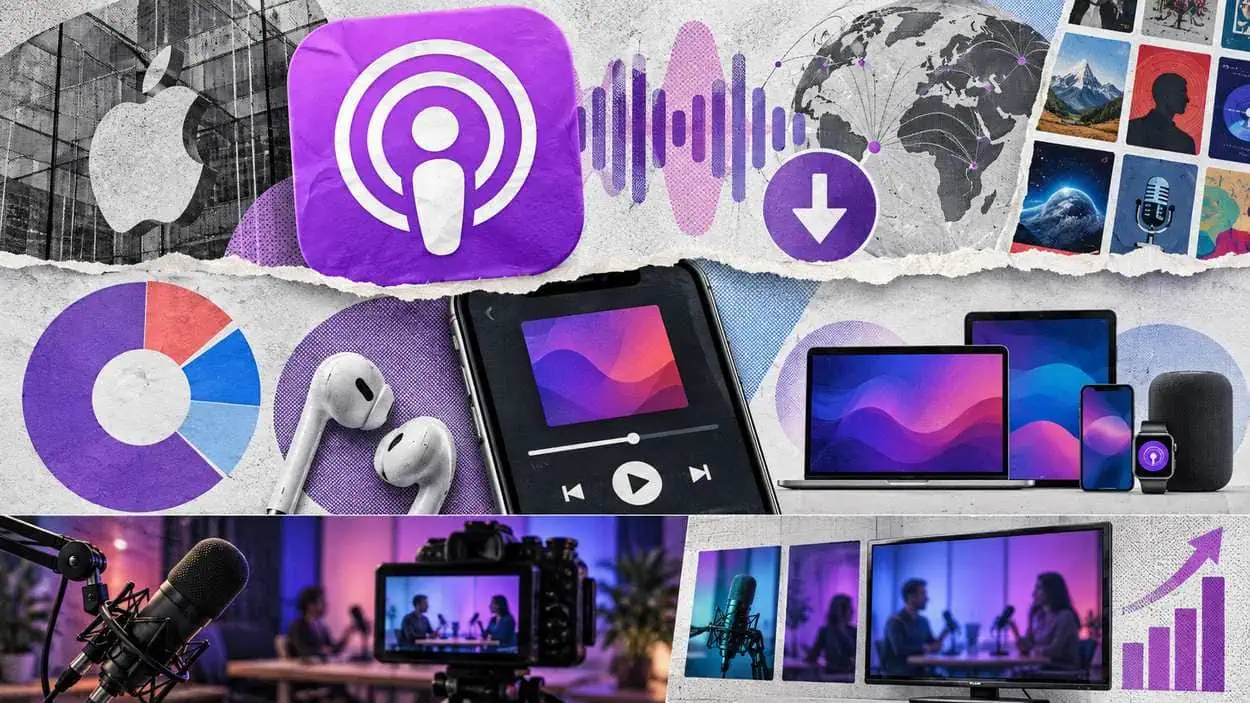
- The app carries transcripts across over 125 million episodes in 13 languages.
- Apple describes the catalog as millions of shows across hundreds of categories rather than publishing a single show count.
- Playback controls span speeds from 0.5x to 3x, with automatically created chapters and timed links.
- Premium subscriptions reached listeners in more than 170 countries and regions starting in May 2021.
- Launch subscription partners included Tenderfoot TV, Pushkin Industries, Radiotopia from PRX, QCODE, NPR, the Los Angeles Times, The Athletic and Sony Music Entertainment.
About This Data
Compiled from 6 primary sources: 4 Tier 1 Apple first-party disclosures and 2 Tier 2 industry datasets, Edison Research’s Infinite Dial 2026 and Buzzsprout’s August 2026 platform report. Publication dates span April 2021 to August 2026. Only official company disclosures and research carrying a published methodology qualified. Figures are reviewed on a rolling basis and updated when sources publish new editions.
| Apple Podcasts metric | Published value |
|---|---|
| Countries and regions served | More than 170 |
| Episodes carrying transcripts | Over 125 million |
| Transcript languages | 13 |
| Playback speed range | 0.5x to 3x |
| Premium subscriptions available from | May 2021 |
Source: Apple Newsroom, February 2026 and April 2021
Apple’s refusal to publish a headline show count is itself informative. Rival platforms quote catalog totals that include long-dead feeds, so a “millions of shows” phrasing avoids a number that would decay within a quarter. The same reticence shows up across Apple’s consumer services, a pattern visible in Apple Music subscriber reporting.

Apple Podcasts Share of US Podcast Listening Time
- Edison Research measured daily US podcast consumption time by source for Q4 2025, among the US population age 13 and older.
- YouTube led that measure at 32%, with Spotify at 25%.
- Edison Research built the estimate from a nationally representative online survey of 2,050 people aged 12 and older, fielded in January 2026.
- Half the sample came from a probability-based SSRS Opinion Panel, with the other half drawn from a non-probability sample, per the study’s published methodology.
| Source | Share of daily podcast listening time (%) |
|---|---|
| YouTube | 32 |
| Spotify | 25 |
Source: Edison Research, The Infinite Dial 2026, Q4 2025 data
Time-based share is the measure that matters most to advertisers, because an impression only exists while someone is listening. It ranks YouTube and Spotify ahead of the field, the reverse of the download logs below, where Apple Podcasts leads.
Recent Developments
- August 2026: Buzzsprout recorded 79,530,369 downloads across 112,207 active podcasts, with Apple Podcasts taking 35.8%.
- August 2026: device data showed 85.0% of downloads arriving on mobile, against 8.0% on computers.
- August 2026: publishing cadence data put 37% of shows on an 8 to 14-day release gap and 34% on a 3 to 7-day gap.
- July 2026: Apple reported June quarter records for iPhone, Mac, and Services revenue, with quarterly revenue of $109.4 billion and gross margin of 50.1%.
- September 2026: Apple’s product page now lists full-screen video playback, Picture in Picture, and searchable transcripts as shipped Apple Podcasts features.
Apple Podcasts Share of Measured Podcast Downloads
- Apple Podcasts accounted for 28,469,589 downloads, or 35.8% of the August 2026 total.
- Spotify followed with 22,921,480 downloads, or 28.8%.
- Direct web-browser playback took 7.2% of downloads, ahead of every third-party app.
- Independent apps stayed small, with Castbox at 1.9%, Overcast at 1.7% and Pocket Casts at 1.3%.
- Amazon Music and iHeartRadio drew 0.8% and 0.6%, respectively.
- The legacy Apple iTunes client still registered 410,722 downloads, or 0.5%.
By the numbers: Buzzsprout logged 28,469,589 Apple Podcasts downloads out of 79,530,369 total in August 2026, all certified to IAB Podcast Measurement Technical Guidelines 2.2. Server-side logs count delivery events rather than stated preferences, which is why this figure runs well above survey-based share estimates.
Is there a way to see Apple Podcast stats?
Apple publishes per-show analytics to the creators who publish a podcast rather than to the public. Outside figures come from two places: hosting platforms that log delivery by user agent, such as the Buzzsprout data above, and survey panels such as Edison Research. Neither is a complete census of Apple Podcasts listening.
How can I find out how many listeners a podcast has?
Public tools do not return verified listener counts for someone else’s show. Hosting-platform reports give downloads by app, and the download distribution below shows how thin the median show really is. Published listener numbers almost always come from the show’s own host.
Which Devices Apple Podcasts Downloads Come From
- Apple iPhones generated 61.8% of all measured downloads in August 2026.
- Android phones accounted for 22.4%, well under half the iPhone figure.
- Windows computers contributed 4.9%, with Apple computers at 1.9%.
- By device class, mobile took 85.0% of downloads and computers 8.0%.
- Smart speakers remained marginal at 0.6%, with smart TVs at 0.2%.
The device split is the mechanism behind Apple’s download share. Apple Podcasts ships preinstalled on every iPhone, so a download-weighted share of roughly a third follows almost mechanically from a device base that supplies six downloads in ten. Readers tracking that installed base will find the trajectory in iPhone shipment and usage data.
How US Listeners Choose a Podcast App
- 11% of US weekly podcast consumers age 13 and older named Apple Podcasts the service they use most often in Q4 2025.
- YouTube took the top position on that question at 39%.
- Spotify placed second at 20%, roughly double Apple’s figure.
- The same study found 57% of Americans have both listened to and watched a podcast, a dual-format habit that splits stated preference between apps.
- Podcast awareness reached an estimated 248 million Americans age 12 and older.
The dual-format finding does most of the explanatory work. When a listener watches a show on YouTube in the evening and downloads the same feed to an iPhone for the commute, the survey records one favorite app while the hosting logs record one download apiece. Comparable measurement splits show up in Spotify’s reported user base, where monthly actives and paying subscribers tell different stories about the same service.
US Podcast Audience Size Behind Apple’s Share
- An estimated 230 million Americans age 12 and older have ever listened to or watched a podcast, or 80% of that population.
- Monthly consumption reached an estimated 167 million people, or 58%, an all-time high.
- Weekly consumption reached an estimated 130 million people, or 45%.
- Awareness of podcasting now covers 248 million Americans age 12 and older.
- Edison Research weighted the sample to national 12 and older US population figures, with the survey offered in English and Spanish.
Key finding: Edison Research put monthly podcast consumption at an estimated 167 million Americans age 12 and older, an all-time high for the series, with weekly consumption at an estimated 130 million. Applying Apple’s most-used-app share to that weekly base implies a core Apple Podcasts audience of roughly 14 million.
How Many Downloads a Podcast Episode Actually Gets
- The median episode drew 27 downloads in its first seven days.
- Reaching the top 25% required 96 downloads in the first week.
- The top 10% threshold sat at 407 downloads.
- The top 5% threshold sat at 1,003 downloads.
- The top 1% of shows cleared 4,526 downloads in the first seven days.
- Buzzsprout hosted 112,207 active podcasts, publishing 142,781 new episodes that month.
| Percentile of shows | Downloads in first 7 days |
|---|---|
| Top 1% | 4,526 |
| Top 5% | 1,003 |
| Top 10% | 407 |
| Top 25% | 96 |
| Top 50% (median) | 27 |
Source: Buzzsprout Global Stats, August 2026
Platform share sits on top of a distribution this steep, which changes what the share figure means. A third of downloads on a platform where half of episodes finish their first week under 30 downloads is a third of a very concentrated pool, not a third of a broad market.
Episode Length and Publishing Cadence
- Episodes of 20 to 40 minutes made up 31% of all episodes published.
- Episodes of less than 10 minutes accounted for 21% of the total.
- Episodes of 40 to 60 minutes took up 20%, with 13% running over 60 minutes.
- On cadence, 37% of shows were published every 8 to 14 days.
- A further 34% published every 3 to 7 days, with 7% publishing every 0 to 2 days.
Duration matters to Apple’s share because longer sessions raise the time-based measure without moving the app-preference measure. A catalog weighted toward 20 to 40-minute episodes suits commute listening, which is where Apple’s CarPlay integration and preinstalled app position carry the most weight. That ecosystem advantage is the same mechanism behind Apple customer retention data.
Apple Podcasts Subscriptions and the Services Business
- Apple launched premium podcast subscriptions in more than 170 countries and regions starting in May 2021.
- Subscription benefits at launch covered ad-free listening, additional content, and early or exclusive access to new series.
- Apple’s fiscal 2026 third quarter closed on June 27, 2026, with revenue of $109.4 billion, up 16% year over year.
- Services revenue set a new June quarter record alongside iPhone and Mac.
- Gross margin reached 50.1%, with diluted earnings per share of $2.02, up 29% year over year.
- Apple’s CFO Kevan Parekh said, “Our installed base of active devices also reached a new all-time high across all major product categories and geographic segments.”
| Apple fiscal 2026 Q3 metric | Value |
|---|---|
| Quarterly revenue | $109.4 billion |
| Year-over-year revenue growth | 16% |
| Gross margin | 50.1% |
| Diluted earnings per share | $2.02 |
| Quarterly dividend declared | $0.27 per share |
Source: Apple Newsroom, July 2026
Worth noting: Apple reports podcast subscription revenue inside its Services segment and never breaks it out, so no published figure isolates Apple Podcasts economics. Services set a new June quarter record in Apple’s most recent reported quarter, yet the podcast contribution to that line stays undisclosed. Growth in the wider Apple hardware base, visible in Apple product sales data, sets the ceiling on it.
Video Podcasts and What Apple Charges
- Apple announced on February 16, 2026, that HLS video podcast capabilities would come to Apple Podcasts.
- Hosting and advertising partners supporting HLS video at launch included Acast, ART19, Triton’s Omny Studio, and SiriusXM, including SiriusXM Media, AdsWizz, and Simplecast.
- Creators gained the ability to dynamically insert video ads, including host-read spots.
- Apple stated that it does not charge hosting providers or creators to distribute podcasts, whether via traditional RSS/MP3 or HLS video.
- Apple will instead charge participating ad networks an impression-based fee for the delivery of dynamic ads in HLS video.
- Testing opened in beta versions of iOS 26.4, iPadOS 26.4 and visionOS 26.4.
| Party | What Apple charges |
|---|---|
| Podcast creators | Nothing to distribute via RSS/MP3 or HLS video |
| Podcast hosting providers | Nothing to distribute via RSS/MP3 or HLS video |
| Participating ad networks | Impression-based fee for dynamic ads in HLS video |
Source: Apple Newsroom, February 2026
Eddy Cue, Apple’s senior vice president of Services, framed the launch as a continuation rather than a pivot: Twenty years ago, Apple helped take podcasting mainstream by adding podcasts to iTunes, and more than a decade ago, we introduced the dedicated Apple Podcasts app. The fee structure is the part worth watching. Billing ad networks per impression rather than taxing creators keeps distribution free at the point of publishing while giving Apple a revenue line that scales with video advertising volume.
Is Spotify or Apple Podcasts more popular?
The answer depends entirely on which measure is used, and the two datasets below rank the platforms in opposite orders. Buzzsprout’s August 2026 server logs put Apple Podcasts ahead on delivered downloads, 35.8% against Spotify’s 28.8%. Edison Research’s survey reverses the ranking on stated preference, with Spotify at 20% of weekly podcast consumers naming it most-used against Apple Podcasts at 11%.
Neither result is wrong. Download logs count delivery events and skew toward feeds distributed by RSS, which is Apple’s native mechanism; the survey counts self-reported habits across a population where video listening has grown. A creator planning distribution should read both: the download figure predicts where files will be fetched, the survey figure predicts where a listener will go looking for the show.
What are the top podcast apps by download share?
Buzzsprout’s August 2026 data ranks the delivery clients by measured downloads: Apple Podcasts at 35.8%, Spotify at 28.8%, direct web browsers at 7.2%, the Buzzsprout embed player at 3.5%, and Castbox at 1.9%. Every remaining client sat below that Castbox line.
That concentration has a practical consequence for publishers. Two apps handle close to two-thirds of delivery, so a feed that renders badly in either one loses most of its potential audience, while the dozen or so remaining clients account for around a tenth between them. The same head-heavy pattern appears in mobile app distribution data across categories.
Conclusion
Apple Podcasts took 35.8% of the 79,530,369 downloads Buzzsprout measured in August 2026, while 11% of US weekly podcast consumers named it their most-used service, and both figures are accurate measurements of different things. Server logs count delivery and surveys count loyalty, and each measures a different behavior. Anyone quoting a single Apple Podcasts market-share number without naming the method is quoting a coincidence.
The direction of travel favors the time-based measure. Apple’s move to HLS video and its decision to bill ad networks per impression rather than charging creators both point toward a platform competing on session depth rather than headcount. The hardware base behind that position is already visible in the delivery data, where 61.8% of measured downloads arrive on an Apple iPhone. The listening-time series will register any shift before the app-preference question does.