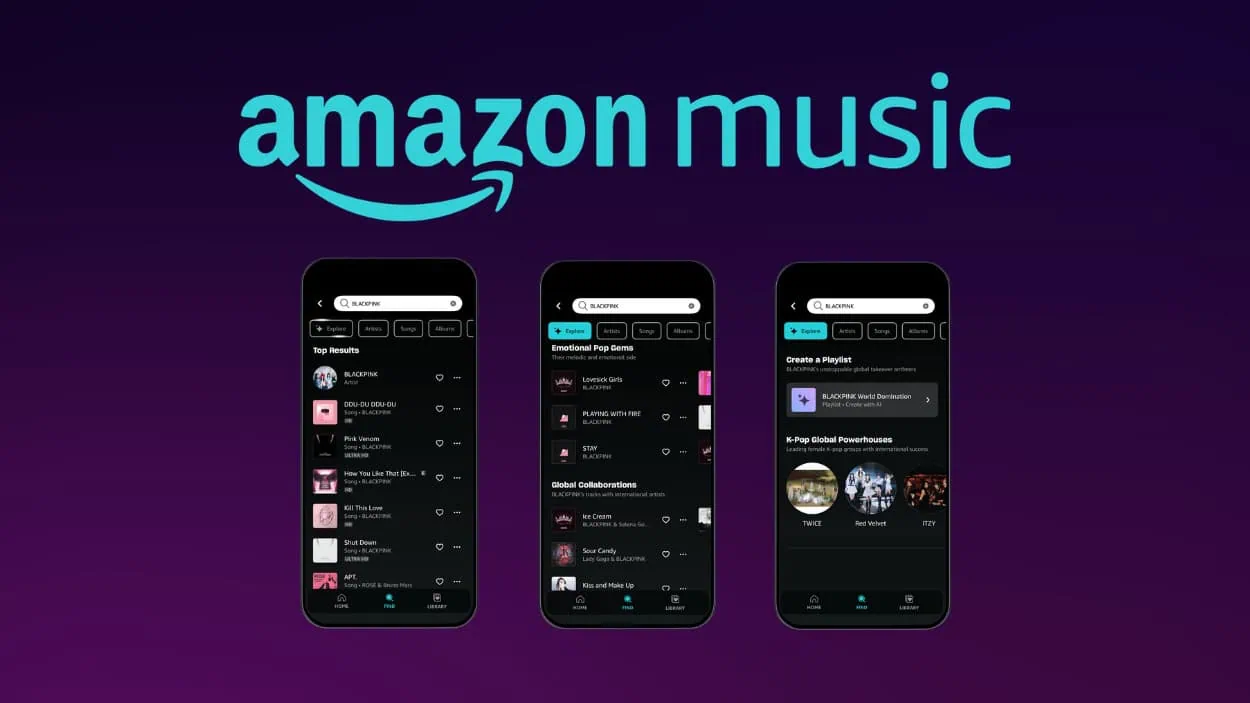






Amazon Music ranks as the third or fourth largest paid music streaming service worldwide, with industry analysts placing its share of global paid subscribers in the low double digits, behind Spotify and within close range of Apple Music. MIDiA Research has reported that Spotify, Apple Music, Amazon Music, Tencent Music Entertainment, and YouTube Music together held 72% of global recorded music revenue in 2024.
The data below covers paid subscribers, market share, revenue, pricing, catalog scale, audiobook bundling, and the disclosure blackout shaping every public Amazon Music figure today.
Key Takeaways
- Global recorded music revenue reached $29.6 billion in 2024, with streaming alone exceeding $20.4 billion for the first time, per IFPI.
- Paid music subscription accounts grew 10.6% in 2024 to 752 million globally, per IFPI.
- Amazon Music sits inside the top five services that together control 72% of streaming revenue, alongside Spotify, Apple Music, Tencent Music Entertainment, and YouTube Music.
- Amazon Music passed more than 55 million customers globally per its January announcement, with Music Unlimited subscriptions growing more than 50% the prior year and nearly 50% YoY in the US, UK, Germany, and Japan.
- Amazon Music’s subscriber base grew 27% year over year during 2020, behind Google’s YouTube Music at 60% and Tencent at 40%, but ahead of Apple Music at 12%.
- Amazon Music Unlimited’s catalog reached 100 million songs in HD, with millions more in Ultra HD plus Dolby Atmos and 360 Reality Audio spatial mixes.
- The individual Music Unlimited plan rose to $11 per month for Prime members in March 2025, with the family plan moving to $20 per month (up $3).
Editor’s Choice
- Spotify, Apple Music, Amazon Music, Tencent, and YouTube Music collectively control 72% of global streaming revenue.
- Streaming represented 69.0% of total recorded music revenue in 2024, per IFPI.
- Amazon Music Unlimited subscriptions more than doubled across 4 markets (France, Italy, Spain, Mexico) over the prior year.
- Amazon Music HD launched on September 17, 2019, with more than 50 million lossless songs at 16-bit/44.1 kHz.
- Amazon Music Unlimited added Audible audiobook listening on November 19, 2024, with one free audiobook per month for subscribers in the US, UK, and Canada.
- IFPI logged the tenth straight year of recorded music revenue growth in 2024 at 4.8%.
- Music streaming revenue from paid subscriptions grew 9.5% during 2024, per the IFPI Global Music Report.
Recent Developments
- Recent quarter: Spotify reported 751 million monthly active users and 290 million paid subscribers, growing 10% year over year.
- Recent quarter: MIDiA Research’s tracking placed the top-five services (Spotify, Apple Music, Amazon Music, Tencent, YouTube Music) at 72% of global streaming revenue.
- Recent annual report: IFPI logged paid music subscription accounts at 752 million globally, up 10.6% year over year.
- March 5, 2025 (effective date): Amazon Music Unlimited price increases lifted individual plans by $1 and family plans by $3 in the US, UK, and Canada.
- November 19, 2024 (launch): Amazon Music Unlimited folded Audible audiobook listening into its top tier, giving subscribers one audiobook per month at no extra cost.
Amazon Music Subscribers
Public subscriber counts for Amazon Music remain estimates rather than disclosures. Amazon’s last verified subscriber announcement put Music’s global customer base at more than 55 million customers. After that, MIDiA Research’s tracking showed Amazon’s subscribers up 27% year over year.
- Amazon disclosed more than 55 million customers globally across all service tiers, including Amazon Music Unlimited, Amazon Music HD, and Prime Music.
- Music Unlimited subscriptions grew by more than 50% over the previous year globally, with nearly 50% year-over-year growth in the US, UK, Germany, and Japan.
- Amazon Music subscribers expanded 27% year over year per MIDiA Research, lagging YouTube Music at 60% and Tencent at 40%, but outpacing Apple Music’s 12%.
- Industry analysts in 2026 widely cite triangulated figures in the 80 to 100 million paid subscriber range, but Amazon has not confirmed a count since the 2020 milestone, leaving the range open to revision.
- Amazon Music’s share of paid subscribers has held in the low double digits, anchored by Prime bundle distribution.
| Period | Amazon Music customers | Source type |
| January 2020 | More than 55 million | Amazon press release |
| 2020 calendar year | +27% YoY subscriber growth | MIDiA Research |
| 2024 (estimated paid) | Triangulated, not disclosed | MIDiA Research model |
Source: Amazon (aboutamazon.com), MIDiA Research via Music Industry Blog
The MIDiA share data tells the next part of the story.

Amazon Music Market Share vs Spotify and Apple Music
Amazon Music’s slice of global streaming revenue sits inside a 72% combined share held by the top five services, according to MIDiA Research. Spotify alone took 32.2% of global music streaming revenue, with the remainder split across Apple Music, Amazon Music, Tencent Music Entertainment, and YouTube Music.
- Spotify held 32.2% of global recorded music streaming revenue during 2024.
- The top five services (Spotify, Apple Music, Amazon Music, Tencent, YouTube Music) controlled 72% of streaming revenue collectively.
- Spotify reported 751 million monthly active users and 290 million paid subscribers in its Q4 2025 results.
- Spotify’s paid subscriber base grew 10% year over year in Q4 2025.
| Service | Estimated paid subscribers | Disclosure source |
| Spotify | 290 million | Spotify Q4 2025 earnings |
| Apple Music | Approximately 100 million | Last disclosed 2023 |
| Amazon Music | Triangulated, low 80s to ~100M | MIDiA Research model |
| YouTube Music (with Premium) | Approximately 125 million | Google blog (2024) |
Source: Spotify investor relations, Apple historical disclosures, MIDiA Research
By the numbers: Spotify, Apple Music, Amazon Music, Tencent Music Entertainment, and YouTube Music together held a 72% share of streaming revenue, MIDiA Research reported. Spotify alone took 32.2%, leaving Amazon Music, Apple Music, and the rest competing for the remaining slice in a tightening top tier.
For platform-level depth on Spotify, see our Spotify subscriber data coverage. The revenue picture, however, tells a slightly different story than the headline subscriber share.
Amazon Music Revenue Trajectory
Global recorded music revenue grew 4.8% to $29.6 billion in 2024, the tenth consecutive year of growth, per IFPI. Streaming pulled the industry forward, with revenues exceeding $20.4 billion for the first time, accounting for 69.0% of recorded music sales.
- Recorded music revenue reached $29.6 billion globally in 2024.
- Streaming hit $20.4 billion, breaking the $20 billion mark for the first time.
- Streaming represented 69.0% of total recorded music revenue in 2024.
- Paid subscription streaming grew 9.5% year over year.
- Latin America led regional growth at 22.5%, followed by the Middle East and North Africa at 22.8% and Sub-Saharan Africa at 22.6%.
- Physical formats declined 3.1% overall, while vinyl rose 4.6% for an eighteenth straight year of gains.

Amazon Music Unlimited Pricing After the 2025 Hike
Amazon raised Music Unlimited prices in March 2025, with the individual plan moving to $11 per month for Prime members and the family plan rising by $3 to $20 per month. Non-Prime individual subscribers now pay $12 per month, up $1, with the changes hitting subscribers in the U.S., U.K., and Canada.
- Individual Unlimited plan: $11 per month for Prime members (was $10), or $110 annually.
- Family plan: $20 per month or $199 annually, up $3 per month from the prior price.
- Non-Prime individual: $12 per month (was $11).
- Effective date: On or after March 5, 2025, for impacted plans.
- The price changes affected subscribers in the United States, the United Kingdom, and Canada.

The price action partly funds catalog and audio quality investments, which is the next angle worth checking.
Amazon Music Catalog and Audio Quality
Amazon Music Unlimited offers 100 million songs in HD, with millions more in Ultra HD, plus a growing catalog of spatial audio tracks mastered in Dolby Atmos and Sony’s 360 Reality Audio. Amazon Music HD launched on September 17, 2019, as a separate paid tier with more than 50 million lossless tracks, and was later folded into Music Unlimited at no extra cost on May 17, 2021.
- Catalog size: 100 million songs in HD on Music Unlimited.
- Ultra HD tier supports 24-bit audio at 44 kHz, 48 kHz, 96 kHz, and 192 kHz sampling rates.
- Lossless HD streaming launched at 16-bit/44.1 kHz on September 17, 2019.
- HD streaming became free for Music Unlimited subscribers on May 17, 2021.
- Spatial audio playback works through the iOS or Android Amazon Music app on any headphones, plus the Echo Studio and select Sony SRS-RA speakers.
| Audio tier | Max bit depth | Max sample rate | Cost |
| Standard MP3 | 16-bit | 44.1 kHz (256 kbps VBR) | Included with Unlimited |
| HD | 16-bit | 44.1 kHz lossless | Included with Unlimited |
| Ultra HD | 24-bit | Up to 192 kHz | Included with Unlimited |
| Dolby Atmos / 360 Reality Audio | Object-based | Multichannel | Included with Unlimited |
Source: Amazon (Music Unlimited product page), Wikipedia (Amazon Music)
Amazon Music Subscriber Growth History
Amazon entered streaming with Prime Music in mid-2014, included free with an Amazon Prime membership. Amazon Music Unlimited followed on October 12, 2016, as a full-catalog paid tier in the United States.
- 2007: Amazon MP3 launched on September 25 as a public beta in the US.
- 2008: International rollout started December 3 in the United Kingdom.
- Mid-2014: Prime Music launched as a streaming benefit included with Prime in several markets.
- 2016: Amazon Music Unlimited launched on October 12 in the US as a paid full-catalog service.
- 2019: Amazon Music HD was announced on September 17 with more than 50 million lossless tracks.
- 2020: Amazon’s January press release reported more than 55 million customers globally.
- 2021: Subscribers up 27% during 2020 per MIDiA, with the HD tier folded free into Unlimited on May 17.
- 2024: Audible audiobook listening was added on November 19 in the US, UK, and Canada.
| Year | Milestone |
| 2007 | Amazon MP3 store debuts (DRM-free) |
| 2014 | Prime Music streaming bundle launches |
| 2016 | Amazon Music Unlimited launches in US |
| 2019 | Amazon Music HD tier introduced |
| 2020 | More than 55M global customers |
| 2021 | HD becomes free with Unlimited |
| 2024 | Audible audiobooks bundled in |
| 2025 | Price hike on Unlimited plans |
Source: Amazon (aboutamazon.com), Wikipedia (Amazon Music), Music Business Worldwide
Key finding: Amazon Music passed 55 million customers globally in January 2020 with Music Unlimited subscriptions growing more than 50% in the prior year, per Amazon’s own announcement. Steve Boom, Amazon Music’s vice president, framed the growth as customer-driven. The platform has not disclosed a fresh subscriber count since.
Amazon Music User Demographics and Geographic Footprint
Demographic depth on Amazon Music is thinner than for Spotify because Amazon does not publish user breakdowns. Industry surveys still point to a clear age skew. Amazon Music is available across the United States, the United Kingdom, France, Germany, Austria, Italy, Spain, Switzerland, Japan, Canada, Australia, Mexico, Brazil, India, and 20-plus additional countries in Europe and Latin America.
- Amazon’s January announcement named the U.S., UK, Germany, and Japan as nearly 50% YoY growth markets, with Unlimited subscriptions growing more than 50% globally over the previous year.
- Amazon Music subscriptions more than doubled in France, Italy, Spain, and Mexico, per Amazon’s announcement.
- Geographic availability covers more than 30 countries across Europe, Asia-Pacific, the Americas, and India.
- Public demographic snapshots consistently identify the 25-34 age band as the largest Amazon Music user cohort, mirroring the Prime member skew toward established households.
- Amazon Music’s distribution leans on Prime household penetration, which gives it disproportionate reach in mature US and UK markets relative to its paid subscriber rank globally.
| Region | Amazon Music status | 2019 growth note |
| United States | Available | Nearly 50% YoY |
| United Kingdom | Available | Nearly 50% YoY |
| Germany | Available | Nearly 50% YoY |
| Japan | Available | Nearly 50% YoY |
| France, Italy, Spain | Available | Subscriptions more than doubled |
| Mexico | Available | Subscriptions more than doubled |
| India | Available | Local-language catalog focus |
Source: Amazon (aboutamazon.com), Wikipedia (Amazon Music)
For broader context on connected-device usage patterns that shape music consumption, see our media screen time data coverage.
Audible Audiobook Bundle Effect
Amazon Music Unlimited rolled Audible audiobook listening into its top tier on November 19, 2024, allowing US, UK, and Canadian subscribers to choose one audiobook per month at no additional cost. Audible’s catalog brought roughly 1 million audiobook titles in the US (and 800,000 in the UK) into Music Unlimited, alongside ad-free podcasts.
- November 19, 2024, launch date in the US, UK, and Canada.
- One Audible audiobook per month is included for Music Unlimited subscribers.
- Approximately 1,000,000 audiobook titles available in the US Audible catalog at launch.
- Approximately 800,000 audiobook titles are available in the UK Audible catalog at launch.
- Audible bundle later expanded to Australia, New Zealand, and France in 2025.
- The National Music Publishers Association said the change was not expected to reduce songwriter royalty payments.

Worth noting: Amazon Music Unlimited folded one Audible audiobook per month into its top tier on November 19, 2024, layering roughly 1 million US audiobook titles on top of 100 million songs in HD. The move read as a defensive countermove to Spotify’s audiobook expansion rather than a new growth lever for Amazon Music subscribers.
Amazon Prime Bundle Saturation Effect
Amazon Music’s flat subscriber trajectory in mature markets reflects a saturation problem: Prime household penetration has plateaued, which means the free Music Prime tier is already in nearly every Prime home, and Music Unlimited has to convert via feature lock-in rather than acquisition. Spotify’s Q4 2025 paid base of 290 million subscribers grew 10% year over year, well above the IFPI industry paid streaming subscription growth rate.
- Industry-wide paid subscription streaming grew 9.5% in 2024 per IFPI.
- Spotify outpaced the industry average at 10% YoY paid subscriber growth.
- Amazon Music’s growth has slipped below Spotify’s, suggesting the Prime bundle distribution advantage in the US and UK is no longer enough to offset Spotify’s mobile-first acquisition.
- Audible bundling and HD inclusion are the two clearest 2024-2025 retention plays.
| Lever | Mechanism | Year introduced |
| HD audio free | Quality lock-in for Unlimited | 2021 |
| Spatial audio (Dolby Atmos) | Premium-feature lock-in | 2022 onward |
| Audible audiobook bundle | Cross-product retention | 2024 |
| Recap year-end feature | Engagement and re-acquisition | Annual |
Source: Amazon (aboutamazon.com), Music Ally
For a parallel ecosystem analysis on retention, see our Apple ecosystem retention data breakdown.
Subscriber Disclosure Blackout Across Streaming Services
Public reporting on Amazon Music has thinned to the point that nearly every “current” subscriber figure is a triangulated MIDiA estimate rather than a vendor-confirmed disclosure. Amazon’s last formal subscriber announcement put Amazon Music at more than 55 million customers globally. Spotify, by contrast, discloses paid subscribers and MAU each quarter: 290 million paid and 751 million MAU as of Q4 2025.
- Amazon last announced a global subscriber number in January 2020.
- Spotify reports paid and MAU figures every quarter in its earnings releases.
- Apple Music‘s last formal subscriber disclosure dates to 2023, leaving Apple’s modern share derived from third-party modeling.
- MIDiA Research’s quarterly subscriber model is the de facto reference for non-disclosing services such as Amazon, Apple, and Tidal.

This disclosure gap matters more than a procedural footnote. It shapes how readers should interpret every “Amazon Music has X million subscribers” headline. The data breach disclosure picture works the same way: figures lag the underlying events. For the consumer angle on what actually surfaces after data exposure, see our data breach statistics coverage.
Frequently Asked Questions (FAQs)
Amazon has not disclosed a global subscriber count since its January announcement of more than 55 million customers across Music Free, Prime Music, and Music Unlimited. Industry analysts at MIDiA Research place Amazon Music’s paid base in the low double digits as a share of global subscribers, behind Spotify and within close range of Apple Music.
Amazon Music sits inside the top five streaming services that together hold 72% of global recorded music streaming revenue, alongside Spotify (32.2%), Apple Music, Tencent Music Entertainment, and YouTube Music. The specific slice is estimated rather than disclosed because the company stopped breaking out music figures after 2020.
Amazon raised prices in March 2025. The individual Unlimited plan is $11 per month for Prime members, $12 per month for non-Prime subscribers, and $20 per month for family plans. Prime member annual pricing now sits at $110 per year.
Amazon Music Unlimited offers 100 million songs in HD lossless quality, with millions more available in Ultra HD at up to 24-bit/192 kHz, plus a growing library of spatial audio tracks mastered in Dolby Atmos and Sony’s 360 Reality Audio.
Amazon Music Unlimited folded one free Audible audiobook per month into its top tier on November 19, 2024, in the US, UK, and Canada, with around 1 million US titles and 800,000 UK titles included. The bundle expanded to Australia, New Zealand, and France during 2025.
Conclusion
Amazon Music holds a credible third or fourth position in global paid music streaming, anchored by a Prime distribution moat that supports retention rather than acquisition. The platform’s catalog reached 100 million songs in HD on Music Unlimited. Amazon’s announcement of more than 55 million customers remains the last vendor-confirmed subscriber figure. MIDiA Research’s quarterly subscriber model anchors the 72% top-five share data that underpins most public reporting.
The bigger story reads as bundle saturation rather than expansion. Music Unlimited’s March 2025 price increase to $11 per month for Prime individuals signals pricing power as the next revenue lever. Across our coverage of mature platform statistics, engagement and pricing leverage take over once user acquisition slows.