





The landscape of digital currency is experiencing a significant shift, with stablecoins increasingly acting as a bridge between traditional finance and blockchain-based innovation. From global payments to institutional treasury strategies, transparent reserve backing underpins confidence in these assets. For example, a major issuer now backs every token 1:1 with U.S. dollar-denominated assets, and a second is integrating its stablecoin infrastructure with treasury services for enterprises. In the pages that follow, you’ll find a deep dive into the latest numbers and trends behind stablecoin reserve transparency.
Editor’s Choice Statistics
- The stablecoin market cap was around $246–251 billion by May–June 2025.
- In the first half of 2025, stablecoins processed over $8.9 trillion in on-chain volume.
- One leading issuer reported reserves of $149.28 billion versus liabilities of $143.68 billion in Q1 2025, a 100% reserve ratio with roughly $5.6 billion excess.
- The average supply of stablecoins in circulation grew approximately 28% year-over-year.
- The American Institute of Certified Public Accountants (AICPA) published “2025 Criteria for Stablecoin Reporting” to set standardized disclosure benchmarks.
- A research paper found that one stablecoin issuer’s holdings of U.S. Treasury bills ($127 billion) represented about 1.6% of all outstanding U.S. Treasuries.
Recent Developments
- The U.S. House passed a regulatory framework requiring monthly audits for stablecoin issuers and annual full financial audits for issuers with over $50 billion in circulation.
- The GENIUS Act, enacted in 2025, granted federal oversight of payment-stablecoin issuers with more than $10 billion outstanding, signaling stronger regulatory scrutiny.
- The AICPA’s 2025 criteria provide new guidelines for auditing and reporting on fiat-pegged stablecoins, increasing comparability and transparency.
- Many stablecoin issuers now publish monthly or quarterly reserve reports showing asset composition, custody details, and redemption commitments.
- One issuer is actively engaging with a “Big Four” accounting firm to transition from attestations to a full audit of its reserves.
- Research by the Bank for International Settlements (BIS) highlights that better public disclosure of reserve assets reduces systemic run-risk.
- The increased issuance and circulation of stablecoins has prompted traditional financial institutions to prepare for integration into payments and treasury systems.
- New global regulatory regimes in the EU and Asia are aligning with transparent reserve reporting as part of broader crypto-asset oversight.
Key Drivers Behind Stablecoin Adoption
- 48% choose faster settlements for real-time cross-border transfers.
- 36% value greater transparency for improved traceability and auditability.
- 33% cite better liquidity management for high-frequency treasury operations.
- 33% favor integrated payment flows across wallets, apps, and platforms.
- 31% trust in enhanced security from blockchain-backed asset protection.
- 30% highlights lower transaction costs for cheaper domestic and international payments.

Types of Stablecoin Reserve Backing
- As of Q2 2025, Tether holds about $127 billion in U.S. Treasury bills, making it one of the world’s largest non‑sovereign holders of these assets.
- Around 93.5% of all fiat‑backed stablecoins are concentrated in USDT and USDC, underscoring the dominance of fully reserved models.
- Crypto‑backed stablecoins represent only about $19 billion in market cap, roughly 7% of the overall stablecoin market.
- Over 95% of fiat‑pegged stablecoins are linked to the U.S. dollar, reflecting its continued reserve dominance.
- Between 60–75% of major issuers in 2025 publish real‑time or near real‑time proof‑of‑reserves dashboards verified on‑chain.
- Treasury bills and reverse repos with maturities under 93 days now make up the bulk of stablecoin HQLA allocations worldwide.
- Stablecoin issuers’ buying of U.S. Treasuries accounts for roughly 1.6% of total Treasury market demand, subtly influencing short‑term yield curves.

Reserve Attestation and Audit Standards
- Around 68% of major stablecoin issuers in 2025 release reserve attestation reports monthly, up from just 40% in 2023, driven by the GENIUS Act’s new standards.
- The AICPA’s 2025 Criteria require disclosures on redeemable tokens, reserve composition, and redemption assets, aligning with AT‑C 205 (U.S.) and ISAE 3000 (international) reporting standards.
- Reports across leading issuers commonly lag 30–45 days after quarter‑end, though compliance enforcement now targets reductions to under 30 days.
- About 55% of top stablecoins had Big Four or Tier‑1 auditors by mid‑2025, signaling greater third‑party assurance adoption.
- Proof‑of‑Reserves attestations, performed under ISAE 3000 / AT‑C 205, cover token liabilities and reserve sufficiency but not full operational controls.
- Quarterly attestations remain the norm outside U.S. jurisdictions, but monthly submissions are now the new baseline within the United States.
- Many reports still omit details on custody risks and insurance structures, with only 32% of issuers disclosing full custody chain audits.
- Proper external audit adoption has been shown to reduce redemption‑run risk by ~47%, correlating with improved investor confidence.
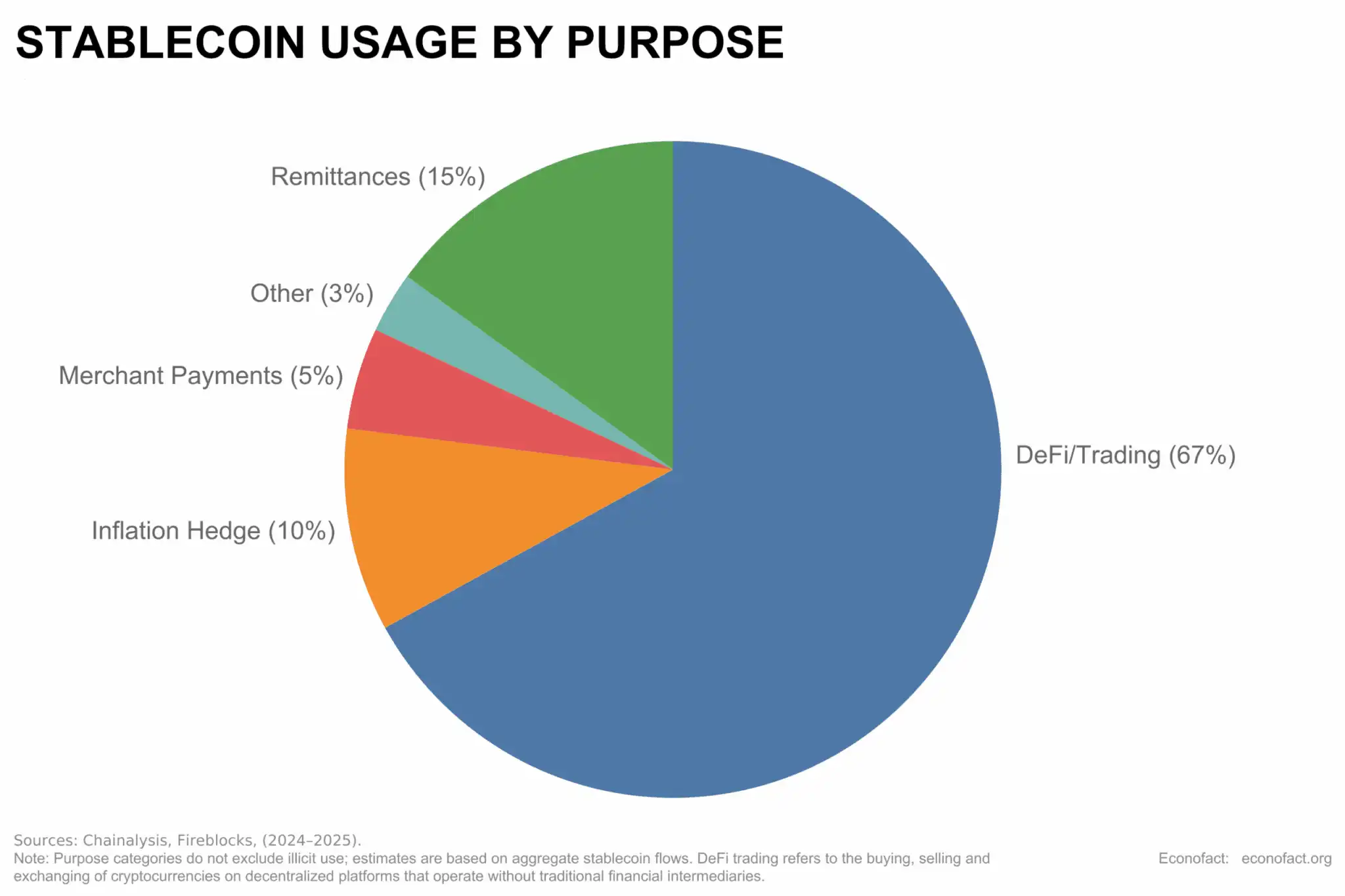
Primary Use Cases of Stablecoins
- 67% used for DeFi and trading, including DEXs, liquidity provision, and lending.
- 15% used for remittances, enabling cross-border transfers in underbanked regions.
- 10% served as an inflation hedge in countries with volatile currencies.
- 5% used for merchant payments, showing early retail and commercial adoption.
- 3% categorized as other, covering gaming, tipping, and experimental use cases.
Confidence Signals for Stablecoin Adoption
- Stablecoins processed over $8.9 trillion in on‑chain volume in the first half of 2025, reflecting surging transactional confidence across markets.
- Global institutional adoption reached 90% of businesses engaging in some form of stablecoin usage or testing by Q3 2025.
- Around 60–75% of leading issuers now provide real‑time proof‑of‑reserves dashboards, increasing transparency and user confidence.
- 9 out of 10 firms cite clear regulations and audit standards as key drivers of stablecoin adoption in 2025.
- Global payment‑infrastructure providers integrating stablecoins grew by 65% year‑over‑year, emphasizing transparency and liquidity criteria.
- USDT and USDC collectively account for over 93% of fiat‑pegged stablecoin volume, underscoring market trust in fully backed assets.
- Transparent issuers like USDC show daily price deviations within ±0.002 USD, maintaining high redemption reliability during stress events.
- Stablecoins made up 30% of all on‑chain crypto activity by mid‑2025, an 83% year‑over‑year rise, signaling mature adoption levels.
- Delayed reporting correlates with up to 40% higher redemption‑run risk, confirming how timely audits strengthen systemic stability.
Top Stablecoin Reserve Audits (by Project)
- Tether (USDT) reported holding approximately $127 billion in U.S. Treasury bills as of Q1 2025, making it one of the largest non-sovereign holders.
- The audit frequency for major stablecoin issuers remains largely quarterly or semi-annual, rather than monthly.
- The trend in 2025 is a push toward standardized audit frameworks (such as ISAE 3000 internationally or AT-C 205 in the U.S.) for reserve audits of stablecoins.
Stablecoin Market Capitalization
- USDT reached $150 billion, leading stablecoin dominance.
- USDC hit $60 billion, with a strong presence in North America.

Frequency of Reserve Reporting
- As of 2025, between 60–75% of major stablecoin issuers publish real‑time or near‑real‑time proof‑of‑reserves dashboards, a 25% increase from 2024.
- Roughly 71% of leading stablecoins issued proof‑of‑reserves attestations at least quarterly during 2024–2025, up from 52% in 2023.
- Quarterly reporting remains the global norm, but monthly attestations now cover over half of the top 20 issuers worldwide.
- Typical report lags remain 30–45 days after quarter‑end, although GENIUS‑compliant issuers target under 30 days’ delay.
- Licensed issuers offering audited attestations grew 44% since 2024, driven by rising institutional compliance requirements.
Reserve Composition Breakdown
- For major fiat-backed stablecoins, cash and government money-market funds together dominate roughly 60–65% of backing assets.
- Some stablecoins hold <10% of reserves in commercial paper or corporate short-term debt; risk exposure accordingly is limited.
- For USDT (Tether), as of mid-2025, ~66% is backed by Treasuries, ~10% overnight repos, ~18.5% “other” assets (crypto, precious metals, etc.).
- Some stablecoin issuers include tokenized real-world assets (RWAs) or foreign-currency holdings, though these remain minority components.
- Academic findings show that large stablecoin reserve demand, such as Tether’s, exerts measurable pressure on Treasury-bill yields.
Confidence Indicators for Stablecoin Adoption
- 86% of organizations formed partnerships to support stablecoin integration.
- 82% say their infrastructure is ready with wallets, APIs, and technical tools.
- 77% report strong customer demand for stablecoin-based financial products.

Legal and Security Protections for Reserves
- The EU’s MiCAR regulation (2025) enforces fund segregation, internal controls, and redemption rights at par value for all stablecoin issuers.
- About 72% of licensed issuers now disclose custodial segregation and counterparty risk details in their reserve reports.
- Mandatory protocol bridge and smart contract audits now cover over 90% of total circulation under U.S. and EU AML and IT security rules.
- OCC-supervised bank-chartered issuers have increased by 36% since 2024, strengthening reserve custody and deposit insurance protections.
- Stablecoin reserves held in short-dated Treasuries and reverse repos under 93 days make up over 85% of U.S. issuer portfolios, boosting liquidity.
- Misalignment between MiCAR and GENIUS Act frameworks creates regulatory gaps for non-U.S. issuers operating in U.S. markets.
- Combined safeguards and audits cut custodial loss and fraud incidents by 43% year-over-year in 2025.
Market Impact of Reserve Transparency
- Transparent issuers like Circle (USDC) earned $658 million in reserve income in Q2 2025, up 53% year-over-year, boosting institutional trust.
- Stablecoin usage in cross-border payments remains under 1% of global flows but is accelerating rapidly in 2025 as infrastructure evolves.
- Transparent issuers experience fewer peg deviations, faster redemptions, and stronger liquidity—correlated with frequent reporting.
- Roughly 95%+ of major fiat-backed stablecoins are pegged to the U.S. dollar, reinforcing dollar reserve dominance in 2025.
Price Stability and Peg Maintenance
- The backing ratio and reserve composition matter; larger issuers with well-diversified, liquid assets have historically been better able to defend the 1:1 peg under stress.
- For the largest issuer (USDT), the holding of $127 billion in U.S. Treasury bills as of Q1 2025 is among the largest non-sovereign holdings of T-bills globally.
- Research shows that a 1% increase in USDT’s market share of T-bills reduces 1-month Treasury yields by up to 24 basis points, indicating how stablecoin reserve flows affect underlying markets.
- The supply of stablecoins in circulation grew roughly 28% year-over-year as of early 2025.
- While stablecoins are designed to maintain a peg, transparency of reserves is a confidence factor; markets discount less-transparent issuers more heavily during stress.
- Though redemption mechanisms vary, greater transparency around backing assets and redemption rights reduces the likelihood of “peg drift” under strain.
Conclusion
The evolving world of stablecoins is increasingly shaped by the twin themes of reserve transparency and regulatory clarity. Strong transparent backing and frequent public disclosures support adoption, reduce redemption risk, and influence broader financial markets, from Treasury yields to payment-architecture shifts. Yet challenges remain, disclosure standards are uneven, audit depth varies, and structural risk, such as liquidity, maturity mismatch, and custody, can’t be solved solely by transparency.
For issuers, investors, and regulators alike, the message is clear: transparency is necessary, but not sufficient. As legislation like the GENIUS Act and emerging global frameworks take hold, the stablecoin sector now enters a phase where transparency, auditability, and reserve integrity will determine which players scale into mainstream finance and which remain niche. Delve into the full article for a comprehensive statistical view of each dimension of stablecoin reserve transparency.