In the heart of a remote fishing village in Indonesia, a local cooperative has started using blockchain to track the origin of its seafood, ensuring transparency for global buyers. Meanwhile, a Chicago-based pension fund just finalized a $500 million smart contract-based trade settlement in seconds instead of days. These aren’t isolated anecdotes; they’re markers of a global wave. Blockchain technology today isn’t just powering crypto anymore; it’s quietly rebuilding how we trust, trade, and transact.
This article breaks down the most up-to-date blockchain statistics, capturing its growth, use cases, and the evolving trust in decentralized ecosystems. Whether you’re a fintech strategist or simply blockchain-curious, these numbers help paint a clear picture of where this technology is heading.
Editor’s Choice
- Around 60% of Fortune 500 companies say they are working on blockchain initiatives as of 2025, up from 47% a year earlier.
- Ethereum processed 200.4 million transactions in Q1 2026.
- 86% of financial services firms report integrating blockchain in some operations.
- Crypto venture funding reached $9.26 billion in Q1 2026.
- The tokenized assets market is estimated at $3.01 trillion in 2026.
- U.S. blockchain developer demand (Rust/Solidity) rose, with Rust roles commanding $150k–$220k mid-level salaries in 2026.
Recent Developments
- Zero-knowledge rollups now account for 35% of Ethereum transactions.
- Account abstraction is supported by over 80% of Ethereum-compatible wallets.
- Intent-based transactions are in early beta on multiple chains, allowing outcome authorization.
- DePIN networks for energy/storage/location data are led by Helium and Filecoin with a $19.2 billion token market cap.
- Quantum-resistance is prioritized with QANplatform and IronFish testing post-quantum primitives.
- Cross-chain liquidity routing tools facilitated $1.6 trillion in interchain swaps in 2025.
- Blockchain oracles processed over 3 billion off-chain data calls monthly.
- Intent-centric UX frameworks like Anoma and Espresso shift dApp design to user-defined goals.
- Tokenized AI datasets are used by decentralized AI compute protocols for privacy-first ML.
Blockchain AI Market Growth
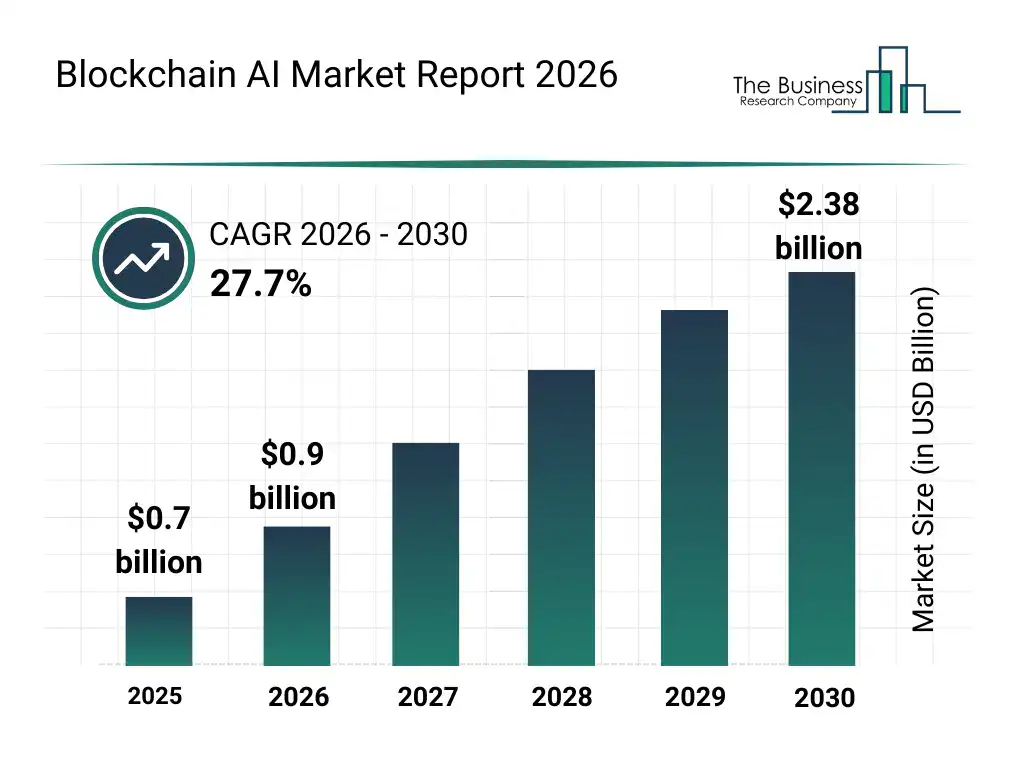
- The global blockchain AI market is projected to grow from $0.7 billion in 2025 to $2.38 billion by 2030, highlighting rapid industry expansion.
- The market is expected to reach $0.9 billion in 2026, showing strong early-stage adoption of blockchain-powered AI technologies.
- By 2027, the Blockchain AI market is forecast to climb to approximately $1.2 billion, reflecting increasing enterprise investment.
- The industry is projected to hit around $1.6 billion in 2028, driven by growing demand for secure AI data infrastructure and decentralized systems.
- In 2029, the market size is estimated to surpass $2.0 billion, indicating accelerating adoption across finance, healthcare, and cybersecurity sectors.
- The Blockchain AI market is forecast to register a strong 27.7% CAGR from 2026 to 2030, underscoring sustained long-term growth potential.
- The steady year-over-year increase suggests Blockchain AI is becoming a key innovation area for businesses seeking enhanced automation, transparency, and data security.
Enterprise and Government Adoption Rates
- 60% of Fortune 500 companies are actively working on blockchain initiatives in 2025, up from 47% the prior year.
- Over 130 countries are actively engaged in CBDC research and development as of 2026.
- The blockchain government market has approximately 52% central government agency adoption driven by digital transformation.
- North America accounts for 35–46% of the global blockchain market share, led by enterprise and fintech adoption.
- Large enterprises hold 66.3% of the total blockchain market revenue, reflecting leadership in adoption.
- 70% of enterprises adopted blockchain for supply chain transparency and digital payment efficiency.
- Around 60% of organizations cite regulatory uncertainty and interoperability as key deployment barriers.
- 55% growth in blockchain integration with AI and IoT technologies observed across financial and logistics sectors.
- 35% of new blockchain projects in 2025 focused on CBDCs and cross-border payment systems.

Blockchain Energy Consumption and Environmental Impact
- Bitcoin’s annual energy consumption is estimated at ~173 TWh in 2025, comparable to Poland’s national usage.
- Renewable energy in mining hit 52.4% in 2025, up from 37.6% in 2022.
- Bitcoin mining claims about 0.5% of global electricity use, drawing ~10 GW of continuous power.
- Over 56.7% of the Bitcoin network is now powered by sustainable energy sources, per Daniel Batten’s analysis.
- A single Bitcoin transaction emits ~712 kg CO₂, equivalent to 1.58 million Visa transactions.
- Bitcoin’s total carbon emissions for 2025 are estimated at ~98 million metric tons CO₂.
- Natural gas 38.2% now overtakes coal 8.9% as the largest fossil source in the Bitcoin mining mix.
- Layer 2 solutions cut mainchain transaction load by 78%, indirectly reducing energy use.
- 60% of blockchain projects are likely to adopt Proof of Stake in 2025, per sustainability reports.

Blockchain Technology Investment
- Crypto startups raised nearly $5 billion in Q1 2026, down 16% from Q1 2025.
- $9.26 billion entered the crypto VC sector across nearly 280 deals in Q1 2026.
- DeFi led in deal count with 57 rounds, though averaging smaller cheques in Q1 2026.
- Payments dominated VC fundraising at $2.67 billion, driven by BVNK’s $1.8 billion M&A deal.
- Prediction Markets secured 17.6% of cumulative capital on Kalshi and Polymarket.
- Crypto hedge fund AUM reached $136.2 billion in Q2 2025 with 400+ active funds globally.
- 55% of traditional hedge funds hold crypto exposure, up from 47% in 2024.
- Institutional investors represent 56% of capital in crypto hedge funds, averaging $132 million per fund.
- Blockchain infrastructure and AI integration startups drew significant deals in mining, raising over $500 million.
Smart Contracts and Decentralized Application Usage
- Over 6.1 million smart contracts were deployed monthly across Ethereum, Solana, and Avalanche in mid-2025.
- dApps serve 315 million unique users globally, up 22% YoY in 2025.
- Finance and gaming account for 71% of dApp user activity in 2025.
- Ethereum Layer 2 networks process 55% of all smart contract interactions.
- On-chain gaming ecosystems record 38 million active users monthly.
- Decentralized social platforms boast 12.4 million active creators.
- 41% of popular dApps support gasless transactions for improved accessibility.
- Average smart contract confirmation time on modern L1s dropped below 1.6 seconds.
- AI-powered dApps make up 11% of newly launched decentralized services in Q2 2025.
- 80% of audited dApps include automated exploit detection hooks to minimize vulnerability windows.

NFT and Web3 Blockchain Activity
- Global NFT market projected to reach $60.82 billion in 2026, up from $43.08 billion in 2025 at 41.2% CAGR.
- NFT market cap estimated at $5.6 billion in 2026, with $13 million daily trading volume.
- Total NFT sales volume reached $2.8 billion in H1 2026, showing sustained market activity.
- Gaming NFTs represent 38% of total transaction volume in 2026, leading all sectors.
- Ethereum dominates 62% of NFT contracts while Solana facilitates 18% of transactions.
- Asia has 2.8 million NFT owners, the largest global region, with India at 13.5% adoption rate.
- Music NFTs grossed over $520 million via streaming tokens and artist royalties.
- Identity NFTs reached 12 million issued in 2026, supporting decentralized IDs and membership.
- Web3 market valued at $12.61 billion in 2026, projected to reach $51.54 billion by 2030 at 42.2% CAGR.
Top Use Cases of Blockchain Technology
- Digital currency leads blockchain applications with 33%, powering cryptocurrencies and DeFi systems.
- Data access and sharing account for 32%, improving secure permissioned data exchange across industries.
- Data reconciliation and identity protection tied at 31%, emphasizing the demand for tamper-proof records.
- Payment solutions make up 30%, highlighting faster, low-fee cross-border transaction integration.
- Track and trace and asset protection each account for 27%, improving transparency and asset safeguarding.
- Asset transfer stands at 25%, indicating smart contract and tokenization growth for ownership changes.
- Certification and record reconciliation are both used by 23%, reinforcing blockchain credibility for auditable records.
- The financial services segment holds 39% blockchain market share as the leading end-use vertical.

Global Crypto Value Distribution by Region
- APAC ranked fastest-growing region with on-chain value received rising 69% YoY, totaling $2.36 trillion.
- North America received over $1 trillion in crypto transaction volume, up 50% YoY per TRM Labs data.
- Sub-Saharan Africa received over $205 billion in on-chain value, up 52% from the previous year.
- Latin America crypto adoption increased 63%, signaling expanding retail and institutional participation.
- South Asia posted 80% YoY increase, generating roughly $300 billion in transaction volume.
- Japan recorded 120% increase in on-chain value received, exceeding Indonesia’s 103% and South Korea’s 100%.
- Asia-Pacific is estimated to lead the cryptocurrency exchanges market with 42.3% share in 2026.
- North America holds 31.1% market share and is projected to be the fastest-growing region for crypto exchanges.
- Latin America saw over $730 billion in crypto volume in 2025, a 60% YoY surge.
- India and the United States lead global cryptocurrency adoption per Chainalysis 2025 Global Adoption Index.
Top Crypto Exchanges by Trading Volume
- Top 5 exchanges, Binance (32.77%), OKX (13.27%), Bybit (9.55%), Gate (8.88%), Bitget (7.70%), command 72.17% market share.

- Binance remains the largest centralized exchange with about 32.8% spot market share in Q1 2026 and typically processes $10–12 billion in daily spot volume over that period.
- Binance spot trading volume dropped to $482.6 billion in April 2025, down -18.0% from March.
- OKX emerged as the quarter’s standout gainer, expanding 1.25 pp to 13.27% market share in Q1 2026.
- Gate.io recorded 9.0% market share with $113.7 billion spot volume in April 2025, up +14.4% MoM.
- Bitget ended April 2025 as the third largest with 7.2% market share and $92.0 billion trading volume, up +1.7% MoM.
- The total 24h trading volume across 177 tracked crypto exchanges is $89.8 billion as of May 2026.
Blockchain Security and Fraud Incidents
- Crypto losses hit $370.3 million in January 2026, the highest monthly total in 11 months per CertiK.
- AI deepfake technology powered approximately 40% of high-value cryptocurrency scams in 2025.
- 31% of cryptocurrency fraud cases involved phishing attacks targeting individuals and organizations.
- DeFi protocols lost more than $750 million to hacks and exploits in 2026 through April.
- Crypto security breaches surpassed $1.01 billion in losses in 2026 as of April.
- The largest 2026 DeFi breach was the Kelp DAO hack, stealing $293 million in March.
- North Korean state-sponsored hackers stole $2.02 billion in 2025, up from the prior year.
Public vs Private Blockchain Usage
- Public blockchains account for roughly 60%+ of on‑chain transaction activity in 2025, while private and permissioned networks handle the remaining ~40%.
- Enterprise blockchain market valued at $9.64 billion in 2023, predicted to reach $145.9 billion by 2030 at 47.4% CAGR.
- Blockchain Technology Market estimated at USD 5,692.1 Mn in 2026, expected to reach USD 172,526.7 Mn by 2033 at 62.8% CAGR.
- North America leads the blockchain market with 47.0% share in 2026, and Europe is the fastest-growing with 25.7% share.
- Solana processes ~65,000 TPS theoretically, while Bitcoin handles ~7 TPS and Ethereum 15–30 TPS.
- Ethereum with Layer 2 solutions achieves 1,000+ TPS, significantly higher than the base layer.
- 19% increase in permissioned blockchain deployment driven by EU and APAC data privacy mandates.
- Interoperable platforms bridge over $1.2 trillion in assets between public and private ecosystems.
Frequently Asked Questions (FAQs)
The average salary for blockchain developers is approximately $145,000 in the United States, with salaries ranging from $150,000 to $175,000 according to Hired, while in India, the average is ₹9.8 lakhs (approximately $11,800) per year.
There is a significant talent gap, with approximately 440,000 blockchain developer job openings globally versus only 26,000 available qualified professionals as of 2025.
Approximately 60% of Fortune 500 companies are actively pursuing blockchain initiatives as of 2025.
Conclusion
Blockchain technology today has matured far beyond its origins in cryptocurrency. It now powers public infrastructure, underpins modern finance, drives sustainability innovation, and decentralizes access to digital ownership. The stats show a technology that’s becoming more scalable, more secure, and more usable across industries and regions.
Blockchain’s momentum is undeniable. But what’s perhaps most compelling is the shift in mindset, organizations now view blockchain not just as a disruptive novelty but as a core part of digital transformation. The road ahead is less about hype and more about trust, infrastructure, and scalable value.