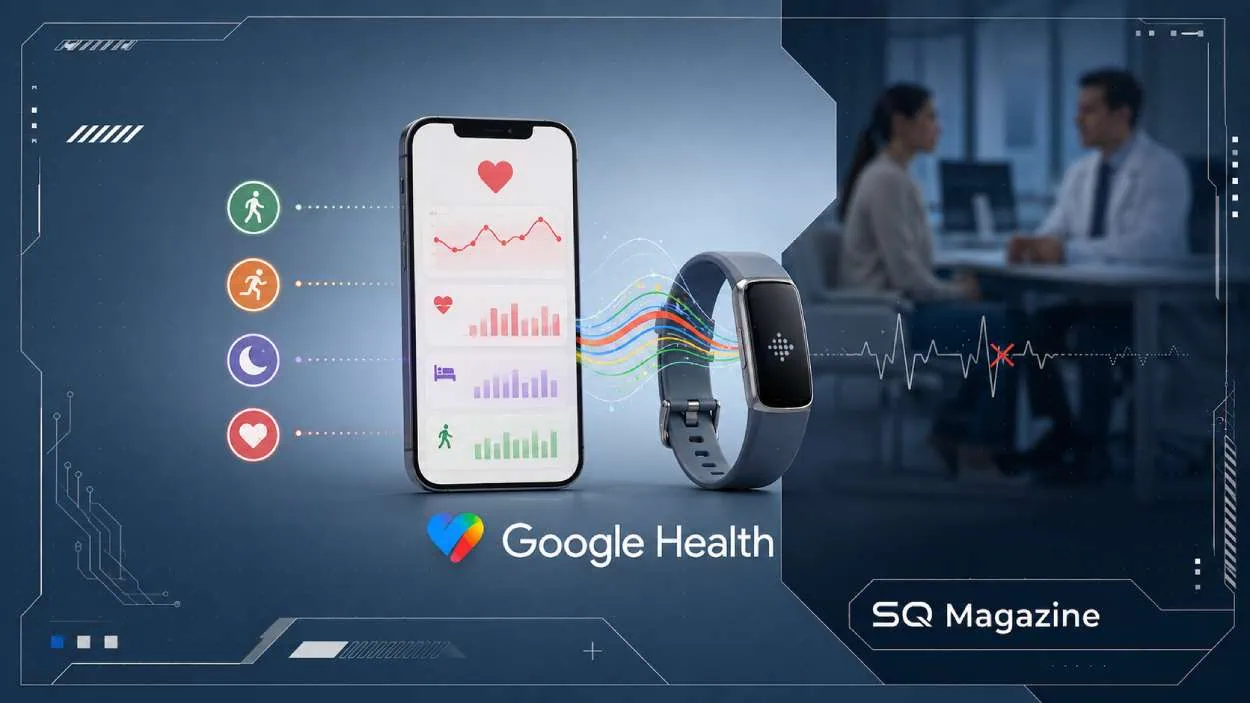






Google released version 5.05 of its Health app in August 2026, adding a sync that writes tracked data from Google Health into Apple Health on iOS. Heart rate variability does not make the trip.
Quick Summary – TLDR:
- Google Health version 5.05 writes steps, workouts, sleep and device vitals into Apple Health on iOS.
- Heart rate variability stays out of the sync, which Fitbit forum users attribute to differing calculation methods.
- Smart Health Links in the same release let United States users share tracked health data with their doctor.
- Fitbit hardware owners on iPhone can read their daily numbers without opening Google’s app.
- Apple took 23% of global smartwatch shipments in 2025, according to Counterpoint Research.
What Happened?
Google shipped Health app version 5.05 to the Apple App Store and to Google Play Store distribution channels this month. The iOS build pushes tracked metrics into Apple Health, covering step counts, workouts, sleep patterns and vitals recorded by Fitbit hardware including the Fitbit Air. The release also fixes fitness-tracking bugs.
Reddit user posting_purple surfaced the change first in the r/fitbit community, before wider coverage picked it up. That thread, not a Google announcement post, is where the metric-by-metric picture emerged.
Apple Health sync release!
by u/posting_purple in fitbit
Heart Rate Variability Stays Behind
Commenters on the same r/fitbit thread flagged the one omission that matters to serious training users. Heart rate variability, the beat-to-beat timing measure athletes use to gauge recovery load, does not cross into Apple Health.
User MashV traced the gap to a methodology difference, since Google Health and Apple Health compute HRV in different ways and the numbers would not be comparable. That reading comes from a Fitbit forum participant rather than from Google, and it stays unconfirmed by the company.
What the evidence supports is narrow. The sync demonstrably moves several metric types, and HRV is not among them. Why it is absent, and whether that is permanent, are separate questions the available material does not answer. Four questions stay open: will HRV arrive once the two platforms reconcile their calculations, does the sync run in both directions, how often does it refresh and backfill history, and when does Smart Health Links sharing reach users outside the United States.
Smart Health Links Reach United States Doctors
Google’s release notes for version 5.05 also describe a sharing route for medical records. In the United States, the update lets users hand tracked health data to a doctor through Smart Health Links, on Android and on iOS.
That piece matters more than the sync for anyone coordinating care rather than counting steps, a use case closer to wearables in caregiving than to fitness logging. Health data leaving a consumer app for a clinical system widens the privacy surface, so the detail those links expose is worth watching.

What Cross-Platform Sync Changes for Wearables?
Apple held 23% of global smartwatch shipments in 2025, per Counterpoint Research figures, so a meaningful share of Fitbit owners already live inside Apple’s health dashboard. The Android and iOS platform split stood at 73.9% Android and 25.7% iOS worldwide in August 2025, which puts a quarter of the global handset base on the side of this fence that previously required a second app.
Version 5.05 reduces that friction to a periodic check-in. A Fitbit user on iPhone can treat Apple Health as the daily view and open Google’s app only for what the sync leaves out.
Anyone already treating Apple Health as a single source of truth should check HRV directly in Google Health before assuming the Apple record is complete. A missing metric in a recovery trend reads as a flat line, not as an error message.
SQ Magazine’s Takeaway
The sync solves an ownership problem rather than a technical one. Fitbit hardware has sat awkwardly on iOS since Google absorbed the brand, and version 5.05 concedes that iPhone owners will use Apple Health as their default dashboard whatever Google prefers. Handing over steps, sleep and workouts while withholding heart rate variability keeps one reason to open Google’s app, which looks less like an engineering limit than a retention decision, though Google has not said so.
What’s next: the HRV question is the one to watch, since a methodology difference is solvable if either company publishes its calculation or accepts the other’s. Users on the current build should verify which metrics actually populate in Apple Health over a full week before retiring their old tracking habits, and United States users who want the doctor sharing feature need to confirm Smart Health Links appears in their app rather than assuming the update enabled it.