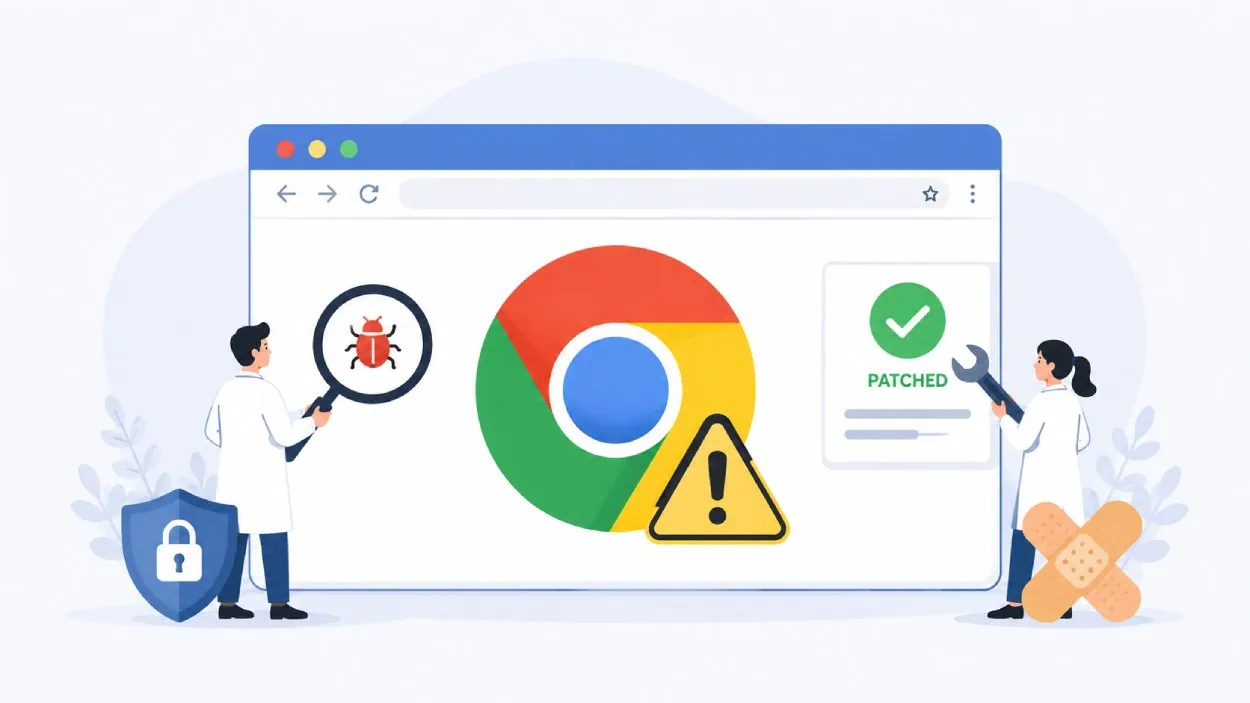






Google fixed 1,072 security bugs across Chrome 149 and 150, more than the previous 23 Chrome milestones combined, after AI agents began scanning Chromium source code in early 2026. One was a sandbox escape that sat unnoticed for over 13 years.
Quick Summary – TLDR:
- Google fixed 1,072 security bugs in Chrome 149 and 150 combined, beating the total from the previous 23 Chrome milestones.
- Gemini-based agents found a sandbox escape that had been in Chromium for more than 13 years without detection.
- The Chrome Security Team estimates automated bug triage saves several hundred working hours every month.
- Google is piloting two security releases per week and moving major Chrome versions to a two-week cycle.
- The 1,072 figure counts internal fixes and does not equal 1,072 published CVE identifiers.
What Happened?
The Chrome Security Team reported that Chrome 149 and Chrome 150 together closed 1,072 security bugs, a total Google says exceeds the security issues patched across the previous 23 Chrome milestones. The jump follows an agent environment built at the beginning of 2026 that applies Gemini to large portions of the Chrome source code.
The agents read Chromium’s Git history, prior CVE entries and per component security notes, then generate several possible source changes. Critic agents compare those proposals against Chromium conventions and existing security boundaries. Human developers still assess every patch before it lands, so Google describes the output as candidate patches rather than autonomous repairs.
The analyses run on isolated systems without general internet access, with traffic routed through narrow allowlists.
wow
— SciTech Era (@SciTechera) August 3, 2026
AI just helped Google fix 1,072 security bugs in just two Chrome updates. 👀
Google revealed that Chrome 149 and 150 fixed 1,072 security bugs, more than the previous 23 Chrome releases combined.
“Company now uses Large Language Models (LLMs) across the entire security… pic.twitter.com/NqAry3fkKV
A Sandbox Escape Sat in Chromium for 13 Years
The most consequential single finding is a sandbox escape that sat unnoticed in the code for more than 13 years. A renderer process an attacker had already compromised could have used it to read local files.
Mozilla logged the same pattern this year. Claude Mythos surfaced 271 vulnerabilities in Firefox, fixed in Firefox 150 on April 22, 2026, against 22 bugs from an earlier test using Claude Opus 4.6. Long-lived boundary bugs survive fuzzing and human review, and agents carrying repository history read them differently.
Veracode’s 2025 analysis found 45% of AI-generated code carries security vulnerabilities, so the technology writing patches also writes a share of the defects.
Agents Triage Reports Before Humans See Them
Google also automated intake. The system screens each report for spam, duplicates and security relevance, tries to reproduce the bug on affected operating system and browser versions, then attaches stack traces, affected components, time of introduction and a preliminary severity before routing the ticket to a Chromium team and a human owner.
The volume explains the investment. Google said it received more external bug reports in March 2026 than throughout all of 2025. Big Sleep and CodeMender now run over submitted code changes every 24 hours, and Google credits its continuous integration systems with stopping more than 20 vulnerabilities in May, one in the internal S1+ category.
What the figures prove has limits. The 1,072 count covers bugs found and fixed during development, some of which never reached a stable Chrome build and some consolidated or handled without a separate CVE identifier. Four questions stay open:
- How many of the 1,072 bugs were reachable in a shipped Chrome release?
- Was the 13-year sandbox escape ever exploited in the wild?
- What share of agent-proposed patches did developers reject or rewrite?
- Which CVE identifiers cover the S1+ bug caught in May?

Two Releases a Week, and the Restart Problem
A patch protects nobody until it is installed. Once a fix appears in the public Chromium repository, attackers can study the change and work backward to the original bug. That window is the patch gap. Google is compressing it: major versions move to a two-week cycle and security updates continue at least weekly.
“In the face of fast-moving, AI-powered attacks, our delivery cadence must accelerate even further. To meet this moment, we are piloting a shift to two security releases per week,” Google said in its security update report.
Installation is the harder half. Chrome 150 introduced a zero window auto restart on macOS, letting the browser restart itself when it runs in the background with no window open and an update pending. Google is also investigating dynamic patching, which would swap individual renderer or GPU processes without closing the browser, with no announced date. Earlier releases took narrower measures such as Chrome 146’s session cookie theft protections.
Anyone running Chrome should open chrome://settings/help, confirm the version reads 150 or later, and restart the browser, because a downloaded update stays inert until that restart completes. Doing so helps reduce exposure during the patch gap. It does not eliminate it.
SQ Magazine’s Takeaway
Discovery used to be the bottleneck in browser security. Google’s own numbers show the constraint has moved to review capacity and delivery speed. A twice-weekly release pilot is what that looks like when a vendor takes it seriously, and it raises the stakes on human sign-off, since the pipeline that produced the 13-year sandbox fix produces every other candidate patch, alongside work such as Gemini-powered AI skills inside Chrome.
What’s next: the twice-weekly cadence stays a pilot with no confirmed permanent date. Enterprise IT teams managing large Chrome fleets should revisit update and pinning policies now, because a two-week major-version cycle changes the testing math for compatibility sensitive deployments. Google recommends enterprise customers use Chrome management tools, update policies and monitoring systems. Longer term, Google says it is expanding memory-safe languages such as Rust, the one measure here that removes bug classes rather than finding them faster.