





Meta is turning to space to secure clean and continuous energy for its rapidly expanding AI infrastructure.
Quick Summary – TLDR:
- Meta signs a deal with Overview Energy for up to 1 gigawatt of space based solar power.
- Technology will beam infrared energy from satellites to solar farms at night.
- First orbital test planned in 2028, with commercial rollout by 2030.
- Move supports Meta’s growing AI data center energy demand.
What Happened?
Meta has entered a long term agreement with Overview Energy to secure space generated solar power for its data centers. The deal gives Meta early access to up to 1 gigawatt of energy, with commercial delivery expected by the end of the decade.
Meta partners with space startup Overview Energy to secure solar power for data centers https://t.co/uLR60nPRz1
— Reuters Energy and Commodities (@ReutersCommods) April 27, 2026
Meta’s Big Bet on Space Solar Power
Meta Platforms is exploring a new frontier in clean energy as it looks to meet the rising electricity needs of its AI operations. The company’s data centers consumed more than 18,000 gigawatt hours of electricity in 2024, a figure expected to grow as AI adoption accelerates.
To tackle this, Meta has committed to building 30 gigawatts of renewable energy capacity, mainly through large scale solar projects. However, solar power comes with a major limitation. It cannot generate electricity at night without costly battery storage or backup systems.
This is where Overview Energy’s approach comes in.
How the Technology Works?
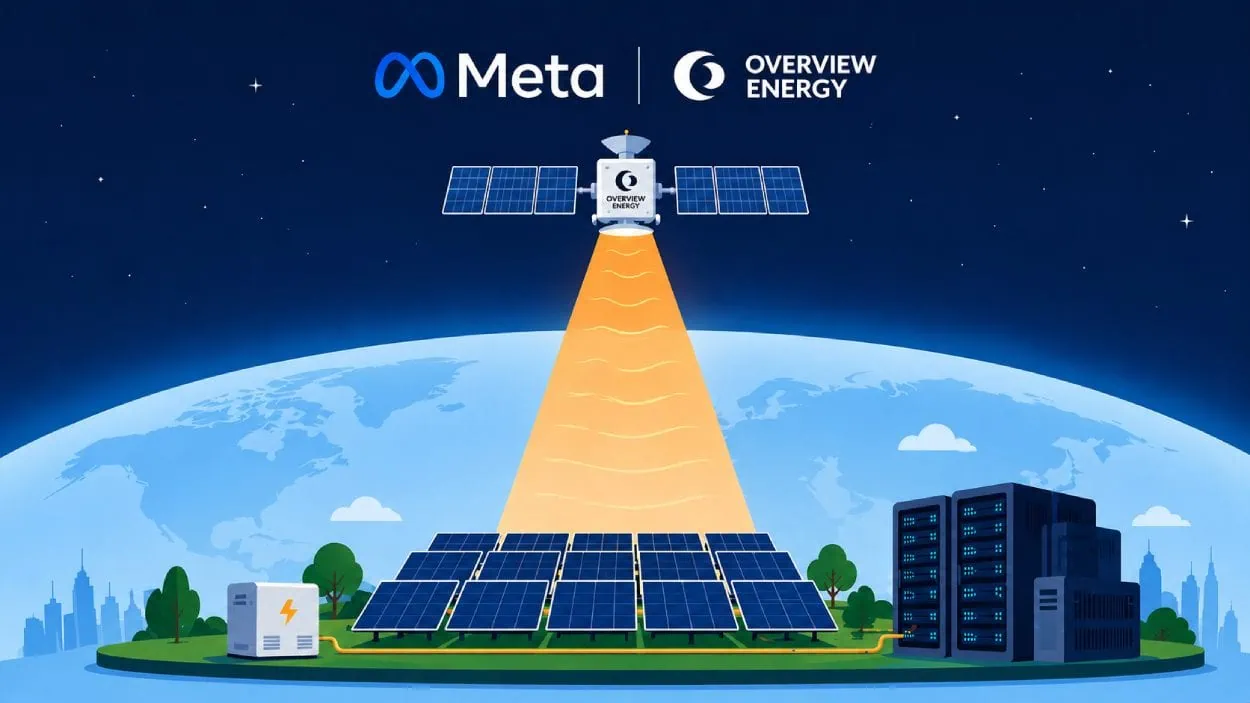
Overview Energy is developing satellites that can collect solar energy in space, where sunlight is constant and uninterrupted. The energy is then converted into near infrared light and transmitted to Earth.
Instead of using high powered lasers or microwave beams, the company plans to send a wide and low intensity infrared beam to ground-based solar farms. These farms can then convert that light back into electricity, even after sunset.
According to CEO Marc Berte, the beam is designed to be safe enough that people could look at it without harm, addressing concerns tied to earlier space power concepts.
The system is expected to:
- Increase efficiency of existing solar farms.
- Reduce reliance on fossil fuels.
- Provide continuous clean energy supply.

Timeline and Scale of Deployment
Overview Energy has already demonstrated early stage power transmission using aircraft. The company is now preparing for its first space-based test in 2028, followed by commercial deployment around 2030.
The long term vision includes launching up to 1,000 satellites in geosynchronous orbit. These satellites would remain fixed over specific regions, enabling consistent energy delivery.
Once fully operational, the network could:
- Cover roughly one-third of the planet.
- Initially serve regions from the US West Coast to Western Europe.
- Deliver power for over 10 years per satellite.
As the Earth rotates, these satellites would continue supplying energy to solar farms entering nighttime, effectively extending daylight energy production.
AI Boom Driving Energy Demand
Meta’s move reflects a broader trend across the tech industry. The rapid rise of AI is pushing companies to secure reliable and scalable energy sources.
Meta is investing hundreds of billions of dollars into AI infrastructure, including massive data centers across the United States. One such project in Louisiana is expected to cost $50 billion and span a huge area.
The company has also partnered with firms like Vistra, Oklo, and TerraPower, making it one of the largest corporate buyers of nuclear energy.
Nat Sahlstrom, Meta’s vice president of energy and sustainability, said:
Challenges and Unknowns
Despite the promise, space-based solar power is still in development. The technology must prove it can:
- Scale efficiently to gigawatt levels.
- Operate reliably in orbit over long periods.
- Deliver power at a competitive cost.
Financial details of the Meta deal have not been disclosed, and it remains unclear how quickly the system can be deployed at full scale.
SQ Magazine Takeaway
I think this is one of the boldest energy bets we have seen from Big Tech. Meta is not just buying power, it is trying to reshape how energy is generated and delivered. If this works, it could solve one of the biggest problems in renewable energy, which is consistency.
At the same time, this is still a high risk idea. Space solar has been talked about for years but never deployed at this scale. Still, with AI pushing energy demand to new extremes, companies like Meta do not have the luxury to wait. They are experimenting now because the future of computing depends on it.