





Anthropic made Claude Fable 5, its most expensive AI model, a permanent subscription feature for Max and Team Premium users on July 20. Pro and Team Standard subscribers lost free access entirely and now face a one-time $100 credit before per-token billing kicks in.
Quick Summary – TLDR:
- Anthropic granted Max and Team Premium subscribers permanent Fable 5 access on July 20, capped at 50% of standard weekly usage limits.
- Pro and Team Standard subscribers lost free Fable 5 access and now receive a single one-time $100 usage credit.
- Fable 5’s API pricing reaches $10 per million input tokens and $50 per million output tokens, the steepest rate in Anthropic’s model lineup.
- GPT-5.6 Sol, OpenAI’s rival model, scores within one point of Fable 5 on the Artificial Analysis Index yet costs about one-third as much per task.
- Anthropic delayed the subscription cutover three times since July 7, citing capacity limits tied to Fable 5’s higher compute cost per token.
Anthropic Splits Fable 5 Access by Subscription Tier
Max and Team Premium subscribers keep Claude Fable 5 permanently, but at 50% of their standard weekly usage limits, Anthropic said in its July 18 announcement. Those standard limits shrink on the same day, since a separate 50% boost to Claude Code weekly rate limits also expires.
Pro and Team Standard subscribers get no equivalent carve-out. Anthropic will issue each a one-time $100 usage credit, after which further Fable 5 use bills at API rates of $10 per million input tokens and $50 per million output tokens, the steepest pricing for any Claude model in general availability.
Beginning July 20, Claude Fable 5 will be included in all Max and Team Premium plans, at 50% of limits.
— Claude (@claudeai) July 18, 2026
Pro and Team Standard users will continue to have access to Fable via usage credits, and will receive a one-time $100 credit.
Demand for Fable has been challenging to…
Three Delays Preceded the Permanent Split
Anthropic originally planned to end free Fable 5 inclusion on July 7, then pushed the deadline to July 12 after user backlash, then again to July 19 as competitive and capacity pressures shifted. Each extension arrived via the company’s official X account, most recently Anthropic’s July 18 announcement confirming the permanent split.
Anthropic said demand for Fable 5 had been difficult to predict, which is why it staged the rollout and extended access multiple times while it secured more serving capacity. A Claude Code lead engineer had publicly promised in early July that Fable 5 would return as a standard Pro-tier benefit, a commitment the announcement does not fulfill.
Why Fable 5 Costs So Much to Serve?
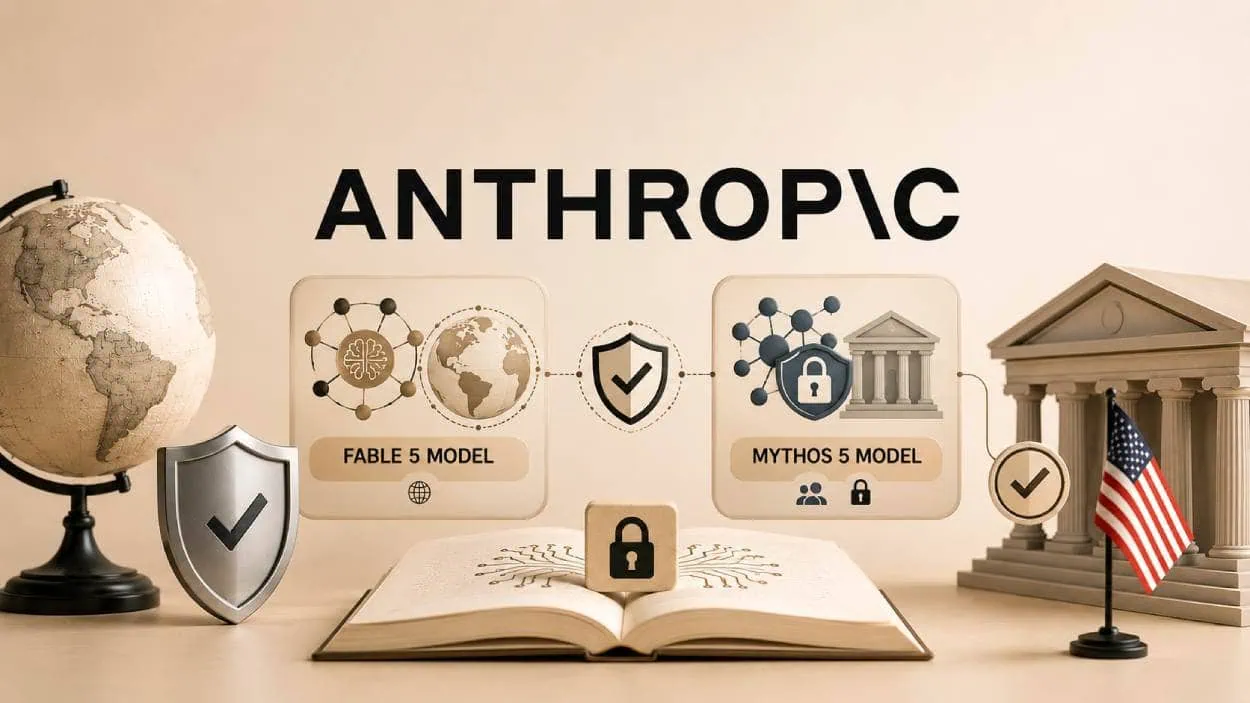
Fable 5 runs the same underlying model as Claude Mythos 5, the version Anthropic reserves for a small group of vetted partners through Project Glasswing. The difference is a layer of safety classifiers that flag queries touching cybersecurity exploitation, biology and chemistry uplift, and suspected large-scale model distillation. When a classifier fires, Claude Opus 4.8 handles the response instead, something that happens in fewer than 5% of sessions, Anthropic says.
The architecture gives Fable 5 a 1-million-token context window and a maximum output of 128,000 tokens per response, built for holding an entire codebase or research archive in one session. Anthropic also applies a mandatory 30-day data retention policy to all Mythos-class traffic, a requirement with no equivalent on Opus-class models.
The tier sits above Opus, introduced in June 2026 with an adaptive reasoning architecture that costs more compute per token to run, part of why serving it broadly took months of capacity planning after its June 9 launch. On SWE-Bench Pro, Fable 5 posted 80.3% using Anthropic’s own scaffolding, a figure no neutral evaluator has independently replicated as of this writing.

GPT-5.6 Sol Forced Anthropic’s Hand
Anthropic originally planned to drop Fable 5 from subscription plans entirely, limiting it to per-token API billing. The reversal followed OpenAI’s release of GPT-5.6 Sol, which reached general availability on July 9 at $5 per million input tokens and $30 per million output tokens, roughly half Fable 5’s input cost and 60% of its output cost.
On the Artificial Analysis Intelligence Index, an independent composite benchmark, Fable 5 scores about 59.9 against GPT-5.6 Sol’s 58.9, a statistical tie in general capability. The larger gap sits in per-task cost: Artificial Analysis found Sol completes equivalent tasks at roughly one-third the cost of Fable 5 because it emits fewer output tokens to reach comparable results.
Fable 5 keeps a narrower edge on repository-level software engineering tasks, while Sol leads on terminal-based and agentic coding benchmarks. A Max or Team Premium plan without Anthropic’s best model offers little to differentiate it from a rival whose flagship costs meaningfully less per task at near-equivalent capability, a dynamic that shaped the subscriber-retention math behind the reversal.
SQ Magazine’s Takeaway
The restructuring exposes a pricing ladder spanning an order of magnitude within one vendor. Anthropic’s published pricing documentation lists Haiku 4.5 at $1 and $5 per million input and output tokens, Sonnet 5 at $2 and $10 during introductory pricing through August 31, 2026, Opus 4.8 at $5 and $25, and Fable 5 at $10 and $50. That output cost ratio of 2:1 between Fable 5 and Opus 4.8 is the widest gap in the lineup, and teams that do not need Fable 5’s context window or extended output get more value redirecting work to Sonnet 5 while its introductory rate holds.
Pro subscribers who lean on Fable 5 for output-heavy work face a narrow window before the $100 credit runs out. A session producing 2 million output tokens, a moderate load for an autonomous coding migration or a long document analysis run, consumes the entire credit at Fable 5’s rate. Pro and Team Standard users should check their usage dashboard now to see how much credit remains and route lighter tasks to Sonnet 5 or Opus 4.8 before starting a long Fable 5 session. Anthropic has not said when the credit will be distributed or how far a typical user should expect it to stretch, and whether it revives the earlier promise of standard Pro-tier access remains an open question.