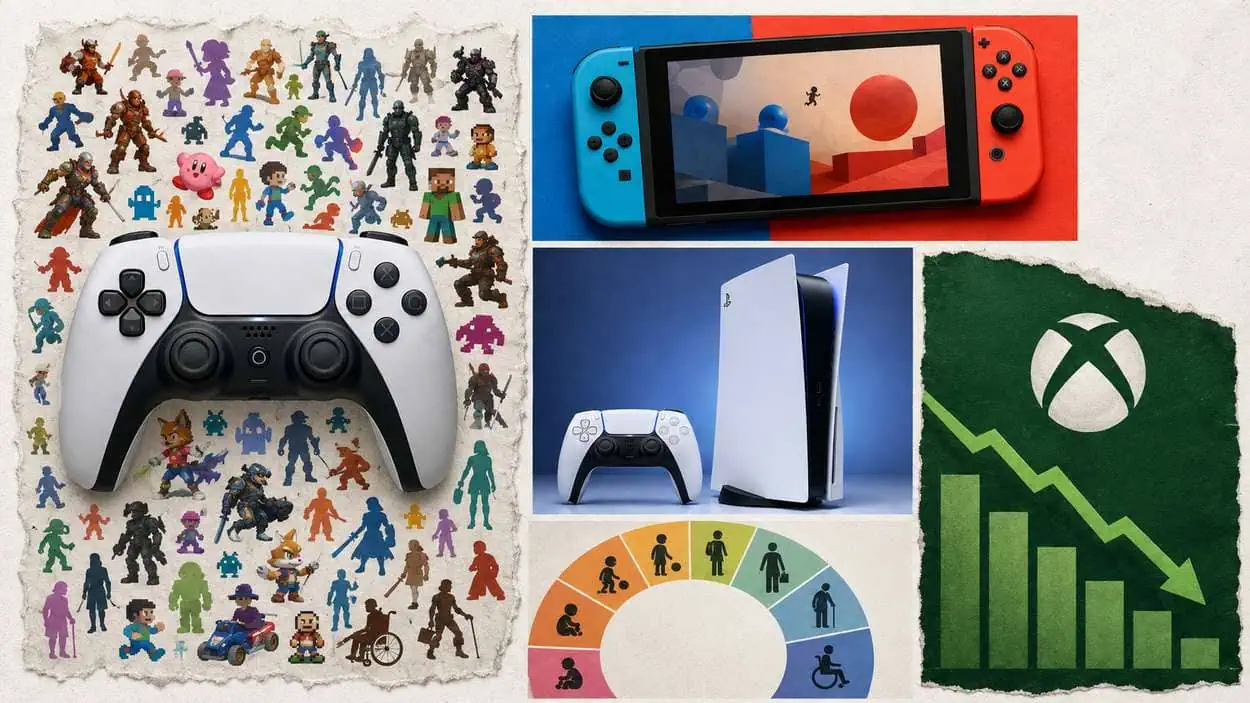
90% of Gen Z say they are gamers, followed by 84% of Millennials, according to Deloitte’s 2025 Digital Media Trends survey. The number reframes gaming as a default behavior for U.S. 18-to-28-year-olds.
The platform mix behind it is layered. Most U.S. teens play video games on a gaming console (73%) or a smartphone (70%), with PCs not far behind, per the Pew Research Center’s 2024 teens and video games survey. The Roblox demographic flip in the same period puts the user-generated platform layer at the centre of where Gen Z’s time and dollars now concentrate.
Key Takeaways
- 90% of Gen Z say they are gamers, and 84% of Millennials say the same per Deloitte 2025.
- 212.3 million Americans play video games every week, an increase of 7.2 million versus 2025, per the Entertainment Software Association’s 2026 Essential Facts report.
- 78% of Gen Z players have purchased in-game content, typically spending $20 per month (median) per ESA 2026.
- Per Pew Research Center, 73% of U.S. teens play on consoles, 70% on smartphones, and 49% on desktop or laptop computers.
- Roblox closed Q3 2025 at 151.5 million average daily active users (up 70% YoY), with the 13-and-older cohort growing 89% year-over-year.
- Gen Z and Millennial gamers dedicate about 8 hours weekly to playing video games per Deloitte 2025; Newzoo’s combined Gen Z + Millennial sample tracks higher at 10.3 hours per week.
- Players aged 18 to 24 saw a 25% drop in gaming expenditure from January to April 2025 compared to the previous year per Sensor Tower’s 2025 State of Mobile.
Editor’s Choice
- U.S. consumer spending on video games totalled $60.7 billion in 2025, an increase of 1.4% from 2024 and the second-highest annual total on record.
- The 17-to-24 age group is Roblox’s fastest-growing segment, with the 18-and-over segment expanding more than 50% year-over-year per Roblox’s Q3 2025 10-Q.
- Mobile is the most-played platform across every age group at 80% per ESA’s 2026 report, with PC and console as the next-most-played.
- 44% of U.S. teen gamers use Discord, while about three-in-ten teens overall (28%) use Discord per Pew.
- Xbox Game Pass subscribers hit 40 million in Q1 fiscal 2026, with cloud gaming hours up 45% year-over-year to 1.7 billion.
- Generation Alpha and Gen Z are the biggest users of consoles at 58% and PCs at 54% per ESA’s 2025 annual study.
- In 2025, global in-app purchases reached $167 billion, an increase of 10% year-over-year per Sensor Tower’s 2025 State of Mobile.
Recent Developments
- June 3, 2026: The Entertainment Software Association released its 2026 Essential Facts report, putting 212.3 million Americans on video games weekly, an increase of 7.2 million from 2025, with the average player age now 37.
- February 11, 2026: ESA, Circana, and Sensor Tower reported 2025 U.S. consumer spending on video games at $60.7 billion, an increase of 1.4% year-over-year and the second-highest annual total on record.
- January 2026: Sensor Tower’s 2025 State of Mobile reported global in-app purchases at $167 billion, up 10% year-over-year, while players aged 18 to 24 saw a 25% drop in gaming expenditure from January to April 2025 compared to the previous year.
- November 2025: Microsoft reported Xbox Game Pass at 40 million subscribers in Q1 fiscal 2026, up from 37 million a year earlier, with cloud-gaming hours from Game Pass subscribers up 45% year-over-year to 1.7 billion.
- October 30, 2025: Roblox closed Q3 2025 at over 151.5 million average daily active users (up 70% YoY), 39.6 billion hours engaged (up 91% YoY), and $1,359.6 million in revenue (up 48% YoY).
Gen Z Gaming Participation and Platform Mix
Nine out of ten Gen Z respondents tell Deloitte they play video games. The ESA 2026 report shows mobile devices as the most popular platform across all age groups at 80%, while PC and console gaming follow as the next most-played platforms.
The pattern is broader than a single device. About a quarter of teens (27%) play video games on at least four of five tracked devices, while only 8% play on one device per Pew’s national teens survey.
The narrower “mobile dominates Gen Z” headline tracks revenue share, not behavior. Reading the platform mix as a stack, not a ranking, lines up better with the time use these surveys measure.
| Device | Share of U.S. teens playing | Detail |
|---|---|---|
| Console (PlayStation, Switch, Xbox) | 73% | Most-played device per Pew |
| Smartphone | 70% | Second-most-played device per Pew |
| Desktop or laptop PC | 49% | Half of teens play on PC |
| Tablet | 33% | One in three teens |
| Virtual reality headset | 24% | Including Quest and PSVR |
Source: Pew Research Center, Teens and Video Games Today (May 2024)
Pew’s survey of 1,453 U.S. teens found 73% play on a gaming console, 70% on a smartphone, 49% on a desktop or laptop, 33% on a tablet, and 24% on a virtual reality headset. The split echoes Newzoo’s global panel, where Gen Z mobile play rate runs at 60% with another 32% on Nintendo Switch. 60% of Gen Z gamers play on mobile phones, while 32% play on Nintendo Switch.
By the numbers: Per Pew Research Center, 85% of U.S. teens report playing video games and 41% play daily, with four-in-ten identifying as a gamer. Multi-device play is the norm with about 27% playing on four or more device types and just 8% sticking to a single device. The mobile-first reading misses how many teens still lean on consoles and PCs.

Mobile Gaming Among Gen Z
Mobile is where the biggest share of Gen Z screen time on games happens. The ESA 2026 cut puts the mobile play rate at 80% across all age groups, the top platform on every age bucket they measure.
Newzoo’s free 2025 global report frames it more sharply for the younger end. Mobile gaming has the highest percentage of players globally at 83%, while PC and consoles trail at 26% and 18% of players respectively.
81% of Gen Z respondents play games, averaging 7 hours and 20 minutes per week per Newzoo’s panel. Mobile revenue scale matched the reach. Mobile gaming profits made up 49% of the global games market in 2024, and mobile revenues will hit $103.0 billion in 2025 (up 2.9% YoY).
The breakdown of where Gen Z plays mobile is fairly conventional. Short sessions, free-to-start titles, and social hooks; the broader mobile games statistics Newzoo and Sensor Tower track now show the mobile and free-to-play layers as the de facto entry point for the cohort.
Console Use Among Gen Z
- 73% of U.S. teens play video games on a gaming console such as PlayStation, Switch, or Xbox.
- Generation Alpha and Gen Z are the biggest users of consoles at 58% of players per ESA’s 2025 annual study.
- Self-identified teen gamers play on a console at 95%, versus 78% of teens who play video games but do not identify as gamers per Pew.
- Per Pew Research Center, 62% of U.S. teen boys identify as a gamer compared with 17% of teen girls, and 61% of boys play every day versus 22% of girls.
The “consoles are dying” framing has been around for the better part of a decade, and the survey data keeps refusing to confirm it. Across our 50-plus platform statistics pages, the shape repeats: usage growth slows on mature platforms, engagement depth deepens, and consoles still anchor the most committed slice of Gen Z’s gaming time.
For the year-by-year market share between PlayStation, Xbox, and Nintendo, the Console data we track separately maps how the three platform-holders trade share as Gen Z ages into the higher-spend brackets.
Worth noting: Per Pew Research Center, the platform-mix totals smooth over a sharp gender divide in self-identification and daily play intensity. Teen boys identify as a gamer at 62% versus 17% for teen girls, and 61% of boys play every day versus 22% of girls. Publishers reading “Gen Z” as monolithic miss the engagement spread.
PC Gaming Share for Gen Z
Per Pew, PC is the third-most-played platform among teens, behind only consoles and smartphones. 49% of U.S. teens play video games on a desktop or laptop computer.
ESA’s 2025 generational cut put Generation Alpha and Gen Z as the largest PC user groups across all platforms tracked. Generation Alpha and Gen Z are the biggest users of PCs (54%) to play video games.
PC reaches 26% of players globally per Newzoo, against 18% for consoles. The lower global number versus the U.S. teen-specific read reflects regional PC penetration differences.
The gap between Pew’s U.S. teen rate and Newzoo’s global reach reflects two things: regional infrastructure differences and higher device-stacking behavior in the U.S. cohort.
Self-identified teen gamers play on a desktop or laptop computer at 72%, versus 45% of teens who play video games but do not identify as gamers per Pew. The broader PC numbers track these trends across older cohorts as well.
| Region/Cohort | PC play rate | Source |
|---|---|---|
| U.S. teens (overall) | 49% | Pew Research 2024 |
| U.S. teens (gamer-identified) | 72% | Pew Research 2024 |
| U.S. teens (non-gamer-identified) | 45% | Pew Research 2024 |
| Gen Alpha + Gen Z (all platforms tracked) | 54% | ESA 2025 |
| Global all-players | 26% | Newzoo 2025 |
Source: Pew Research Center, Entertainment Software Association, and Newzoo
Roblox and the User-Generated Platform Layer
Roblox Corporation closed Q3 2025 with the largest demographic shift on the platform in the company’s reporting history. Roblox’s average daily active users reached 151.5 million in Q3 2025, up 70% year-over-year and up 36% from Q2.
More telling: the 13-and-older cohort grew faster than the under-13 cohort that historically defined the platform’s audience. User growth was even stronger among users aged 13 and older, which grew 89% year-over-year, compared with 67% growth for users under 13.
On engagement, the inversion was sharper still. Engagement growth was higher among 13+ users, with total Hours increasing 107% year-over-year compared to a 67% increase for users aged under 13.
The 10-Q for the same quarter clarifies the verified-user age mix and the methodology shift. As of Q3 2025, 44% of Roblox daily active users were over 17 years old, with the 17-to-24 age group as the fastest-growing segment and the 18-and-over segment growing more than 50% year-over-year. Among verified Roblox users as of January 2026, 38% are aged 13 to 17, 35% are under 13, and 27% are 18 or older.
Key finding: Per Roblox’s Q3 2025 shareholder letter, average daily active users hit over 151.5 million while bookings hit $1,921.8 million in the quarter. The 13-and-older user base now grows 89% year-over-year, faster than the under-13 cohort. Roblox is no longer accurately described as a kids’ platform.
The age-mix inversion lines up with what we have been tracking across mature platform statistics pages: user growth slows or rotates among older cohorts while engagement depth in the original audience persists. Roblox sits unusually in that it is both growing its under-13 cohort and adding teens and adults faster.
Hours Played and Engagement
Gen Z and Millennial gamers dedicate about 8 hours weekly to playing video games, a number that has stayed largely unchanged in recent years per Deloitte’s 2025 Digital Media Trends survey.
Newzoo’s combined Gen Z and Millennial sample tracks higher at 10.3 hours per week, up from 8.2 hours overall in 2024. The Newzoo figure runs higher because the panel weights Gen Z and Millennials specifically, while Deloitte averages each cohort separately.
For daily intensity, 41% of U.S. teens play video games at least once a day per Pew, a baseline that holds even though many also use other entertainment platforms. 41% of U.S. teens say they play video games at least once a day. Pew’s gender split there is wide: 61% of teen boys play every day, versus 22% of teen girls. 61% of teen boys play video games every day, versus 22% of teen girls.
In-Game Spending and Monetization
Most Gen Alpha (69%), Gen Z (78%) and Millennial (67%) players have purchased in-game content, typically spending $20 per month (median) per the ESA 2026 cut.
The median spend matched ESA’s 2025 reading from a year earlier. Most Gen Alpha (69%), Gen Z (78%), and Millennial (67%) players have purchased in-game content, typically spending $20 per month (median).
The macro picture diverged from the player-level steady-state in 2025. In 2025, in-app purchases reached $167 billion globally, an increase of 10% year-over-year. Players aged 18 to 24 saw a 25% drop in gaming expenditure from January to April 2025 compared to the previous year, while older generations experienced less than a 5% decline.
Sensor Tower attributed the 18-to-24 spending decline to economic pressures and rising hardware and software costs hitting younger consumers harder.
Worth noting: Per Sensor Tower’s 2025 State of Mobile, global in-app purchases hit $167 billion (up 10% year-over-year) while players aged 18 to 24 cut gaming expenditure by 25% in the January-April 2025 window. The cohort that posts the highest engagement is also the cohort that pulled spending hardest in 2025, a divergence publishers should monitor as the 2026 generational data lands.
The 25% drop versus less than 5% for older generations is the kind of cohort spread that does not show up in headline industry totals. The 1.4% YoY rise in U.S. consumer spend looks healthy at the top line, but its composition is shifting toward older players, subscriptions, and hardware refreshes rather than the Gen Z in-game-purchase engine that historically drove the live-service category.
Subscription Services and Cloud Gaming
- U.S. consumer spending on video games totalled $60.7 billion in 2025, an increase of 1.4% from 2024.
- 2025 consumer spending growth was driven by a 20% growth in subscription services and a 1% increase in mobile.
- Xbox Game Pass subscribers hit 40 million in Q1 fiscal 2026, up from 37 million a year earlier.
- Cloud gaming hours hit 1.7 billion in 2025, a 45% increase from 1.2 billion in 2024, with about 87% of cloud traffic coming from mobile devices.
- 39% of all consumers cancelled at least one paid SVOD service in the last six months per Deloitte, but Gen Z and Millennial churn jumps above 50%.
| Subscription metric | 2025 value | Year-over-year change |
|---|---|---|
| U.S. consumer spend on video games | $60.7 billion | +1.4% |
| Subscription-service spend growth | 20% | (within 2025) |
| Xbox Game Pass subscribers (Q1 FY26) | 40 million | +3 million |
| Cloud-gaming hours | 1.7 billion | +45% |
| Mobile share of cloud traffic | 87% | (composition) |
Source: ESA, Circana, and Sensor Tower 2025 release; Microsoft Q1 fiscal 2026 update
Deloitte’s read on Gen Z SVOD churn predicts the gaming pattern. The dip-in, dip-out cancellation behavior, with Gen Z signing up for a release window, cancelling, and re-subscribing for the next release, explains how Xbox can show 45% more cloud-gaming hours without proportional permanent subscriber growth. The Xbox Game Pass subscriber data tracks the same pattern across Microsoft’s quarterly disclosures.
The takeaway: Per Deloitte’s 2025 Digital Media Trends, above-50% SVOD churn among Gen Z and Millennials. Cloud-gaming hours grew 45% year-over-year per Microsoft’s Q1 fiscal 2026 disclosure, even as Game Pass subscribers moved from 37 million to 40 million in the same window. Engagement and headcount have decoupled for this cohort.
Social Layer, Discord, Twitch, and Game Streaming
Where Gen Z plays games and where Gen Z talks about games are increasingly different platforms. Per Pew, 44% of U.S. teen gamers say they use Discord, while about three-in-ten teens overall (28%) use Discord.
Twitch has similar gamer concentration. 30% of U.S. teen gamers say they use Twitch, while 17% of teens overall use the platform. The Discord statistics we track over time show the structural Gen Z and Millennial concentration on the chat platform.
Gaming as a social experience showed up cleanly in Pew’s reasons-to-play data. 72% of U.S. teens who play video games say a reason they play is to spend time with others.
47% of teen video game players say they have made a friend online from playing video games per Pew. For the competitive ecosystem, the esports data we maintain separately captures the streaming and tournament side of the same engagement curve.
Gen Z Gaming as a Social Space
- Gen Z players believe video games are a great way to bring people together at 88% and to build relationships at 87% per the ESA 2026 report.
- 89% of Gen Z (ages 13-28) believe video games can introduce them to new friends and relationships per ESA 2025.
- 56% of Gen Z and 43% of Millennials say social media content is more relevant to them than traditional TV shows and movies per Deloitte.
- Gen Z respondents spend 54% more time, or about 50 minutes more per day, than the average consumer on social platforms and watching user-generated content.
Our attention span statistics document a trajectory that reshapes every content strategy. Average engagement windows contracted from 12 seconds in 2015 to under 5 seconds for short-form content in 2026, and gaming is one of the few entertainment categories where Gen Z still spends multi-hour sessions. The “primary social space” framing now lines up with the survey data, not just the industry take. The broader Gen Z social media data on platform-use density gives the comparison set for those time-use figures.
By the numbers: Per the Entertainment Software Association 2026 Essential Facts report, 88% of Gen Z players say games are a great way to bring people together and 87% say they help build relationships. Per Deloitte 2025, 56% of Gen Z say social-media content is more relevant than TV shows or movies. The gaming and social-platform stack is now where Gen Z’s discretionary attention concentrates.
Are Younger Players More Interested in Mobile Gaming Than Consoles?
Yes by reach, no by intensity. Playing on a mobile device is the most popular platform across all age groups at 80% per the ESA 2026 cut.
Console use among self-identified teen gamers runs at 95% per Pew, well ahead of the 78% console rate among teens who play but do not identify as gamers. The cohort-level read is reach-mobile, depth-console. Smartphones get them in the door, consoles get the longer sessions for the most committed slice.
What Online Games Are Under-25s Spending the Most Time On?
Newzoo’s 2025 panel identified shooters and fighting games as the dominant genre cluster for Gen Z, with 3 franchises at the top by mention rate. Generation Z loves shooters and fighting games, with Minecraft, Call of Duty, and Grand Theft Auto being the most popular franchises among Gen Z users.
On the user-generated layer, Roblox’s Q3 2025 success on viral experiences like Grow a Garden, Steal a Brainrot, and 99 Nights in the Forest captured the same engagement window. Roblox observed continued success from Grow a Garden and witnessed the rise of two new viral experiences, Steal a Brainrot and 99 Nights in the Forest.
The mix of established franchises and emergent UGC titles is consistent across the Newzoo panel and the Roblox shareholder letter. The 3-experience Roblox cluster alone helped lift the platform to over 151 million daily users in Q3 2025.
Conclusion
Gen Z’s gaming platform mix is a layered stack, not a winner-takes-all migration. The headline figure, 90% of Gen Z identify as gamers per Deloitte, sits on top of a structural breakdown where consoles still anchor the most committed segment, smartphones dominate by reach, and PCs hold a steady third slot. Roblox’s Q3 2025 demographic flip and Xbox Game Pass’s cloud-hour growth show two specific channels, user-generated content and subscription cloud play, where Gen Z’s preferences are reshaping platform economics fastest.
The harder pattern for publishers to track is the engagement-versus-monetisation divergence the data now makes visible. Gen Z hours held flat at 8 to 10.3 weekly while the 18-to-24 spending cohort cut purchases 25% in early 2025. The next batch of generational data should clarify whether that is a one-year economic dip or a longer behavioral shift; the answer will determine how publishers price live-service, subscription, and user-generated layers for the cohort that now defines the category.