In 1971, a computer engineer named Ray Tomlinson sent the very first email, a test message to himself. It was simple, unremarkable, and never intended to spark a revolution. Fast forward today, and email is far from a relic of the past. It’s the beating heart of digital communication, powering global business, nurturing relationships, and driving billions in revenue.
But how is email really performing in today’s complex digital landscape? This article breaks down the most up-to-date email statistics, helping you navigate trends, benchmark performance, and uncover opportunities across industries.
Editor’s Choice
- Over 4.7 billion people actively use email in 2026, representing about 58% of the global population.
- Around 376.4 billion emails are sent and received every day worldwide in 2025, up roughly 4.3% year over year.
- Average marketing email open rates across industries generally fall between 22%–27%, with top programs exceeding 40%.
- Mobile devices now account for about 60% of all email opens globally, making mobile-first design essential.
- Email marketing delivers an average ROI of about $36–$40 for every $1 spent, still the highest among digital channels.
- Roughly 93% of people check their email daily, confirming email as the preferred work communication channel.
- Automated email flows generate around 37% of email revenue while representing only 2% of total sends.
- AI-driven subject lines and content optimization help leading brands achieve open rates above 40% and click-through rates over 8% on key campaigns.
Recent Developments
- Over 70% of advanced email programs use heatmapping or click-tracking overlays to analyze scroll depth and on-message engagement.
- Cross-device and omnichannel attribution capabilities are embedded in roughly 55% of modern analytics stacks, improving multi-touch journey insight.
- Real-time or sub-hour analytics dashboards are now standard for around 60% of data-mature teams, enabling rapid mid-campaign optimization.
- AI-powered subject line and copy generators are used regularly by an estimated 40%–50% of marketers to improve open and click metrics.
- Interactive modules such as carousels and embedded surveys commonly drive 10%–20% higher engagement than static designs across leading brands.
- Enterprise teams report integrating automated pre-send testing and QA workflows, including compatibility checks, in more than 70% of large-scale email operations.
Email Marketing Budget Trends
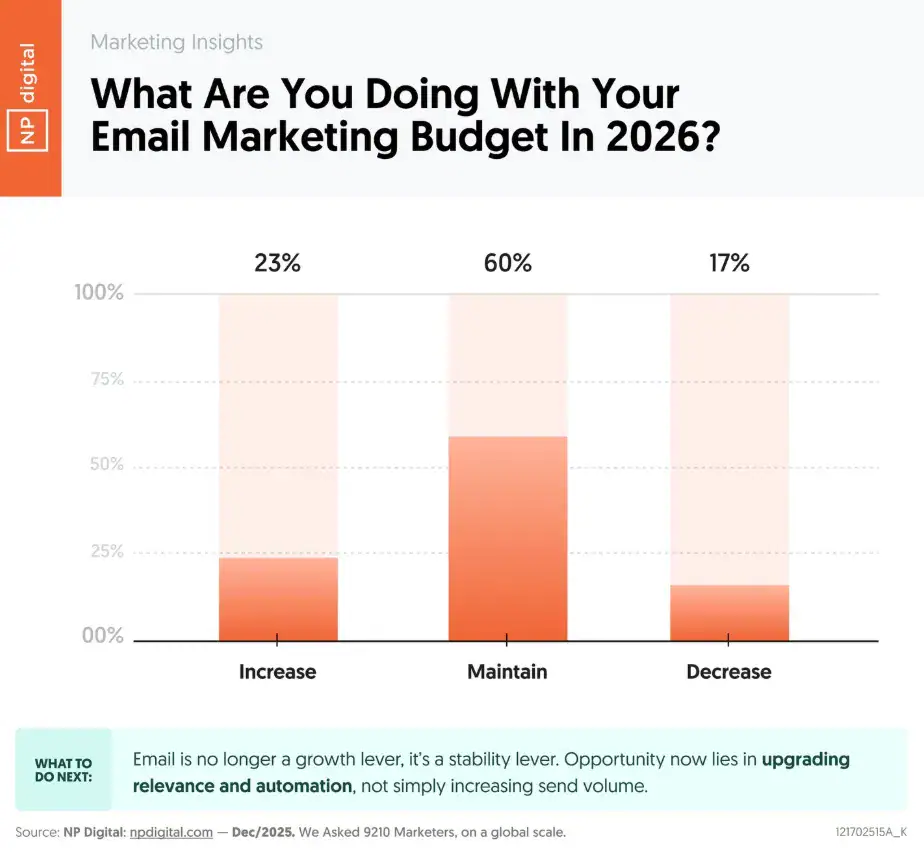
- 60% of marketers plan to maintain their email marketing budgets in 2026, showing a strong focus on stability and long-term performance.
- Around 23% of marketers intend to increase their email marketing spending, signaling continued confidence in email ROI.
- Only 17% of marketers expect to decrease their email marketing budgets in 2026.
- The data suggests that most brands view email marketing as a stable and reliable channel rather than a high-growth investment area.
- Marketers are shifting priorities toward automation, personalization, and relevance instead of simply increasing email volume.
- The survey was conducted among 9,210 marketers globally in December 2025, highlighting broad industry sentiment entering 2026.
- The findings indicate that businesses are focusing more on efficiency and smarter engagement strategies in email marketing campaigns.
How Often Marketers Send Emails
- About 36.3% of businesses send between 1 and 3 email campaigns per month, favoring lighter-touch cadences.
- Roughly 29.5% of businesses send emails every week as their primary outreach rhythm.
- Around 12.2% of businesses send two email campaigns per week, representing a moderate frequency.
- Approximately 10.8% of businesses send marketing emails every day, using a high-intensity cadence.
- Median B2B send frequency sits at 4.2 emails per month to each contact on the list.
- Median B2C send frequency reaches 8.3 emails per month per subscriber, reflecting more aggressive outreach.
- Retail and B2C brands often send 8–12 emails monthly, while B2B and services typically send 2–6 per month.

Business Email vs. Consumer Email Metrics
- Globally, an estimated 376.4 billion emails are sent and received per day in 2025, with around 45% classified as spam.
- The average professional now deals with about 121 business emails per day, spending roughly 2.5 hours managing their inbox.
- Around 28% of the workweek is spent on email, equating to about 13 hours per week for the average knowledge worker.
- Apple Mail and Gmail together account for nearly 69% of tracked email client market share, while Outlook holds about 5.7%.
- Gmail counts about 1.8 billion active users, while Outlook has roughly 400 million, and Yahoo Mail has around 225 million users.
- Gmail represents just over 50% of users across the major free email providers, underscoring its dominance in consumer email.
- Business-focused users typically handle about 40 sent business emails per day on average.
How Companies Use Email Marketing
- 55% of companies use email primarily for marketing and promotional campaigns, making it the most common email strategy.
- Around 46% of businesses rely on newsletters to maintain audience engagement and share updates regularly.
- Nearly 44% of companies use lifecycle or onboarding emails to nurture leads and improve customer retention.
- About 39% of organizations send action-triggered transactional emails, such as confirmations and account notifications.
- Approximately 24% of businesses use re-engagement emails to reconnect with inactive subscribers and customers.
- Around 19% of companies deploy date-triggered emails, including birthday greetings and appointment reminders.
- Roughly 17% of brands use operations-triggered emails for updates like shipping confirmations and restock alerts.
- Only 3% of companies currently use machine-triggered emails, such as sensor activation or low-battery notifications.
- The data highlights that companies prioritize customer engagement, automation, and retention through diverse email marketing strategies.

Mobile vs. Desktop Email Engagement
- In some benchmarks, mobile devices account for about 62% of all email opens, compared to 27% on desktop and 11% via webmail.
- Mobile-responsive emails can drive up to a 15% increase in mobile clicks compared with non-optimized designs.
- Roughly 56% of marketers say they actively prioritize mobile-friendly design in their email strategy.
- Around 59% of Millennials primarily use their cellphone to check email, underscoring mobile’s dominance for younger users.
- Dark mode is now enabled by more than 25% of email users across major clients, influencing design and contrast choices.
- Businesses see an average email CTR in the 2%–5% range, with content-rich and mobile-optimized layouts at the higher end of that band.
Spam and Unwanted Email Statistics
- Roughly 45% of the 376.4 billion emails sent daily are classified as spam, equating to about 169–171 billion spam messages every day.
- Global estimates suggest each person receives around 21 spam emails per day on average.
- Spam costs businesses approximately $20.5 billion per year in lost productivity and related impacts.
- The average employee loses about 2 days of work annually dealing with spam, translating to around $1,934 in wasted productivity per worker.
- About 52% of organizations rank spam reduction as their number one email-related priority.
- Nearly 96% of phishing attacks are delivered via email, underscoring its role as the primary phishing vector.
- Business Email Compromise incidents now average losses of about $137,000 per successful attack.
First Online Check of the Day: Email vs. Social Media
- Around 58% of internet users say checking email is the first thing they do online each day.
- Roughly 20% start their online session by using a search engine.
- About 14% of users open social media platforms before any other online activity.
- Approximately 5% of people begin their day by visiting online news sites.
- Close to 3% report that their first stop online is a company intranet or internal portal.

Personalization and Automation in Email Campaigns
- About 80% of consumers are more likely to purchase from brands that offer personalized experiences.
- Personalized emails generate roughly 122% higher ROI than non-personalized campaigns.
- Emails with personalized content see around 6x higher transaction rates than generic emails.
- Personalized emails achieve about 29% higher open rates and 41% higher click-through rates than non-personalized sends.
- Segmented email campaigns drive roughly 30% more opens and 50% more clicks than non-segmented blasts.
- Automated and behavior-triggered emails generate about 320% more revenue than standard non-automated campaigns.
- Around 76% of businesses already use marketing automation platforms, with 96% of marketers having used or planning to use automation.
Consumer Sentiment on AI-Generated Email Content
- About 61% of consumers are neutral toward brands using AI-generated marketing content, while 32% say it makes them trust brands less, and 7% say it makes them trust brands more.
Average Email Open Rates by Industry
- Media and publishing brands record average open rates near 43.16%.
- Non-profit organizations achieve strong engagement with open rates of around 42.68%.
- Healthcare emails see average open rates of about 41.48%, reflecting high relevance.
- Travel and hospitality campaigns enjoy open rates around 40.87%.
- Online training and education emails average roughly 39.06% open rates.
- Accounting and financial services emails see open rates of about 37.74%, still above broad industry baselines.

Email Deliverability and Bounce Rates
- The average global email deliverability rate for bulk and marketing messages sits around 83%–85%, with 95%–99% considered strong performance.
- Cross-industry email bounce rates average about 1.2%, while top-performing, well-maintained lists keep bounce rates near 0.3%.
- Real-time verification and regular list cleaning can reduce bounce rates to roughly 0.3% and lift inbox placement to about 95%.
- Poorly maintained lists can see bounce rates climb above 6.5%, losing nearly 33% of emails to spam or blocking.
- In some benchmark datasets, delivery rates as high as 99.4% are reported, with a combined bounce rate of just 0.06% for top senders.
- Non-profit senders can achieve inbox placement rates up to 93%, while sectors like real estate may average closer to 79%.
- Average inbox placement for ecommerce brands is about 75.6%, meaning roughly 1 in 4 marketing emails never reach the inbox.
- Teams that track deliverability metrics weekly are better positioned to catch issues early, helping maintain rates above 92%–95%.
Key Elements of Effective Abandoned Cart Emails
- Up to 45% of abandoned cart emails are opened, with well-crafted subject lines playing a major role in recovery performance.
- Sending the first reminder email within 1–2 hours of abandonment can boost conversion rates by up to 20%.
- A 2–3 email sequence sent within 72 hours of abandonment recovers on average 5%–15% of otherwise lost carts.
- Including urgency or scarcity messaging in follow-up emails can lift click-through rates by around 19%.
- Featuring clear product images and a prominent CTA helps abandoned cart emails reach conversion rates of around 6.33% in some benchmarks.
- Adding incentives in later emails (such as discounts or free shipping) commonly increases overall recovery rates toward the upper end of the 5%–15% range.
Impact of AI and Machine Learning on Email Strategies
- Around 87% of marketing teams now use AI for email, but only 6% qualify as high performers based on workflow maturity.
- Over 80% of marketers report using AI for content creation, including email copy.
- Roughly 49% of email marketers use AI tools to help create content such as subject lines and body copy.
- About 66% of marketers who use AI apply it specifically for email personalization, lifting open and click rates.
- Companies using AI in marketing programs see 10%–20% higher overall ROI, driven in part by smarter email orchestration.
- Brands that pair AI-generated subject lines with ongoing optimization report a compounding improvement rate of about 3.1% per quarter.
- AI-driven email marketing is now cited as the top trend, with automated campaigns demonstrating dramatically higher conversion potential than traditional sends.
Frequently Asked Questions (FAQs)
Around 376.4 billion emails are sent and received each day globally in 2025, rising to about 392.5 billion by 2027.
Approximately 4.7 billion people use email globally in 2026, with users projected to reach about 4.9 billion by 2028.
Average email open rates across industries generally fall in the 22%–27% range, with many benchmarks clustering around 25%–35% for well-optimized programs.
Email marketing delivers an average ROI of about $36–$40 for every $1 spent, or roughly 3,600%–4,000%, outperforming most other digital channels.
Roughly 45% of global email volume is classified as spam, equating to about 170 billion spam messages per day.
Conclusion
Email has evolved beyond its early days as a basic communication tool; it’s now an intelligent, personalized, and data-driven engine that fuels engagement across industries. The line between email marketing and AI-driven customer experience continues to blur. Whether you’re a marketer optimizing open rates or a tech leader driving compliance, understanding the latest email statistics isn’t optional; it’s essential.
From higher ROI metrics to the rise of AI and automation, email is not just holding strong; it’s innovating fast. The smart brands of tomorrow are already embracing these shifts. Are you?