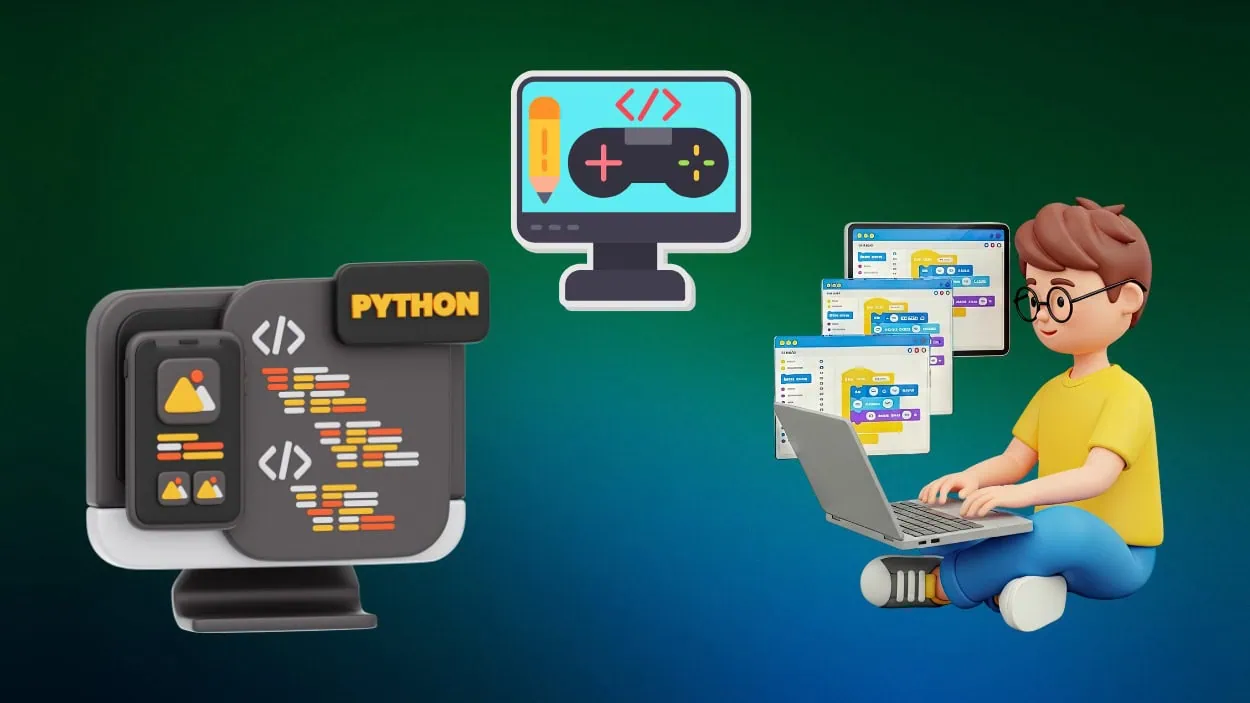


A child’s first experience of programming can shape how they think about coding for years. Present it as a wall of technical terms and punctuation, and many will decide it is not for them. Give them a clear challenge, an interesting character and the freedom to experiment, and the same subject can feel more like solving a mystery than completing a lesson.
That is one reason Python works well as an introduction to text-based coding. Its commands are relatively easy to read, children can see the results of their instructions quickly, and simple programs do not require pages of complicated setup.
Python is not the only language a young learner could begin with. Visual block coding can be more suitable for younger children, while another language may make sense for a specific project. However, for children ready to move from dragging blocks to writing actual commands, Python offers a manageable next step.
What Makes Python Approachable for Beginners?
Programming languages are written for computers to interpret, but they also need to be understood by people. Some languages place a large amount of punctuation and structure around even a basic instruction. Python generally keeps simple tasks comparatively uncluttered.
Consider a child who wants a game character to say hello. In Python, the command can look close to an ordinary instruction:
print(“Hello”)
A beginner can make a reasonable guess about what that line will do. The word print describes the action, while the message appears clearly inside brackets and quotation marks.
Of course, Python becomes more complex as projects grow. Children will still encounter unfamiliar concepts, syntax rules, and frustrating errors. Its advantage is not that everything is effortless. It is that the first few steps can feel understandable.
This matters because early progress builds confidence. When a child can read a line, predict its effect and test it immediately, coding begins to feel less mysterious.
Python Helps Children Focus on the Logic
Beginners already have plenty to think about. They need to understand the aim of the task, decide which instructions are required and place those instructions in the correct order. If the language adds too much visual clutter, children may spend more time fighting the format than thinking about the problem.
Python allows many introductory exercises to remain focused on logic:
- What should happen first?
- Which instruction needs to repeat?
- What information should the program remember?
- How should it respond when a condition changes?
- Why did the result differ from the plan?
These questions are at the heart of programming. They are also useful outside computing because they encourage children to break large problems into smaller parts.
A child debugging a short sequence is learning more than how to correct code. They are practising how to inspect a failed attempt, identify a likely cause, and change one element before testing again.
Why Games Make the First Lessons Easier
Starting with an empty coding window can be intimidating. Even adults struggle when told to create anything they want without a clear brief. Games solve that problem by providing context.
Instead of asking a child to practise loops for no obvious reason, a game might require them to repeat an action until a character reaches an object. Rather than introducing conditions through a definition, it can ask the program to behave differently when an obstacle appears.
Parents looking for a more structured way to help a child learn Python for kids can use game-based challenges to connect each new command with an immediate objective. The code is not presented as something to memorise in isolation. It becomes the tool the child needs to move the story forward.
That distinction is important. Children may not be excited by the idea of studying variables, but they may be interested in storing a score, tracking an item or helping a character complete a mission. The game gives the concept a purpose.
Games Provide Immediate and Useful Feedback
Traditional learning often separates action from feedback. A child completes an exercise, hands it to an adult and waits to discover whether it was correct. Coding is more immediate.
The child writes an instruction, runs the program, and watches what happens. If the character moves left instead of right, the result offers a clue. If nothing happens, the program may contain a missing command or a typing error.
This feedback does not always reveal the answer, but it gives the learner something concrete to investigate.
That process can make mistakes feel less personal. The computer is not saying the child is bad at coding. It is simply showing that the current set of instructions produces a particular result.
The next question becomes, “What should I change?”

Start at the Right Stage
Python may be readable, but that does not mean every child should begin with it immediately.
Young learners who are still developing reading, spelling, and keyboard confidence may benefit more from visual coding. Block-based systems let them explore sequences, repetition and events without worrying about misplaced punctuation.
Text-based Python becomes more useful when a child can:
- Read short instructions independently
- Type simple words with reasonable confidence
- Follow a sequence of several steps
- Cope with small mistakes without immediately giving up
- Explain what they expected a program to do
Age can offer a rough guide, but readiness matters more. One child may be eager to type commands earlier, while another may prefer visual projects for longer.
Moving to Python should feel like an interesting progression, not a test of whether the child is advanced enough.
Keep the First Sessions Short
Parents sometimes damage a promising new interest by becoming too enthusiastic.
A child enjoys ten minutes of coding, so the adult signs them up for a lengthy course, plans a weekly timetable and starts discussing future careers in technology. What felt playful suddenly becomes another obligation. A better first session has a narrow aim.
Let the child solve a few challenges or experiment with one idea. End while they are still interested rather than waiting until concentration disappears.
Twenty focused minutes can be more useful than an hour of guessing, complaining and clicking through hints.
Short sessions also make it easier to return regularly. Coding skills develop through repeated practice, not one exhausting afternoon.
Do Not Rush to Fix Every Error
Watching a child struggle can be uncomfortable, especially when the solution appears obvious.
You may see a misspelt command or an instruction in the wrong place and want to point it out immediately. Doing so will finish the task faster, but it may remove the most valuable part of the activity.
Give the child time to inspect the result.
Useful questions include:
- “What did you expect to happen?”
- “Which part worked correctly?”
- “Where did the result start to go wrong?”
- “What is one thing you could change?”
These prompts keep ownership of the problem with the learner. They direct attention without turning the parent into a human answer button.
There is still a point at which support becomes necessary. Productive frustration can encourage persistence, while prolonged confusion simply drains motivation. Offer a small hint when needed, then hand the problem back.
Teach One Concept at a Time
Coding terms can pile up quickly. Variables, loops, functions, conditions, and Boolean values may all be important, but introducing them together makes the subject harder than necessary.
Begin with simple sequences. Let the child see that instructions run in a particular order.
Then introduce repetition. A loop becomes meaningful when the same action would otherwise need to be typed several times.
Conditions can follow once the child understands that a program may need to make a decision:
- If the path is clear, move forward.
- If an obstacle appears, turn.
- If the score reaches a target, finish the level.
Each new idea should solve a problem the child has already encountered. This gives the concept a reason to exist.
Move From Guided Games to Small Projects
Structured games are useful because they remove the fear of the blank page. Eventually, however, children need opportunities to make their own choices.
The first independent project should be small. A child could create:
- A number guessing game
- A short interactive quiz
- A programme that tells a simple joke
- A basic score counter
- A text adventure with two possible routes
- A random name generator for fictional characters
These projects are modest enough to finish, but open enough to allow personal decisions.
Completion matters at this stage. An enormous game idea may sound exciting, but it can collapse under its own complexity. A tiny working project gives a child something they can demonstrate, improve, and feel proud of.
Connect Python to a Child’s Existing Interests
Coding becomes more engaging when it supports something the child already enjoys.
A football fan might create a score tracker. A keen reader could build a quiz about a favourite story. A child interested in animals might write a programme that selects random facts or names a fictional creature.
The project does not need to be impressive. Its purpose is to show that Python is not simply a school subject. It is a way to make ideas behave.
Personal interests also give children a reason to solve problems. Fixing a loop feels more worthwhile when it improves their own game rather than completing an arbitrary worksheet.
Treat Debugging as Part of the Activity
Children often assume successful programmers write correct code on the first attempt. When their own program fails, they may interpret the error as evidence that they lack ability. Parents should challenge that assumption early.
Errors are normal because code must be precise. A program can fail because of a misspelt word, incorrect spacing, a missing bracket, or a mistake in the underlying logic.
Encourage children to check problems systematically:
- Read the error message.
- Look at the most recent change.
- Check spelling and punctuation.
- Compare the code with a working example.
- Change one thing and test again.
This turns debugging into a method rather than a guessing game. It also teaches patience. The child learns that frustration is a signal to slow down and inspect the problem, not proof that the task is impossible.
Avoid Measuring Progress by Speed
Some children race through challenges but struggle to explain what they did. Others spend longer on each problem and develop a stronger understanding. Level completion is therefore a poor measure on its own.
Ask your child to predict what a command will do before running it. Invite them to explain why their solution works. Change one detail and ask what they expect to happen.
These conversations reveal whether the child is thinking or simply repeating patterns.
Praise the process you want them to continue:
- “You noticed the repeated steps.”
- “You tested one change instead of starting over.”
- “You explained your idea clearly.”
- “You stayed with the problem even when the first attempt failed.”
This feedback reinforces useful habits rather than speed or the vague idea of being naturally talented.
Keep Coding in a Balanced Routine
Python can support logical thinking, creativity and digital confidence, but it is not the only activity children need.
They still benefit from reading, sport, imaginative play, music, crafts, conversations and practical responsibilities around the home. Coding should add another form of exploration rather than replace the rest of childhood.
A game-based Python session can fit comfortably into a broader routine. A child might code for half an hour, play outside, and later sketch ideas for a character or game level on paper.
The screen is then part of a creative process, not the entire experience.
The Right First Step Is a Small One
Parents do not need a programming background to introduce Python at home. They need an age-appropriate starting point, enough patience to let a child make mistakes, and the judgement to stop before the activity becomes a chore.
Games can make that beginning easier by giving commands a visible purpose. The child writes code because a problem needs solving, not because an adult has told them syntax is important.
From there, progress can remain gradual. One challenge becomes a sequence of challenges. A guided level leads to a tiny independent project. An error that once caused frustration becomes something the child knows how to investigate.
That is a more useful outcome than racing towards advanced code. The real foundation is the confidence to look at a problem, test an idea, and keep working when the first attempt does not succeed.