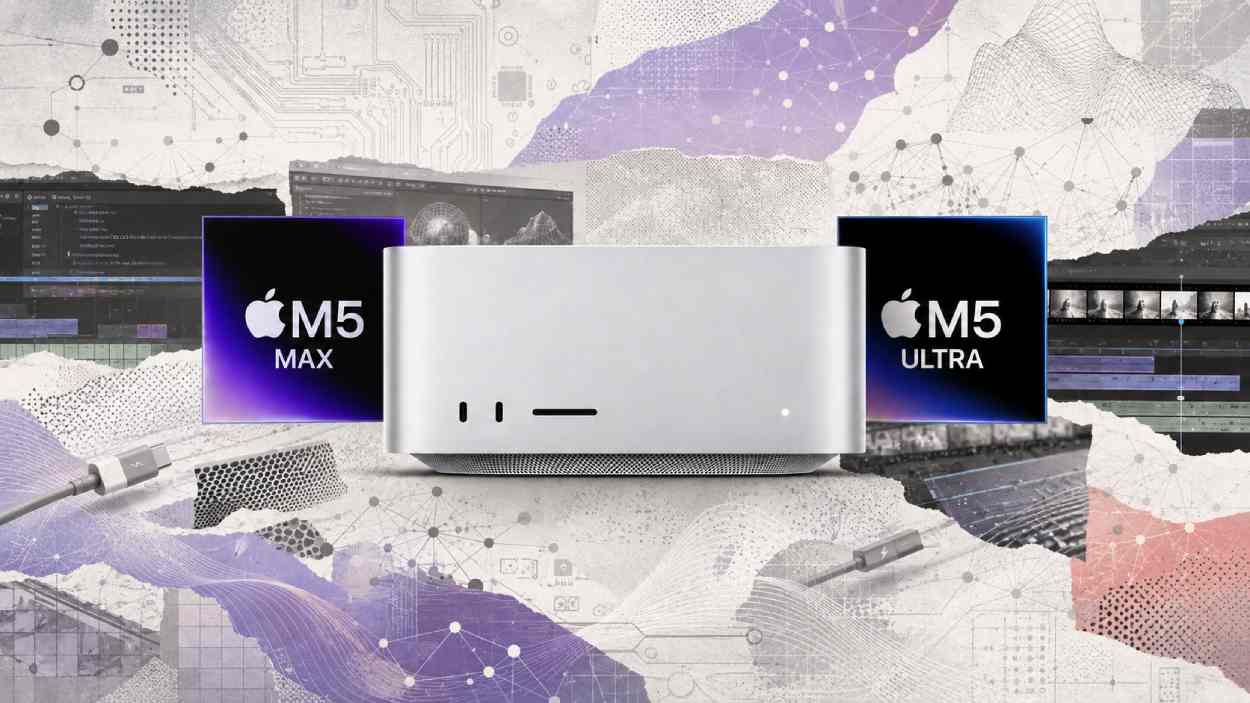






Apple announced a new Mac Studio on August 25, 2026, with an M5 Ultra configuration that holds up to 512GB of unified memory. That ceiling decides whether a frontier-class open-weight model loads on the machine at all.
The Big Picture
- Mac Studio with M5 Ultra scales to a 36-core CPU, an 80-core GPU and 512GB of unified memory.
- Apple starts the M5 Max model at $2,499 and the M5 Ultra model at $5,499, with shipping from September 22.
- Thunderbolt 5 and RDMA let four Mac Studio units share one memory pool for up to 3x faster inference.
- Apple ran every performance test itself in July 2026, and no independent benchmarks exist yet.
- Wi-Fi 7 and Bluetooth 6 reach Mac Studio for the first time through Apple’s N1 wireless chip.
Apple puts a frontier-model memory pool on a desk
The M5 Ultra configuration tops out at 512GB of unified memory running at 1.2TB/s, a bandwidth figure Apple puts 50% above the prior generation. That memory is shared across the CPU, GPU and Neural Engine, so a model’s weights sit in a single address space instead of sharding across discrete cards. The M5 Max stops at 128GB and 614GB/s.
Johny Srouji, Apple’s chief hardware officer, said in the company’s announcement that the machine delivers “huge performance gains for pro workloads and AI inference with frontier-class models.” Apple’s own testing puts M5 Ultra at up to 4.3x the peak AI compute of M3 Ultra and 9.8x that of M1 Ultra, with LM Studio prompt processing at up to 4x M3 Ultra.
Apple names no competing part anywhere in the release, though the 512GB figure invites the comparison against the discrete-GPU systems that dominate current AI chip market. Those systems reach comparable accelerator memory by stacking cards, which forces the model to be split before it runs.
M5 Ultra has also landed
— Marques Brownlee (@MKBHD) August 25, 2026
– Up to 36-core CPU
– Up to 80-core GPU
– 1.2TB/s for unified memory
(A fully specced-out M5 Ultra Mac Studio with 16TB storage and 256GB of memory now costs $18,299)https://t.co/h2XOgf5P82
Four boxes, one memory pool
Apple built cluster support into the hardware. Thunderbolt 5 now carries RDMA (remote direct memory access, which lets one system read another’s memory without routing through its CPU), creating a shared pool across linked units. A cluster of four Mac Studio systems delivers up to 3x faster AI inference than a single system, by Apple’s measurement.
Four machines returning 3x is sublinear, and the release publishes no scaling curve beyond four units and no indication of which model sizes the figure covers. The port layout supports up to six Thunderbolt 5 connections at 120Gb/s each, and storage moves to a PCIe Gen 6 architecture rated at up to 2x the previous read and write speeds.
What the benchmarks measure, and what they leave out?
The LM Studio figures describe prompt processing, the prefill stage where a model reads its input before generating anything. Sustained token generation appears nowhere in the release. That gap matters because prefill loads the compute units hard and generation leans on memory bandwidth, so the two scale differently on the same silicon.
Four things go unstated in Apple’s release:
- Which memory configuration each published benchmark actually ran on?
- What quantization the LM Studio prompt-processing tests used?
- How cluster performance scales beyond four units?
- Whether every memory tier ships on the same date as the base configurations?
Apple frames on-device inference as running with “complete privacy” and without “counting tokens or worrying about rising cloud costs,” and publishes no cost comparison against the hosted alternatives tracked in cloud computing statistics. Anyone already running local models on an M3 Ultra or M4 Max should size their workload before configuring an order, because 512GB and 128GB are ceilings for their respective chips and Apple does not state what memory the starting prices include.

SQ Magazine’s Takeaway
The memory ceiling is the product here. A 4.3x compute multiplier does nothing for a model whose weights will not fit, and holding that much in one address space is what puts the largest open-weight releases inside reach of a single desktop rather than a rack. Clustering extends the same logic outward, though the four-unit result points at the interconnect as the next limit.
Buyers who want independent numbers will have to wait for third-party testing between the pre-order opening and the September 22 ship date, since the only figures on record are Apple’s own July results. Developers should watch Core AI, the framework Apple introduced alongside the machine, because deployment tooling decides how much of that memory an application can address in practice.