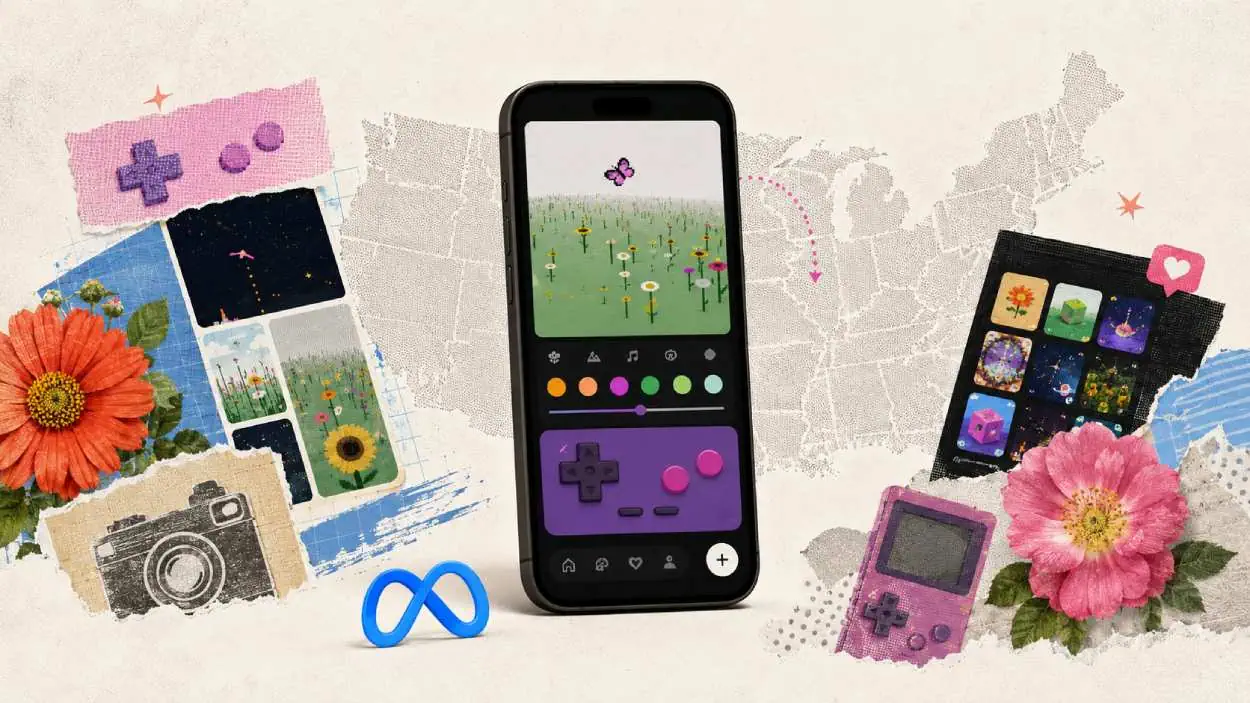






Meta opened Pocket, its AI game-making app, to all users in the United States on August 20, 2026, after testing it only in Brazil. People type a text prompt and get back a small playable game that posts to a public feed.
The Big Picture
- Meta made Pocket available across the United States on August 20, 2026, under two months after its Brazil-only test began.
- Pocket users write text prompts and get small games called gizmos, which publish to a scrollable feed.
- Gizmos react to taps and phone tilt, play sound effects, and can pull photos from a user’s camera roll.
- Meta built the app around the team behind Gizmo, a vibe-coding game platform whose engineers it hired earlier this year.
- Mark Zuckerberg told analysts on Meta’s most recent earnings call that AI-assisted development is making new apps faster to ship.
Meta opens Pocket to every US user
Meta is distributing Pocket nationally through its listing on Apple’s App Store, lifting the country restriction that had kept the app inside Brazil during its test run. The app takes a written prompt and returns a working mini-game, which Meta calls a gizmo.
Gizmos respond to screen taps and to the tilt of a phone, play sound effects, and can include clips of songs. They can also read photos from a camera roll or open the camera directly.
Creators publish gizmos to the Pocket feed or to their own profile, where other users save them, remix them, or repost them. The remix loop is the social layer: one gizmo becomes raw material for the next.
Big update from us on Meta AI – this time focused on small businesses.
— Prashant Ratanchandani (@pratanchandani) August 19, 2026
It can now plug into your FB/IG analytics, Ads, + Google Workspace to audit campaigns, benchmark vs similar brands, and tell you what’s actually working.
And there’s a new native Mac app — you can share any…
From acqui-hire to shipped app in one year
Pocket traces back to Gizmo, a platform for vibe-coded mini apps whose founding engineers Meta hired earlier this year. Those engineers, who came from Snapchat, joined Meta Superintelligence Labs, and the product they built inside Meta kept the vocabulary they arrived with. Creations are still called gizmos.
That compression is the point. Meta absorbed an outside team and shipped its idea as a national consumer app inside the same calendar year.
Pocket now sits beside Meta’s other generative experiments, including image creation in the Meta AI app, the AI video app Vibes, and Meta’s AI tools for building game environments in Horizon.
Meta’s shipping rate is the real story
“Earlier this year, we shipped Instagram Instants. We also just launched Forum, a stand-alone Groups app, and Seller, a stand-alone Marketplace app. I expect it to become a lot easier to ship new apps,” Zuckerberg told analysts on the July earnings call, adding that Meta plans “to build out more ideas and use our recommendation systems to scale them.”
Zuckerberg credits AI-assisted software development for that pace. Alongside the three apps he named, Meta has run an AI bedtime stories experiment and put out a Meta AI app for Mac this week.
Rival tools are moving onto phones too, a shift visible in AI app builders arriving on iOS and Android. What separates Meta is distribution: a new app can be seeded to an audience that already exists.

What Meta has not spelled out?
Meta’s public description of Pocket covers what a gizmo can do. It says much less about what happens around the edges. Five questions sit unanswered:
- How many people built gizmos in Brazil, and how many came back the following week?
- What happens to a photo or camera frame after a gizmo uses it, and whether Meta retains it or trains on it?
- How Meta moderates a feed where every item is freshly generated code?
- Whether the song clips a gizmo can include are licensed, and what happens to gizmos that fall outside those terms?
- What a creator receives when someone else remixes their work?
The available material establishes that gizmos can request camera roll and camera access. It does not establish how long that data lives or where it travels once a gizmo finishes running.
Anyone who already installed Pocket can open iOS Settings, check the photo and camera permissions it holds, and switch full library access to selected photos. Narrowing those permissions helps reduce exposure while Meta’s data handling stays undocumented.
Why It Matters?
The real claim inside Pocket is about Meta’s own engineering. Zuckerberg’s argument is that AI coding tools have dropped the cost of launching a standalone app far enough that Meta can treat launches as cheap experiments and let its ranking systems decide which ones survive. Pocket carries the most exposure of those experiments, because it hands generated code straight to a public feed.
What comes next depends on that feed. Meta has said it will use recommendation systems to scale the ideas that work, so Pocket’s retention, which Meta has not published, will decide whether the app grows or gets folded into something bigger. Watch for a clearer statement on camera roll handling and on how gizmos get reviewed before they reach other users. Meta’s AI adoption numbers show how fast scale arrives once ranking gets involved, which makes the moderation question the one to keep asking.