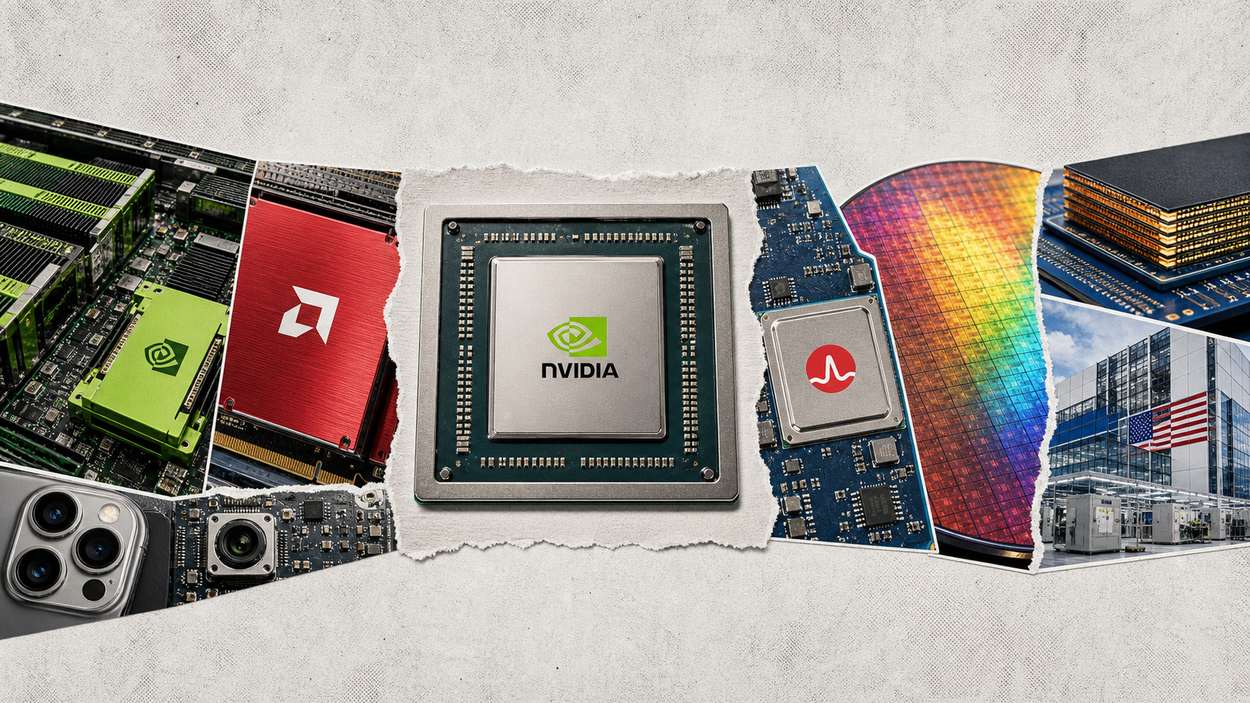






NVIDIA reported record Data Center revenue of $75.2 billion in the first quarter of fiscal 2027, up 92% year-over-year. Broadcom’s Q2 fiscal 2026 AI semiconductor line matched the same trajectory at $10.8 billion, up 143% year-over-year. AMD’s Q2 2026 Data Center segment reached $6.7 billion, up 107% year-over-year from $3.2 billion a year earlier. This brief tracks the vendor disclosures, foundry mix, memory supply, and public funding that together set how much AI silicon reaches the market, with each figure carried from the document that published it.
Every figure below traces to a primary issuer filing, an SIA release, or a CHIPS Program Office disclosure. Each vendor reports on its own fiscal calendar, so the three headline numbers are separate disclosures, not one comparable quarter.
Key Takeaways
- NVIDIA’s Q1 fiscal 2027 total revenue reached a record $81.6 billion, up 85% year-over-year and 20% sequentially, per the company’s May 20, 2026 release.
- Data Center revenue hit $75.2 billion, up 92% year-over-year, with Data Center networking at a record $14.8 billion (up 199%).
- AMD’s Q2 2026 Data Center segment revenue of $6.7 billion grew 107% year-over-year and represented 58% of company revenue, up from prior-year Data Center segment revenue of $3.2 billion.
- Broadcom’s Q2 fiscal 2026 AI semiconductor revenue reached $10.8 billion, up 143% year-over-year, with a $30 billion AI-bookings backlog.
- Global semiconductor sales hit $791.7 billion in 2025, an increase of 25.6% compared with 2024, per the Semiconductor Industry Association’s February 6, 2026 release.
- TSMC Q1 2026 US-dollar revenue reached $35.90 billion, up 40.6% year-over-year, with advanced technologies at 74% of total wafer revenue.
- Intel’s CHIPS Act agreement covers up to $7.86 billion in direct funding for its commercial semiconductor manufacturing projects in Arizona, New Mexico, Ohio and Oregon.
Editor’s Choice
- The global semiconductor industry is projected to reach roughly $1 trillion in worldwide annual sales in 2026, per SIA forecasts.
- NVIDIA’s Q2 fiscal 2027 revenue guidance is $91.0 billion, plus or minus 2%, and the outlook explicitly assumes zero Data Center compute revenue from China.
- Broadcom’s Q3 fiscal 2026 AI semiconductor revenue guidance is $16.0 billion, up over 200% year-over-year.
- Broadcom expects to achieve full-year 2026 AI semiconductor revenue of $56 billion, up approximately 180% from fiscal 2025.
- NVIDIA on May 18, 2026, authorised an additional $80.0 billion share repurchase and raised the quarterly cash dividend from $0.01 to $0.25 per share.
- The Broadcom AI backlog stands above $30 billion in bookings against $10.8 billion shipped in Q2 FY26, a book-to-bill ratio well above 2:1.
AI Chip Market Size and Revenue
- Global semiconductor sales totalled $791.7 billion in 2025, up 25.6% from $630.5 billion in 2024, setting an annual record.
- Annual sales are projected to reach roughly $1 trillion worldwide in 2026, per SIA forecasts.
- Logic chips, the category that contains AI accelerators, grew 39.9% in 2025 to $301.9 billion, making them the largest semiconductor product category by sales.
- Memory products increased 34.8% to $223.1 billion in 2025.
- Fourth-quarter 2025 sales alone reached $236.6 billion, 37.1% above Q4 2024 and 13.6% higher than Q3 2025.
- Regional sales were up 45.0% in Asia Pacific All Others in 2025, the fastest of the five regions SIA reports.
- Sales in the Americas were up 30.5% over the same year.
- The three vendor lines above are not additive, because each covers a different fiscal quarter.
- Logic outgrowing the wider industry in 2025 points to AI accelerators taking most of the incremental spend, and the 2026 issuer tape carries the same pattern.
| Metric | 2024 (implied) | 2025 | YoY Change |
|---|---|---|---|
| Global semiconductor sales | $630.5 billion | $791.7 billion | +25.6% |
| Logic chips | ~$216 billion | $301.9 billion | +39.9% |
| Memory products | ~$165 billion | $223.1 billion | +34.8% |
| Q4 stand-alone sales | ~$172.6 billion | $236.6 billion | +37.1% |
Source: Semiconductor Industry Association, February 6, 2026. SIA reports the prior-year industry total directly; the logic, memory, and quarterly cells in the implied column are each obtained by dividing the reported level by its stated growth rate, rather than being separately published.
NVIDIA’s Data Center Dominance
- NVIDIA’s Q1 fiscal 2027 total revenue was $81.6 billion, up 20% sequentially and 85% year-over-year.
- Data Center revenue reached a record $75.2 billion, up 21% sequentially and 92% year-over-year.
- Data Center compute revenue was $60.4 billion, up 77% year-over-year and 18% sequentially.
- Data Center networking revenue hit $14.8 billion, up 199% year-over-year and 35% sequentially.
- Edge Computing, the second of NVIDIA’s two new market platforms, posted $6.4 billion, up 29% year-over-year.
- GAAP gross margin was 74.9%, with non-GAAP at 75.0%, up from 60.5% GAAP in Q1 fiscal 2026.
- Q2 fiscal 2027 revenue guidance is $91.0 billion, plus or minus 2%, and NVIDIA is not assuming any Data Center compute revenue from China.
- The company also returned approximately $20.0 billion to shareholders through buybacks and dividends in the quarter. Workforce context relates to how many people work at NVIDIA.
- The Q1 FY27 disclosure adds a Data Center / Edge Computing framework with Hyperscale and ACIE sub-markets, the first material segment-reporting change since 2019.

Recent Developments
- August 10, 2026: NVIDIA partnered with Apollo, BlackRock, Blackstone, Brookfield, Goldman Sachs and KKR to establish AI compute infrastructure financing platforms to mobilise over $500 billion of third-party capital, the first securitisation-scale mechanism for AI compute.
- August 4, 2026: AMD reported Q2 2026 revenue of $11.5 billion, up 50% year-over-year, with Data Center at $6.7 billion and Data Center segment operating income of $2.1 billion.
- June 3, 2026: Broadcom announced Q2 fiscal 2026 AI semiconductor revenue of $10.8 billion, up 143% year-over-year, and guided Q3 AI semiconductor revenue to $16.0 billion.
- May 20, 2026: NVIDIA released Q1 fiscal 2027 results with $75.2 billion Data Center revenue and Q2 FY27 revenue guidance of $91.0 billion, plus or minus 2%.
- April 16, 2026: TSMC released Q1 2026 results showing US-dollar revenue of $35.90 billion, up 40.6% year-over-year, with a gross margin of 66.2%.
- February 6, 2026: The Semiconductor Industry Association reported Q4 2025 chip sales of $236.6 billion, 37.1% above Q4 2024, capping a record full year.
AMD’s Data Center Segment and Instinct GPU Ramp
| AMD Segment | Q2 2025 | Q2 2026 | YoY Change |
|---|---|---|---|
| Data Center revenue | $3.2 billion | $6.7 billion | +107% |
| Data Center operating income | -$0.155 billion | $2.1 billion | to positive |
| Data Center share of company revenue | n/a | 58% | n/a |
| Total company revenue | $7.7 billion | $11.5 billion | +50% |
Source: AMD Q2 2026 earnings release, August 4, 2026
- AMD’s Q2 2026 Data Center segment revenue was $6.7 billion, up 107% year-over-year, against prior-year Data Center segment revenue of $3.2 billion.
- Total Q2 2026 revenue reached a company record $11.5 billion, up 50% year-over-year.
- Data Center accounted for 58% of total company revenue in the quarter.
- Data Center segment operating income was $2.1 billion, against a prior-year Data Center segment operating loss of $155 million.
- Growth was driven by strong demand for AMD EPYC processors and AMD Instinct GPUs.
Why is AMD’s Data Center segment now the majority of revenue?
AMD’s Data Center segment revenue reached $6.7 billion in Q2 2026 and represented 58% of company revenue, growth the company attributes to demand for its EPYC processors and Instinct GPUs. The Q2 operating-income swing from a nine-figure loss to solid positive shows the ramp cleared its unit-economics inflection.
Broadcom Custom Silicon and Hyperscaler XPU Customers
- Broadcom Q2 fiscal 2026 AI semiconductor revenue was $10.8 billion, up 143% year-over-year.
- The whole semiconductor solutions segment, AI and non-AI product lines together, reached $15 billion, up 79% year-over-year.
- Total company revenue was $22.2 billion, up 48% year-over-year.
- Broadcom has six core custom-chip customers, among them Google, Anthropic, Meta and OpenAI, per the June 3, 2026 call.
- Networking represented almost 40% of Broadcom’s Q2 AI revenue.
- The company reported AI semiconductor bookings above $30 billion against $10.8 billion shipped, a ~2.8:1 book-to-bill ratio.
- Broadcom expects Q3 semiconductor revenue from AI to grow over 200% year-over-year to $16.0 billion.
- Full-year FY26 forecast is $56 billion in AI semiconductor revenue, up approximately 180% from fiscal 2025.
- Broadcom reiterated its AI semiconductor revenue guidance of in excess of $100 billion for fiscal year 2027.
- The $30 billion AI backlog against a $10.8 billion Q2 ship rate signals sold-out custom-silicon capacity well into fiscal 2027, with hyperscalers pre-buying against silicon that has not yet taped out.
TSMC Foundry Capacity and Advanced-Node Mix
- TSMC Q1 2026 US-dollar revenue was $35.90 billion, up 40.6% year-over-year.
- Local-currency revenue reached NT$1,134.10 billion, up 35.1% year-over-year.
- High-performance computing accounted for 61% of first-quarter revenue by platform, the largest share of the six platforms TSMC reports.
- Advanced nodes (7nm and below) made up 74% of wafer revenue.
- 3nm contributed 25% of wafer revenue, and 5nm contributed 36%.
- Gross margin rose to 66.2% in 1Q26 from 62.3% in 4Q25.
- 2026 capital expenditures are expected to be between $52 billion and $56 billion.
AI Compute Demand Visibility and Financing
- NVIDIA told shareholders in its fiscal 2026 annual report that it has visibility into more than $1 trillion in cumulative Blackwell and Rubin revenue from the start of 2025 through 2027.
- Since GTC DC in October 2025, the company has received additional purchase orders and further diversified its customer base.
- On August 10, 2026, NVIDIA partnered with Apollo, BlackRock, Blackstone, Brookfield, Goldman Sachs and KKR to mobilise over $500 billion of third-party capital for AI compute infrastructure financing platforms, the capital side of the same buildout driving enterprise generative AI adoption.
- Read the trillion-dollar line precisely: three years of cumulative revenue across two product generations, and management’s own visibility rather than a signed order book. The financing consortium is the more novel disclosure, underwriting AI compute the way lenders underwrite a power plant.
AI Chip Market Share by Vendor
- AMD’s Q2 2026 Data Center segment revenue of $6.7 billion represents the clearest revenue-side challenger.
- Broadcom’s $10.8 billion Q2 FY26 AI semiconductor revenue reflects custom silicon outside the merchant GPU market.
- Vendor share of the merchant AI accelerator market is absent from this table because no issuer publishes it.
- The hyperscaler push to custom ASICs (Google TPU, Amazon Trainium, Meta MTIA) sits outside the merchant-GPU share data, captured indirectly via Broadcom’s six core XPU customers.
- NVIDIA’s CUDA stack and priority TSMC CoWoS allocation are the durable moats. AMD’s inference price-performance and Broadcom’s custom-silicon margins are the pressure points, and nothing in the Q2 2026 tape suggests either has moved that lead yet.
Memory Supply as the Binding Constraint
- SK hynix reported for Q2 2026 that customer demand exceeds supply capabilities, and that delivering requested volumes on time has emerged as a core business competitiveness.
- The same release attributes the pressure to major tech companies increasing their AI infrastructure investments, with additional supply requests continuing to mount.
- SK hynix has finalised long-term agreements with around 10 customers, including key strategic partners, to secure mid-to-long-term supply stability.
- Micron’s own filing gives the wafer arithmetic behind the squeeze: HBM requires a higher number of wafers and more cleanroom space to produce the same number of bits as conventional DRAM in the same technology node.
- TSMC’s CEO stated in November 2025 that advanced-process demand was running roughly three times ahead of what the company could produce.
- Relief is dated rather than immediate: SK hynix is expanding production capacity following the opening of the Yongin Phase 1 cleanroom in early 2027.
- No memory maker publishes an HBM demand-growth rate or a year the gap closes, so this section carries neither. What they do state is the mechanism and the timing: HBM burns more wafers per bit, customers contract years ahead, and the new cleanrooms open in 2027.
Edge AI Chip Adoption in Smartphones and Consumer Devices
- Apple’s M4 chip carries a 16-core Neural Engine capable of up to 38 trillion operations per second, per Apple’s own launch disclosure.
- Google’s TPU v6 Trillium delivers up to a 3x increase in inference throughput versus TPU v5e.
- Trillium TPUs post a 67% increase in energy efficiency over TPU v5e.
- Cross-vendor TOPS tables rest on figures the vendors never publish on the same basis. Apple gives an absolute throughput number; Qualcomm only a percentage against its own previous part, so no ranking appears here. Handset adoption sits in iPhone statistics.
Automotive AI Chips and ADAS Compute
- The autonomous-driving chip market was estimated at $24.22 billion in 2024.
- 2025 market size is projected at $29.73 billion, growing to $191.07 billion by 2034, a 23% CAGR.
- NVIDIA’s DRIVE AGX Orin and DRIVE Thor platforms deliver up to 2,000 TOPS.
- Mobileye’s EyeQ chip series is deployed in over 100 million vehicles globally, a data advantage for AI training. Related edge-AI silicon patterns show up in Robotics deployments where the same architectures often carry over.
CHIPS Act Funding and Manufacturing Reshoring
| Manufacturer | CHIPS Act Award | Notes |
|---|---|---|
| Intel | up to $7.86 billion | Arizona, New Mexico, Ohio, Oregon |
| TSMC Arizona | up to $6.6 billion, plus up to $5 billion in loans | Phoenix, Arizona |
| Total announced (Aug 2026) | $36 billion+ | of the $52 billion the Act created |
Source: NIST CHIPS Program Office funding updates; Intel Newsroom, November 26, 2024; TSMC Form 20-F, April 16, 2026
- The CHIPS and Science Act created a $52 billion investment to revitalize America’s domestic semiconductor industry when it was signed into law on August 9, 2022.
- CHIPS for America has announced more than $36 billion in funding as of August 2026.
- Intel reached agreement on up to $7.86 billion in direct funding for commercial semiconductor manufacturing projects across Arizona, New Mexico, Ohio and Oregon.
- TSMC Arizona’s Phoenix projects were awarded up to $6.6 billion in direct funding under the US CHIPS Act, and are entitled to draw down up to a further $5 billion in government loans.
- The disclosed awards skew toward leading-edge logic fabs rather than the packaging and memory steps that actually gate accelerator output. HBM packaging draws less direct subsidy than its role would suggest.
Export Controls and Geopolitical Exposure
- On April 9, 2025, NVIDIA was informed by the U.S. government that a license is required for exports of its H20 products into the China market, per NVIDIA’s Q1 fiscal 2026 release.
- NVIDIA’s H20 charge was $4.5 billion for the first quarter of fiscal 2026.
- The Q1 FY27 disclosure notes H20 charges were insignificant for Q4 fiscal 2026 and none for Q1 fiscal 2027.
- NVIDIA’s Q2 fiscal 2027 outlook explicitly does not assume any Data Center compute revenue from China.
- Pricing zero China Data Center compute into Q2 FY27 guidance treats the H20 aftermath as a stable planning assumption rather than a one-off charge.
The takeaway: A single April 9, 2025 export-licensing requirement triggered a $4.5 billion NVIDIA inventory charge in Q1 FY26 and, by the Q1 FY27 disclosure, has hardened into an explicit zero-China assumption in guidance. One product line and one regulator moved a whole quarter’s disclosure.
Where do most AI chips come from?
Most cutting-edge AI accelerator silicon is fabricated in Taiwan by TSMC and packaged with HBM memory from South Korean and US suppliers. TSMC’s advanced nodes (7nm and below) accounted for 74% of Q1 2026 wafer revenue, with 3nm at 25% and 5nm at 36%. HBM memory, the second bottleneck, requires more wafers and more cleanroom space per bit than conventional DRAM at the same technology node.
By the numbers: Two supply lanes, TSMC advanced-node wafers and HBM DRAM allocation, sit above every AI accelerator sold today. Taiwan concentration on the logic side pairs with SK Hynix, Samsung and Micron concentration on the memory side, giving four foundry-and-memory decisions the pricing power over every downstream vendor above.
Conclusion
The Q1 fiscal 2027 and Q2 2026 tape captures the modern AI chip cycle: NVIDIA’s $75.2 billion Data Center revenue at 92% year-over-year growth, AMD’s $6.7 billion Data Center segment up 107%, and Broadcom’s $10.8 billion AI semiconductor revenue up 143%. Each figure covers that vendor’s own fiscal period and its own revenue scope, so they describe three separate disclosures rather than one comparable quarter. Those disclosures sit against a 2025 global semiconductor market of $791.7 billion that SIA projects will reach roughly $1 trillion in 2026.
NVIDIA’s Q2 FY27 zero-China guidance turns the H20 aftermath into a planning assumption. Broadcom’s $30 billion backlog signals sold-out custom-silicon capacity through fiscal 2027. The winners will secure HBM packaging and priority foundry allocation alongside the silicon design.