





According to CDC YRBS 2023 data, 77.0% of U.S. high school students reported frequent social media use; the same year, 39.7% of those students experienced persistent feelings of sadness and hopelessness. That pairing sits at the center of the modern debate about screens and minds.
The evidence connecting social media to mental health is broader, messier, and more interesting than a single number can capture. The data below covers the mechanisms researchers have isolated, the longitudinal studies linking use to depression (per JAMA Network Open), the platform-level differences (per Pew Research Center), the populations facing the greatest risk, and the practical steps endorsed by the American Psychological Association and the U.S. Surgeon General.
Key Takeaways
- Up to 95% of youth ages 13-17 use a social media platform, and nearly 40% of children ages 8-12 use one despite the typical minimum age of 13, per the U.S. Surgeon General.
- 77.0% of U.S. high school students report frequent social media use, according to CDC YRBS 2023 data.
- More than 1 in 10 adolescents (11%) showed signs of problematic social media behaviour in 2022 across 44 countries, per WHO Regional Office for Europe data published in 2024.
- A 3-year cohort of 11,876 children, according to JAMA Network Open, linked within-person increases in social media use to greater depressive symptoms 1 year later.
- A meta-analysis of 143 studies and 1,094,890 adolescents, per JAMA Pediatrics, found a significant correlation between time on social media and internalizing symptoms.
- The American Psychological Association warned in May 2023 that risks are likely greater in early adolescence (typically ages 10-14), the period of greatest biological and social transition.
How Social Media Affects Mental Health: The Core Mechanisms
The U.S. Surgeon General reported in May 2023 that up to 95% of youth ages 13-17 use a social media platform and concluded that we cannot conclude social media is sufficiently safe for children and adolescents. Researchers cluster the harm pathways into four mechanisms: social comparison, dopamine-style reinforcement, displaced sleep and movement, and high-volume exposure to harmful content.
Social comparison is the best-evidenced pathway for image-led platforms. According to the American Psychological Association’s May 2023 advisory, using social media for comparisons and feedback related to physical appearance is linked to poorer body image, disordered eating, and depressive symptoms, especially among girls. The mechanism is not the screen itself but the constant exposure to curated photos and metrics that invite upward comparison.
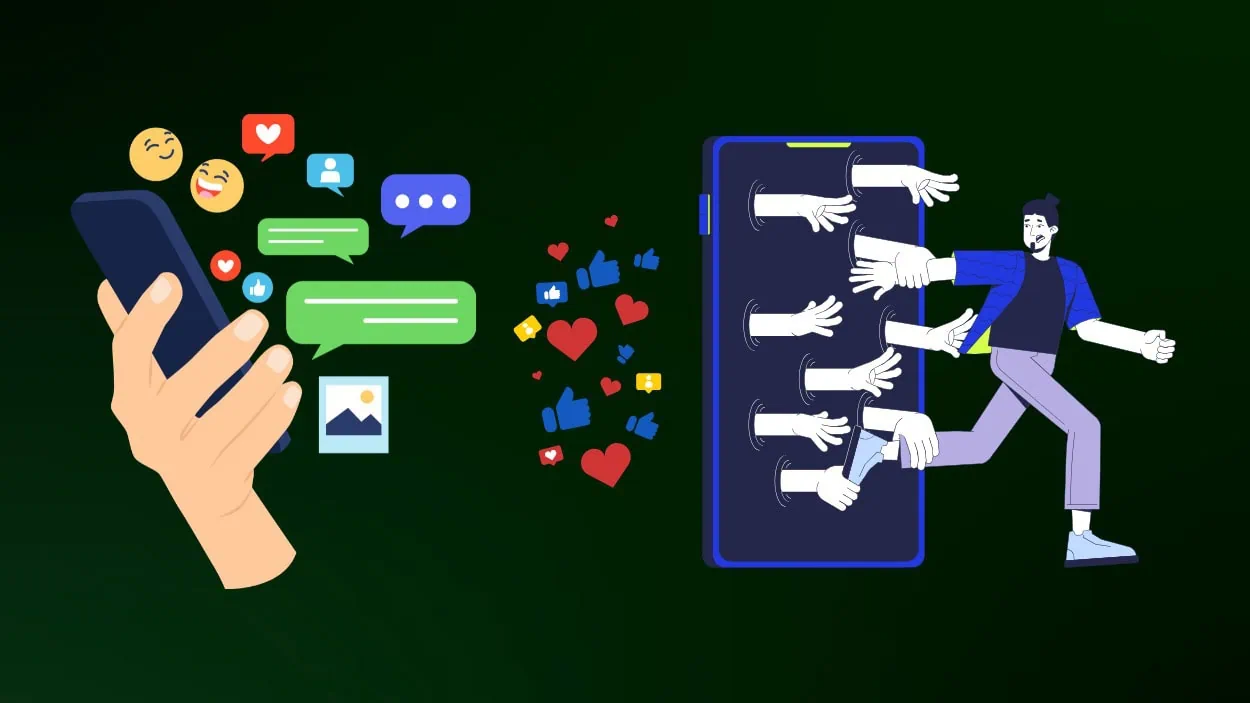
Dopamine-style reinforcement describes how variable rewards from likes and infinite-scroll feeds train compulsive checking. Displacement captures the time arithmetic: minutes scrolling at midnight are minutes not spent sleeping or moving. Exposure intensity describes the volume of distressing content a heavy user encounters daily.
For deeper context on user attention and engagement patterns, see our social media attention span data.
Key finding: The CDC’s 2023 Youth Risk Behavior Survey reported that 77.0% of high schoolers used social media frequently, the same survey that documented 39.7% experiencing persistent sadness or hopelessness. The pairing does not prove causation, but it sets the scale of the public-health question regulators are responding to.
The Evidence Linking Social Media to Depression and Anxiety
A longitudinal cohort published in JAMA Network Open in May 2025 found that within-person increases in social media use during early adolescence were prospectively associated with greater depressive symptoms 1 year later in the Adolescent Brain Cognitive Development Study. The design is important: the same children were measured repeatedly, ruling out the alternative explanation that already-depressed teens simply scroll more.
A complementary JAMA Pediatrics meta-analysis published in August 2024 pooled 143 studies that included 1,094,890 adolescents and 886 effect sizes. A positive and significant meta-correlation was found between social media use and internalizing symptoms, both for time spent and user engagement. The effect sizes are modest at the population level, but they hold across clinical and community samples.
Population surveillance reinforces the picture. The CDC’s 2023 Youth Risk Behavior Survey reported that 20.4% seriously considered attempting suicide and 9.5% had attempted suicide among U.S. high schoolers. The CDC has been careful not to assign all of the rise to phones, but the overlap with the period of mass smartphone adoption is hard to dismiss.
Sleep, Attention, and the Body: Indirect Pathways
Sleep is the most consistent indirect pathway. The American Psychological Association advised in May 2023 that the use of social media should be limited so as not to interfere with adolescents’ sleep and physical activity. The Sleep Foundation summarizes the underlying mechanism: nighttime use of electronics can affect sleep through the stimulating effects of light from digital screens, with blue light having the greatest impact on sleep by stimulating parts of the brain that make us feel alert. Heavy users are more likely to fall asleep late, to wake during the night, and to struggle to fall back asleep.
The WHO Regional Office for Europe added in 2024 that problematic social media use has been associated with less sleep and later bedtimes. Once sleep slips, almost every mental-health metric tracked in adolescent surveys drifts in the wrong direction.
Attention is the other indirect pathway. Constant context-switching trains the brain to expect novelty, eroding the sustained focus that supports schoolwork and emotional regulation.
A trend that surfaces consistently across our published datasets.

How Effects Differ by Platform
Platforms are not interchangeable. Pew Research Center’s December 2024 Teens, Social Media and Technology survey of 1,391 U.S. teens found that YouTube tops the list, with nine-in-ten teens reporting using the site, while roughly six-in-ten teens use TikTok and Instagram, and 55% say the same for Snapchat. Pew also reported that nearly half of teens say they are online almost constantly.
Image-led platforms such as Instagram and TikTok concentrate the social-comparison pathway, while Snapchat’s friend-graph design loads more on connection.
Each platform’s design weights those mechanisms differently.
A newer Pew Research Center survey published in April 2025 found that about half of U.S. teens say social media has a mostly negative effect on people their age, while only 14% say it has a mostly positive effect. Just 14% say it has a mostly negative effect on them personally, a self-other gap that mirrors how people think about advertising and addiction more broadly.
Who Faces the Greatest Risk
Risk is not evenly distributed. The American Psychological Association warned that potential risks are likely to be greater in early adolescence, a period of greater biological, social, and psychological transitions, than in late adolescence and early adulthood. That window (roughly ages 10-14) is where the prospective JAMA evidence is strongest and where the APA recommends adult monitoring.
Sex and identity matter too. The WHO/HBSC report found that girls reported higher levels of problematic social media use than boys (13% vs 9%). The CDC’s YRBS 2023 documented that especially impacted are female students, lesbian, gay, bisexual, transgender, queer/questioning (LGBTQ+) students, and students from marginalized racial and ethnic groups. Body image and appearance pressures fall disproportionately on girls, a pattern the APA tied directly to disordered eating and depressive symptoms.
Worth noting: Emerging research cited by the CDC has found that social media can be protective for youths who identify as LGBTQ+ by connecting them with affirming communities, support networks, and resources online and might even reduce suicide risk for certain youths. The same platform features that elevate risk for some readers can lower it for others, depending on who they follow.
Where Social Media Helps
A balanced reading of the research has to account for benefits. A 2022 systematic review in the Journal of Medical Internet Research found that social media was a popular tool used by lesbian, gay, bisexual, transgender, and queer (LGBTQ) youths to connect with LGBTQ communities, and social media was associated with reduced mental health concerns and increased well-being among LGBTQ youths in 38% of quantitative studies reviewed (3 of 8). Integration of LGBT social media into social routines was positively associated with community connectedness and well-being.
Connection benefits are not unique to LGBTQ+ youth. Teens with chronic illness and immigrant teens also report that online communities reduce isolation.
A 2025 Pew Research Center survey found that just 14% of teens say social media has a mostly negative effect on them personally, even as half view its effect on peers as mostly negative. The self-other gap suggests most teens do not experience their own use as harmful, even when the public narrative says it should be.
Across our social media coverage, the pattern that holds is “design and dose, not blanket harm.” The same teen on the same platform can have a healthy or unhealthy relationship with it, depending on hours, content, and which features dominate the feed.
What the Research Doesn’t Yet Settle
The National Academies of Sciences, Engineering, and Medicine published a consensus report on February 27, 2024, that found the potential link between social media and adolescent mental health turns out to be far more complex than might appear at first glance, and there is no easy answer to whether increasing social media use is associated with growing mental distress for adolescents. However, the science suggests that some features of social media function can harm some young people’s mental health, the committee wrote.
Three open questions follow. First, dose-response is unsettled: where light use ends and harmful use begins remains unclear, though the WHO threshold for problematic use is the cleanest marker available. Second, content composition matters more than total time but is harder to measure. Third, platform-design accountability is the policy lever the National Academies endorsed most strongly.
Why it matters: Population-level effect sizes look modest in JAMA Pediatrics meta-analyses, but they coincide with rising rates of adolescent depression and self-harm. Modest effects across hundreds of millions of young people add up to a public-health signal that regulators on both sides of the Atlantic now treat as actionable.
Practical Steps to Protect Mental Health
The American Psychological Association’s May 2023 advisory issued 10 recommendations; the practical core is a short list that parents, teens, and educators can act on this week. The APA advises that in early adolescence (typically 10-14 years), adult monitoring is advised for most youths’ social media use, with autonomy increasing as digital literacy grows.
Five concrete moves carry the most evidence:
- Move phones out of the bedroom at night to protect sleep onset, the single highest-leverage change tied to mood. The APA frames it as keeping social media from interfering with sleep and physical activity.
- Cap heavy content categories, especially appearance-focused feeds, given the APA’s body-image findings.
- Build digital literacy skills before account ownership, the APA’s prerequisite for autonomy.
- Create family media plans that name times, places, and content categories, the framing JAMA’s 2025 cohort study endorses for clinicians.
- Reduce daily screen time gradually rather than going cold turkey. Our step-by-step guide to reducing social media screen time breaks the process into eight research-backed steps.
Schools and platforms carry weight, too. Until platform-level changes land, household-level moves are the lever most parents and teens have.
Frequently Asked Questions (FAQs)
Prospective evidence comes from a JAMA Network Open cohort of 11,876 children followed for 3 years, which found that within-person increases in social media use during early adolescence were prospectively associated with greater depressive symptoms 1 year later. That design helps rule out reverse causation, though population-level effect sizes remain modest, and individual experience varies widely by platform and content.
The WHO Regional Office for Europe identifies problematic social media use as the threshold of concern, affecting more than 1 in 10 adolescents (11%) across 44 countries and regions in Europe, central Asia, and Canada in 2022, up from 7% in 2018. The American Psychological Association advised in May 2023 that the use of social media should be limited so as not to interfere with adolescents’ sleep and physical activity, rather than naming a single hourly cap.
The American Psychological Association reported that using social media for comparisons and feedback related to physical appearance is linked to poorer body image, disordered eating, and depressive symptoms, especially among girls, a pathway concentrated on image-led platforms. Pew Research Center reported in December 2024 that nine-in-ten teens use YouTube, but watch patterns differ from feed-style apps.
Yes. A 2022 systematic review in the Journal of Medical Internet Research found that social media was associated with reduced mental health concerns and increased well-being among LGBTQ youths in 38% of quantitative studies (3 of 8) included in the review. CDC-reviewed studies found that social media can be protective for youths who identify as LGBTQ+ by connecting them with affirming communities, support networks, and resources online and might even reduce suicide risk for certain youths.
Move phones out of the bedroom at night, cap appearance-focused feeds, build digital-literacy skills before granting autonomy, create a family media plan, and step screen time down gradually. The American Psychological Association’s May 2023 advisory frames adult monitoring as the default for most youths’ social media use in early adolescence (typically 10-14 years), with autonomy increasing as digital literacy grows.
Conclusion
The CDC’s pairing of 77.0% frequent social media use and 39.7% persistent sadness among U.S. high schoolers in 2023 is the figure that anchors this debate, but the picture is wider. A JAMA Network Open cohort of 11,876 children, a JAMA Pediatrics meta-analysis covering 1,094,890 adolescents, and the WHO’s tracking of problematic use rising from 7% in 2018 to more than 1 in 10 (11%) in 2022 all point toward measurable harm in heavy and feature-led use, especially in early adolescence and especially for girls and LGBTQ+ youth.
The same evidence base shows real benefits for connection, identity, and community when use is moderate and intentional. Families, schools, and regulators each control different levers; the household ones (sleep, content, and digital literacy) are the levers that can move this year, while platform design and policy work continue at the National Academies and ISO levels.