





Social media plays a central role in today’s lives, both in the U.S. and around the world, and this intersection of constant connectivity and daily use is having measurable effects on mental health. In real-world settings, mental health clinics are increasingly treating young adults whose symptoms correlate with excessive social media use, and schools are adapting their curricula to address digital well-being in response to rising anxiety and sleep disturbance trends. This article presents the latest statistics and compares them with last year’s data to help you understand how usage patterns and mental health outcomes are evolving.
Editor’s Choice
- 48% of U.S. teens say social media has a mostly negative effect on peers in 2025, up from 32% in 2022.
- 45% of teens say they spend too much time on social media in 2025, compared with 36% in 2022.
- 63% of people on social media report feelings of loneliness.
- 41% of women on social media feel pressured to present themselves a certain way.
- 10% of U.S. social media users are estimated to be addicted, according to recent surveys.
- 11% of adolescents showed signs of problematic social media use in a 2024 WHO Europe report.
- 54% of survey respondents say they encounter mental health misinformation on social media at least weekly.
Recent Developments
- A 2025 study from UT Southwestern Medical Centre found 40% of depressed or suicidal youth reported problematic social media use, defined by distress when offline.
- The World Health Organization reports that more than 1 in 6 people globally (≈ 17%) experience significant loneliness, which is strongly linked to online behaviours.
- Surveys show that 23% of respondents have sought mental health advice on social media; for Gen Z, the rate is 55%.
- The number of teens who believe social media hurts their sleep reached 50% for girls (13-17 yrs) in late 2025, compared with 40% of boys.
- Reports estimate that by 2025, around 210 million people globally (~4.7% of users) may struggle with social media addiction.
- The U.S. Dept. of Health & Human Services noted that nearly two-thirds of teens use social media daily, and one-third say they use it “almost constantly.”
- A survey found 54% of Americans reported seeing mental health misinformation on social media at least weekly, 27% experienced stress or anxiety from self-diagnosis.
Teen Social Media Behavior
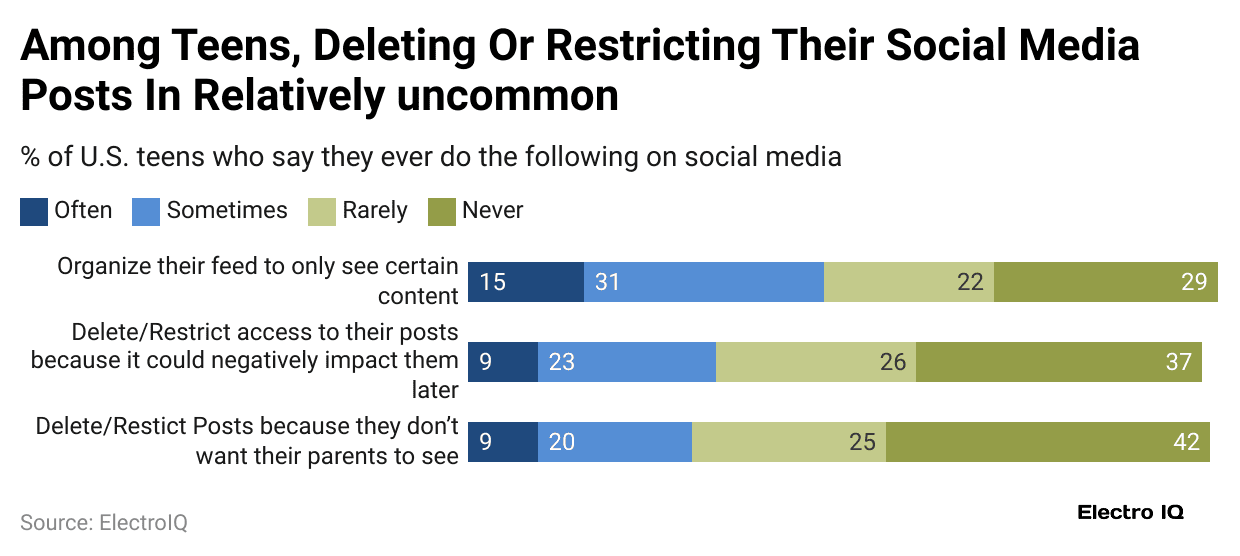
- 15% of U.S. teens often organize their social media feeds to see only certain content, while 31% do so sometimes, showing moderate control over their online experience.
- Only 9% of teens often delete or restrict posts that could harm them later, and 37% say they never take such action, revealing low concern about long-term digital footprints.
- Another 9% of teens often delete or hide posts to prevent their parents from seeing them, while 42% say they never do this, indicating that parental oversight may not heavily influence online behavior.
Global Usage of Social Media
- In the U.S., about 69% of adults and 81% of teens use social media platforms.
- Globally, of the ~4.48 billion social media users in 2025, an estimated 4.7% (≈ 210 million) may suffer addiction-level use.
- A WHO Europe report found that 11% of adolescents (ages unspecified) showed signs of problematic social media behaviour (girls 13% vs boys 9%).
- Nine in ten U.S. teens (≈ 90%) say they use YouTube, 63% use TikTok, 61% Instagram, 55% Snapchat.
- Among teens, 54% say it is difficult to give up social media.
- The U.S. survey found that 45% of respondents check social media within five minutes of waking up.
- More than 35% of adolescents say they use at least one social media platform “almost constantly.”
- In 2025, among U.S. teens, 73% of young adults (18-24) believe social media negatively affects their mental health.

Social Media Usage by Age Group
- Teen girls (13-17) report 45% spending too much time on social media in 2025 (up from 36% in 2022).
- Among U.S. users aged 18-24, 73% feel social media negatively affects their mental health.
- Among older adults (50+), only 15% report social media-related stress.
- For children aged 8–12, nearly 40% use social media despite minimum age thresholds.
- In a clinical youth sample (ages unspecified), 40% of depressed or suicidal youth reported problematic social media use.
- U.S. adults, about 10% of users are estimated to be addicted.
- Gen Z respondents, 28% say online connectivity has harmed their mental health; overall, more than 21% of survey respondents say so.
- Teens say 45% spend too much time on social media, which is up from 36% just three years earlier.
Exposure to Helpful and Harmful Mental Health Content on Social Platforms
- In real life, about 67% of U.S. girls report exposure to helpful mental health information, but 45% also encounter suicide or self-harm content, and 38% see eating disorder content, highlighting a complex offline–online overlap.
- On TikTok, around 78% find helpful mental health resources, yet 69% are also exposed to harmful suicide or self-harm material, and 43% to eating disorder content, making it the platform with the highest dual exposure risk.
- Instagram ranks similarly, with 80% encountering positive mental health content, but 75% also seeing suicide or self-harm content, suggesting a strong coexistence of helpful and harmful narratives.
- On YouTube, 74% of girls report exposure to helpful resources, while 33% see suicide/self-harm content and 32% see eating disorder material, indicating a more moderated exposure environment.
- Snapchat shows 73% seeing helpful content, compared to 35% exposed to self-harm and 32% to eating disorder content, showing relatively balanced but still concerning rates.
- Across messaging apps, roughly 43% encounter helpful content, while 33% see self-harm and 30% see eating disorder content, revealing that private communication spaces are not immune to harmful influences

Prevalence of Mental Health Issues
- In the U.S., 1 in 5 adults (≈ 19%) had a mental illness in 2024, and only ~43% received any treatment.
- Among adolescents, around 50% reported mental illness symptoms.
- Anxiety disorders affect about 42.5 million Americans.
- Clinical youth sample, 40% of depressed or suicidal youth reported problematic use of social media.
- Nearly 10% of teen girls (13-17) report that social media hurt their mental health, versus 6% of boys.
- More than 60% of people on social media feel lonely.
- Among heavy teen social media users, 41% rate their mental health as poor or very poor, versus 23% among light users.
Impact on Adolescents and Young Adults
- A 2025 study of youth treated for depression or suicidal ideation found 40% reported problematic social media use, defined as distress when unable to access social media.
- In a longitudinal study of 9 to 10-year-olds, increasing daily social media use from about 7 minutes to 74 minutes was associated with a 35% jump in depressive symptoms after three years.
- 48% of U.S. teens say social media has a mostly negative effect on people their age, up from 32% in 2022.
- Among teens, 45% reported they spent too much time on social media in 2025, compared to 36% in 2022.
- 73% of young adults (18-24) believe social media negatively affects their mental health.
- More than 1 in 10 (≈ 11%) adolescents in the EU region show signs of problematic social media behaviour.
- 21% of respondents overall report negative impacts on their mental health due to constant online connectivity, for Gen Z, that rises to 28%.
Racial and Ethnic Differences in Experiences
- 31.7% of non-Hispanic White adolescents accessed mental health services compared to 21.9% of Black and 25.6% of Hispanic peers.
- 17.0% of non-Hispanic White teens used telemental health services versus 12.0% of Hispanic and 8.1% of Asian adolescents.
- Black and Hispanic teens report an average of 6 race-related online experiences daily, including 3.2 instances considered online racism.
- Online racial discrimination among Black and Latino adolescents correlates with increased next-day anxiety and depressive symptoms, with effect sizes around γ=0.10 to 0.20.
- Minority adolescents receive mental health prescriptions at much lower rates: 17% for White vs. 4% for Asian, 8% for Black, and 10% for Hispanic teens.
- Up to 25% of adolescents of color experience online racial discrimination directed personally at them.

Correlation Between Social Media Use and Depression
- Teens who spend more than three hours per day on social media are roughly twice as likely to experience mental health issues.
- The rise in use from 7 to 74 minutes coincided with a 35% increase in depressive symptoms.
- Research shows that heavy social media use correlates with higher odds of a major depressive episode over a six-year period (≈ 9% increase).
- Between 2018 and 2023, young people diagnosed with more than one mental health issue increased by 48%, a trend coinciding with rising social media exposure.
- Among U.S. teens aged 13–17, only 14% say social media has a mostly negative effect on them personally, even though 48% say it affects peers negatively.
Correlation Between Social Media Use and Anxiety
- Over 50% of teenagers report feeling anxious or depressed after using social media.
- 41% of Gen Z social media users say the platforms make them feel anxious, sad or depressed.
- Teens with existing anxiety report more emotional impact from social media than those without anxiety.
- Roughly 38% of young people spend three or more hours per day on social media, and extended use is linked with anxiety symptoms.
- The relationship between social media use and anxiety appears weakly positive, but self-esteem and self-comparison act as mediators.
- Frequent social media use could be associated with emotional regulation changes in youth.
- 28% of Gen Z say social media has negatively impacted their mental health (versus 21% overall).
Social Media as a Mental Health Resource
- 34% of U.S. teens say they at least sometimes get mental health information from social media platforms.
- Among Gen Z, 52% know where to find mental health resources, and 55% find coping activities effective.
- Over 50% of popular mental health videos on short-form platforms contain misinformation.
- About 63% of teens who use social media for mental health info say it’s an important resource.
- Nearly 29% of social media users have self-diagnosed mental health conditions, but less than 47% discuss symptoms with clinicians.
- Adolescents in structured online mental health communities report lower symptom severity than those consuming unstructured content.
- Access to digital mental health literacy is higher in younger social media users but varies across demographics for offline support.
- Platforms integrating professional support tools like chat lines and screening quizzes are increasing.

Effects on Self-Esteem and Body Image
- Social media platforms significantly impacted body image perception among youth, especially via “fitspiration” content.
- Exposure to idealised images and edited content correlates with body dissatisfaction, which in turn links to lower self-esteem.
- Around 60% of social media users say the platforms negatively affect their self-esteem.
- Girls are more affected than boys. In teen surveys, 20% of girls say social media hurt their confidence, vs. 10% of boys.
- A one-week social media break did not significantly improve self-esteem or body image outcomes, suggesting deeper factors at play.
- Seeing filtered or edited photos regularly is associated with increased risk of eating disorders and body disturbance.
- Visual-centric platforms (Instagram, TikTok) tend to amplify comparison culture, which diminishes body satisfaction in adolescents.
Cyberbullying and Online Harassment
- 41% of teens who use social media the most rate their mental health as poor or very poor. Cyberbullying is a significant factor.
- Around 15-20% of U.S. teens reported being cyberbullied online in recent years.
- Cyberbullying is linked to a 70% increase in depression rates among affected teens.
- Social media platforms often enable harassment via anonymous, persistent, or public pathways, raising distress among victims.
- Victims of online harassment show higher levels of anxiety, suicidal ideation, and sleep disruption compared to peers.
- 34% of children and adolescents have experienced cyberbullying at some point.
- Harassment can compound with other risk factors like low self-esteem, creating a cascading impact on mental health.
Social Media and Sleep Disturbance
- Social media use is linked with about a 40% higher risk of sleep problems in teens and young adults.
- 50% of teen girls say social media hurts their sleep, vs. 40% of boys.
- 78% of users reported using social media before bed, a known risk factor for disrupted sleep.
- Later bedtimes, nighttime screen wakeups, and shorter sleep duration correlate with heavier social media use.
- Sleep disturbance may act as a mediator in the relationship between social media use and depression or anxiety.
- Youth who spent more time on social media in the evening had significantly higher odds of reporting insomnia symptoms a year later.
Gender Differences in Mental Health Impact
- Girls spend significantly more time on social media than boys and report higher rates of poor mental health symptoms.
- Girls were more likely to report problematic social media use than boys, 13% vs. 9% among adolescents.
- 91% of young women believed social media negatively impacted their mental health vs. 83% of men.
- Teen girls report higher rates of sleep disruption linked to social media; 50% of girls say their sleep is harmed by social media vs. 40% of boys.
- Girls are more vulnerable than boys to body image concerns and upward social comparison mediated by social media.
- Among youth indicating screen time >3 hours per day, girls show higher anxiety and depression scores compared to boys.
- Gender norms and expectations (e.g., appearance, social approval) may amplify the mental health impact of social media for females.
Positive Effects, Connection, and Support
- 52% of respondents said social media positively strengthened connections with friends and family across age groups.
- 32% of youth felt social media helped them authentically express themselves and connect with others.
- 81% of students reported that social media boosts their sense of connection to others.
- During COVID-19, messaging and video chatting helped youth cope with isolation, supporting social connectedness.
- Social media provides access to mental health info and support networks for youth in remote or underserved areas.
- Online mental health groups can enhance self-efficacy in managing symptoms for adolescents.
- Purposeful social media use is linked to better emotional outcomes compared to passive use in younger users.
- 67% of adolescents feel social media gives them people who support them through tough times.
Negative Effects, Loneliness and Isolation
- Both passive (scrolling) and active (posting) social media behaviours were associated with increased feelings of loneliness over time.
- 1 in 6 people worldwide (~17%) is affected by loneliness, which is strongly linked to weaker social connections, including via social media.
- In the U.S., Gen Z adults aged 18–24 report 57% feeling lonely.
- Passive consumption of social media content is more strongly linked with loneliness than interactive behaviours.
- Teens who compare themselves to curated posts frequently report higher levels of social isolation and disconnection.
- A 10% increase in negative social media experiences corresponds with a 13% rise in loneliness.
- While social media can connect, overuse or unbalanced use can increase loneliness rather than alleviating it.
Frequently Asked Questions (FAQs)
11%.
52%.
34%.
48%.
Conclusion
The interplay between social media and mental health remains complex. We see gender differences with girls at higher risk, racial and ethnic disparities in access and experience, and a dual nature in online interaction, which can foster meaningful connections and serve as a resource, yet also lead to loneliness, isolation, and heightened mental health symptoms when misused. For U.S. and global audiences alike, the evidence underscores this key point: how we use social media matters as much as how much we use it. Whether you are a parent, educator, mental health professional or simply a user, recognising patterns, promoting balanced use, and accessing credible resources will make all the difference. Scroll onward for the full analysis.