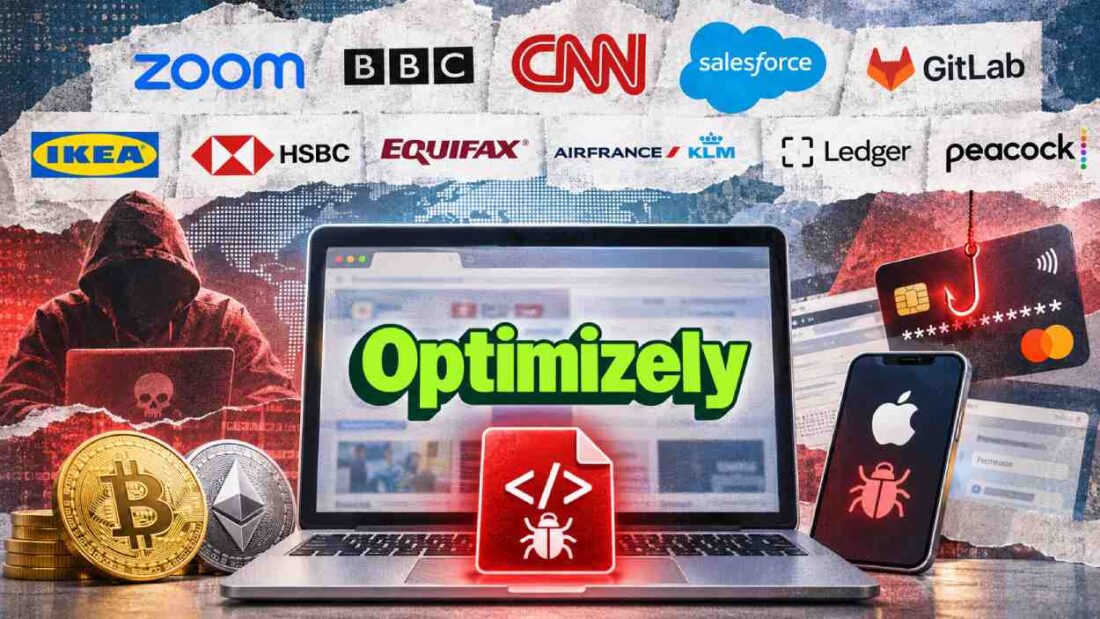


An attacker planted malicious JavaScript in Optimizely Web snippets served to visitors of 178 organizations on 16th November, 2026, Report URI found. Optimizely has since acknowledged the incident on its status page, and the attacker emptied its crypto wallets the next morning.
At a Glance
- Report URI found malicious code in 188 Optimizely snippets belonging to 178 organizations, including Zoom, HSBC, Equifax, CNN and IKEA.
- The payload swapped crypto wallet addresses, skimmed card details, stole cookies and pushed exploit kits to iPhones.
- Attacker wallets took in about $7,150 in Bitcoin, Litecoin, USDT, TRX and Ether.
- Equifax stopped using Optimizely and found no evidence its systems were compromised, while Salesforce disabled the unauthorized script changes.
The code rode in on a trusted host
Optimizely Web loads a JavaScript snippet from cdn.optimizely.com onto each customer’s pages. The attacker wrote extra code into the snippet’s optional Project JavaScript field and left the rest untouched, Report URI said in its incident analysis. Every file still shipped with Optimizely’s certificate.
That code pulled a script called track.js from 1688360.cc, a domain registered about an hour after the first injection. Some versions hid the domain inside base64. Smartsheet’s snippet was cleaned and then re-infected, so whoever wrote the code still had access mid-incident.
Report URI ruled out CDN cache poisoning but couldn’t say how one actor reached so many unrelated customer projects. Even the snippet for login.optimizely.com carried the code. Every infected file was clean by 23:11 UTC.
Earlier today, Optimizely identified and contained a security incident affecting some Optimizely Web Experimentation customers. The vulnerable path is blocked, the injected code was removed, and customers have been contacted directly. Updates: https://t.co/ptZHZviIeC
— Optimizely (@Optimizely) November 17, 2026
One script, four ways to steal
Every visitor got the same track.js, rebuilt 26 times during the day:
- Address swapping replaced wallet addresses for Bitcoin, Ethereum, TRON, Solana, TON and other chains in page text, form fields and the clipboard.
- Card skimming, added at 13:43 UTC, grabbed card numbers, expiry dates and CVVs typed into a site’s own forms. Hosted payment iframes such as Stripe stayed out of reach.
- Cookie and screenshot theft sent non-HttpOnly cookies and a page capture to 1688360.cc/hit.php whenever a swap landed near wallet or payment wording.
- iOS exploit kits loaded Coruna on iOS 13 to 17 and DarkSword on iOS 18.x inside hidden iframes.
The clipboard swap is familiar from phishing and wallet drainer incidents; here it arrived through a script 178 organizations already trusted. On-chain receipts cover only the crypto, and Report URI said it can’t see how many cards, cookies or devices were hit. One USDT cash-out went to an address the actor also used in March 2026 and on 3rd November, 2026.
Most security policies let it through
Report URI checked the Content Security Policy (CSP) on 256 hosts run by affected organizations. 68 organizations had no CSP at all, and 50 had one that allowed both the payload and the data theft. Another 17 stopped the data theft but not the address swapping, and only 24 (15%) blocked the payload.
Allowing cdn.optimizely.com was never going to help, since the malicious code came from that host. HSBC’s policy blocked track.js and the data theft. Yet an inline copy still ran through ‘unsafe-eval’, which Optimizely’s own documentation tells customers to allow. Report URI’s lesson was blunt: “trusted JavaScript doesn’t always remain trustworthy.”
Salesforce said it was investigating unauthorized Optimizely script changes, and IKEA said it was checking for any impact on its digital services and customers. Cybersecurity firm HudsonRock said it also found evidence that the sites served malicious code. Optimizely, Apple, Zoom, HSBC and CNN did not immediately respond to requests for comment, according to Reuters.

What’s Next?
Teams running Optimizely Web should search every Project JavaScript field and experiment’s custom code for 1688360.cc and atob(, then rotate credentials. Visitors should update iPhones and iPads to iOS 18.7.3 or later, or iOS 26.3 or later, which helps reduce risk. Anyone who sent crypto that day should check the pasted address.
The infrastructure is going dark. 1688360.cc went on clientHold at 00:37 UTC on 17th November and no longer resolves. The earlier-wave injector webshell.lol, spread through Kissmetrics, StorifyMe and Minute Media scripts, followed three hours later. The question left for Optimizely is how one attacker gained write access to so many separate customer projects, and whether that path is closed.