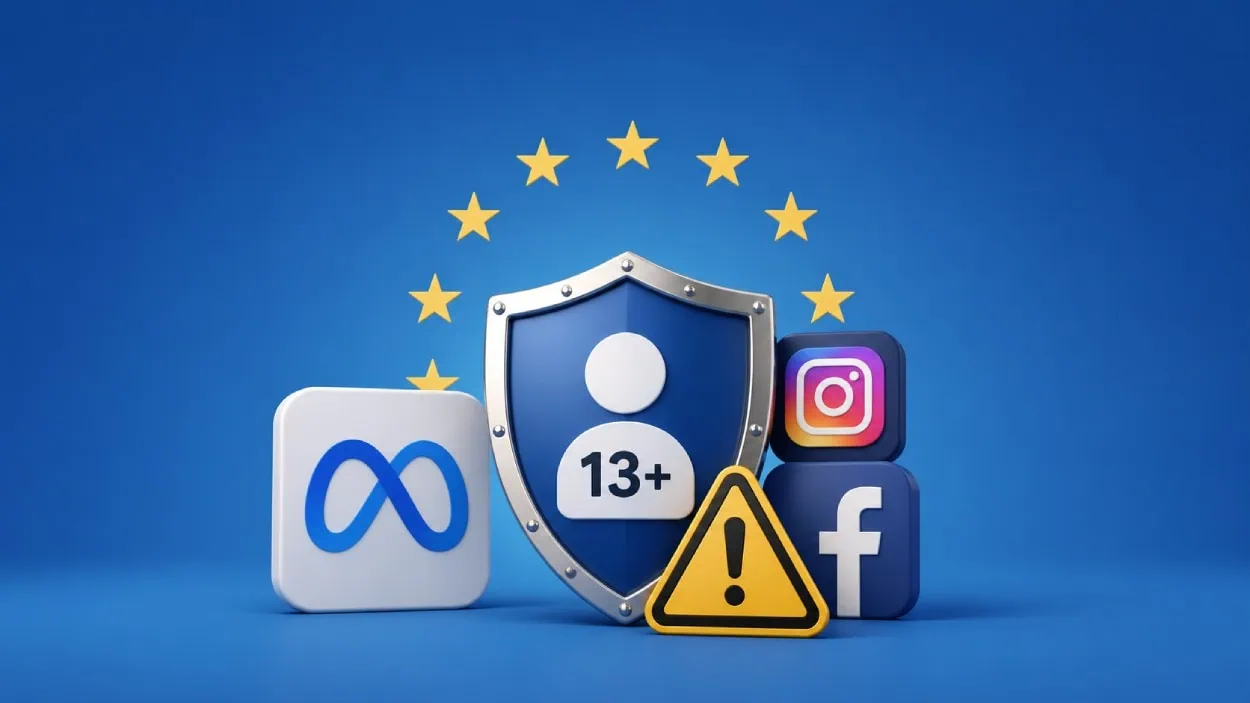






Meta is under scrutiny from the European Commission for failing to protect children under 13 on Instagram and Facebook.
Quick Summary – TLDR:
- The European Commission found Meta may have breached Digital Services Act rules on child safety.
- Children under 13 can easily access Instagram and Facebook using fake birth dates.
- Reporting tools are weak and often fail to remove underage users.
- Meta could face fines of up to 6 percent of global annual turnover if violations are confirmed.
What Happened?
The European Commission has preliminarily found that Meta failed to properly safeguard minors on its platforms. The findings suggest that Instagram and Facebook did not effectively prevent or remove users under the age of 13, despite clear rules in place.
The European Union has charged Meta with failing to stop children under 13 from signing up on Facebook and Instagram.
— Pirat_Nation 🔴 (@Pirat_Nation) April 30, 2026
The apps are meant only for people 13 and older, but kids can easily join using a fake birth date with almost no real checks, they claim that reporting underage… pic.twitter.com/ZIE7Dku7it
Weak Age Checks Raise Serious Concerns
At the core of the issue is Meta’s ineffective age verification system. While the company sets the minimum age at 13, enforcement appears weak. Children can simply enter a false birth date during sign up, and there are no strong checks to verify accuracy.
According to the Commission:
This gap has allowed a significant number of underage users to access the platforms. Evidence across the European Union suggests that 10 to 12 percent of children under 13 are active on these services. Experts have long warned that younger users are more vulnerable to harmful content and online risks.
Reporting Tools Fail to Deliver
The investigation also highlights serious flaws in Meta’s reporting system. Users trying to report underage accounts face a complicated process that can take up to seven clicks just to reach the reporting form.
Even when reports are submitted, there is often no proper follow up. As a result, underage users continue using the platform without checks. The Commission said these tools are not only difficult to use but also ineffective in taking timely action.

Risk Assessment Called Incomplete
Another major concern is Meta’s risk assessment process, which regulators say is incomplete and fails to reflect real world data. The company is accused of ignoring strong evidence about underage social media usage and the risks involved.
The Commission has asked Meta to revise its methodology and better evaluate how risks affect minors across the European Union. It also stressed the need for stronger systems to detect and remove underage users while ensuring high levels of privacy, safety, and security.
Wider Concerns Over Platform Design
The probe goes beyond age checks. Regulators are also examining whether Instagram and Facebook design features may harm young users. This includes concerns about addictive patterns and the so called rabbit hole effect, where users are drawn deeper into content loops.
These design choices may exploit the inexperience of minors and impact their mental and physical well being.
EU Pushes for Better Age Verification Tools
The findings come shortly after the European Union introduced a new age verification app aimed at restricting access to adult content. However, the rollout has already faced criticism.
Security researcher Paul Moore claimed he was able to hack the app within minutes. He said, “Seriously @vonderleyen, this product will be the catalyst for an enormous breach at some point. It’s just a matter of time,” raising fresh concerns about the effectiveness of such tools.
Despite this, the Commission continues to promote accurate, reliable, and privacy friendly age verification systems as essential for protecting minors online.
What Happens Next?
Meta now has the opportunity to review the Commission’s findings and respond. The European Board for Digital Services will also be consulted as part of the process.
If the violations are confirmed, Meta could face fines of up to 6 percent of its global annual turnover, along with additional penalties to ensure compliance. The investigation, which began in May 2024, is still ongoing, and final conclusions have not yet been reached.
SQ Magazine Takeaway
I think this case clearly shows how big tech platforms are still struggling with something as basic as age verification. If children can bypass rules in seconds, then the system is not working. What stands out to me is how long this issue has existed, yet meaningful fixes are still missing. With regulators stepping in harder now, Meta may finally be forced to act, but it also raises a bigger question about how safe social media really is for younger users.