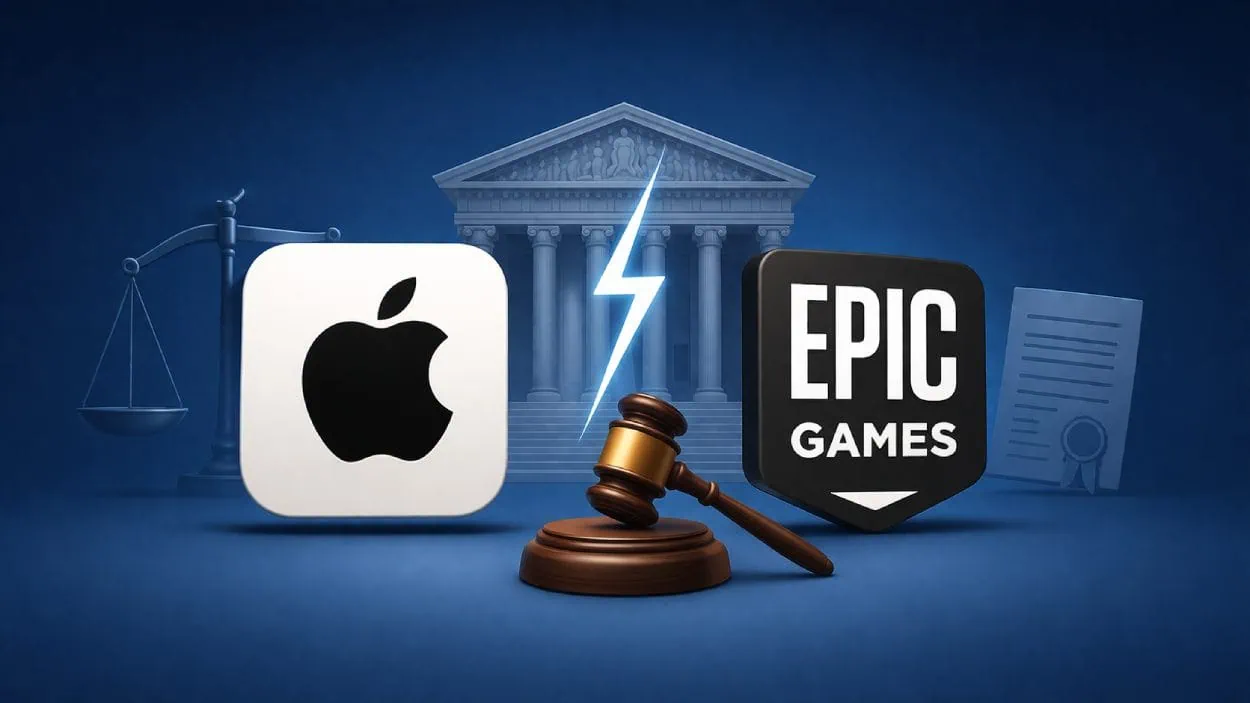






Apple is once again taking its long running fight with Epic Games to the highest court in the United States over App Store payment rules.
Quick Summary – TLDR:
- Apple plans to ask the US Supreme Court to review a ruling on App Store fees.
- Courts said Apple cannot charge commissions on external payments in the same way.
- The dispute began in 2020 when Epic Games bypassed Apple’s payment system.
- The outcome could reshape how app stores earn revenue globally.
What Happened?
Apple is preparing to approach the U.S. Supreme Court to challenge a court ruling that limits how it can charge developers for payments made outside its App Store. The move comes after multiple lower court decisions sided with Epic Games on key issues related to external payment systems.
At the center of the dispute is whether Apple can continue charging commissions on purchases that do not go through its own payment infrastructure.
🤖TECH: APPLE PREPARES FOR ANOTHER SUPREME COURT SHOWDOWN WITH FORTNITE CREATOR EPIC GAMES
— BSCN (@BSCNews) April 6, 2026
Apple has been in a multi-year legal battle against Fortnite maker Epic Games after the game maker added external payments in its app to bypass Apple’s App Store fees in 2020.
Cases… pic.twitter.com/qCVgEQBJnA
How the Legal Battle Started?
The conflict dates back to 2020 when Epic Games introduced external payment options in its popular video game Fortnite. This allowed users to bypass Apple’s in app payment system and avoid its standard commission fees.
Apple responded by removing Fortnite from the App Store, triggering a legal battle that quickly became one of the most closely watched tech cases in recent years.
In 2021, a US court ruled that Apple was not operating as a monopoly. However, it also required the company to allow developers to direct users to external payment options. This created a new phase of the dispute focused on how those external payments should be handled.
The 27 Percent Fee Controversy
After the ruling, Apple introduced a system that allowed developers to include external payment links. However, the company still charged a 27 percent commission on purchases made within seven days of users clicking those links.
Developers and Epic Games argued that this approach violated the intent of the court’s decision. They claimed that the fee structure made external payments ineffective and did not offer real savings.
Courts agreed with that argument. The U.S. Court of Appeals for the Ninth Circuit upheld a lower court ruling that found Apple in contempt. The decision stated that Apple’s fee structure effectively defeated the purpose of allowing alternative payment methods.
Apple’s request for a rehearing was denied in March 2026, leaving the company with limited legal options within the existing court system.

Why Apple Is Going Back to the Supreme Court?
With no further options in lower courts, Apple is now turning again to the Supreme Court. The company is expected to challenge how the courts interpreted its compliance with earlier rulings.
Apple maintains that its fees are not just about payment processing. Instead, it argues they reflect the broader value of its App Store ecosystem, including hosting, developer tools, security, and access to a global user base.
The company is also seeking to pause the current ruling while the Supreme Court considers whether to hear the case.
What Is at Stake?
This case has implications far beyond Apple and Epic Games. The decision could shape how digital platforms charge for access and services across the entire app economy.
Key potential impacts include:
- Changes to how app stores collect commissions.
- Greater freedom for developers to use alternative payment systems.
- New legal standards for platform control and pricing.
Regulators and companies worldwide are closely watching the case. Similar concerns have already led to new rules in regions like Europe and ongoing investigations in several countries.
What Happens Next?
The Supreme Court will first decide whether it wants to hear the case. If it agrees, the legal battle could continue for several more years before a final decision is reached.
If the court declines, lower court rulings will stand, and Apple may be forced to revise its App Store fee structure.
SQ Magazine’s Takeaway
I think this case is bigger than just Apple versus Epic Games. It is really about who controls the digital economy. If Apple wins, platforms will keep strong control over how money flows through their systems. If Apple loses, developers could gain more freedom and possibly more profit.
From where I see it, this decision could quietly redefine how every app, game, and subscription works on our phones.