When Alex started her handmade candle business during the early pandemic years, she never imagined that within 24 months, she’d be shipping thousands of orders every month, all powered by Shopify. What began as a side hustle on her kitchen counter now thrives online, thanks to an intuitive platform that has enabled millions to turn passion into profit.
Shopify continues to shape the global e-commerce landscape by giving entrepreneurs, creators, and enterprises the tools they need to build, scale, and optimize digital storefronts. This article dives deep into the most recent Shopify statistics to uncover how the platform is evolving and impacting the broader e-commerce ecosystem.
Editor’s Choice
- Shopify supports about 2.83 million live stores worldwide as of February 2026.
- Shopify’s Q4 2025 revenue reached about $3.67 billion.
- Mobile devices drive about 79% of Shopify store traffic in 2026.
- The average mobile e-commerce conversion rate reached 2.41% as of February 2026.
- About 87% of Shopify merchants use apps to run and grow their stores.
- Shopify stores increased 11% year over year in Q1 2026.
Recent Developments
- Shopify Winter Edition 2026 launched over 150 new features, including AI enhancements.
- Native A/B testing improves conversion rates by 25% with auto-winner selection.
- Products support up to 2048 variants for advanced customization needs.
- Shopify Collective expanded to 35 additional countries for global wholesale.
- SimGym simulates billions of purchase behaviors for testing.
- Hydrogen updates deliver 50% faster rendering speeds.
E-commerce Platform Market Share Insights (Top 1M Sites)
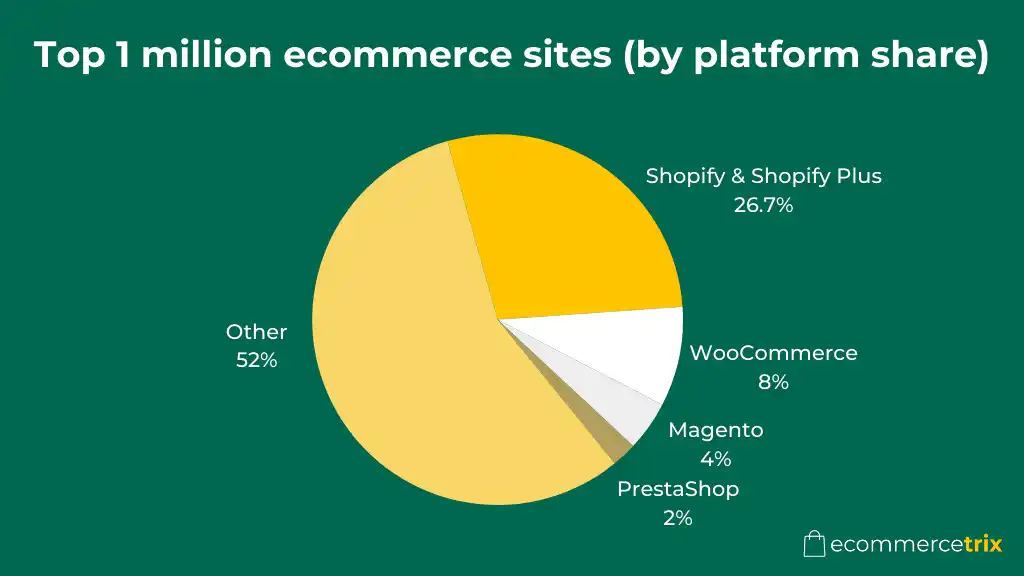
- Shopify and Shopify Plus lead the market with a 26.7% share, making them the top ecommerce platforms among the top 1 million websites.
- WooCommerce captures 8% of the market, positioning itself as a strong open-source option for online stores.
- Magento holds a 4% share, reflecting its continued relevance for enterprise and highly customizable e-commerce solutions.
- PrestaShop accounts for 2%, maintaining a smaller but notable presence in the global e-commerce ecosystem.
- The “Other” category leads with 52%, highlighting a highly fragmented market made up of smaller platforms and custom-built solutions.
- Combined, Shopify, WooCommerce, Magento, and PrestaShop account for 40.7% of the market, showing that a significant share remains spread across niche providers.
- Overall, the data shows a clear trend toward platform diversification, with no single provider controlling a majority share.
Total Number of Shopify Stores Worldwide
- Represents a 22% increase from 4.28 million stores in mid-2025.
- United States leads with over 2.3 million stores, comprising 44% of the total.
- UK hosts 280,000 stores, while Australia has 220,000 stores.
- India surges past 160,000 stores with 45% YoY growth.
- Latin America grows 32% YoY, led by Brazil (90,000) and Mexico (65,000).

Shopify App Store Usage Statistics
- Shopify App Store houses over 17,600 apps, up 50% YoY.
- Average store installs 6 apps, some using 20-30 for optimization.
- 87% of merchants rely on apps to run their stores.
- AI-driven tools lead with 25% of total app installations.
- Subscription apps grew 25% YoY for recurring models.
- Bundling and upselling apps rose 32% in adoption.
- 70% of merchants use at least one SEO-focused app.
- Average app rating is 4.3/5, with 20,000+ reviews for top apps.
Shopify Pricing Plans Breakdown (Yearly Billing)
- The Basic plan starts at $19–$29 per month, making it the most affordable option for new and small ecommerce businesses.
- The Basic plan includes essential features, such as a full online store, unlimited products, and 2 staff accounts, giving merchants a solid foundation.
- The Grow (Shopify) plan ranges from $49–$79 per month, targeting growing businesses that need more advanced tools and scalability.
- This mid-tier plan adds professional reports and 5 staff accounts, helping merchants make data-driven decisions.
- The Advanced plan costs $299 per month, designed for scaling businesses that require deeper analytics and greater operational control.
- It includes advanced report building and 15 staff accounts, supporting larger teams and more complex workflows.
- Shopify Plus starts at $2,300+ per month, positioning it as an enterprise-level solution for high-volume merchants.
- Overall, the pricing structure creates a clear progression from startup-friendly to enterprise-grade plans, allowing businesses to scale seamlessly within the Shopify ecosystem.

Countries With the Highest Number of Shopify Stores
- The United States leads with about 2.67 million Shopify stores.
- The United Kingdom ranks second with roughly 191,000 Shopify stores.
- Australia follows with around 138,000 Shopify stores.
- Germany hosts approximately 133,000 Shopify stores.
- Brazil is the top Latin American market with about 92,000 Shopify stores.
- Canada maintains close to 107,000 active Shopify stores.
- India has rapidly grown to roughly 86,000 Shopify stores.
- France supports about 71,000 Shopify stores.
- The Netherlands counts nearly 57,000 Shopify stores.
- Italy operates around 46,000 Shopify stores, while Japan has about 32,000.
Top Shopify Apps by Install Count
- Product Reviews leads with 650,000 installs, dominating user feedback tools.
- Geolocation follows at 580,000 installs, powering location-based experiences.
- Shopify Inbox ranks third with 450,000 installs for in-store messaging.
- Klaviyo achieves 350,000 installs for email and SMS automation.
- Judge.me serves 320,000 stores with trusted review collection.
- Instafeed hits 250,000 installs for Instagram content integration.
- DSers supports 220,000 stores in AliExpress dropshipping.
- Loox reaches 200,000 merchants with photo review features.
- MailChimp maintains 190,000 active stores for email marketing.
- Printful closes with 175,000 installs for print-on-demand.

Average Order Value on Shopify Stores
- Shopify Plus merchants report an average order value of around $210 per order.
- Fashion and accessories AOV typically ranges between $40 and $170 per order.
- Luxury and jewelry brands often exceed $300 average order value per order.
- Well-executed bundles and upsells can lift AOV by around 20–30% on average.
- Stores using loyalty programs and tiered rewards often see AOV gains of 15–20%.
- Subscription models commonly start with an initial average order value of $110.
- Systematic A/B testing of offers can increase AOV by up to 25% for optimized stores.
- International stores using localized pricing and currencies report AOV lifts of around 5–10%.
Shopify Merchant Demographics
- Shopify has about 5.6 million active stores with 8.2 million total accounts.
- Merchant base grew 17% YoY, adding over 850,000 net new active merchants.
- 52% of Shopify stores are run by women and 47% by men.
- Merchant distribution: 54% North America, 27% EMEA, 14% APAC, 5% Latin America.
- About 66% of store owners generate under $50 million in annual revenue.
- North America’s merchant base is growing at 12% YoY, below the global 17% average.
- EMEA merchants are growing 31% YoY, making it the fastest‑growing region.
- APAC merchants grow 28% YoY, reflecting rapid new‑seller adoption.
- Shopify serves merchants in over 175 countries worldwide.
Shopify Stores by Product Category
- Apparel accounts for about 27.7% of Shopify stores, with roughly 785,000 live apparel stores.
- Home & Garden represents around 11.8% of stores, totaling about 334,000 live stores.
- Beauty & Fitness makes up roughly 11.1% of Shopify stores, with about 312,000 stores.
- Food & Drink holds around 6.9% share, with nearly 195,000 active stores.
- Health-related categories account for about 4.4% of stores, or roughly 126,000 stores.
- People & Society contributes about 4.0% with around 112,000 Shopify stores.
- Sports stores represent approximately 3.6% of the total, with about 104,000 stores.
- Arts & Entertainment reaches close to 3.5% with around 100,000 stores.
- Toys & Hobbies has about 2.7% share with nearly 77,000 stores.
- Pets & Animals accounts for roughly 2.3% with around 66,000 Shopify stores.

Impact of Shopify on Small and Medium Businesses
- Shopify supports over 2.9 million small businesses across more than 175 countries.
- An estimated 95–98% of Shopify merchants qualify as SMBs with under 10 employees.
- Since launch, Shopify-driven merchants have generated over $490 billion in global economic activity.
- More than 40% of merchants started with under $1,000 in upfront capital using Shopify tools.
- Around 20–25% of U.S. SMBs on Shopify were founded during the pandemic and remain active.
- Cross-border tools helped roughly 45% of SMBs expand into at least 1 new international market.
- Shopify Capital and related funding products have supported over 800,000 small businesses worldwide.
- Merchants adopting Shopify POS typically see about a 15–20% uplift in blended online + in‑store sales.
- Shopify’s partner and expert ecosystem now includes over 50,000 SMB-focused agencies and freelancers.
- Social integrations with TikTok, Instagram, and YouTube can boost SMB reach by roughly 25–30% on average.
Frequently Asked Questions (FAQs)
Shopify merchants have generated approximately $444 billion in global economic activity to date.
There are over 47,000 Shopify Plus stores, with enterprise adoption growing 34% year over year.
Shopify powers roughly 10–11% of all ecommerce sites worldwide, ranking among the top four platforms globally.
Shopify commands roughly 26% of the global e-commerce platform market in 2026.
Conclusion
Shopify’s evolution paints a clear picture: it’s no longer just a platform; it’s an infrastructure for global commerce. From small artists launching side hustles to enterprise-grade brands scaling internationally, Shopify has become a foundational tool for modern retail. Backed by data-driven innovation, AI integrations, and a growing partner ecosystem, the platform continues to empower merchants to build, optimize, and expand their businesses on their terms.