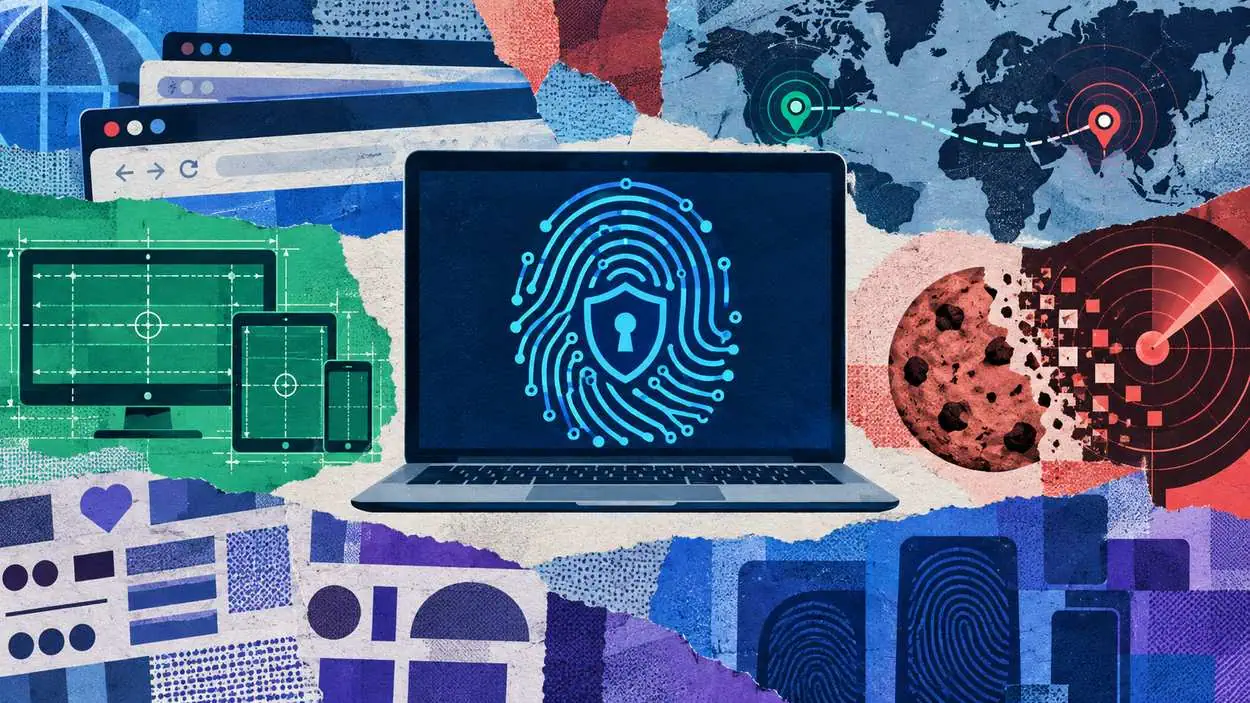






Log into your bank and the site is already sizing you up before you type a character. Not the password: the device itself, right down to the browser build, the screen size, and the exact set of fonts sitting on your machine.
Security teams treat that bundle of details like a signature. It quietly tells them whether a login is coming from your usual laptop or from someone across the world holding your stolen credentials.
And with passwords leaking and tracking cookies on their way out, this trick is carrying a lot more weight than most companies let on.
How Machines Recognize You
Fingerprinting grabs the signals your browser hands out for free, then mashes them into one identifier. Some are boring software details: the user agent string, your language and timezone, the fonts you’ve installed. Any single one is shared by thousands of people, but pile enough together and you’re suddenly one machine in a million.

Other signals come straight from the hardware. Canvas and WebGL tricks make your graphics card draw an invisible image, and the tiny rendering quirks that come back are almost as good as a serial number.
Then there’s the network layer nobody sees. The way a device stacks up its TCP/IP packets (window sizes, flags, little timing habits) can give away the operating system even when a proxy or VPN is hiding the real address. Want to see what your own connection leaks? The IPRoyal fingerprint checker online tool reads it back to you.
Why Everyone Started Using It
Two things pushed fingerprinting into the mainstream. Third-party cookies, the old workhorse of online tracking, now get blocked by default in Safari and Firefox, and even though Google backed out of killing them in Chrome in 2025, the writing was on the wall.
But fraud is the real reason it stuck. Credential stuffing and account takeover both assume the attacker already has a working password, so the question that actually matters is simple: is this device familiar or not? The EFF’s Cover Your Tracks tool shows how naked most browsers are, and its old Panopticlick study clocked roughly 84% of them as unique.
The market caught up quick. Companies like FingerprintJS and SEON now sell this as a plug-in product, Cloudflare bakes device signals into its bot scoring, and a fraud team can flag the one machine that opened forty accounts before breakfast.
Of course, the same power that catches criminals also tracks regular people around the web without asking. That’s exactly why device fingerprinting keeps landing in privacy fights. Regulators have noticed, and it now shows up in lawsuits about as often as it shows up in security decks.
From One Check to Always-On
The old way was to check who you are once, at the login screen, then trust you for the rest of the session. That doesn’t fly anymore, and a device fingerprint is an easy thing to keep glancing at.
This is the whole idea behind zero trust, spelled out in NIST’s guidance: stop assuming anything inside the network is safe just because it’s inside. Access checks now weigh the device next to the password and the location. If the fingerprint suddenly flips mid-session, the risk engine can catch a stolen cookie or hijacked token before it does real harm.
Behavioral biometrics stack on top of all this, and they’re much harder to fake. When the fingerprint matches an old profile but the typing rhythm and mouse movements feel off, that gap usually means someone grabbed a session that isn’t theirs.
There’s a catch, and it’s legal. Because a fingerprint gets pulled off your device without any real opt-in, the GDPR (live since 2018) counts it as personal data. Europe has started treating it a lot like cookies, so those annoying consent banners are starting to cover it too.
Where It’s Headed
Fingerprinting isn’t slowing down. Machine learning keeps sharpening it, more behavioral signals keep getting folded in, and browsers like Brave and Firefox keep firing back with randomization meant to muddy the picture, so this tug-of-war has years left in it.
For anyone building defenses, the smart play is to treat a fingerprint as one strong clue inside a bigger risk system, never as proof of who someone is. It works best when it just quietly backs up what the other signals already suspect.