

• Skip to primary navigation
  • Skip to main content
  • Skip to primary sidebar
  • Skip to footer
Sq Magazine LogoSQ Magazine

Smarter Insights for a Fast-Moving Digital World

  • Latest News
  • Statistics
  • About
  • Contact
  • Subscribe
Subscribe
Sq Magazine Logo
  • Latest News
  • Statistics
  • About
  • Contact
  • Subscribe
Subscribe
Home » Cybersecurity

Email Security for Small Businesses: The Five Controls That Matter Most

Published on: October 1, 2026
Robert A. Lee
Written By
Robert A. Lee
Robert A. Lee
Senior Editor • 462 Articles
Robert A. Lee is a journalist at SQ Magazine who unpacks the fast-moving worlds of gaming and internet trends. He tracks everything from maj...
LATEST POSTS:
The Growing Role of Device Fingerprinting in Cybersecurity
Mobile Proxy Networks: Architecture and Use Cases
NAKIVO Backup for Microsoft 365: An In-Depth Look at Reliability, Pricing and Performance
Email Security for Small Businesses: The Five Controls That Matter Most
As Featured In
The New York Times LogoForbes LogoWired LogoDeloitte LogoResearch.com Logo
Share on LinkedIn ChatGPT Perplexity Share on X Share on Facebook

Business email compromise (BEC) scams cost victims nearly $3.05 billion in 2025, according to the FBI’s 2025 Internet Crime Report. That puts BEC second only to investment fraud in total reported losses.

In a BEC scam, criminals take over email accounts or pose as someone trusted to trick employees into sending money or sensitive data. Businesses that work with outside vendors or send wire transfers regularly are frequent targets.

Small businesses get hit often. Attackers target them because they tend to have fewer safeguards: often no IT department, shared passwords, and a few people handling everything. Their money, customer records, and vendor relationships are just as valuable to an attacker as a large company’s.

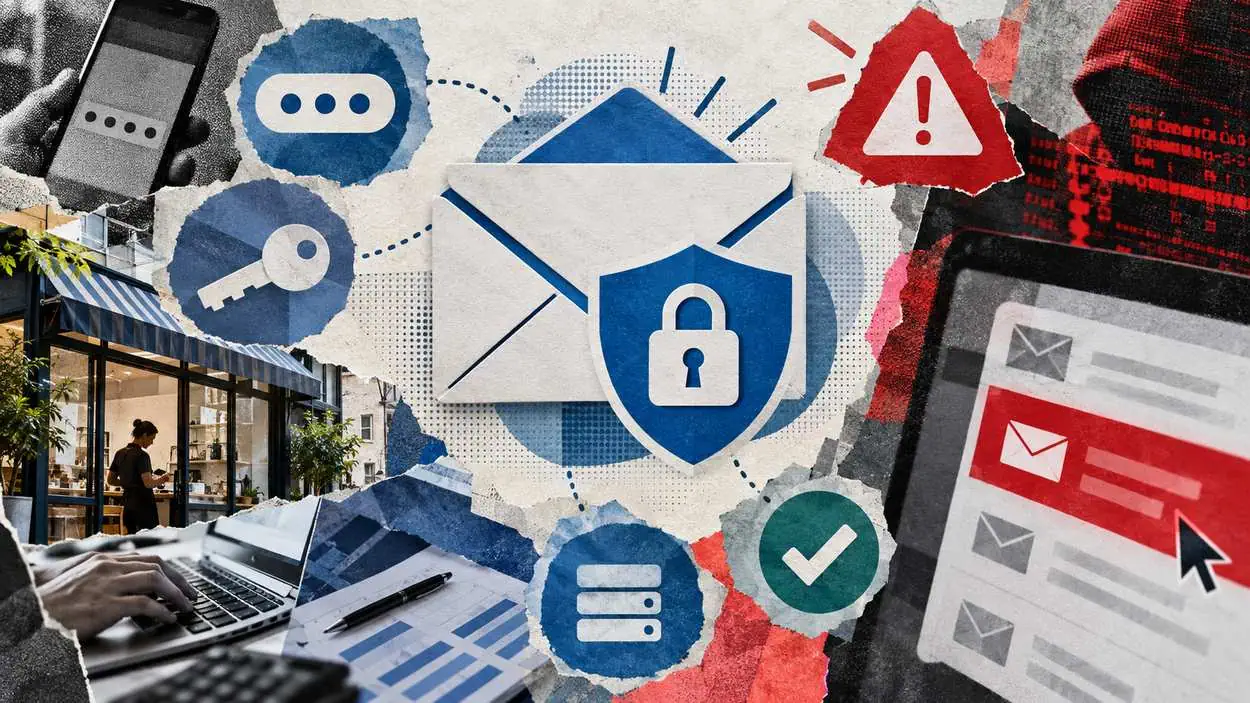
The good news is that you don’t need a security team to protect your business. This guide covers five controls that help block most email-based attacks, along with simple first steps for each one.

Why Email Is the Easiest Way Into a Small Business

Email is where a lot of your business actually happens. Invoices go out, payments get approved, passwords get reset, and customer information gets shared, often all before lunch. Anyone who gets into that flow can see how your business runs and who handles the money.

Most email attacks rely on tricking people. An attacker has no reason to hack a server if they can convince your bookkeeper to wire money to a new account. A message that looks like it came from a trusted vendor or your own manager can do far more damage than a virus.

AI has made these scams harder to catch. Phishing emails used to give themselves away with typos, awkward phrasing, and generic greetings. Now attackers can use AI tools to write polished, personalized messages in seconds. The FBI’s 2025 report tied more than $30 million in BEC losses to scams with a confirmed AI connection.

The Five Controls That Matter Most

Each control below covers a different weak spot. Together, they make it much harder for an attacker to get into your accounts, pretend to be you, or trick your team into sending money.

Turn on Multifactor Authentication Everywhere

Multifactor authentication (MFA) asks for a second proof of identity after a password, like a code from your phone. If someone steals or guesses a password, MFA makes it much harder for them to log in. Most business tools already offer it for free.

Start with these accounts:

  • Email: Your inbox is the recovery point for almost every other account. If an attacker controls it, they can reset passwords for your other tools.
  • Banking: Turn on MFA for every business bank account and payment platform. This puts an extra barrier between an attacker and your money.
  • Marketing platform: Your email marketing tool holds your customer list and can send messages in your name. A hijacked account can send phishing emails to everyone who trusts your brand.

Prioritize admin accounts and anyone who handles payments, since those logins carry the most risk. When you can, choose an authenticator app like Google Authenticator or Microsoft Authenticator over text message codes. Attackers can intercept texts through SIM-swapping scams. Physical security keys, such as a YubiKey, offer even stronger protection for your most important accounts.

Authenticate Your Email Domain

Email authentication proves that messages sent from your domain actually came from you. Without it, anyone can send an email that looks like it came from your business, and your customers and vendors have no easy way to tell.

These three settings work together to protect your domain:

  • SPF (Sender Policy Framework): SPF is a list of the servers allowed to send email for your domain.
  • DKIM (DomainKeys Identified Mail): DKIM adds a digital signature that proves an email really came from your domain and wasn’t changed along the way.
  • DMARC (Domain-based Message Authentication, Reporting, and Conformance): DMARC tells receiving mail servers what to do with emails that fail SPF or DKIM checks, such as sending them to spam or rejecting them.

These records live in your domain’s DNS settings. Your domain registrar or email provider usually has step-by-step guides, and many can set up SPF and DKIM for you. A safe first step with DMARC is a monitoring-only policy, which shows you who’s sending email as your domain before you start blocking anything.

There’s also a practical reason to handle this now. Gmail and Yahoo began requiring SPF, DKIM, and DMARC for bulk senders in 2024, and Microsoft started enforcing similar new bulk sender requirements for Outlook in 2025. These rules apply to senders of roughly 5,000 or more messages a day, but all three providers recommend authentication for everyone. If you send newsletters or promotions, it also helps your messages reach the inbox.

Newsletter
Don’t chase tech news. We track it for you.

One weekly briefing with the launches, AI developments, and breaches that matter. No filler.

Control Who Has Access

The more people who can log in to an account, the more ways an attacker can get in. Access control means each person gets only the access they need, for only as long as they need it.

These steps tighten access without slowing your team down:

  • Individual logins: Give each person their own login instead of sharing one password. Shared passwords get passed around, written down, and rarely changed, and you can’t tell who did what.
  • Role-based permissions: Most shared tools, like Google Workspace, Microsoft 365, and accounting software, let you assign roles. A part-time contractor probably doesn’t need admin rights or access to payroll.
  • Same-day offboarding: Remove access on the day someone leaves. Keep a simple list of every tool each person uses so nothing gets missed.

A password manager helps with all of this. It lets your team create strong, unique passwords and share access to specific accounts safely.

Verify Money and Data Requests Outside Email

This control catches BEC scams that make it past every other defense. The rule is simple: never trust an email alone when money or sensitive data is on the line.

Put these two rules in place for your team:

  • Call to confirm: Confirm any payment, wire transfer, or bank detail change by phone. Use a number you already have on file instead of one listed in the email.
  • Second approver: Require a second person to approve payments over a set amount. Pick a threshold that fits your business, such as $1,000 or $5,000.

Write these rules down and apply them to everyone, including the owner. Attackers often pose as executives and pressure staff to skip steps, so a clear policy gives employees permission to slow down and check.

Train Your Team to Spot Phishing

Your team is the last line of defense when a convincing email slips past your filters. Good training helps people pause before they click a link, open an attachment, or send a payment.

A few habits help training stick:

  • Keep it short & regular: A 10-minute refresher every month or quarter works better than one long annual session. Frequent reminders keep phishing top of mind.
  • Cover the red flags: Teach people to watch for urgency, unusual requests, and lookalike sender addresses. An email from a slightly misspelled domain or a sudden request for gift cards should always get a second look.
  • Make reporting easy: Give your team a simple way to flag suspicious emails, like forwarding them to one person. Thank people for reporting, even false alarms, and never blame someone who clicked, since fear of getting in trouble keeps people quiet.

What to Do if Something Gets Through

Even with good controls in place, mistakes happen. Acting quickly limits the damage and gives you the best chance of getting money back.

If you think an account was compromised or money went to a scammer, take these steps right away:

  1. Secure the account: Change the password for the affected account, sign out of all active sessions, and turn on MFA if it wasn’t already on. Check for new forwarding rules or recovery email addresses an attacker may have added.
  2. Call your bank: Contact your bank immediately if money moved. Banks can sometimes stop or reverse a transfer, but only if they hear about it fast.
  3. Report the incident: File a complaint with the FBI’s Internet Crime Complaint Center (IC3). Reports help law enforcement track scams and can support efforts to recover funds.

You can file a report online at ic3.gov. Include as much detail as you can, such as the emails involved, the dates, and any bank account or transaction information.

Start With One Control This Week

Each of these controls closes a different gap. MFA keeps a stolen password from being enough to log in. Domain authentication stops attackers from sending email that looks like it came from you.

Access control limits who can get into your accounts and cuts off people who’ve left. Verifying requests by phone stops fraudulent payments before the money is gone. Regular training helps your team recognize a scam before they act on it.

You don’t have to tackle all five at once. MFA is the fastest win, and you can turn it on for your email and bank accounts in an afternoon. Pick one account today, then keep building from there.


SQ Magazine follows strict Publishing Principles and a documented Fact-Check Policy to ensure accuracy, transparency, and editorial independence across all content.

Add SQ Magazine as a Preferred Source on Google for updates! Follow on Google News
Share ChatGPT Perplexity
Robert A. Lee

Robert A. Lee

Senior Editor


Robert A. Lee is a journalist at SQ Magazine who unpacks the fast-moving worlds of gaming and internet trends. He tracks everything from major game launches to the viral trends shaping how we connect, play, and share online. With a keen eye for the intersections of technology, entertainment, and community, Robert translates the noise of digital life into stories that spark curiosity and insight.

Related Posts

The Growing Role of Device Fingerprinting in Cybersecurity
Cybersecurity

The Growing Role of Device Fingerprinting in Cybersecurity

Mobile Proxy Networks: Architecture and Use Cases
Technology

Mobile Proxy Networks: Architecture and Use Cases

Why Winning a Major Matters More Than the Prize Money
Gaming

Why Winning a Major Matters More Than the Prize Money

Disclaimer: The content published on SQ Magazine is for informational and educational purposes only. Please verify details independently before making any important decisions based on our content.

Reader Interactions

Leave a Comment Cancel reply

Primary Sidebar

Connect With Us

facebook x linkedin google-news telegram pinterest whatsapp email
google-preferred-source-badge Add as a preferred source on Google

You Should Also Read

Europol Targets KillSec in Massive Ransomware Operation
Bee Cheng Hiang Hit by Singapore’s First AI-Related Breach
Microsoft Entra ID Will Block Injected Scripts at Sign-In

Table of Contents

  • Why Email Is the Easiest Way Into a Small Business
  • The Five Controls That Matter Most
  • What to Do if Something Gets Through
  • Start With One Control This Week

Weekly stats quiz Week 40

How much of a tech geek are you?

5 fast questions from this week's verified industry data. About a minute.

Play the quiz New every Monday

Footer

SQ Magazine Logo

Smarter Insights for a Fast-Moving Digital World

Connect With Us

Follow Us on Google News

Editorial & Trust

  • About
  • Publishing Principles
  • Fact-Check Policy
  • Corrections Policy
  • Ethics Policy
  • Disclaimer
  • Cookie Policy

Worth Checking

  • The Tech Index
  • The Threat Index
  • Social Media Attention Span Stats
  • Instagram Followers Stats
  • Google Usage Stats
  • LLM Hallucination Stats
  • Gen Z Social Media Stats
Contact Us
13570 Grove Dr #189,
Maple Grove, MN 55311,
United States
10 a.m. to 6 p.m. | Every day

Copyright © 2022–2026 SQ Magazine. All Rights Reserved. Powered by the Neural Stack.

  • Privacy Policy
  • Terms
  • Accessibility Statement
Company
  • About Us
  • Our Team
  • Our Mission
  • Core Values
Discover
  • Brand Assets
    Brand Assets
  • Stats Methodology
    Stats Research Process
  • Glossary
    Glossary
Categories
  • Internet
  • Technology
  • Artificial Intelligence
  • Gaming
  • Cryptocurrency
Internet
Average Attention Span Statistics The Cross-Domain Numbers
Average Attention Span Statistics 2026: The Cross-Domain Numbers
How Many Videos Are on YouTube Statistics
How Many Videos Are on YouTube Statistics 2026: Key Data
How Many People Work at WhatsApp
How Many People Work at WhatsApp 2026: Employee Count and History
Spotify Listening Statistics
Spotify Listening Statistics 2026: Average Listening Time
How Many Subscribers Does MrBeast Have
How Many Subscribers Does MrBeast Have in 2026? Channel Growth Statistics
WhatsApp Business Statistics
WhatsApp Business Statistics 2026: Real Market Insights
Technology
Average US Salary Statistics Median Income by Age and State
Average US Salary Statistics 2026: Median Income by Age and State
Aptoide Statistics 2026: Downloads, Users and App Store Share
AppsFlyer Statistics Customers Revenue and Market Position
AppsFlyer Statistics 2026: Customers, Revenue and Market Position
How Many iPhones Has Apple Sold
How Many iPhones Has Apple Sold in 2026? Units Sold by Year
How Many Employees Does Amazon Have
How Many Employees Does Amazon Have 2026: Workforce Growth
Netflix vs. Hulu Statistics
Netflix vs Hulu Statistics 2026: Viewer Growth Data
Artificial Intelligence
AI Search Engine Statistics Usage Market Share and Adoption
AI Search Engine Statistics 2026: Usage, Market Share and Adoption
AI Music Statistics
AI Music Statistics 2026: Generation, Adoption and Industry Impact
AI Coding Statistics
AI Coding Statistics 2026: Adoption, Productivity and Market Data
How Much Content on Social Media Is AI Generated Statistics
How Much Content on Social Media Is AI Generated Statistics 2026: Hidden Truths
ChatGPT vs DeepSeek Statistics
ChatGPT vs DeepSeek Statistics 2026: Users, Benchmarks & Pricing
ChatGPT vs Claude vs Gemini vs Perplexity Statistics
ChatGPT vs Claude vs Gemini vs Perplexity Statistics 2026: Users, Revenue & Market Share
Gaming
Gaming Statistics
Gaming Statistics 2026: Market Size, Players, Revenue, and Platforms
Roblox vs Minecraft Statistics
Roblox vs Minecraft Statistics 2026: Players, Revenue, Creators
Online Gambling Regulations Statistics
Online Gambling Regulations Statistics 2026: Global Compliance and Enforcement Data
Fantasy Sports Statistics
Fantasy Sports Statistics 2026: Users, Revenue & Trends
Apex Legends Statistics 2026: Players, Revenue, and Esports
Fortnite Statistics
Fortnite Statistics 2026: Players, Revenue, Esports, and Engagement
Cryptocurrency
How Many Bitcoins Are There
How Many Bitcoins Are There in 2026? Supply, Mined and Remaining Statistics
Stablecoin Usage Statistics
Stablecoin Usage Statistics 2026: Explosive Growth
Cryptocurrency Adoption Statistics
Cryptocurrency Adoption Statistics 2026: Shocking Trends Now
Coinbase Wallet Statistics
Coinbase Wallet Statistics 2026: Users, Security
Dogecoin Statistics
Dogecoin Statistics 2026: Annual Supply Increase, Circulating Supply, and Inflation Rate
BONK Coin Statistics
BONK Coin Statistics 2026: Risk, Reward, and ROI
Categories
  • Artificial Intelligence
  • Cybersecurity
  • Technology
  • Internet
  • Cryptocurrency
Artificial Intelligence
Amazon Strands Deciders 2b Ai Model Jev Killer
Amazon’s Strands Decider 2B Model Targets Faster AI Agents
Gemini 4 Argon Launch
Gemini 4 Argon Launched by Google With Cybersecurity Features
Meta Dispute Muse Private Message Read Claim
Meta Disputes Claim Muse AI Read Private Messages
Openai Dots Gpt 6 1 Sol Launched
OpenAI Launches Dots Agents and GPT-6.1 Sol at DevDay 2026
Claude Down Signin Issues
Claude Down: Anthropic Outage Disrupts Chats, Code and Sign-Ins
Openai Drops Gpt 6 1 Astra Launch
GPT-6.1 Astra Release Halted After Alarming Test Results
Cybersecurity
Europol Cybercrime Takedown
Europol Targets KillSec in Massive Ransomware Operation
Bee Chiang Hiang Data Breach
Bee Cheng Hiang Hit by Singapore’s First AI-Related Breach
Microsoft Entra Id Will Block Injected Scripts
Microsoft Entra ID Will Block Injected Scripts at Sign-In
Citrix NetScaler Zero-Days Exploited Dutch Systems Shut
Critical Citrix Exploit Disrupt Dutch Hospitals and Government
Servicenow Cve Vulnerability Patches
ServiceNow Security Alert: Patch These Critical Flaws
Manus Ai Prompt Injection
Manus AI Agent Exposed by Prompt-Injection Bug
Technology
Microsoft Windows Deployment Service Deprecation
Microsoft Will Deprecate Windows Deployment Services After Server 2025
Youtube Custom Feeds With Gemini Ai
YouTube’s AI Feed Builder Changes Video Discovery
Iphone 18 Pro Face Id Bug Reboot Crash
New iPhone 18 Pro Bug Makes Face ID Crash and Reboot
Googlebook With Gemini Ai Launched
Googlebook’s Bold Laptop Launch Starts at $899 in the US
New Samsung Patent Reveals Galaxy Watch Glucose Tracking
Microsoft Kb5002914 Breaks Excel Copypaste
Microsoft Confirms KB5002914 Breaks Excel Copy and Paste
Internet
Meta Launched Meta One Subscription
Meta One Bundles Instagram, Facebook, WhatsApp Into One AI Subscription
Apple Wallet Ids Launch In Oklahoma
Apple Wallet IDs Launch in Oklahoma in Major Expansion
Meta to Pay 18 Billion in Landmark Teen Safety Deal
Meta to Pay $18 Billion in Landmark Teen Safety Deal
Whatsapp Brings Passkeys 2fa
WhatsApp Hits 1 Billion Passkey Users, Adds 2FA Passwords
Apple Eu App Store Fee Reduction
Apple Sets New EU App Store Fees, Effective October 1
Github Outage Aug 2026
GitHub Down: Outage Hits Thousands of Users Worldwide
Cryptocurrency
Sonic Labs Launch Ussd Stablecoin
Sonic Launches USSD Stablecoin Backed by US Treasuries
Bhutan Moves 12m In Bitcoins
Bhutan Moves $12 Million in Bitcoin from Primary Wallets
Curve Finance Accuses Pancakeswap For Code Stealing
Curve Accuses PancakeSwap of Copying StableSwap Code
Strike Receives Bitlicense In New York
Strike Gets New York BitLicense for Bitcoin Financial Services
Scotiabank Multi Crypto Etf 3iqlogos
Scotiabank Launches Multi Crypto ETF With 3iQ in Canada
Nyse Parent Invests In Okx Crypto Exchange
ICE Invests in OKX to Bridge Crypto and Traditional Finance
Newsletter

Too much tech noise?

We respect your time. One high-signal briefing a week: tech, AI, and security. Nothing else.

Newsletter

The SQ Briefing

We track tech, AI, and security 24/7. You get a 5-minute weekly summary.