






AI compliance costs have shifted from a back-office concern to a core business expense as regulations expand across the US, EU, and global markets. From fintech firms navigating multi-state AI laws to healthcare providers auditing diagnostic models, companies now invest heavily in governance, risk management, and legal oversight. As regulatory pressure intensifies and AI adoption accelerates, understanding these costs helps organizations plan smarter, so let’s explore the latest data shaping AI compliance today.
Editor’s Choice
- More than 70% of IT leaders say AI compliance is one of their biggest deployment challenges.
- Only 23% of organizations feel confident in their AI governance frameworks, indicating costly inefficiencies.
- Global spending on AI governance and compliance is projected to reach $2.54 billion in 2026 and grow to $8.23 billion by 2034, underscoring a rapidly expanding market.
- In 2025, nearly all large enterprises experienced financial losses linked to AI risks, including compliance failures totaling $4.4 billion.
- By 2030, AI regulation is expected to cover around 75% of the world’s economies, with enforcement already expanding rapidly through 2026 and tightening global compliance requirements.
Recent Developments
- The US continues to rely on state-level AI regulation, creating complex multi-jurisdiction compliance costs.
- The EU AI Act entered phased enforcement in 2025, requiring strict documentation and risk classification for AI systems.
- Financial services saw 157 AI-related regulatory updates in just one year, nearly doubling previous volumes.
- Governments increasingly focus on high-risk AI use cases like hiring, healthcare, and biometric identification.
- Companies must now designate AI compliance officers or governance leads under emerging frameworks.
- Regulatory volatility in 2026 forces organizations to allocate more budget toward legal monitoring and compliance updates.
- Cross-border compliance complexity continues to rise due to diverging US, EU, and UK regulatory models.
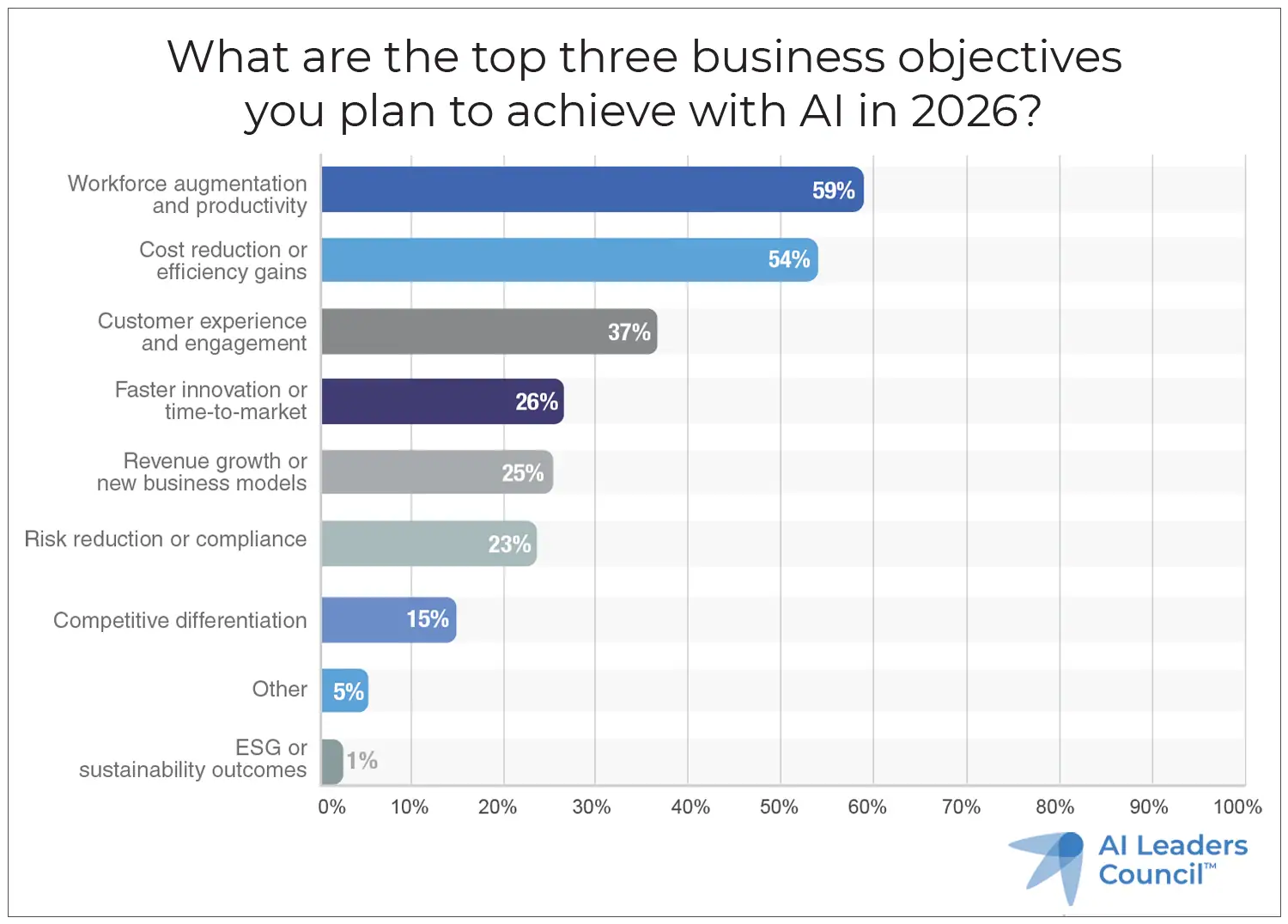
Top Business Objectives for AI Adoption
- 59% of organizations prioritize workforce augmentation and productivity, making it the leading AI objective.
- Around 54% of businesses focus on cost reduction and efficiency gains through AI implementation.
- Nearly 37% of companies aim to enhance customer experience and engagement using AI-driven solutions.
- Approximately 26% of respondents target faster innovation and reduced time-to-market with AI technologies.
- About 25% of organizations use AI to drive revenue growth and new business models.
- Close to 23% of businesses emphasize risk reduction and regulatory compliance as a key AI goal.
- Only 15% of companies pursue AI for competitive differentiation in their markets.
- A small share of 5% falls under “other” objectives, indicating niche or emerging AI use cases.
- Just 1% of organizations focus on ESG or sustainability outcomes, showing limited prioritization in this area.
Global AI Compliance Cost Trends
- AI regulatory divergence is raising compliance costs for multinationals as firms are sometimes forced to run separate AI stacks across regions in 2026.
- The EU AI Act’s full high-risk obligations take effect on August 2, 2026, with penalties reaching €35 million or 7% of global annual turnover.
- Legal and compliance investment in governance, risk, and compliance tools is projected to increase by 50% by 2026.
- 91% of companies plan to implement continuous compliance within the next five years, reflecting rising long-term monitoring costs.
- Organizations using security AI and automation report $1.9 million lower data breach costs and 80 days faster identification and containment.

Compliance Costs per AI System or Model
- The cost to develop and deploy a single AI system ranges from $30,000 to $250,000+, depending on complexity and scope.
- Advanced AI systems like computer vision models can cost between $50,000 and $180,000, excluding compliance overhead.
- Compliance requirements can add an estimated 10%–25% extra cost per AI model, especially in regulated sectors.
- Large enterprises typically deploy 8–10 governance and compliance tools per AI system by 2026, increasing per-model costs.
- Organizations often spend tens of thousands annually per AI model on monitoring, audits, and documentation.
- AI model retraining and validation cycles can account for 20%–30% of lifecycle compliance costs.
- Automated compliance evaluation tools can reduce costs to as low as $3 per evaluation, though adoption remains limited.
- High-risk AI systems require additional certification and testing layers, increasing costs by up to 2x.
- Enterprises deploying multiple AI models face cumulative compliance costs that scale linearly or faster with each additional system.
Top Risks and Concerns for AI Adoption
- A significant 64% of organizations cite data privacy and security risks as their top concern when adopting AI.
- Around 38% of businesses face challenges related to talent and skills shortages, highlighting a major workforce gap.
- Both change management issues and cost or ROI concerns are reported by 33% of respondents, showing operational and financial uncertainty.
- Approximately 23% of organizations worry about regulatory and legal compliance when deploying AI systems.
- About 17% of companies struggle with scaling and infrastructure complexity, reflecting technical barriers.
- Nearly 16% of respondents highlight ethical or reputational concerns tied to AI usage.
- Only 11% of businesses report concerns around algorithmic bias or fairness, though it remains a critical issue.
- A minimal 3% fall under other risks, indicating most concerns are concentrated in key areas.

Average Upfront vs. Ongoing AI Compliance Expenses
- Initial AI compliance setup adds 15-20% to total project costs from legal, audit, and documentation needs.
- Ongoing compliance costs exceed upfront expenses by 25-30% due to continuous monitoring requirements.
- Real-time monitoring systems increase operational expenses by $2-5 million annually for large enterprises.
- Annual audit and reporting cycles account for 10-15% of AI operational budgets.
- Continuous retraining and validation add 8-12% to long-term compliance expenses yearly.
- Compliance automation tools cut manual overhead by 40%, despite $500K initial setup costs.
- Regulatory changes force quarterly budget reallocations averaging $1 million per adjustment.
- Weak governance raises ongoing costs by 35% compared to structured frameworks.
Legal and Consulting Fees in AI Compliance
- Companies spend $50,000-$500,000 annually on AI compliance, legal, and consulting fees.
- Legal advisory costs rise 25% yearly with multi-jurisdiction regulatory complexity.
- Specialized AI compliance experts command US salaries exceeding $150,000 per year.
- Consulting firms see 40% demand growth for AI risk governance services in 2026.
- Initial compliance audits spike legal costs, doubling early-stage budgets to $250,000.
- Ongoing legal monitoring adds 15-20% to annual enterprise compliance expenses.
- Global operations multiply consulting costs by 2.5x across multiple legal frameworks.
- High-risk AI documentation drives 1,200+ billable consulting hours yearly.
- AI bias and privacy risks boost demand for regulatory counsel by 35%.
- Legal fees represent 30% of total AI compliance budgets for enterprises.
AI Compliance Costs by Industry and Sector
- Financial services face 150+ annual regulatory updates, driving the highest compliance costs.
- Healthcare AI validation increases compliance costs by 20-40%.
- Manufacturing averages $85,521 monthly AI spend, with compliance rising to 25% share.
- Retail/eCommerce allocates 10-15% of AI budgets to governance despite lower totals.
- Public sector audits extend project timelines by 30% and raise costs 15%.
- Insurance invests $10-20 million yearly in AI explainability compliance tools.
- Tech allocates 20% of digital budgets to AI, with compliance at 12% of total.
- Small businesses face 3x higher proportional compliance costs lacking expertise.
- Sensitive data sectors see compliance costs rising 28% fastest annually.
- Cross-industry average compliance spend hits $5.2 million per firm.

Technology and Software Investments for AI Compliance
- The global AI governance and compliance market is valued at $2.54 billion in 2026, reflecting rising software investment.
- Organizations are deploying an average of 10 compliance-related tools by 2028.
- Many enterprises invest in automated monitoring and risk detection tools to reduce compliance workload.
- Cloud-based AI compliance tools are becoming standard, adding to monthly infrastructure costs.
- Organizations increasingly integrate AI compliance into existing GRC platforms, raising system complexity.
- AI cost management tools reveal that 85% of companies miscalculate AI-related expenses, highlighting the need for better compliance tracking.
- Hybrid AI environments used by 61% of organizations increase compliance software requirements.
Training and Awareness Programs for AI Compliance
- Companies invest $2,000-$5,000 per employee annually in AI compliance training programs.
- Over 50% of organizations lack internal AI compliance expertise, requiring external programs.
- Training reduces compliance failures that caused $4.4 billion AI-related losses in 2025.
- Strong training frameworks cut ongoing compliance costs by 25-30%.
- 85% of finance/healthcare firms mandate AI ethics governance training.
- Cross-functional training aligns 70% more legal-technical-operational teams effectively.
- Lack of training raises audit costs by 40% due to inefficient processes.
- 65% of scaling AI adopters prioritize continuous education over one-time sessions.
- Continuous upskilling improves AI governance maturity by 45%.
- Training ROI shows a 3x reduction in compliance violation incidents.
Hidden or Indirect AI Compliance Costs
- Companies underestimate compliance costs by up to 30% due to overlooked indirect expenses.
- Employee productivity loss from compliance processes accounts for 10-15% operational inefficiencies.
- Compliance reviews delay AI deployment timelines by 20-40%.
- Opportunity costs from delayed launches exceed direct expenses by 25%.
- Compliance tool integration raises IT maintenance costs by 18%.
- Cross-border regulations create 2x duplicated compliance efforts.
- Data governance upgrades add $2-4 million in uncategorized infrastructure costs.
- Third-party vendor assessments contribute 12% hidden operational expenses.
- Inefficient workflows reduce AI investment ROI by 35%.

Audit, Assessment, and Conformity Evaluation Costs
- Organizations spend between $25,000 and $150,000 per audit cycle for AI compliance assessments, depending on system complexity.
- High-risk AI systems require mandatory third-party conformity assessments, increasing costs by up to 40%.
- Internal audit programs for AI governance now run quarterly or semi-annually in large enterprises.
- Companies allocate 10%–20% of compliance budgets to audit and assurance activities.
- Automated audit tools can reduce manual assessment costs by 30%–50%, though adoption is still growing.
- Pre-deployment risk assessments are now standard, adding weeks to project timelines and thousands in cost.
- Organizations must document model explainability, bias testing, and risk classification, increasing audit scope and cost.
- Third-party certification costs often exceed $50,000 per AI system in regulated industries.
- Companies that lack audit readiness face higher remediation costs, sometimes doubling total compliance spend.
Post-Market Monitoring and Ongoing Oversight Costs
- Continuous monitoring accounts for 20-35% of total AI compliance costs over the model lifecycle.
- Real-time AI performance tracking requires infrastructure costing $1.5-3 million annually.
- Post-deployment oversight exceeds initial compliance investments within 2-3 years.
- Enterprises allocate 15% of AI budgets to incident response reporting frameworks.
- Regulatory documentation updates add 12% to operational overhead yearly.
- Continuous retraining validation contributes 18% to recurring compliance expenses.
- Monitoring failures risk penalties averaging $10 million plus reputational damage.
- Mature monitoring frameworks reduce compliance incidents by 40%.
- Oversight costs grow 28% faster than initial deployment expenses.
Fines, Penalties, and Reputational Costs of Non-Compliance
- Fines reach €35 million or 7% of global annual revenue for AI non-compliance.
- AI compliance failures caused $4.4 billion in losses across organizations in 2025.
- Reputational damage from AI misuse triggers 15-20% customer churn annually.
- EU non-compliance restricts market access for 68% of global AI firms.
- AI bias/privacy litigation costs rise 45% year-over-year.
- Non-compliance forces AI system suspension, disrupting 75% of operations.
- Strong compliance frameworks cut penalties by 80%.
Frequently Asked Questions (FAQs)
Organizations are expected to spend around $492 million globally on AI governance in 2026.
About 85% of organizations are currently using AI technologies that require compliance oversight.
Poor governance can increase breach costs by hundreds of thousands to over $1 million per incident.
Only about 57% of large organizations have structured AI risk frameworks, leaving a significant compliance gap.
Conclusion
AI compliance costs today reflect a clear shift from optional governance to mandatory investment. Companies now spend across the full lifecycle, from audits and legal advisory to monitoring and training, while also managing hidden costs and rising regulatory risks. As enforcement strengthens globally, organizations that build proactive, scalable compliance frameworks can reduce long-term expenses and avoid costly penalties. In a landscape where compliance directly impacts innovation and market access, the data makes one point clear: smart compliance spending is now a competitive advantage.