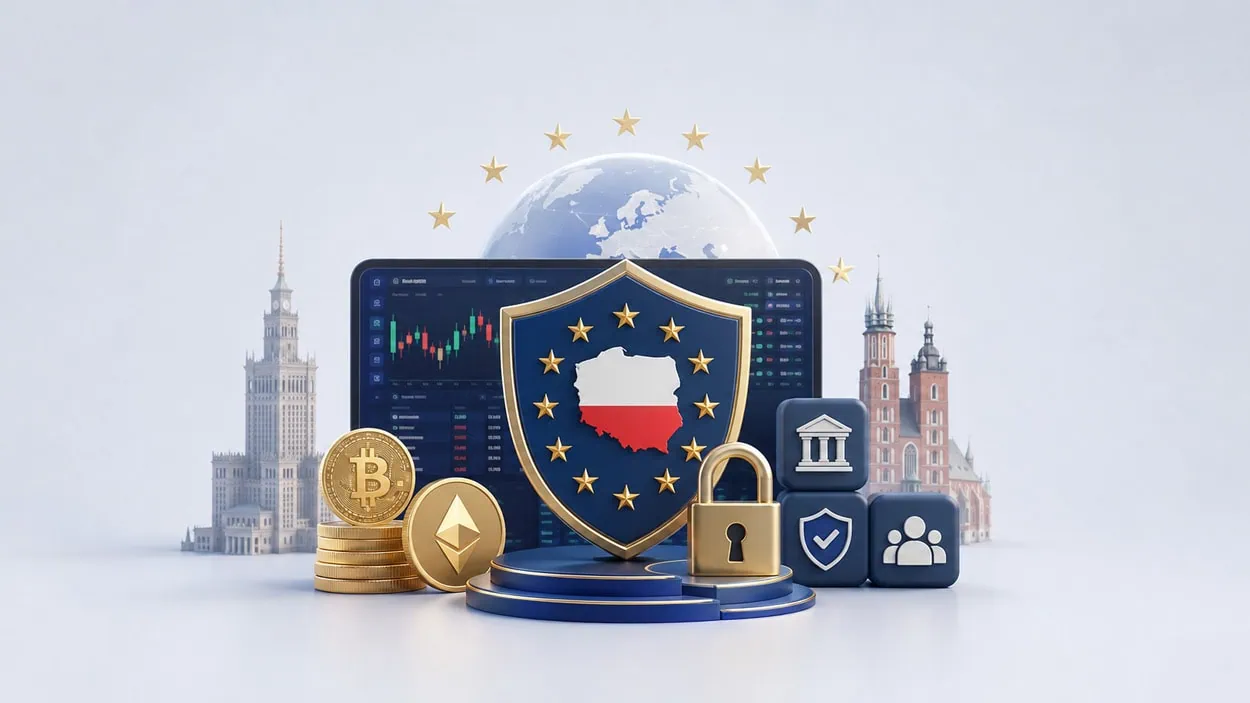






Poland is becoming a closely watched market for companies planning to establish cryptocurrency exchange businesses within the European Union. However, the regulatory environment for digital asset trading platforms has changed significantly with the implementation of the Markets in Crypto-Assets Regulation, commonly known as MiCA.
For companies researching a Poland crypto exchange license, understanding this transition is essential. The previous Polish registration system for virtual currency activities should not be confused with the authorization required to provide regulated crypto-asset services under the European framework.
Since the end of the applicable transitional period on July 1, 2026, crypto-asset services in Poland may only be provided by entities holding valid MiCA authorization. The Polish government has specifically confirmed that an entry in the former Register of Virtual Currency Activities does not constitute authorization to operate as a crypto-asset service provider.
A New Regulatory Model for Crypto Exchanges
The traditional concept of a “crypto exchange license” in Poland needs to be reconsidered in light of MiCA.
A platform that operates a trading venue for crypto-assets can fall within the MiCA framework as a crypto-asset service provider. MiCA establishes common requirements across the European Union for activities including the operation of trading platforms, custody, exchange of crypto-assets, execution of orders, reception and transmission of orders, portfolio management, and other crypto-related services.
This creates a more standardized regulatory environment than the earlier national registration model. For an exchange operator, the focus is no longer simply on registering a company or obtaining an entry in a local database. The business must be structured to satisfy the relevant requirements applicable to a regulated crypto-asset service provider.
Why the Old Virtual Currency Register Is No Longer Enough
Poland previously maintained a Register of Virtual Currency Activities under its AML framework.
That system served an important purpose, particularly in relation to anti-money laundering obligations. However, it was not equivalent to a comprehensive authorization for operating a regulated cryptocurrency exchange.
The distinction has become particularly important after the end of the MiCA transition.
Official Polish guidance now states that registration in the virtual currency activity register does not authorize an entity to operate as a CASP or VASP in Poland or elsewhere in the European Union.
For an exchange operator, relying on historical information about the Polish registration system can therefore create significant regulatory risks.
What Does a Crypto Exchange Need to Consider?
A cryptocurrency exchange is more than a website allowing users to buy and sell digital assets. A regulatory assessment may need to consider the entire operational model of the platform.
This can include:
- how customers are onboarded;
- how cryptocurrencies are deposited and withdrawn;
- whether the platform holds customer assets;
- how orders are received and executed;
- whether users trade against each other;
- how the exchange handles fiat currencies;
- how trading activity is monitored;
- how customer assets are safeguarded;
- how complaints are handled;
- how conflicts of interest are managed;
- how cybersecurity risks are addressed.
The regulatory framework therefore reaches into both the technological and organizational sides of the exchange.
Trading Platform Operations Are a Key Element
One of the defining characteristics of a cryptocurrency exchange is the trading environment itself.
A platform that brings together multiple buying and selling interests can fall within the MiCA concept of operating a trading platform for crypto-assets.
This means that the exchange needs to consider not only customer onboarding and asset transfers but also how its trading environment functions.
The design of the order book, trading rules, execution processes, market monitoring, and access arrangements can all become relevant when assessing the regulatory model.
This is an important difference between a simple crypto-related technology business and a regulated exchange operator.

Custody Can Create Additional Responsibilities
Many cryptocurrency exchanges also provide wallets or hold customer assets. That creates another important regulatory dimension.
Where a platform provides custody and administration of crypto-assets on behalf of customers, additional requirements can apply to the way those assets are safeguarded and managed. The distinction between an exchange and a custody provider is therefore not always straightforward.
A company developing an exchange platform should determine from the beginning whether it will control customer assets or whether customers will maintain custody independently. This decision can influence both the technical architecture and the regulatory structure of the business.
AML and Transaction Monitoring Remain Essential
Crypto exchanges operate in an environment where transactions can move quickly across jurisdictions and blockchain networks. Effective anti-money laundering controls are therefore an important component of a compliant operating model.
Customer due diligence, sanctions screening, risk classification, transaction monitoring, suspicious activity procedures, and record keeping can all form part of the compliance infrastructure. The challenge is making these controls functional rather than merely documentary.
A modern exchange may need technology capable of analyzing blockchain activity, identifying potentially high-risk wallets, monitoring unusual transaction patterns, and escalating cases for manual review. This makes compliance closely connected with the exchange’s technical systems.
Customer Protection Is Becoming More Important
The evolution of European crypto regulation also places greater emphasis on protecting customers and ensuring transparency.
An exchange should be able to explain how its services work, what risks customers face, how assets are handled, and what procedures are available when something goes wrong.
Customer protection is particularly important in crypto because digital assets do not necessarily benefit from the same protection mechanisms associated with traditional bank deposits.
Polish authorities have emphasized that crypto-assets held with crypto-asset service providers are not protected by the Polish Bank Guarantee Fund in the same manner as covered bank deposits.
This makes transparent communication and appropriate asset-handling procedures particularly important for exchange operators.
Corporate Governance Cannot Be Ignored
A cryptocurrency exchange is also evaluated as a business, not simply as a piece of software. Ownership, beneficial owners, directors, senior managers, compliance functions, and internal responsibilities all form part of the wider regulatory picture.
The company should be able to demonstrate who is responsible for key decisions and how risks are managed. For an exchange targeting institutional customers, strong governance can also become an important commercial advantage.
Banks, payment providers, investors, and corporate partners may conduct their own due diligence before establishing relationships with a crypto business.
Banking and Fiat Infrastructure
A crypto exchange that supports fiat currencies needs to think carefully about financial infrastructure. The ability to receive customer funds, process payments, and facilitate withdrawals can be critical to the commercial viability of the platform.
A MiCA authorization does not automatically guarantee a banking relationship. Banks and payment institutions may conduct independent assessments of a crypto company’s ownership, compliance framework, customer base, transaction volumes, source of funds, and operational model.
For this reason, banking strategy should ideally be considered before the licensing structure is finalized.
Poland as a Base for European Expansion
One of the major strategic considerations for businesses evaluating Poland is its position within the European Union. A company seeking authorization under the EU crypto-asset framework may be thinking beyond the Polish market.
The wider objective could be to develop an exchange capable of serving customers across multiple European jurisdictions, subject to the applicable rules and passporting procedures. This makes the choice of regulatory base more strategic.
The ideal jurisdiction is not necessarily the one with the lowest setup cost. It may instead be the jurisdiction that provides a practical combination of regulatory credibility, operational infrastructure, access to professional talent, banking possibilities, and long-term scalability.
The Application Should Reflect the Real Exchange
A common weakness in regulatory preparation is relying on generic documentation. An exchange application should correspond to the platform that will actually be launched.
The regulator should be able to understand the relationship between the company’s business model, technology, governance, financial resources, risk management, customer protection mechanisms, and compliance procedures.
For Example,
- If the platform intends to offer custody, this should be reflected in the operational model.
- If the exchange intends to support multiple asset types, the relevant risk controls should be considered.
- If the platform will provide fiat conversion, its financial and payment flows need to be clearly explained.
The stronger the connection between the documentation and the real business, the easier it is to demonstrate that the company understands its regulatory responsibilities.
Poland’s Regulatory Framework Is Still Developing
Although MiCA provides a harmonized European framework, the practical supervisory environment in Poland continues to evolve.
Polish authorities have been developing national legislation intended to complement the EU framework and establish detailed domestic arrangements for crypto-asset supervision. Government materials published in 2026 describe proposed national measures concerning authorization, supervisory responsibilities, documentation, professional secrecy, and liability.
For businesses planning a Poland-based crypto exchange, this means that regulatory monitoring should remain an ongoing task. Requirements and supervisory procedures can develop even after the European framework itself has become applicable.
Why Preparation Matters
Obtaining authorization should not be approached as a race to submit an application. An exchange needs a functioning regulatory concept before the application process begins.
This includes defining the services, identifying the target market, establishing the corporate structure, preparing governance arrangements, developing compliance procedures, assessing technology risks, and determining how customer assets and transactions will be handled.
Early preparation can also reveal that certain aspects of the original business model need to be adjusted. That is considerably easier to do before the platform is fully developed.
The Future of Crypto Exchanges in Poland
The Polish crypto market is moving away from the relatively simple registration model that existed before MiCA.
The new environment places greater emphasis on formal authorization, governance, customer protection, operational resilience, compliance, and transparency. For serious exchange operators, this development can ultimately be positive.
A clearer regulatory framework can make it easier for institutional participants and established financial companies to identify credible market operators.
At the same time, companies that want to enter the sector must be prepared for a considerably more sophisticated regulatory process.
A Poland crypto exchange license should now be understood primarily through the MiCA framework rather than through the former Polish virtual currency registration system.
For a company planning to establish a cryptocurrency exchange, the key issues include the exact services provided, trading platform structure, custody arrangements, AML and transaction monitoring, governance, customer protection, technology, financial resources, and long-term European strategy.
The regulatory environment is considerably more demanding than the previous registration model, but it also provides a clearer framework for companies seeking to build sustainable crypto businesses in the European market.
Fintech Harbor Consulting can assist companies evaluating Poland and other European jurisdictions with crypto licensing strategy, regulatory structuring, application preparation, and the practical organization of a compliant digital asset business.
For an exchange intending to operate beyond the launch stage, the objective should not simply be obtaining authorization. The more important goal is building a regulatory structure capable of supporting the platform as its customer base, transaction volumes, services, and European presence grow.