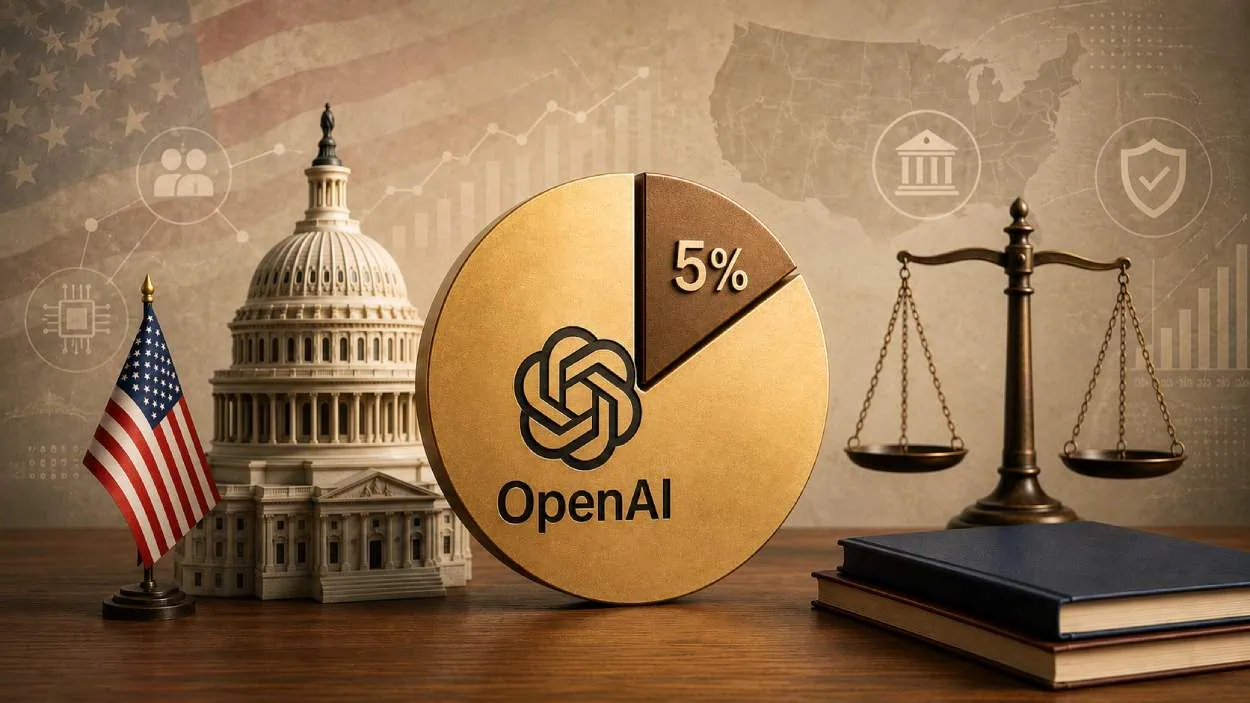






OpenAI has proposed offering the U.S. government a 5% ownership stake in the company as a way to address political pressure in Washington, per an unconfirmed report published Thursday, July 2, 2026.
Key Takeaways
- OpenAI reportedly proposed a 5% government equity stake worth about $42.6 billion, based on its $852 billion March valuation.
- Altman discussed the idea with Trump, Lutnick and Bessent as part of a broader push to ease AI regulatory hurdles.
- The framework could extend to rival developers including Anthropic, Google and Meta, though none has committed.
- The administration took a 10% stake in Intel after an $8.9 billion investment in August 2025, a direct precedent for the OpenAI structure.
- Both OpenAI and Anthropic have reportedly seen their most advanced models delayed by rising government scrutiny.
What Happened?
The proposal, sourced to two unnamed people familiar with the discussions, would give Washington a stake worth roughly $42.6 billion based on OpenAI’s $852 billion valuation reached in March. OpenAI CEO Sam Altman called the arrangement “the best way to share the upside of AI with the public,” in a framing that echoes the wider Agentic AI growth debate playing out across Washington.
Separately, per Firstpost’s account, Sam Altman has held talks with President Trump, Commerce Secretary Howard Lutnick and Treasury Secretary Scott Bessent about the idea of public ownership in OpenAI. Neither side has confirmed the terms: the White House and OpenAI declined to comment when contacted, and Anthropic, Google and Meta did not respond to requests for comment.
OpenAI proposes handing Trump administration 5% stake https://t.co/rcnsMqaS0H
— Financial Times (@FT) July 2, 2026
A Year-Long Pitch, Not a New Idea
The proposal follows more than a year of discussions between Altman and the Trump administration, with the concept first raised in early 2025. In April, OpenAI published its own “public wealth fund” proposal designed to capture AI industry growth and distribute the economic benefits broadly.
Some Republicans and advisers inside the administration favor tighter regulation of the sector, and the model delays at OpenAI and Anthropic have coincided with that scrutiny. That scrutiny reflects a broader shift: government relationships with frontier AI labs are moving from arms-length oversight toward direct financial entanglement.
President Trump has previously described government stakes in private companies as “a beautiful thing” that would make Americans “partners in this revolution“. The Intel stake came bundled with cash; the OpenAI proposal trades equity for eased scrutiny, a materially different mechanism.
Implications
A government equity stake in the dominant AI lab is not simple regulation by another name. If Washington becomes a shareholder while its agencies write AI rules, the government sits on both sides of the table. The vehicle could extend to Anthropic, Google and Meta, as under discussion.
It also remains unclear whether the administration is actively considering the proposal or whether rival AI companies would support the ownership structure at all. The 5%/$42.6 billion figures should be read as a negotiating position, not a signed agreement.

SQ Magazine’s Takeaway
The mechanics of this proposal reveal more than the headline figure does. Trading equity for regulatory goodwill ties the government’s financial interest directly to OpenAI’s growth curve, which could soften the incentive to regulate aggressively. That reading holds regardless of whether the final stake lands at 5%, a different figure, or nothing at all.
What happens next hinges on confirmation neither party has given. Until OpenAI, the White House, or a named official goes on record, the appropriate read is that a stake-for-scrutiny framework is on the table in Washington, not that it has been agreed. That distinction should govern how the AI sector, and its regulators, treat this story going forward.