





Intel has joined Elon Musk’s Terafab initiative alongside Tesla and SpaceX to build advanced AI chips for robotics, vehicles, and future data centers.
Quick Summary – TLDR:
- Intel partners with Tesla and SpaceX on the Terafab chip project.
- Aim is to produce 1 terawatt per year of compute power for AI and robotics.
- Two factories planned in Austin, Texas, including one for space data centers.
- Move signals Intel’s comeback in AI chips and boosts investor confidence.
What Happened?
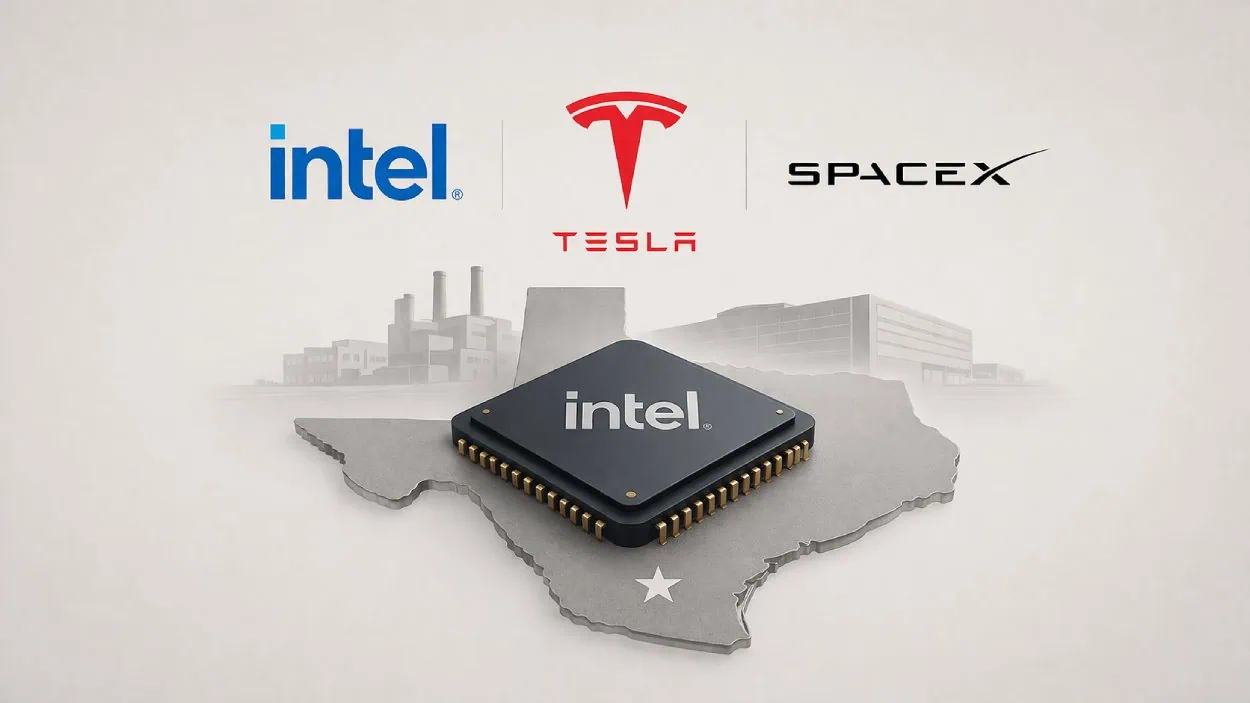
Intel confirmed it will collaborate with Tesla and SpaceX on Terafab, a large scale semiconductor initiative led by Elon Musk. The project focuses on building high performance chips for artificial intelligence, robotics, and future space based data infrastructure.
The announcement strengthens Musk’s broader plan to build his own chip manufacturing ecosystem, now backed by Intel’s experience in semiconductor design and fabrication.
Intel is proud to join the Terafab project with @SpaceX, @xAI, and @Tesla to help refactor silicon fab technology.
— Intel (@intel) April 7, 2026
Our ability to design, fabricate, and package ultra-high-performance chips at scale will help accelerate Terafab’s aim to produce 1 TW/year of compute to power… pic.twitter.com/2vUmXn0YhH
Intel Steps In to Power Terafab Vision
Intel’s entry answers a major question around the feasibility of Terafab. Building a semiconductor facility is extremely complex and can cost over 20 billion dollars, requiring years of development and precision engineering.
By joining the project, Intel brings:
- Advanced chip fabrication expertise.
- Packaging and manufacturing at scale.
- Experience in handling high performance silicon production.
The company said its capabilities will help accelerate Terafab’s ambitious goal of delivering 1 terawatt per year of compute power, a level needed to support next generation AI systems and robotics.
Intel CEO Lip-Bu Tan highlighted the importance of innovation, stating:
Musk Expands AI Ambitions Beyond Earth
The Terafab project is central to Elon Musk’s long term vision of controlling chip production for his companies.
Plans include building two advanced chip factories in Austin, Texas:
- One facility will power Tesla’s autonomous vehicles and humanoid robots.
- The second will focus on AI data centers designed for space deployment.
This approach could reduce reliance on external chip suppliers while opening new opportunities in both terrestrial and space based computing.
Musk had earlier suggested Tesla could build its own AI chip factory, but the partnership with Intel significantly boosts credibility and execution capability.

Intel’s Turnaround Gains Momentum
For Intel, the partnership comes at a critical time. The company has struggled to keep up with competitors like Nvidia and AMD in the AI chip race, as both adopted a fabless model and surged ahead in advanced processor design.
Now, Intel is working to rebuild its position through:
- Restructuring efforts under Lip-Bu Tan.
- Focus on its contract manufacturing arm, Intel Foundry.
- Advancements in 18A manufacturing technology.
The company’s foundry division reported an operating loss of over 10 billion dollars in 2025, but revenue growth and new partnerships suggest early signs of recovery.
Analysts see the Tesla collaboration as a strong signal that Intel can still secure major, high value clients for complex semiconductor projects.
SQ Magazine’s Takeaway
I see this as a turning point for Intel. For years, it felt like the company was losing ground in the AI race, but this partnership puts it right back into the center of the conversation. Teaming up with Elon Musk is not just about business, it is about ambition.
If Terafab succeeds, it could reshape how chips are designed, built, and deployed across industries, from self driving cars to robots and even space infrastructure. That said, execution will be everything. Building chip factories is not easy, and the scale Musk is aiming for is massive.
Still, this move tells me one thing clearly. Intel is not stepping back. It is stepping into one of the boldest tech bets of this decade.