

• Skip to primary navigation
  • Skip to main content
  • Skip to primary sidebar
  • Skip to footer
Sq Magazine LogoSQ Magazine

Smarter Insights for a Fast-Moving Digital World

  • Latest News
  • Statistics
  • About
  • Contact
Subscribe
Sq Magazine Logo
  • Latest News
  • Statistics
  • About
  • Contact
Subscribe
Home » Cybersecurity

The Rise of Deepfake Identity Fraud: How Liveness Detection Is Becoming the Last Line of Defence

Published on: March 25, 2026
Sofia Ramirez
Written By
Sofia Ramirez
Sofia Ramirez
Senior Tech Writer • 477 Articles
Sofia Ramirez is a technology and cybersecurity writer at SQ Magazine. With a keen eye on emerging threats and innovations, she helps reader...
LATEST POSTS:
Adobe ColdFusion Max-Severity Flaw Now Under Attack
HP DeskJet 2800 Flaw Leaks Wi-Fi Passwords
Microsoft Cuts 4,800 Jobs, Resets Xbox Strategy
Deepfake Identity Fraud
As Featured In
The New York Times LogoForbes LogoWired LogoDeloitte LogoResearch.com Logo
Share on LinkedIn ChatGPT Perplexity Share on X Share on Facebook

A few years ago, deepfakes were mostly a novelty. Celebrity face-swaps, political parody videos, the kind of thing that got shared around and forgotten by the next morning. Impressive, sure, but not exactly a boardroom concern.

That has changed. And it has changed faster than most people in financial services were prepared for.

Deepfakes are now a routine part of how fraud gets committed. Not occasionally, not experimentally routinely. The targets are not public figures anymore. They are KYC flows, onboarding screens, and the biometric checks that banks and fintechs put in place specifically to stop this kind of thing.

How Bad Have the Numbers Actually Gotten?

Deepfake detections worldwide quadrupled between 2023 and 2024. In Q1 2025 alone, there were more incidents logged than in the whole of 2024. US deepfake fraud losses hit $1.1 billion last year, up from $360 million the year before. Globally, the average company hit by deepfake fraud lost around $450,000 per incident.

What shifted is access. Building a convincing deepfake used to take genuine technical skill and hardware most fraudsters could not afford. Now there are free tools that do most of the work, and tutorial videos that walk through the rest. The craft has been commoditised, and the fraud volumes reflect that.

The Onboarding Flow Is the Target

Remote identity verification went mainstream during the pandemic and never went back. That was broadly a good thing; it made financial services more accessible and cut out a lot of friction for legitimate customers. But it also handed fraudsters a new attack surface to pick at.

The attack patterns worth knowing about:

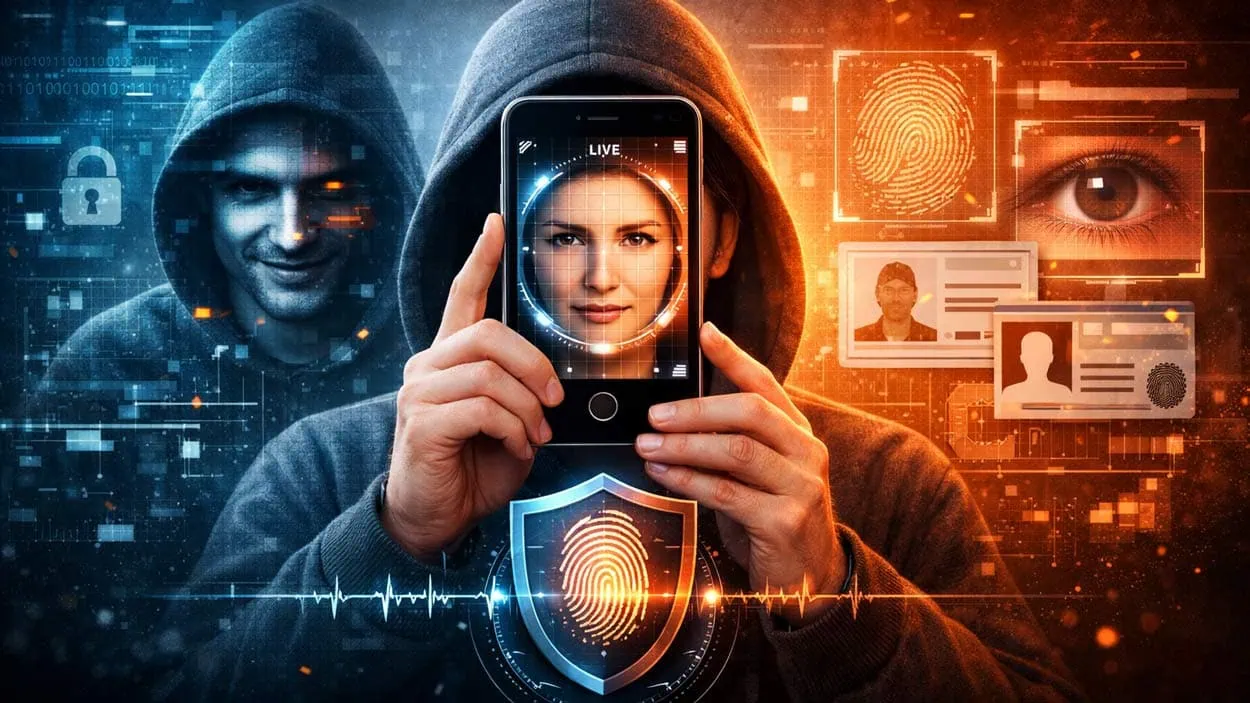
  • Face-swap deepfakes: A stolen identity’s face gets overlaid onto the fraudster’s own during a live selfie check. To the camera, it looks like a real person. It is not.
  • Video injection: Instead of holding a deepfake up to the camera, the attacker skips the camera entirely, injecting a synthetic video stream directly into the verification pipeline via virtual camera software. The platform receives what looks like a legitimate live feed. It is not that either.
  • Synthetic identities: AI-generated faces paired with fabricated or stolen personal data. These are not real people at all, but they can pass document checks if the verification layer is not built to catch them.
  • Voice cloning: Mostly a call centre and social engineering problem for now, but increasingly relevant as voice authentication gets more widespread.

Half of all businesses globally reported dealing with audio or video deepfake fraud in 2024. Crypto platforms got hit hardest; incidents in that sector rose 654% year on year. Fintech and traditional financial services were not far behind.

Old Verification Methods Were Built for a Different Problem

Document fraud used to mean someone altering a physical ID with a razor blade and a photocopier. The countermeasures built to catch that, UV checks, hologram verification, and trained document reviewers, are not much use against a photorealistic synthetic passport generated in seconds by an AI model.

Selfie checks were supposed to be the answer. Take a photo of your face, match it against the ID. The logic was sound when the threat was someone trying to use a different person’s document. It stops making sense when the face in the selfie can be faked in real time.

Knowledge-based authentication, security questions, and memorable dates had already been eroding for years as personal data became easier to scrape. Deepfakes did not kill it, but they have made the case for moving past it a lot harder to argue against.

There is a particular issue with deepfake attacks that makes them worse than most fraud types: when one gets through, there is no alert. The system logs a successful verification. The account looks clean. The fraudster is inside, and nobody knows.

Detection tools tested in controlled environments against known deepfakes perform reasonably well. Against new attack techniques they have not been trained on, accuracy can drop by 50% or more. Fraudsters probe verification systems the same way penetration testers do, trying different approaches until something works, and they have the time and financial incentive to keep at it.

What Liveness Detection Is Actually Doing

The job of liveness detection is narrow but important: confirm that a real person is physically present in front of the camera, right now.

Active liveness checks prompt the user: blink, turn your head, smile. Harder to fake than a static photo, easier than passive methods to work around if you have real-time deepfake software running.

Passive liveness operates without any prompts. It watches the video feed for signals that synthetic media consistently gets wrong: micro-movements in the face, the way light reflects off skin at different angles, blood-flow-driven colour changes, depth and texture cues. These are not things a human reviewer would notice. They are things a well-trained model picks up on even when the deepfake looks visually perfect to the naked eye.

Better implementations combine both, passive analysis running continuously, with active prompts triggered when the confidence score drops below a threshold. Then a cross-check: does the face on the camera match the face on the ID document, and does the whole session look like a genuine live capture rather than a replay or a feed that has been tampered with?

Newsletter
Subscribe To Our Newsletter!

Be the first to get exclusive offers and the latest news.

Injection Attacks Are a Different Problem Entirely

Most of the public conversation about deepfake fraud focuses on face-swap attacks. Injection attacks get less attention, but they are arguably harder to defend against because they sidestep the camera altogether.

In a standard verification flow, the platform assumes the video it is receiving came from the user’s actual camera. Injection breaks that assumption; the attacker intercepts the video pipeline before it reaches the platform and substitutes a synthetic stream. The platform never sees a real camera feed at all. It sees something that looks exactly like one.

Camera-based liveness detection, no matter how good, does not help here. The platform is being fed a signal that has already been compromised upstream.

Defending against injection means checking things that have nothing to do with the video content itself, whether the device has virtual camera software installed, whether the session metadata looks consistent with a genuine device capture, and whether there are signals at the OS or hardware level that suggest something has been inserted into the pipeline. It is a different technical problem, and a lot of platforms are not set up to handle it yet.

Putting Together a Defence That Actually Holds

No single layer makes a verification stack deepfake-proof. These things only work in combination:

  • ISO/IEC 30107-3 Level 2 certified liveness, independently tested against presentation attacks, not just self-assessed.
  • Injection attack detection at the device and session level, separate from video content analysis.
  • Document-to-face matching that runs in real time against the live capture, not just against a stored selfie.
  • Continuously updated detection models, if the AI is not being retrained on new attack methods regularly, it is falling behind.
  • Cross-session fraud signals, repeat attempts from the same device, unusual metadata patterns, and behavioural signals that suggest someone’s probing the system rather than trying to open an account.

Regulators are starting to make some of this mandatory rather than optional. FATF’s digital identity guidance calls out presentation attack detection specifically. eIDAS 2.0 sets explicit requirements for liveness and injection resistance at high assurance levels. The direction of travel is clear, and firms still running verification infrastructure that was designed for a pre-deepfake threat environment are going to find the next round of audits uncomfortable.

Conclusion

Fraud losses matter, obviously. But deepfake fraud has a second-order consequence that is harder to put a number on. Every financial institution’s relationship with its customers rests on the assumption that verification works to ensure that the person on the other side of the account is who they say they are.

Liveness detection, done well, is the most direct technical response available right now. It will not solve the problem permanently, the attack methods will keep evolving, and the defenders will have to keep pace. But it is the checkpoint that everything else in a remote verification flow depends on. If it fails, the rest of the stack does not matter much.


SQ Magazine follows strict Publishing Principles and a documented Fact-Check Policy to ensure accuracy, transparency, and editorial independence across all content.

Add SQ Magazine as a Preferred Source on Google for updates! Follow on Google News
Share ChatGPT Perplexity
Sofia Ramirez

Sofia Ramirez

Senior Tech Writer


Sofia Ramirez is a technology and cybersecurity writer at SQ Magazine. With a keen eye on emerging threats and innovations, she helps readers stay informed and secure in today’s fast-changing tech landscape. Passionate about making cybersecurity accessible, Sofia blends research-driven analysis with straightforward explanations; so whether you’re a tech professional or a curious reader, her work ensures you’re always one step ahead in the digital world.

Related Posts

AI Cyber Attacks Statistics
Cybersecurity

AI Cyber Attacks Statistics 2026: How Attacks, Deepfakes & Ransomware Have Escalated

Voice Phishing Statistics
Cybersecurity

Voice Phishing Statistics 2026: Startling Data

Online Payment Fraud Statistics
Cybersecurity

Online Payment Fraud Statistics 2026: What You See

Disclaimer: The content published on SQ Magazine is for informational and educational purposes only. Please verify details independently before making any important decisions based on our content.

Reader Interactions

Leave a Comment Cancel reply

Primary Sidebar

Connect With Us

facebook x linkedin google-news telegram pinterest whatsapp email
google-preferred-source-badge Add as a preferred source on Google

You Should Also Read

What Is Identity Verification and How Does It Work?
Top AI Fraud Prevention Platforms That Evolve With Threats 2026
AI Voice Cloning Fraud Statistics 2026: Alarming Trends You Must Know Now

Table of Contents

  • How Bad Have the Numbers Actually Gotten?
  • The Onboarding Flow Is the Target
  • Old Verification Methods Were Built for a Different Problem
  • What Liveness Detection Is Actually Doing
  • Injection Attacks Are a Different Problem Entirely
  • Putting Together a Defence That Actually Holds
  • Conclusion
Connect on Telegram

Footer

SQ Magazine Logo

Smarter Insights for a Fast-Moving Digital World

Connect With Us

Follow Us on Google News

Editorial & Trust

  • About
  • Publishing Principles
  • Fact-Check Policy
  • Corrections Policy
  • Ethics Policy
  • Disclaimer

Worth Checking

  • Social Media Attention Span Stats
  • Gen Z Social Media Statistics
  • TikTok vs. Instagram Statistics
  • LLM Hallucination Statistics
  • Spotify User Statistics
  • Apple Customer Loyalty Statistics
Contact Us
13570 Grove Dr #189,
Maple Grove, MN 55311,
United States
10 a.m. to 6 p.m. | Every day

Copyright © 2022–2026 SQ Magazine. All Rights Reserved. Powered by the Neural Stack.

  • Privacy Policy
  • Terms
  • Accessibility Statement
Company
  • About Us
  • Our Team
  • Our Mission
  • Core Values
Discover
  • Brand Assets
    Brand Assets
  • Stats Methodology
    Stats Research Process
  • Glossary
    Glossary
Categories
  • Internet
  • Technology
  • Artificial Intelligence
  • Gaming
  • Cybersecurity
Internet
Hulu Statistics
Hulu Statistics 2026: Subscribers, Revenue and Market Share
Spotify vs Apple Music Statistics
Spotify vs Apple Music Statistics 2026: Subscribers, Revenue, Market Share
Time Spent on TikTok Statistics
Time Spent on TikTok Statistics 2026: Daily Minutes by Age
Google Workspace Statistics
Google Workspace Statistics 2026: Users, Market Share and AI
YouTube vs TikTok Statistics
YouTube vs TikTok Statistics 2026: Users, Revenue, Creator Economy
Internet Outage Statistics
Internet Outage Statistics 2026: Frequency, Cost and Causes
Technology
Google Cloud Platform Statistics
Google Cloud Platform Statistics 2026: Market Growth
Asana Statistics
Asana Statistics 2026: Revenue, Customers, AI ARR and Market Share
AWS Statistics
AWS Statistics 2026: Revenue, Market Share and AI Growth
Adobe Creative Cloud Statistics
Adobe Creative Cloud Statistics 2026: Subscribers, Revenue and Market Share
Adobe Statistics
Adobe Statistics 2026: Revenue, ARR, and Workforce Data
Employee Productivity Statistics
Employee Productivity Statistics 2026: Engagement, Costs & Trends
Artificial Intelligence
Grammarly AI Statistics
Grammarly AI Statistics 2026: Users, Revenue, Funding, Rebrand
Copilot Statistics
Copilot Statistics 2026: Users, Adoption, Revenue and Market Share
AI Image Generation Statistics
AI Image Generation Statistics 2026: Market Size, Adoption & Risks
Machine Learning Adoption
Machine Learning Adoption in 2026: What Businesses Need to Know
AI Influencer Marketing Statistics
AI Influencer Marketing Statistics: Market Size and Engagement
AI Market Statistics
AI Market Statistics 2026: Size, Growth & Investment
Gaming
Online Gambling Regulations Statistics
Online Gambling Regulations Statistics 2026: Global Compliance and Enforcement Data
Fantasy Sports Statistics
Fantasy Sports Statistics 2026: Users, Revenue & Trends
Apex Legends Statistics
Apex Legends Statistics 2026: Players, Revenue, and Esports
Fortnite Statistics
Fortnite Statistics 2026: Players, Revenue, Esports, and Engagement
Gamers Statistics
Gamers Statistics 2026: Players, Habits & Global Data
Minecraft Statistics
Minecraft Statistics 2026: 300 Million Copies Sold & 212M Monthly Players
Cybersecurity
Password Statistics
Password Statistics 2026: Credential Theft, MFA, and the Passkey Tipping Point
Identity Theft Statistics
Identity Theft Statistics 2026: Key Fraud Data and Trends
CVE Statistics
CVE Statistics 2026: Severity Distribution and Top Affected Vendors
Dark Web AI Tool Marketplace Statistics
Dark Web AI Tool Marketplace Statistics 2026: Explosive Market Growth
API Security Breach Statistics
API Security Breach Statistics 2026: Hidden Threats
AI Voice Cloning Fraud Statistics
AI Voice Cloning Fraud Statistics 2026: Alarming Trends You Must Know Now
Categories
  • Cybersecurity
  • Artificial Intelligence
  • Internet
  • Technology
  • Gaming
Cybersecurity
Accenture Confirms Breach After Hacker Lists Stolen Data
Adobe Coldfusion Max Severity Flaw Now Under Attack
Adobe ColdFusion Max-Severity Flaw Now Under Attack
Hp Deskjet 2800 Flaw Leaks Wi Fi Passwords
HP DeskJet 2800 Flaw Leaks Wi-Fi Passwords
Pamstealer Macos Malware Exposed
PamStealer Malware Verifies Stolen Mac Passwords Live
Google Fbi Disrupt Netnut Residential Proxy Network
Google, FBI Disrupt NetNut Residential Proxy Network
India Drafts Stricter Rules For Vpn Providers
India Drafts Stricter Rules for VPN Providers: Report
Artificial Intelligence
Openai Launches Gpt Live Full Duplex Voice Models
OpenAI Launches GPT-Live Full-Duplex Voice Models
Trump Administration Clears Openai S Gpt 5 6 For Launch
Trump Administration Clears OpenAI’s GPT-5.6 for Launch
Anthropic Extends Claude Fable 5 Included Access
Anthropic Brings Claude Cowork To Phones And Web
Anthropic Brings Claude Cowork to Phones and Web
Terawulf Signs 20 Year 19 Billion Anthropic Lease
TeraWulf Signs 20-Year, $19 Billion Anthropic Lease
Microsoft Launches Frontier Company
Microsoft Launches Frontier Company With $2.5B Bet
Internet
Whatsapp Launches Username Reservation Feature
WhatsApp Opens Username Reservations for Its 3 Billion Users
Chrome 149 Update Fixes Serious Vulnerabilities
Google Chrome 149 Fixes 18 Serious Security Flaws
Meta Hands Whatsapp Reins To Cred Founder Kunal Shah
Meta Hands WhatsApp Reins to CRED Founder Kunal Shah
Major X Outage Disrupts Users Worldwide
Major X Outage Disrupts Users Worldwide, Service Restored
Meta Adds 13 Plus Age Verification For Teen Safety
Meta Adds 13+ Content Settings and AI Age Checks for Teens
Telegram Restricted In India Temporarily
Telegram Restricted in India as NEET Fraud Crackdown Grows
Technology
Microsoft Lays Off 4800 Employees
Microsoft Cuts 4,800 Jobs, Resets Xbox Strategy
Chrome Update Fixes 382 Vulnerabilities
Chrome 150 Patches 382 Security Fixes, 15 Critical
Apple Leak Reveals Six New Iphones For 2027
Massive Apple Leak Reveals Six New iPhones for 2027
Google Finance Comes Out Of Beta With Android App
Google Finance Gets Major AI Upgrade and New Android App
Windows Recycle Bin Bug Confirmed After June Security Update
Apple Urgently Fixes Beats Studio Buds Bug
Apple Urgently Fixes Beats Studio Buds Bug That Enabled Spying
Gaming
Gta Vi Official Cover Art
GTA 6 Pre-Orders Start June 25, New Cover Art Unveiled
Epic Games Teases Unreal Engine 6 For Rocket League
Epic Games Teases Unreal Engine 6 for Rocket League
Stardew Valley Launched For Nintendo Switch 2 Edition
Stardew Valley Switch 2 Edition Arrives with Online Co-op
Hogwarts Legacy Game Crosses 40m Downloads
Hogwarts Legacy Crosses 40M Sales, Beating Industry Giants
Pubg Black Budget Closed Alpha Launched
PUBG: Black Budget Launches Closed Alpha Test With a Bold PvPvE Twist
Counter Strike 2 Skin Market Crashes After Valve Update
Counter-Strike 2’s $5.9 Billion Skin Economy Just Got Shattered
Newsletter

Subscribe To Our Newsletter!

Be the first to get exclusive offers and the latest news.

Newsletter

Subscribe To Our Newsletter!

Be the first to get exclusive offers and the latest news.