





Corporations will actively waste a projected $240 billion on cybersecurity this year, shoveling massive capital onto the wrong side of the wall. Nobody bothers brute-forcing a corporate perimeter anymore. Today’s syndicates prefer the path of least resistance; they just log right in using stolen credentials or synthetic digital clones. Supply chain compromises, often backed by state-sponsored capital, allow advanced adversaries to walk completely around your expensive firewalls without triggering a single alarm. The explosion of microservices and third-party integrations has dissolved any recognizable network boundary. A modern digital platform handling high-velocity financial streams must operate under the absolute assumption that the internal network is already compromised. Every single user, autonomous API, and database query must be dynamically authenticated and continuously verified.
The Perimeter Illusion and the Kernel Revolution
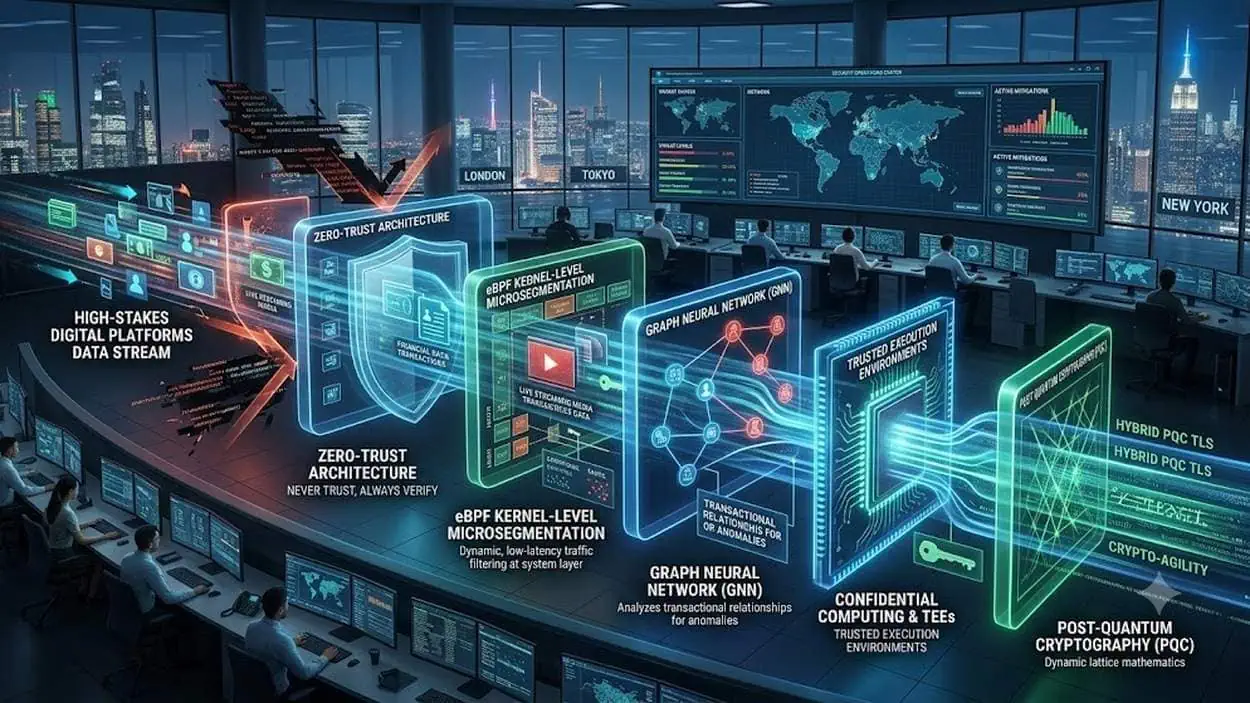
Frameworks such as NIST SP 800-207 scream for a strict “never trust, always verify” baseline. The reality on the ground, however, exposes a brutal maturity gap. A fragmented pile of overlapping legacy tools will never yield genuine security. We all know that microsegmentation looks mathematically perfect on a whiteboard, yet the physical deployment routinely breaks low-latency environments. Back in the early days of service meshes, engineers shoved Envoy sidecar proxies inside every single Kubernetes pod just to manage mutual TLS and route traffic. Latency spikes from that architectural choice were absolutely catastrophic. You cannot afford a 166% processing delay (along with heavy memory overhead) when facilitating high-frequency trades or massive data streams. Platform engineers were frequently forced to carve out dangerous security exceptions just to keep their applications responsive. Frankly, that compromise is no longer necessary. The extended Berkeley Packet Filter (eBPF) revolutionized this exact bottleneck.
This sandboxing mechanism operates directly within the Linux kernel space. We can now run custom security programs without altering the kernel source code or rebooting the host machine. Packets are scrutinized via the eXpress Data Path (XDP) at the exact millisecond they hit the network interface. Security tools monitor process file access and privilege escalations in kernel space, terminating malicious execution chains instantly. Telemetry collection happens automatically. Developers do not need to instrument a single line of code, and application throughput jumps by nearly 40% compared to legacy proxy models.

Relational Myopia and the Graph Intelligence Shift
Infrastructure security only solves half the equation. The application layer faces an entirely different breed of financial warfare. Traditional machine learning models are structurally blind to the reality of modern fraud. Tabular systems analyze transactions as isolated, independent events. A sudden large withdrawal might trigger an alert, but these systems completely miss the coordinated web of synthetic identity clusters, mule accounts, and circular money flows. Organized financial crime is highly relational. It demands a topological defense.
The magic of Graph Neural Networks (GNNs) lies in how they map the entire digital ecosystem as an organic, breathing web. Devices, scattered IP addresses, and actual human users function as the isolated nodes in this model. Rapid-fire transactions and mutual device logins act as the invisible wires connecting everything together. The model uses message-passing algorithms to aggregate risk signals from localized neighborhoods. A seemingly legitimate user sharing a device edge with a known fraudulent entity immediately triggers a mathematical risk propagation. We are now deploying hybrid frameworks that utilize Reinforcement Learning to dynamically adjust sampling strategies. These systems isolate complex fraud rings in under 50 milliseconds while drastically reducing false positive rates.
The catch? Retaining the massive historical datasets required to train these graphs creates a brutal compliance paradox. European data protection laws mandate the immediate deletion of user data upon request. Conversely, financial regulators demand a multi-year retention of audit trails for forensic investigations. Jurisdictional crossfires of this magnitude require advanced federated learning and format-preserving encryption, allowing institutions to map the mathematical structure of the fraud without hoarding toxic plaintext liabilities.
The Cryptographic Reality of Millisecond Media
Sub-second media delivery historically required sacrificing robust encryption. That specific tradeoff is completely unacceptable in highly regulated, high-stakes environments. Look closer. You will see tier-one fintech apps and strictly governed live online casinos operating under immense technical friction. These platforms must synthesize the massive throughput of a streaming media service with the uncompromising transactional integrity dictated by strict frameworks. Outside auditing firms will ruthlessly tear apart random number generators to ensure mathematical unpredictability. These external regulators also mandate grueling penetration benchmarks and demand relentless monitoring of every active session.
The only viable bridge across this technical chasm is Web Real-Time Communication (WebRTC). Older HTTP-based models lean heavily on client-side polling; that alone introduces lag times that will instantly kill an interactive application. A modern WebRTC pipeline completely dodges that delay by shoving data straight through the User Datagram Protocol (UDP). Network jitter is managed instantly via highly adaptive bitrates. You also get a mathematically absolute security perimeter with this setup. Default end-to-end encryption is hardcoded into the pipeline. Cryptographic key exchanges fall under the jurisdiction of Datagram Transport Layer Security (DTLS), whereas the Secure Real-Time Transport Protocol (SRTP) clamps down on the physical media payloads. Anyone trying to hijack these live feeds mid-transit will hit a brick wall unless they somehow steal the ephemeral session keys first.
Synthetic Flesh and the Eradication of the Password
Pipeline encryption means nothing if the onboarding process remains vulnerable to biometric manipulation. Physical liveness checks are completely obsolete in 2026. Anyone can purchase a convincing real-time face-swap or voice clone on the dark web for roughly five dollars. Attackers have abandoned crude presentation tricks in favor of sophisticated software injection vectors. Pre-rendered synthetic video is piped directly into the application API, tricking the downstream liveness algorithms into processing the deepfake as a legitimate hardware sensor feed.
Victory against these synthetic injections requires a layered, multimodal perimeter. Zero-shot pixel forensics can detect the invisible statistical artifacts left behind by generative AI. System architects now demand hardware-attested frames. The physical camera silicon must cryptographically sign the video frame; otherwise, the system instantly drops the connection as a suspected emulator.
Once a user actually clears this gauntlet, securing their session with a password is an indefensible liability. The industry has forcibly migrated to FIDO2 passkeys. Your device generates an asymmetric key pair, locking the private key inside a hardware-isolated enclave. Credential theft is structurally impossible here because there is no shared secret to steal. Widespread adoption of these passkeys also completely eliminates the massive IT support burden of constant password resets.


Silicon Encryption and the Quantum Horizon
Data encryption at rest and in transit is basic table stakes. You still have to decrypt that highly sensitive payload into system RAM to actually process it. Highly privileged cloud administrators, or a compromised hypervisor, could theoretically dump the memory and extract proprietary model weights or plaintext financial APIs. Confidential Computing eliminates this glaring loophole. Silicon-level encryption is the primary weapon of a hardware-based Trusted Execution Environment (TEE). A hypervisor locks down the isolation boundaries with such extreme prejudice that outside processes remain completely blind to the memory partition. Cryptographic attestation allows the enclave to mathematically prove its secure state before any cloud key management system releases the decryption keys.
We are also simultaneously racing to patch the impending quantum apocalypse. Cryptographically Relevant Quantum Computers (CRQCs) will eventually shatter classical asymmetric algorithms. State-sponsored threat actors are actively harvesting massive tranches of encrypted global traffic under a “Store Now, Decrypt Later” doctrine. The only viable defense is immediate crypto-agility, a posture heavily mandated by updated PCI DSS 4.0 frameworks. Critical financial streams now utilize a hybrid post-quantum key exchange, concatenating classical Elliptic Curve Diffie-Hellman with new lattice-based standards like ML-KEM. A hidden vulnerability in the new quantum math will not expose the session, because the classical cryptographic layer remains intact to maintain defense-in-depth.
The Economic Brutality of Cyber Insurability
None of this architectural evolution is driven solely by technical idealism. Follow the money. The cyber insurance market is aggressively enforcing these exact security postures. Underwriting has evolved from passive questionnaires into ruthless, evidence-backed technical evaluations. Carriers will instantly deny coverage or hike premiums drastically if an organization cannot prove universal deployment of phishing-resistant authentication and kernel-level endpoint detection. The financial feedback loop is highly effective. Platforms clinging to legacy VPNs, password-based access, and fragmented telemetry are effectively uninsurable.
Modern defense architectures must meet this threat directly at the edge. Highly coordinated business enterprises weaponize synthetic media to bypass identity checks instantly. Complex algorithms map relational graphs on the fly, laundering funds through the microscopic latency windows of legacy infrastructure. Security architecture must be relentlessly fluid, continuously verified, and mathematically absolute. The margin for error has permanently vanished. Zero room remains for outdated trust models or the comforting illusion of a fortified perimeter.