As cyber threats escalate, demand for skilled defenders rises in tandem. In the U.S. alone, cybersecurity roles are among the fastest‑growing tech jobs. Organizations across finance and government now treat security talent as foundational. This article dives into the latest statistics on cybersecurity careers in 2025, from workforce growth to in‑demand roles, and shows you where the greatest gaps and opportunities lie.
Editor’s Choice
- The U.S. cybersecurity workforce is estimated at roughly 1.33 million professionals.
- National demand still outpaces supply. CyberSeek reports a 74% supply ratio (workers available vs. employer demand).
- U.S. employers posted over 514,000 cybersecurity job openings in the past 12 months, up 12% year over year.
- Globally, there are about 4.8 million unfilled cybersecurity jobs in 2025.
- According to the U.S. Bureau of Labor Statistics, employment of information security analysts is projected to grow 29% from 2024 to 2034.
- Fifty‑two percent of cybersecurity leaders now say that the real issue is not the headcount but the lack of the right skills.
- In ISC²’s 2025 hiring survey, 56% of hiring managers said training entry‑level professionals to full independence takes 4–9 months.
Recent Developments
- In 2024, 37% of organizations reported budget cuts to their cybersecurity departments.
- That same survey found 25% of organizations did layoffs in cybersecurity teams in 2024.
- The World Economic Forum’s Global Cybersecurity Outlook notes that since 2024, the cyber skills gap has increased by 8%, with two out of three organizations saying their gap is moderate to critical.
- According to SANS/GIAC’s 2025 workforce research, 52% of leaders say the shortage is not sheer numbers but the misalignment of skills.
- Cybersecurity job postings in some roles are shifting rapidly; for example, Cybersecurity/Privacy Attorney posts surged 40.7% year over year.
- Product Security Engineers’ postings rebounded by 12.08% from 2023 to 2024 after earlier declines.
- Inflation pressures and cost control are pushing some companies to slow hiring or cut headcount, even in security firms.
- Federal cybersecurity agencies face disruption; the U.S. Cybersecurity and Infrastructure Security Agency (CISA) has seen attrition and staffing stress amid budget uncertainty.
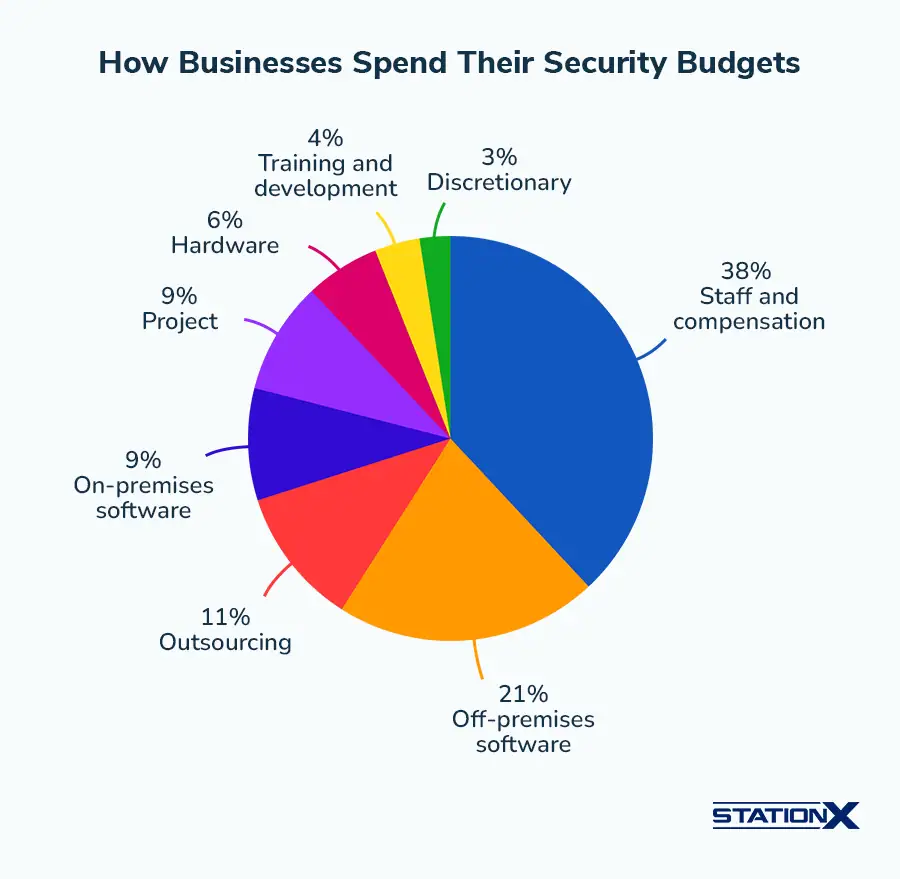
How Businesses Allocate Their Security Budgets
- Staff and compensation take the largest share of security spending at 38%, reflecting the ongoing need for skilled cybersecurity professionals.
- Off-premises software accounts for 21%, highlighting the growing reliance on cloud-based security tools and SaaS platforms.
- Outsourcing represents 11% of total budgets, as many organizations turn to managed security service providers (MSSPs) for specialized expertise.
- On-premises software and project investments each consume 9%, showing that businesses still maintain hybrid security infrastructures.
- Hardware purchases make up 6%, covering essentials like firewalls, routers, and endpoint protection devices.
- Training and development receive 4%, emphasizing a modest but crucial investment in upskilling cybersecurity teams.
- Discretionary spending stands at 3%, reserved for unexpected risks or emerging security needs.
Cybersecurity Workforce Size and Growth
- The U.S. cybersecurity workforce is estimated at 1.33 million professionals.
- Since 2010, that workforce has grown by around 59%.
- CyberSeek’s heat map shows a 74% match between available workers and job openings, that is, a supply shortfall.
- CyberSeek’s job openings count for 2025 is ~457,398 in the U.S.
- CompTIA figures note nearly 470,000 U.S.-based job openings with cybersecurity-related skills from May 2023 to Apr 2024.
- NIST/CyberSeek data indicate a gap of ~265,000 more cybersecurity workers needed to fill current U.S. demand.
- Globally, ~4.8 million cybersecurity roles remain unfilled in 2025.

Cybersecurity Job Demand and Employment Outlook
- U.S. employers posted over 514,000 cybersecurity job openings in the past 12 months, up 12% from the previous year.
- Demand is largely stable or growing across sectors, driven by regulation, breach risk, and digital transformation.
- For the period 2023 to 2033, U.S. employment in cybersecurity is expected to grow by ~33%.
- The BLS projects ~16,000 annual openings for information security analysts over the decade, to replace those retiring or changing fields.
- In 2025, some estimates indicate 4.8 million unfilled global cybersecurity roles.
- The supply–demand ratio suggests many regions will remain underserved. CyberSeek’s 74% figure underscores the gap.
- Some organizations are shifting more toward internal training and retention due to recruitment challenges.
Top Cybersecurity Threats
- AI-driven malware tops the list at 43.4%, as attackers use artificial intelligence to create adaptive, self-learning malicious code that evades traditional defenses.
- AI-enhanced password cracking follows at 39.2%, with cybercriminals leveraging machine learning to break complex passwords in seconds.
- Ransomware as a service accounts for 38.4%, reflecting the rise of subscription-based ransomware kits that make attacks accessible even to non-experts.
- Supply chain attacks stand at 33.6%, highlighting vulnerabilities in third-party vendors and software dependencies that expose entire ecosystems.
- Shadow IT threats make up 32.6%, as unauthorized tools and apps create hidden entry points for cyber intrusions.
- IoT device vulnerabilities reach 30.2%, with billions of connected devices lacking adequate security patches and monitoring.
- Deepfakes pose emerging risks at 27.5%, being used for identity theft, misinformation, and corporate fraud through hyper-realistic synthetic media.

Skills Gap and Worker Shortage in Cybersecurity
- In 2025, 4.8 million cybersecurity jobs will be vacant globally.
- ISC² data shows lack of budget is cited by 33% as a driver of talent shortage and by 39% for skills gap.
- In 2024, 37% of organizations reported budget cuts in their cybersecurity functions.
- 25% of organizations said they had done layoffs of cybersecurity staff in 2024.
- According to SANS/GIAC, 52% of leaders say the real deficit is not headcount but skill misalignment.
- Eighty-seven percent of organizations experienced at least one breach, with more than half losing over $1 million, linked to skills gaps.
- Organizations with high skills shortage see average breach costs of $5.74 million vs $3.98 million for less-short companies, a difference ≈ $1.76M.
- The healthcare sector, with high data sensitivity, is particularly exposed and suffers among the highest breach costs.
In‑Demand Cybersecurity Job Roles
- Cybersecurity/Privacy Attorney postings up 40.74% year over year.
- Red Teamer roles up 29.18%.
- Cybersecurity Sales Engineer postings rose 26.22%.
- Cyber Threat Intelligence Analyst posted +14.24%.
- Incident Responder roles +12.14%.
- Product Security Engineer +12.08%.
- GRC Analyst (Governance, Risk & Compliance) +11.81%.
- Reverse Engineer / Malware Analyst +6.66%.
- Security Engineer and Security Analyst remain high-volume roles, though some decline is observed.
- Roles in “response” functions are seeing rapid growth in demand.
- DevSecOps roles declined earlier but show signs of stabilization.
- Demand for privacy, legal, and compliance–related cybersecurity roles has increased.
- In many job listings, soft skills like communication and project management are required in tandem with technical ability.
Cybersecurity Job Satisfaction and Workplace Factors
- 66% of professionals say their job is more stressful than five years ago.
- 44% reported severe stress or burnout; another 28% were unsure.
- Only 1 in 3 professionals would recommend their current employer.
- Job satisfaction is ~71% in organizations without recent layoffs.
- 55% of cybersecurity teams report being understaffed, and 65% have unfilled roles.
- Women report higher satisfaction under stable conditions but suffer more in layoffs.
- Flexible models, mental health support, and clear advancement improve satisfaction.
- High threat volumes, understaffing, and blurred role boundaries contribute to stress.
- Academic cybersecurity staff report higher satisfaction under hybrid models.

Most Needed Cybersecurity Skills and Specializations
- Cloud security, including AWS, Azure, and GCP, ranks among the top 3 skill demands in 2025 cybersecurity job postings.
- Identity and access management (IAM) skills appear in 48% of security job descriptions.
- Incident response and forensics are cited in over 40% of mid‑ to senior‑level roles.
- Threat intelligence/threat hunting specializations appear in 37% of listings.
- DevSecOps / secure coding is required in ~32% of job ads.
- Risk management / GRC shows up in ~28% of senior roles.
- Zero Trust architecture expertise is increasingly a must; over 25% of large orgs demand it.
- AI/machine learning security is emerging, ~15% of cutting‑edge roles now expect familiarity with adversarial ML.
- Soft skills like communication, cross‑team collaboration, and business acumen are stipulated in many listings.
Average Salaries for Cybersecurity Positions
- The median annual wage for U.S. information security analysts was $124,910 in May 2024.
- Entry-level cybersecurity roles often begin in the $70,000–$90,000 range.
- Senior or specialized roles frequently command $140,000–$160,000+ annually.
- A Cybersecurity Engineer’s average base in the U.S. is $164,339, with total compensation averaging ~$197,307.
- In 2025, one source estimated an average for cybersecurity roles of $111,473, with high roles pushing $150,726.
- In California, security specialists often earn between $140,000 and $226,000, with an average of $176,616.
- The 10th percentile among security analysts makes less than $69,660, while the 90th percentile exceeds $186,420.
- Across states, average cybersecurity salaries range broadly from $44,000 to $147,514.
Educational Requirements for Cybersecurity Careers
- A bachelor’s degree in computer science, cybersecurity, or a related field remains standard for ~70–80% of roles.
- About 20–30% of listings now accept equivalent experience instead of a degree.
- Master’s degrees are required in ~15% of senior roles.
- Certificates, bootcamps, and academies are accepted in ~25% of mid-level listings.
- 55% of organizations consider internships, and 46% apprenticeships as viable junior hire pathways.
- Public and private institutions are improving their cybersecurity programs to close pipeline gaps.
- For specialties like forensics or cryptography, formal graduate coursework is often preferred.
- Certifications, real projects, and competitions are used to validate hands‑on competency over academic credentials.

Highest‑Paying Cybersecurity Careers
- CISO roles often fall in the $160,000–$250,000+ band.
- Security Architect / Cloud Security Architect roles commonly reach $130,000–$190,000+.
- Lead Penetration Tester positions command $115,000–$160,000.
- Cybersecurity Manager / Director roles often occupy the $110,000–$155,000+ range.
- Information Security Director roles reach $125,000–$180,000+.
- Cloud Security Engineer salaries often land in $120,000–$160,000.
- Application Security Engineers may see an average $95,000–$135,000.
- In some executive circles, a CISO’s total compensation can exceed $500,000.
Cybersecurity Job Openings by Location and Region
- Coastal tech hubs like the San Francisco Bay Area, the New York metro, and Washington, D.C. regularly report over 2,000 active security job postings.
- California leads nationally in average security salaries.
- Regions with lower cost of living often show more modest salary bands but still strong demand for remote‑capable roles.
- Some states report 10–20% more security openings per capita than the national average.
- Asia-Pacific and Europe report steady growth in cybersecurity hiring.
- Remote and hybrid job models have enabled more national coverage.
- Regions with heavy regulation, like New York, Virginia, and Maryland, frequently post high volumes of security roles.
- Growth of cloud operations in nontraditional tech regions is shifting more security roles toward those geographies.
Cybersecurity Certifications and Their Impact on Hiring
- Certified professionals often command 10–20% higher salaries than non-certified peers.
- Workers with a certification earned a median weekly wage of $1,463 vs. $1,024 for those without.
- Senior leadership roles require CISSP, CISM, or CRISC as baseline credentials.
- Cloud roles prefer CCSP, AWS Certified Security, and Azure Security Engineer.
- Over 60% of employers prefer certified candidates when technical skills are similar.
- Employers discourage “certificate stacking” and favor recognized, relevant certifications.
- For entry-level roles, CompTIA Security+ and Certified in Cybersecurity (ISC²) are among the most requested.
- Certifications serve as trust signals in regulated sectors and can impact compliance readiness.
Career Pathways and Advancement in Cybersecurity
- Many professionals progress from analyst → engineer → architect → director / CISO over 10–20 years.
- Others move laterally into threat intelligence, red teaming, or cloud security before rising to leadership.
- ~61% of cybersecurity staff work across multiple domains, not just single specialties.
- Smaller organizations may assign two or more roles to one individual due to constraints.
- Internships and apprenticeships are increasingly recognized as talent pipelines.
- Some firms offer rotational programs to expose hires to SOC, incident response, compliance, and more.
- Mentorship, internal training, and cross-functional exposure influence career progression.
- Certifications earned post-hire often trigger promotions or role expansion.
Remote and Hybrid Work in Cybersecurity
- Only 8% of Fortune 100 security job postings offer remote work flexibility.
- ~93% of organizations now use remote work security frameworks.
- 90% of higher education security staff report improved work-life balance under flexible work.
- 78% saw increased job satisfaction in hybrid or remote setups.
- Fully remote onboarding may lead to higher early attrition within 3 years.
- Hybrid models support integration, mentoring, and workplace stability.
- Remote jobs now require rigorous home-office security standards.
- Many roles remain regionally anchored for compliance or on-site audits.
Recruiting, Retention, and Turnover in Cybersecurity Roles
- Entry-level and mid-level roles take 3 to 6 months to fill.
- 77.2% of firms used sign-on bonuses in 2025, and 54% used retention bonuses.
- Sign-on bonuses average $5,500–$19,000, depending on level.
- Retention bonuses range from ~$9,000 to $35,000.
- 61% of professionals believe regular turnover poses security risks.
- Replacing a cybersecurity professional costs ~$145,000, including productivity loss.
- Talent poaching is cited by 67% of CISOs as a top turnover driver.
- Burnout, lack of mobility, and underinvestment are key attrition causes.
Frequently Asked Questions (FAQs)
About 514,359 cybersecurity‑related job postings are active nationally in 2025.
The U.S. faces a gap of nearly 265,000 cybersecurity workers needed to meet demand.
The employment of information security analysts is expected to grow by 29% from 2024 to 2034.
There are an estimated 4.8 million unfilled cybersecurity positions worldwide
Conclusion
The cybersecurity job landscape is a balancing act between urgent demand and severe talent constraints. As organizations across sectors continue to expand their digital footprint, demand for security expertise will only intensify. Yet high turnover, burnout, and skill mismatches challenge sustainable growth. For those building or navigating a cybersecurity career, success will hinge on hybrid technical and soft skill mastery, adaptability to new domains, and choosing environments that value work-life balance and clear progression. Use this data as your map, then build toward roles and sectors that reflect both demand and your personal strengths.