

The cryptocurrency market is valued at $2.7 trillion in 2026. A modern crypto on-ramp allows users to buy crypto in a few minutes.
| Platform | Supported Countries | Fiat Currencies | Payment Methods | Cryptocurrencies | Limits | KYC Requirements | Transaction Time | Wallet Delivery | Integration Options |
|---|---|---|---|---|---|---|---|---|---|
| Paybis | Over 180 | Up to 70 | Over 20 | Over 90 | Up to $1,000,000 | Personal details, selfie check, and ID | Up to 10 minutes | External wallets and Paybis wallet | API, business on/off ramp, white-label |
| MoonPay | Over 100 | Over 30 | Up to 13 | Over 60 | Varies by region/KYC tier | Personal details, selfie check, and ID | Up to a few minutes | External wallets and MoonPay wallet | API/SDK, hosted widgets, headless |
| Transak | Over 60 | Up to 27 | Up to 7 | Up to 136 | Up to $75,000 | Personal details, selfie check, and ID | Up to 3 minutes | External wallets | API/SDK, widgets, white-label |
| Ramp Network | Over 150 | Up to 36 | Over 10 | Over 130 | $50,000 per 30 days | Personal details, selfie check, and ID | Up to a few minutes | External wallets | API/SDK, widget, business integrations |
| Banxa | Over 180 | Over 30 | Over 20 | Over 300 | Varies by country/payment method | Personal details, selfie check, and ID | Up to 90 minutes | External wallets | Native API, SDK, hosted checkout |
(Info relevant for Sep 10, 2026)
What Is a Crypto On-Ramp?

Crypto on-ramp platforms live inside Web3 products. When a developer plugs in an on-ramp, providers take the burden of regulatory compliance. They handle identity verification required by local laws, process traditional payments, and deliver digital assets straight to users.
Centralized exchanges, like Binance or Coinbase, differ from crypto on-ramp platforms. They usually use a custodial wallet controlled by the platform to exchange assets.
On-ramps bridge assets and your personal wallet. They let you send funds directly to your private wallet.
Cryptocurrency on-ramping is a middleman service that reduces legal friction. The fees of on-ramping are dynamic. They depend on your:
- Specific country.
- Payment method.
- Fiat currency.
- Digital asset.
- Size of transaction.
- Blockchain.
You can’t assume a flat rate applies universally. Instead, you should check the live final quote before confirming the purchase.
5 Best Crypto On-Ramp Platforms in 2026
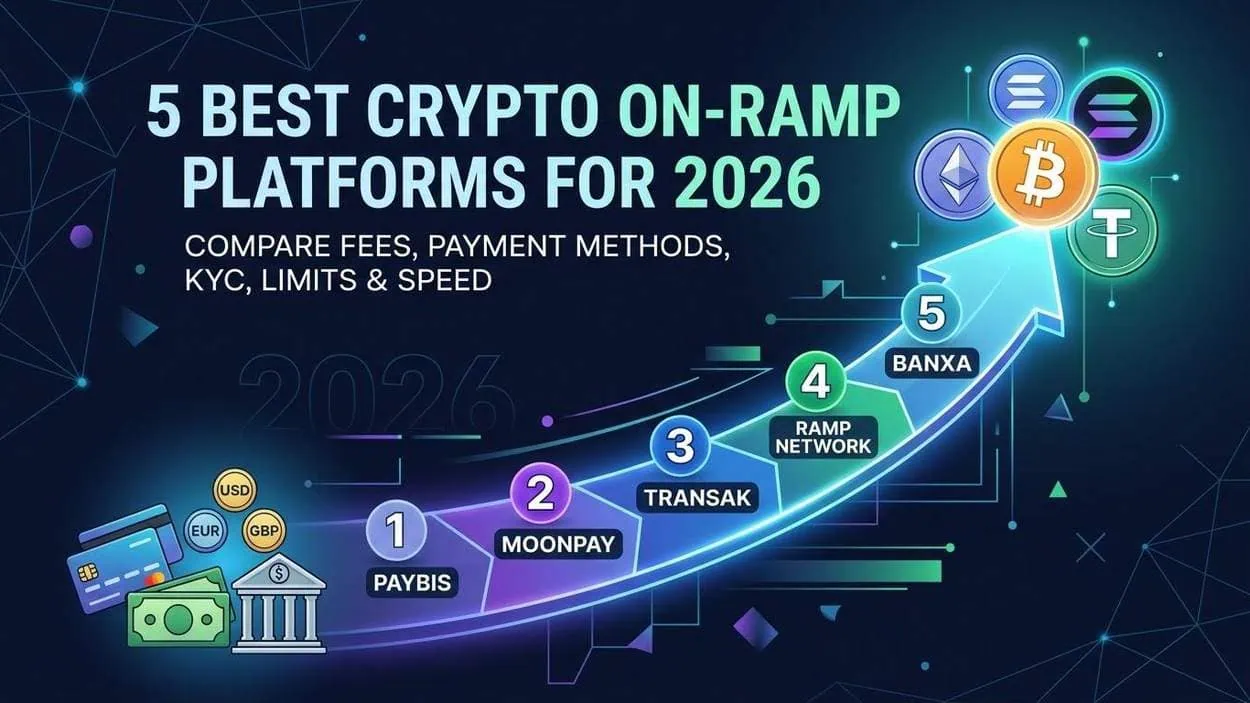
In 2026, there are five on-ramp platforms worth your attention:
1. Paybis
Paybis offers over 90 cryptocurrencies and up to 70 fiat currencies in over 180 countries.
The platform can process transactions of $5 to $20,000 per purchase. To complete any Paybis transaction, you should complete the KYC procedure by providing your personal data, ID photo, and selfie check.
You can store assets in your private wallet or Paybis wallet. For easier purchasing, you can first sign up for Paybis and complete KYC. Then, you can choose the amount, fiat currency, and crypto options on the Paybis homepage. You enter your wallet address, send your fiat, and confirm the transaction.
Paybis’s main limitation is its fees. Fees range from 0.99% for bank transfers to 8.5% for card purchases. The platform also supports over 20 payment methods like Skrill, Neteller, PayPal, Apple Pay, and Google Pay.
For Web3 developers, Paybis offers APIs and customizable white-label options.
2. MoonPay
MoonPay acts as a seamless bridge for integration into wallets, exchanges, and apps. It offers hosted widgets and headless solutions for developers building their own UI with MoonPay in the background.
The platform taps into various consumer payment rails like Apple Pay, Google Pay, PayPal, and Revolut. MoonPay offers over 60 cryptocurrencies across various supported networks and over 30 fiat currencies in over 100 countries.
The platform provides a non-custodial wallet option. MoonPay offers the convenience of centralized checkout while ensuring you maintain ownership of your digital assets.
MoonPay uses a dynamic fee structure based on payment method and network. Processing fees are usually 4.5% for cards and 1% for bank transfers. To complete a transaction, MoonPay asks users to provide personal information, a selfie check, and ID for verification.

3. Transak
Transak supports over 130 cryptocurrencies and up to 27 fiat currencies in over 60 countries. Transak also provides developers with widgets, an API, and a web SDK. This allows for business integration use cases like NFT markets, Web3 gaming, and decentralized finance projects.
One innovative way Transak manages compliance is through tiered verification. It offers light and standard KYC.
Transak’s fee structure depends on the payment method and network. It usually charges 1% for SEPA and 5.5% for non-EUR Apple Pay or Google Pay payments. The settlement process moves fast once you complete registration and KYC. Transactions can take up to three minutes.
Transak offers wire transfers in the US, SEPA in the EU, and Faster Payments in the UK.
4. Ramp Network
Ramp Network offers access to over 130 cryptocurrencies and up to 36 fiat currencies in over 150 countries. It offers transactions within the BTC, SOL, Stellar, and ETH networks.
During the Ramp Network checkout flow, users provide their private wallet addresses. The platform processes the fiat purchase and delivers it directly to the blockchain. Card purchases through this platform arrive in your personal wallet in a few minutes. Before completing any transaction, you should provide your proof of address, ID or driving license, and a selfie check as part of verification.
The platform fees start at 1.4% for manual bank transfers. For card transfers in EUR, USD, and GBP, the fee is 3.9%; for other currencies, it’s 5.45%. You can also use Ramp Network’s SDK and API to integrate its widgets and payment capabilities.
Ramp Network supports major global rails like debit and credit cards, Apple Pay, Google Pay, and bank transfers. However, similar to MoonPay, this platform isn’t immune to regional limitations.
5. Banxa
Banxa offers over 300 cryptocurrencies and over 30 fiat currencies in over 180 countries. Banxa also integrates SEPA in Europe and ACH in the US.
Banxa fees range from 1% for bank transfers and up to 5% for card transactions. During checkout, the settlement system locks the quoted crypto price for three minutes to protect against market volatility. You can use your private crypto wallet for on-ramping crypto with Banxa.
The platform provides hosted checkouts, APIs, and SDKs. Banxa handles the compliance required to process high volumes. It also provides identity verification, liveness checks, and online anti-money laundering checks.
Which Crypto On-Ramp Should You Choose?
The best platform depends on your needs. If you are a first-time buyer and want a straightforward purchase with a debit or credit card, you’ll likely lean toward MoonPay or Paybis. However, if card fees are a deal-breaker and you want the lowest total-cost direct local bank transfer, Banxa (best for geographic coverage) and Transak dominate the regional payment rails.
If your primary concern is immediate self-custody, Ramp Network can provide that option. The platform allows you to use your private wallet without compromising transaction speed. However, if you are a Web3 developer, your options include Transak and MoonPay for seamless Web3 integration, or Banxa if your model requires access to local payment options.
The cheapest crypto on-ramp varies by country and payment method. Card transactions usually cost more because they involve international payment rails and security measures that take time and money to process.
Final Recommendations
For individual buyers, Paybis and MoonPay are ideal options, with simple, fast checkout. Businesses will benefit from MoonPay and Transak with their seamless API and SDK integrations into web3 solutions. For payment method coverage, Banxa and Paybis offer over 20 options. Ramp Network, on the other hand, combines various benefits of crypto on-ramps with a simple private wallet delivery system.