

• Skip to primary navigation
  • Skip to main content
  • Skip to primary sidebar
  • Skip to footer
Sq Magazine LogoSQ Magazine

Smarter Insights for a Fast-Moving Digital World

  • Latest News
  • Statistics
  • About
  • Contact
Subscribe
Sq Magazine Logo
  • Latest News
  • Statistics
  • About
  • Contact
Subscribe
Home » Technology

Consumer Trust In Technology Statistics 2026: Alarming Signals

Published on: February 26, 2026
Sofia Ramirez
Written By
Sofia Ramirez
Sofia Ramirez
Senior Tech Writer • 496 Articles
Sofia Ramirez is a technology and cybersecurity writer at SQ Magazine. With a keen eye on emerging threats and innovations, she helps reader...
LATEST POSTS:
WhatsApp Scams in 2026: Common Types and How to Spot Them
Cursor’s Unpatched Zero-Day Lets Repos Run Malicious Code
Notepad++ 8.9.7 Patches Five Security Vulnerabilities
Robert A. Lee
Reviewed By
Robert A. Lee
Robert A. Lee
Senior Editor • 409 Articles
Robert A. Lee is a journalist at SQ Magazine who unpacks the fast-moving worlds of gaming and internet trends. He tracks everything from maj...
LATEST POSTS:
WhatsApp vs Signal vs Telegram: Which Is Most Secure in 2026?
Social Media Demographics by Platform Statistics 2026: A Definitive Guide
Amazon Music Statistics 2026: Subscribers, Share and Revenue
Consumer Trust In Technology Statistics
As Featured In
The New York Times LogoForbes LogoWired LogoDeloitte LogoResearch.com Logo
Share on LinkedIn ChatGPT Perplexity Share on X Share on Facebook

Consumer trust in technology continues to define how Americans adopt digital products, share personal data, and engage with artificial intelligence. Today, trust is neither collapsing nor fully recovering; it is evolving.

From smart home ecosystems and wearable health devices to AI-powered banking tools and automated customer service, trust directly influences spending behavior, brand loyalty, and long-term adoption. The data below outlines where trust stands today, how it shifted from last year, and what it means for businesses operating in a privacy-sensitive economy.

Editor’s Choice

  • 34% of organizations cite data leaks tied to generative AI as their top security concern in 2026.
  • 86% of companies plan to increase investment in AI-related data privacy protections over the next two years.
  • 86% of consumers expect strong data privacy rights from online companies.
  • 48% of individuals reported experiencing at least one data security failure in the past 12 months.
  • 75% of Americans say they trust online information less than they did a few years ago.
  • 74% of US wearable device users worry about how their health data is collected and shared.

Recent Developments

  • Cybersecurity now ranks among the top three board-level priorities for 80% of enterprise leaders in 2026.
  • AI-driven phishing attacks increased by 47% year over year in 2025.
  • Consumers reported a 48% rise in security-related incidents compared with the previous year.
  • 64% of consumers say advanced encryption and visible security measures would significantly increase their confidence in a brand.
  • Zero-trust architecture adoption increased by 39% among US enterprises over the past two years.
  • 67% of consumers now expect companies to clearly disclose AI use in customer interactions.
  • Privacy-related litigation increased by 18% in 2025 compared with 2024.
  • 72% of organizations expanded internal AI governance frameworks in response to public trust concerns.

Trust in Online Financial Transactions by Income Level

  • People earning more than 76,000 show the highest trust at 74%, indicating strong confidence in online financial services.
  • Those in the 50,000–75,000 income group report 68% trust, slightly lower but still high overall.
  • Individuals earning under 49,000 show 67% trust, nearly equal to the middle-income group.
  • Higher income generally links to greater trust, but the gap between groups remains small.
  • Overall, trust stays above two-thirds across all income levels, showing broad acceptance of online transactions.
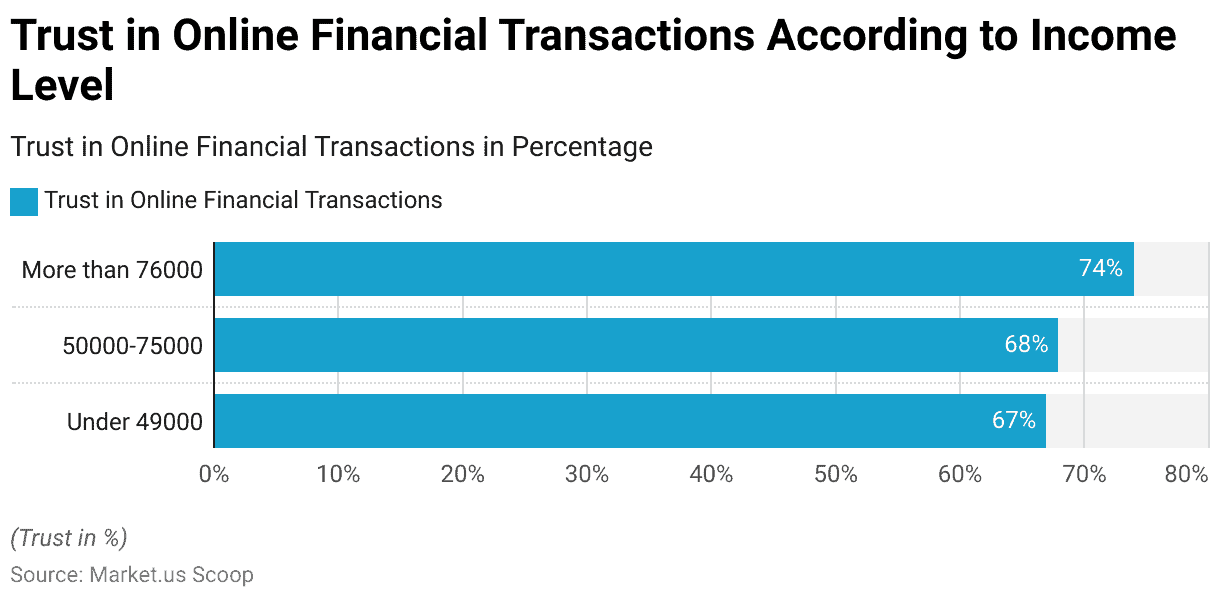
Trust In Online Financial Transactions By Income Level
(Reference: Market.us Scoop)

Overall Consumer Trust Levels

  • 86% of consumers expect companies to protect their data proactively.
  • 63% believe that too much responsibility for cybersecurity falls on individuals rather than companies.
  • 48% of Americans experienced at least one breach notification in the past year.
  • Only 58% of wearable tech users feel confident that their devices adequately safeguard personal data.
  • 75% of Americans say online misinformation has reduced their overall trust in digital platforms.
  • Trust in big tech companies declined by 6 percentage points year over year in 2025.
Newsletter
Don’t chase tech news. We track it for you.

One weekly briefing with the launches, AI developments, and breaches that matter. No filler.

Trust in AI and Emerging Tech

  • 52% of Americans say they are more concerned than excited about AI’s growing presence in daily life.
  • Only 10% report feeling more excited than concerned about AI adoption.
  • 61% would feel uncomfortable with AI making hiring decisions without human oversight.
  • 73% believe companies should disclose when AI systems are used in customer service.
  • 42% of US adults say they have little to no trust in companies to deploy AI responsibly.
  • 35% of device users have disabled AI features due to privacy concerns.
  • 78% of executives say responsible AI governance directly impacts customer trust.
  • 58% of consumers acknowledge AI improves personalization, yet 64% worry about how that personalization uses their data.
  • Emerging markets report AI trust levels exceeding 65%, compared with 38% in North America.

Consumer Trust in Digital Services by Industry

  • The Banking & Financial sector earns the highest trust at 42%, showing strong confidence in digital money services.
  • Healthcare providers follow with 37% trust, reflecting growing acceptance of online health platforms.
  • Consumer technology providers reach 32% trust, driven by everyday use of digital devices and services.
  • Social media companies receive only 18% trust, indicating ongoing concerns about privacy and data use.
  • Trust in government digital services stands at 14%, showing limited public confidence.
  • Media & Entertainment ranks lowest with just 12% trust, suggesting skepticism toward online content platforms.
  • Overall, essential services like banking and healthcare gain far more trust than media and social platforms.
Consumer Trust In Digital Services By Industry
(Reference: Statista)

Regional Differences in Trust

  • Consumers in Southeast Asia report AI trust levels above 65%, compared with 38% in North America.
  • 72% of consumers in India believe AI will positively impact economic growth.
  • In Western Europe, 60% of consumers say GDPR increases their confidence in digital services.
  • 49% of US consumers say national privacy regulation would improve their trust in tech companies.
  • Latin American fintech trust levels exceed 55% in Brazil and Mexico.
  • 68% of Japanese consumers express skepticism toward AI-generated news.
  • 74% of Singapore residents report comfort using government-backed digital identity systems.
  • African mobile money platforms report user confidence levels of 62%.
  • Cross-border data concerns influence trust perceptions for 70% of global consumers.

Demographic Variations

  • Adults aged 18 to 29 are twice as likely as those over 65 to say AI benefits outweigh risks.
  • 71% of Gen Z consumers are comfortable sharing data for personalization, compared with 48% of Baby Boomers.
  • 59% of college-educated adults say they understand AI basics, versus 34% of those with less formal education.
  • Women are 8 percentage points more likely than men to report concerns about AI bias.
  • 43% of rural Americans say limited broadband access affects their trust in digital services.
  • Digitally skilled users are 1.8 times more likely to trust fintech platforms.
  • 55% of small business owners say they trust cloud-based tools more than on-premise software.

Data Privacy Concerns

  • 81% of Americans believe data collection risks outweigh the benefits.
  • 76% of global consumers would stop doing business with a company they do not trust to protect their data.
  • 63% say companies are unclear about how personal information is used.
  • 90% of consumers want the right to permanently delete personal data.
  • 58% have abandoned an online purchase due to privacy concerns.
  • 70% say greater transparency around data practices would increase trust.
  • 52% of wearable users worry about health data being sold to third parties.
Consumer Data Privacy Concerns

Cybersecurity and Data Breaches

  • Cybercrime is projected to cost the global economy $10.5 trillion annually.
  • 72% of organizations experienced ransomware attacks in 2025.
  • The global average cost of a data breach reached $4.45 million.
  • In the US, average breach costs climbed to $9.48 million.
  • Healthcare breaches average $10.93 million per incident.
  • 60% of small businesses close within six months of a major cyberattack.
  • 83% of companies report experiencing more than one breach.
  • 57% of US adults now use multi-factor authentication, up from 45% two years earlier.
  • AI-powered cyberattacks increased by 47% year over year.

Impact of Data Breaches

  • Public companies see an average 7.5% stock price decline following major breach disclosures.
  • 65% of consumers say they immediately lose trust in a brand after a breach.
  • 32% would permanently stop doing business with a company following financial data exposure.
  • Organizations with zero-trust frameworks reduce breach costs by nearly $1 million.
  • Breach-related legal settlements increased by 18% year over year.
  • 74% of consumers say transparent breach communication influences loyalty.
  • Customer churn increases by an average 3% to 5% after high-profile cyber incidents.
  • Repeat breach incidents increase regulatory scrutiny by 40%.
  • Incident response delays increase overall financial impact by up to 22%.

Consumer Behaviors After Breaches

  • 76% of consumers stop sharing personal data after a breach.
  • 67% change passwords across multiple accounts after major incidents.
  • 58% enroll in credit monitoring services after financial breaches.
  • 53% enable multi-factor authentication following breach notifications.
  • 41% read privacy policies more carefully after exposure to breach news.
  • 39% reduce mobile app permissions post-incident.
  • 28% switch to competitors after repeated cybersecurity failures.
  • 45% may give a company a second chance if compensation or protection services are offered.
How Consumers React After Data Breaches

Factors Building Trust

  • 81% say clear communication about data usage increases brand trust.
  • 78% of executives report that cybersecurity investments strengthen customer relationships.
  • Companies with strong privacy frameworks show 2.7 times higher loyalty scores.
  • 72% of consumers prefer brands that offer simple data deletion controls.
  • 66% trust platforms more when independent audits are published.
  • 68% expect proactive notifications when privacy policies change.
  • 64% say visible compliance certifications influence buying decisions.
  • Ethical AI commitments increase adoption willingness among 59% of Americans.
  • Transparent breach reporting reduces churn by up to 30%.

Regulatory Impact on Trust

  • 60% of European consumers say GDPR increases digital trust.
  • 49% of US adults say a national privacy law would make them more confident sharing data.
  • 73% of executives say compliance improves brand reputation.
  • Privacy compliance budgets increased by 57% in 2025.
  • Companies with mature compliance programs report $1.2 million lower breach costs on average.
  • 52% say current US privacy protections are insufficient.
  • 74% would switch to brands headquartered in countries with stronger data protections.

Frequently Asked Questions (FAQs)

How many consumers insist that companies disclose AI use?

87% of consumers say businesses should disclose when AI is being used in an interaction.

What share of consumers want a human option instead of AI?

90% of consumers believe they should always have the option to reach a real human instead of AI.

What proportion of consumers refuse to share any data with AI agents in 2026?

27% of consumers currently refuse to share any data with AI agents, even for personalized experiences.

What percentage of consumers would stop engaging with a brand after personal data misuse?

43% of consumers say they would stop engaging with a brand entirely if their personal data were misused.

Conclusion

Consumer trust in technology today remains cautious but data-driven. Rising AI adoption, expanding digital services, and escalating cybersecurity threats continue to reshape public perception. Breach costs and even a single incident can erode years of brand equity. Meanwhile, organizations that prioritize transparency, regulatory compliance, AI governance, and proactive cybersecurity consistently outperform peers in customer retention.

For US businesses, trust now sits at the intersection of privacy rights, AI accountability, and cyber resilience. Consumers expect control, clarity, and protection. Companies that deliver on those expectations will not only reduce risk but also strengthen long-term competitive advantage in a trust-centered digital economy.


This article has been reviewed and fact-checked by Robert A. Lee. SQ Magazine follows strict Publishing Principles and a documented Fact-Check Policy to ensure accuracy, transparency, and editorial independence across all content. Our statistics are verified using a documented Research Process.

Add SQ Magazine as a Preferred Source on Google for updates! Follow on Google News
Share ChatGPT Perplexity

References

  • Statista
  • Statista
  • Statista
  • Statista
  • PwC
  • Qualtrics XM Institute
  • LRN
Sofia Ramirez

Sofia Ramirez

Senior Tech Writer


Sofia Ramirez is a technology and cybersecurity writer at SQ Magazine. With a keen eye on emerging threats and innovations, she helps readers stay informed and secure in today’s fast-changing tech landscape. Passionate about making cybersecurity accessible, Sofia blends research-driven analysis with straightforward explanations; so whether you’re a tech professional or a curious reader, her work ensures you’re always one step ahead in the digital world.

Related Posts

Internet of Things Statistics
Internet

Internet of Things Statistics 2026: Devices, Security, and Adoption

Identity Theft Statistics
Cybersecurity

Identity Theft Statistics 2026: Key Fraud Data and Trends

Chatbot Statistics
Artificial Intelligence

Chatbot Statistics 2026: What You Should Know Today

Disclaimer: The content published on SQ Magazine is for informational and educational purposes only. Please verify details independently before making any important decisions based on our content.

Reader Interactions

Leave a Comment Cancel reply

Primary Sidebar

Connect With Us

facebook x linkedin google-news telegram pinterest whatsapp email
google-preferred-source-badge Add as a preferred source on Google

You Should Also Read

Customer Data Privacy Statistics 2026: What Matters Most
Technology Usage Statistics 2026: Data-Driven Insights and Trends
Digital Identity Statistics 2026: Vital Insights Now

Table of Contents

  • Editor’s Choice
  • Recent Developments
  • Trust in Online Financial Transactions by Income Level
  • Overall Consumer Trust Levels
  • Trust in AI and Emerging Tech
  • Consumer Trust in Digital Services by Industry
  • Regional Differences in Trust
  • Demographic Variations
  • Data Privacy Concerns
  • Cybersecurity and Data Breaches
  • Impact of Data Breaches
  • Consumer Behaviors After Breaches
  • Factors Building Trust
  • Regulatory Impact on Trust
  • Frequently Asked Questions (FAQs)
  • Conclusion
Connect on Telegram

Footer

SQ Magazine Logo

Smarter Insights for a Fast-Moving Digital World

Connect With Us

Follow Us on Google News

Editorial & Trust

  • About
  • Publishing Principles
  • Fact-Check Policy
  • Corrections Policy
  • Ethics Policy
  • Disclaimer

Worth Checking

  • Social Media Attention Span Stats
  • Gen Z Social Media Statistics
  • TikTok vs. Instagram Statistics
  • LLM Hallucination Statistics
  • Spotify User Statistics
  • Apple Customer Loyalty Statistics
Contact Us
13570 Grove Dr #189,
Maple Grove, MN 55311,
United States
10 a.m. to 6 p.m. | Every day

Copyright © 2022–2026 SQ Magazine. All Rights Reserved. Powered by the Neural Stack.

  • Privacy Policy
  • Terms
  • Accessibility Statement
Company
  • About Us
  • Our Team
  • Our Mission
  • Core Values
Discover
  • Brand Assets
    Brand Assets
  • Stats Methodology
    Stats Research Process
  • Glossary
    Glossary
Categories
  • Internet
  • Technology
  • Artificial Intelligence
  • Gaming
  • Cybersecurity
Internet
Social Media Demographics By Platform
Social Media Demographics by Platform Statistics 2026: A Definitive Guide
Amazon Music Statistics
Amazon Music Statistics 2026: Subscribers, Share and Revenue
How Many People Use YouTube
How Many People Use YouTube 2026: Users by Country
How Many People Work At Amazon
How Many People Work At Amazon 2026: Headcount, Layoffs, Productivity
Hulu Statistics
Hulu Statistics 2026: Subscribers, Revenue and Market Share
Spotify vs Apple Music Statistics
Spotify vs Apple Music Statistics 2026: Subscribers, Revenue, Market Share
Technology
Google Cloud Platform Statistics
Google Cloud Platform Statistics 2026: Market Growth
Asana Statistics
Asana Statistics 2026: Revenue, Customers, AI ARR and Market Share
AWS Statistics
AWS Statistics 2026: Revenue, Market Share and AI Growth
Adobe Creative Cloud Statistics
Adobe Creative Cloud Statistics 2026: Subscribers, Revenue and Market Share
Adobe Statistics
Adobe Statistics 2026: Revenue, ARR, and Workforce Data
Employee Productivity Statistics
Employee Productivity Statistics 2026: Engagement, Costs & Trends
Artificial Intelligence
ChatGPT vs DeepSeek Statistics
ChatGPT vs DeepSeek Statistics 2026: Users, Benchmarks & Pricing
ChatGPT vs Claude vs Gemini vs Perplexity Statistics
ChatGPT vs Claude vs Gemini vs Perplexity Statistics 2026: Users, Revenue & Market Share
How Many People Work At Midjourney
How Many People Work At Midjourney 2026: Lean Team, Big Revenue
Grammarly AI Statistics
Grammarly AI Statistics 2026: Users, Revenue, Funding, Rebrand
Copilot Statistics
Copilot Statistics 2026: Users, Adoption, Revenue and Market Share
AI Image Generation Statistics
AI Image Generation Statistics 2026: Market Size, Adoption & Risks
Gaming
Online Gambling Regulations Statistics
Online Gambling Regulations Statistics 2026: Global Compliance and Enforcement Data
Fantasy Sports Statistics
Fantasy Sports Statistics 2026: Users, Revenue & Trends
Apex Legends Statistics
Apex Legends Statistics 2026: Players, Revenue, and Esports
Fortnite Statistics
Fortnite Statistics 2026: Players, Revenue, Esports, and Engagement
Gamers Statistics
Gamers Statistics 2026: Players, Habits & Global Data
Minecraft Statistics
Minecraft Statistics 2026: 300 Million Copies Sold & 212M Monthly Players
Cybersecurity
Password Statistics
Password Statistics 2026: Credential Theft, MFA, and the Passkey Tipping Point
Identity Theft Statistics
Identity Theft Statistics 2026: Key Fraud Data and Trends
CVE Statistics
CVE Statistics 2026: Severity Distribution and Top Affected Vendors
Dark Web AI Tool Marketplace Statistics
Dark Web AI Tool Marketplace Statistics 2026: Explosive Market Growth
API Security Breach Statistics
API Security Breach Statistics 2026: Hidden Threats
AI Voice Cloning Fraud Statistics
AI Voice Cloning Fraud Statistics 2026: Alarming Trends You Must Know Now
Categories
  • Cybersecurity
  • Artificial Intelligence
  • Internet
  • Technology
  • Gaming
Cybersecurity
Cursor S Unpatched Zero Day Lets Repos Run Malicious Code
Cursor’s Unpatched Zero-Day Lets Repos Run Malicious Code
Notepad 8 9 7 Patches Five Security Vulnerabilities
Notepad++ 8.9.7 Patches Five Security Vulnerabilities
Telegram S T Me Domain Suspended Amid Ofac Sanctions Link
Telegram’s t.me Domain Suspended Amid OFAC Sanctions Link
Shinyhunters Abuses Salesforce Oauth To Bypass Mfa
ShinyHunters Abuses Salesforce OAuth to Bypass MFA
Lidl Confirmed Data Breach Of Online Store
Lidl Confirms Data Breach at Third-Party IT Provider
Ghostcommit Attack Hides Prompt Injection Inside Images
GhostCommit Attack Hides Prompt Injection Inside Images
Artificial Intelligence
Openai Reveals Gpt Red For Powerful Ai Security Testing
OpenAI Reveals GPT Red for Powerful AI Security Testing
Openai S First Hardware Device Is Reportedly A Screenless Speaker
OpenAI’s First Hardware Device Is Reportedly a Screenless Speaker
Claude For Teachers Launched
Anthropic Gives Verified K-12 Teachers Free Claude Access
Kalshi S World Cup Odds In Chatgpt
OpenAI Shows Kalshi’s World Cup Odds in ChatGPT
Anthropic Extends Claude Fable 5 Access Again
Openai Launches Chatgpt Work With Gpt 5 6 Agents
OpenAI Launches ChatGPT Work With GPT-5.6 Agents
Internet
Whatsapp Launches Username Reservation Feature
WhatsApp Opens Username Reservations for Its 3 Billion Users
Chrome 149 Update Fixes Serious Vulnerabilities
Google Chrome 149 Fixes 18 Serious Security Flaws
Meta Hands Whatsapp Reins To Cred Founder Kunal Shah
Meta Hands WhatsApp Reins to CRED Founder Kunal Shah
Major X Outage Disrupts Users Worldwide
Major X Outage Disrupts Users Worldwide, Service Restored
Meta Adds 13 Plus Age Verification For Teen Safety
Meta Adds 13+ Content Settings and AI Age Checks for Teens
Telegram Restricted In India Temporarily
Telegram Restricted in India as NEET Fraud Crackdown Grows
Technology
Apple S Foldable Iphone Ultra Battery Capacity Allegedly Leaks
Apple’s Foldable iPhone Ultra Battery Capacity Allegedly Leaks
Microsoft Lays Off 4800 Employees
Microsoft Cuts 4,800 Jobs, Resets Xbox Strategy
Chrome Update Fixes 382 Vulnerabilities
Chrome 150 Patches 382 Security Fixes, 15 Critical
Apple Leak Reveals Six New Iphones For 2027
Massive Apple Leak Reveals Six New iPhones for 2027
Google Finance Comes Out Of Beta With Android App
Google Finance Gets Major AI Upgrade and New Android App
Windows Recycle Bin Bug Confirmed After June Security Update
Gaming
Gta Vi Official Cover Art
GTA 6 Pre-Orders Start June 25, New Cover Art Unveiled
Epic Games Teases Unreal Engine 6 For Rocket League
Epic Games Teases Unreal Engine 6 for Rocket League
Stardew Valley Launched For Nintendo Switch 2 Edition
Stardew Valley Switch 2 Edition Arrives with Online Co-op
Hogwarts Legacy Game Crosses 40m Downloads
Hogwarts Legacy Crosses 40M Sales, Beating Industry Giants
Pubg Black Budget Closed Alpha Launched
PUBG: Black Budget Launches Closed Alpha Test With a Bold PvPvE Twist
Counter Strike 2 Skin Market Crashes After Valve Update
Counter-Strike 2’s $5.9 Billion Skin Economy Just Got Shattered
Newsletter

Too much tech noise?

We respect your time. One high-signal briefing a week — tech, AI, and security. Nothing else.

Newsletter

The SQ Briefing

We track tech, AI, and security 24/7. You get a 5-minute weekly summary.