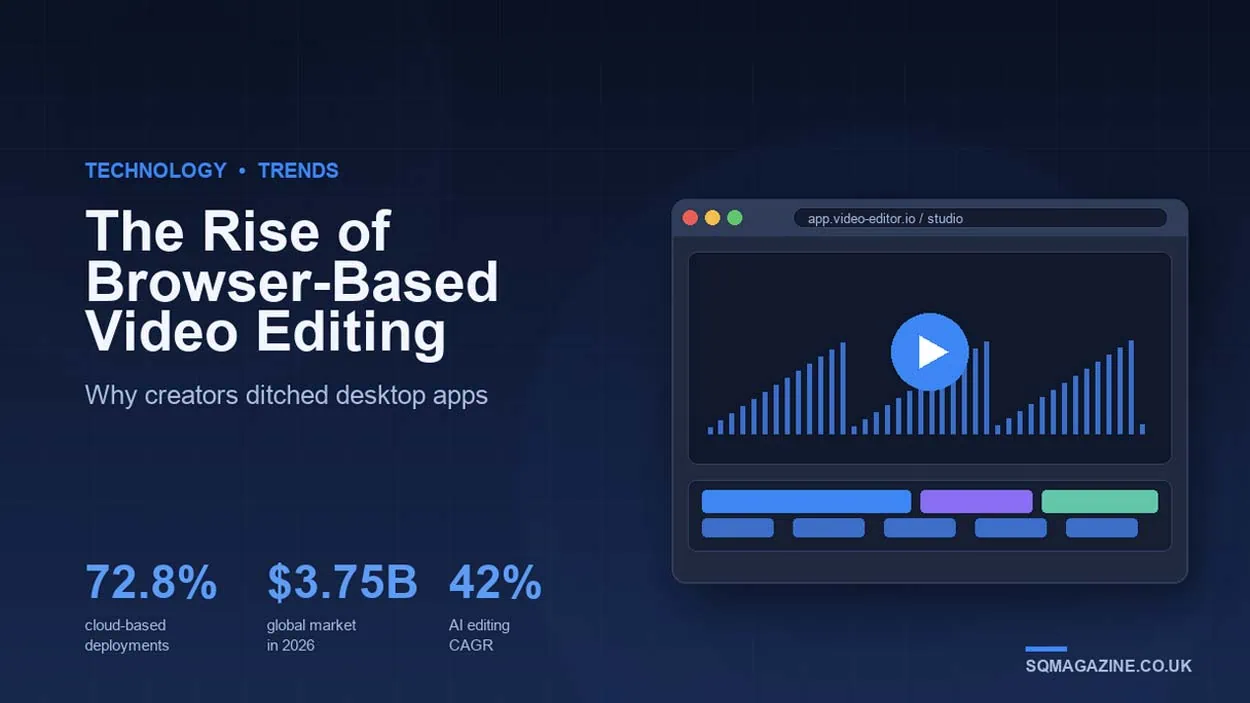






Browser-based video editing now accounts for an estimated 72.8% of cloud editing deployments, according to industry market analyses, and 48% of content creators routinely work in cloud tools rather than installed software. A market that Adobe and Apple have dominated for two decades is being rewritten in the browser tab.
Key Takeaways
- The global video editing software market reached $3.75 billion in 2026 and is forecast to grow at a 5.88% CAGR through 2031, per Mordor Intelligence.
- Cloud-based deployments account for 72.8% of the editing software market, reflecting a structural shift away from installed software.
- An estimated 48% of content creators now use browser-based or cloud video editing tools as part of their regular workflow.
- AI-powered editing features are growing at roughly a 42% CAGR, on track to a $9.3 billion valuation by 2030.
- Adobe Premiere Pro still leads professional desktop editing with about 35% market share, followed by Final Cut Pro at 25% and DaVinci Resolve at 15%.
- Asia-Pacific leads regional growth at a projected 7.22% CAGR through 2031, driven by smartphone proliferation.
- Mobile-first short-video workflows drive most new tool adoption, with browser editors closing the gap on desktop non-linear editors for short-form work.
How browser-based video editing took over the creator workflow
Browser-based video editors won the creator workflow by removing three frictions at once: installation, hardware cost, and platform lock-in. A creator can open Chrome on a Chromebook, edit a 1080p clip, and export to TikTok in the same hour, with no install prompt and no $1,800 laptop required.
Three technical shifts made this practical. The WebCodecs API, defined by the W3C and shipped in modern Chrome and Edge, gave browsers low-level access to hardware-accelerated video encoding and decoding. WebAssembly brought near-native performance for in-browser processing, letting tools run real codecs and effects without a native binary. Average residential broadband speeds in major markets passed 200 Mbps, making uploads of 4K source footage tolerable rather than overnight.
The other half of the story is demographic. Short-form vertical video, popularised by TikTok and Instagram Reels, rewards speed and iteration over feature depth. Creators who post daily care more about getting an edit out before the trend dies than about a 32-track timeline. That preference favours editors that load in three seconds over editors that take three minutes to launch.
Browsers themselves became the runtime that mattered. Recent web browser usage data shows Chrome alone holds roughly two-thirds of the desktop browser market, giving a single web video tool effectively the same install base as Windows.
The numbers behind the cloud video editing shift
Mordor Intelligence values the global video editing software market at $3.75 billion in 2026, projecting growth to $4.99 billion by 2031 at a 5.88% CAGR. Most of that growth is cloud-shaped. Cloud-based deployments now represent 72.8% of total market value, a share that did not exist in this form five years ago.
The breakdown of who actually edits is also shifting. Roughly 48% of content creators report using cloud editing tools in their regular pipeline, often alongside a desktop NLE rather than as a full replacement. Enterprises remain the heavier spenders, accounting for an estimated 64.2% of total spend, but the user count is dominated by individual creators and small teams.
The acquisition signal reinforces the data. Microsoft bought the browser-based editor Clipchamp in 2021 and folded it into Microsoft 365, a move The Verge described as a direct bet on the browser as the new creator surface. Adobe responded with the cloud-only Adobe Express. Canva, originally a static-graphic tool, pushed aggressively into in-browser video.
Three datapoints worth keeping in mind:
- Market value (2026): $3.75 billion globally, per Mordor Intelligence.
- Cloud share of deployments: 72.8%, leaving roughly a quarter of the market still on locally installed software.
- AI editing CAGR: approximately 42%, the fastest-growing sub-segment of the entire creative software stack.
What desktop editors still do better
Desktop NLEs still beat browser tools on the work that matters most to professional editors: long-form, multi-track, colour-graded, finished content. A feature film conform with 64 tracks, 4K ProRes media, and a node-based colour pipeline is not a browser job in 2026, and probably will not be in 2027.
Four areas where installed software still wins decisively:
- Large project files: 200 GB of raw 6K footage is unpleasant to upload, even on a gigabit connection.
- Colour pipelines: DaVinci Resolve’s node graph and ACES workflows are unmatched in any browser tool.
- Plug-in ecosystems: Premiere Pro and Final Cut have decades of third-party effects, transitions, and audio plug-ins.
- Offline reliability: a flight, a coffee-shop dead zone, or a flaky hotel Wi-Fi connection breaks every browser editor instantly.
The honest framing is not that desktop is dying. The honest framing is that the bottom 80% of editing tasks (trim, merge, compress, caption, resize for vertical, blur a face) no longer need a desktop application at all. Adobe and Blackmagic still own the top 20%. Browser editors absorbed everything below the waterline.

How AI rewrote the rules for online video editors
AI was the multiplier that turned browser editors from “lighter version of the real thing” into something genuinely faster than desktop. The industry’s roughly 42% CAGR in AI-editing features is not theoretical; it shows up in product UI every quarter.
Five AI features now standard in mainstream browser editors:
- Auto-captioning with speaker diarisation, hitting word-error rates below 5% for clean English audio.
- Smart cuts that detect silence, filler words, and dead air, removing them in a single click.
- Background removal without a green screen, using on-device or server-side segmentation models.
- AI voiceovers in dozens of languages, replacing the studio booth for explainer content.
- Auto-resizing that reframes a 16:9 source into 9:16 vertical with subject tracking.
Cumulatively, these features compress a 30-minute manual edit into a 5-minute supervised one. A YouTube tutorial that previously took an afternoon to caption now captions itself while the creator drinks coffee. That productivity delta is the real reason short-form creators moved to browser tools, and it shows in AI in social media tools data on adoption rates among working creators.
The catch is that AI features run on someone else’s servers. That changes the privacy calculus, which is covered further down.
The new landscape of browser-based video editors
The browser editor market is not monolithic. Four distinct categories serve different workflows, and creators routinely use two or three depending on the job.
| Editor category | Best for | Representative tools | Typical pricing |
|---|---|---|---|
| Collaboration-first | Teams, agencies, brand video | Kapwing, VEED | $20 to $30 per month per seat |
| Batch utility | Trim, merge, compress, resize, subtitle | Clideo, Online Video Converter | $6 to $10 per month |
| AI-first | Auto-edited shorts, talking-head content | Submagic, Descript Web | $12 to $30 per month |
| Beginner / template | Social posts, marketing clips | Canva Video, Clipchamp | Free tier, $10 to $15 paid |
Batch-utility editors deserve a closer look because they solve a problem the big NLEs ignore. A creator who needs to compress 14 clips for a podcast feed, merge three webinar exports, or strip metadata from a video before sharing it does not want a full timeline editor. They want a focused single-task tool that loads instantly. Clideo’s browser-based editor takes this category seriously, with separate dedicated tools for trim, merge, compress, resize, loop, mute, and subtitle generator, each accessible without leaving the browser.
Collaboration-first editors compete on real-time multi-user editing and brand asset libraries. AI-first editors compete on output speed. Beginner editors compete on templates and the soft on-ramp. The market is large enough to support all four lanes, and most successful tools blend two of them rather than trying to do everything.
The mobile-first workflow
Roughly half of all video views happen on mobile, and a growing share of edits happen there too. The phone is no longer just the camera; it is also the cut, the caption layer, and often the upload step.
A typical 2026 mobile-web workflow looks like this:
- Capture on the phone camera.
- Rough cut in a mobile app on the same phone, often during a commute.
- Polish in a browser editor on a laptop later, using the same account.
- Export to the target platform from whichever device is closer.
The friction point used to be moving the file between devices. Cloud-synced projects fixed that. A creator can start a cut in the Clideo iOS app, open the same project in a browser an hour later, finish it, and export, with no AirDrop, no cable, no re-encode.
For creators outside the US and EU, mobile-web is often the entire workflow. Asia-Pacific markets, projected to grow at a 7.22% CAGR through 2031, lean heavily mobile. A creator in Jakarta or Lagos editing on a mid-range Android phone is the modal user of these tools, not a North American creator with a MacBook Pro. Browser and mobile editors design accordingly.
What this means for businesses, agencies, and educators
Companies adopted browser video editors faster than most expected, for reasons that have little to do with creator economics. The driver is procurement.
A marketing team of 20 people does not want to install Adobe Premiere on 20 laptops, manage licences in 20 places, or train 20 people on a desktop NLE. A browser editor with single-sign-on, shared brand assets, and per-seat billing solves a procurement problem and a training problem in one purchase order.
Education followed the same path. Schools and universities run on Chromebooks more often than not, and Chromebooks cannot run Premiere Pro. The only way to teach video editing to a school class in 2026 is through the browser. That installed base of student users feeds the next generation of creators directly into browser tools rather than into Avid or Final Cut.
Agencies sit in the middle. Most agencies still finish in Premiere or Resolve, but their assistants and junior editors do the rough work in browser tools to keep senior editor hours free for the parts that pay the bills.
Privacy and data handling in browser-based editing
Browser editing changes one fundamental thing about a video file: it leaves the device. That introduces privacy questions that desktop editing never raised.
Three questions worth asking of any browser editor:
- Where is the file stored? EU-based servers carry different regulatory implications from US-based servers under GDPR and the EU AI Act.
- How long is it retained? Some tools delete uploads within hours; others keep them for the lifetime of the account.
- Is the content used to train models? Some editors quietly include this in their terms; others explicitly opt out.
Established browser editors typically publish retention windows and security practices. Clideo, for example, transmits files over HTTPS and deletes uploaded files within a defined window for free-tier users, with longer storage available for paying users who explicitly request it.
The harder question is what creators owe their own subjects. Editing a video of a child, a patient, or a private individual in a third-party cloud tool is a data-handling decision, not just an editing decision. The convenience of browser editing comes with a duty to read the privacy policy before uploading sensitive footage.
What’s next: the 2026-2030 forecast
The next four years will be defined by three shifts, all of which are already visible in early-2026 product releases.
The first is agentic editing. Instead of a creator selecting clips and AI applying transitions, the workflow inverts: the creator describes the edit (“a 60-second highlight reel from this hour of footage, with captions and music”), and the editor executes. Several browser tools have shipped early versions of this in 2026.
The second is real-time multi-user editing. Google Docs-style collaboration arrived in browser editors years ago for basic timelines, but real-time editing of a 4K timeline with sub-frame precision is still rough. By 2028, it will be standard.
The third is the absorption of the AI editing market into the broader creative tools stack. AI editing alone is on track to a $9.3 billion valuation by 2030 at roughly a 42% CAGR, and that growth will not stay confined to dedicated AI editors. Adobe, Canva, and the browser-native editors will continue folding AI features into their core surfaces until “AI editing” stops being a separate category.
Frequently Asked Questions (FAQs)
For trim, merge, compress, caption, and resize work, browser editors now match or beat desktop NLEs on speed and convenience. For long-form, multi-track, colour-graded work, desktop software still wins. Most professional creators use both.
Established browser editors transmit files over HTTPS and publish retention windows. Sensitive footage of identifiable people deserves a check of the editor’s privacy policy and data-retention settings before upload, regardless of brand.
Three reasons drive the shift: no installation friction, lower hardware requirements (any Chromebook will do), and faster AI-assisted features that automate the most repetitive parts of editing. Short-form creators benefit the most.
Upload and export speed depend on internet quality, but most editors render previews in the browser without re-uploading the source. A 100 Mbps connection is comfortable for 1080p source files; 4K source files benefit from 500 Mbps or fibre.
By installed user count, Microsoft Clipchamp (bundled with Microsoft 365) likely has the widest reach. By active editing usage, Kapwing, Clideo, and Canva Video each serve millions of monthly users across different creator workflows.
Conclusion
Browser-based video editing absorbed the bottom 80% of editing tasks within five years, leaving installed desktop software to defend the top 20% where it still wins on raw capability. The market data tells the story plainly: a $3.75 billion video editing market, 72.8% cloud-deployed, growing fastest in the AI sub-segment at a 42% CAGR.
For creators, the practical takeaway is that the right tool for any given edit is increasingly a browser tab, not an installed application. For businesses and educators, the procurement and training case for browser editors has already been won. The interesting question is no longer whether browser editing replaces desktop, but how soon the few remaining holdouts (long-form colour grading, large-format film conforms) follow.