





Artificial intelligence is reshaping medical imaging by improving how clinicians detect, interpret, and prioritize scans. Hospitals now use AI to flag urgent findings in emergency CT scans, while screening programs rely on algorithms to identify early-stage cancers in mammography and lung imaging. As imaging volumes surge and radiologist shortages persist, AI offers a scalable way to improve speed and accuracy across healthcare systems. Let’s explore the latest AI in medical imaging statistics to understand how this transformation is unfolding.
Editor’s Choice
- By 2025, over 1,451 AI/ML-enabled medical devices will be authorized by the FDA.
- Radiology accounts for roughly 76% of all FDA-approved AI devices, making it the dominant application area.
- More than 1,000 AI tools are now deployed in radiology workflows, signaling widespread clinical adoption.
- Total FDA-authorized AI imaging tools exceeded 1,039 devices by late 2025.
- Healthcare AI adoption rose from 72% in early 2024 to 85% by year-end, showing rapid integration.
Recent Developments
- The FDA approved a record 295 AI/ML medical devices in 2025, reflecting accelerating innovation.
- Over 115 new radiology AI algorithms were added in 2025 alone.
- Radiology AI tools now represent nearly 80% of all AI-enabled medical devices.
- Around 97% of AI radiology devices are cleared via the 510(k) pathway, enabling faster market entry.
- Only 29% of approved radiology AI tools had clinical validation data, highlighting a regulatory gap.
- AI-related funding in radiology research rose from 3.9% in 2015 to 30.4% in 2024, showing a strong institutional focus.
- Over 1,300 AI-driven healthcare products are now in use across specialties, with imaging leading.
- Radiology secured 75%–80% of FDA AI approvals annually between 2023 and 2025, indicating sustained dominance.
AI in Radiology Market Growth Trends
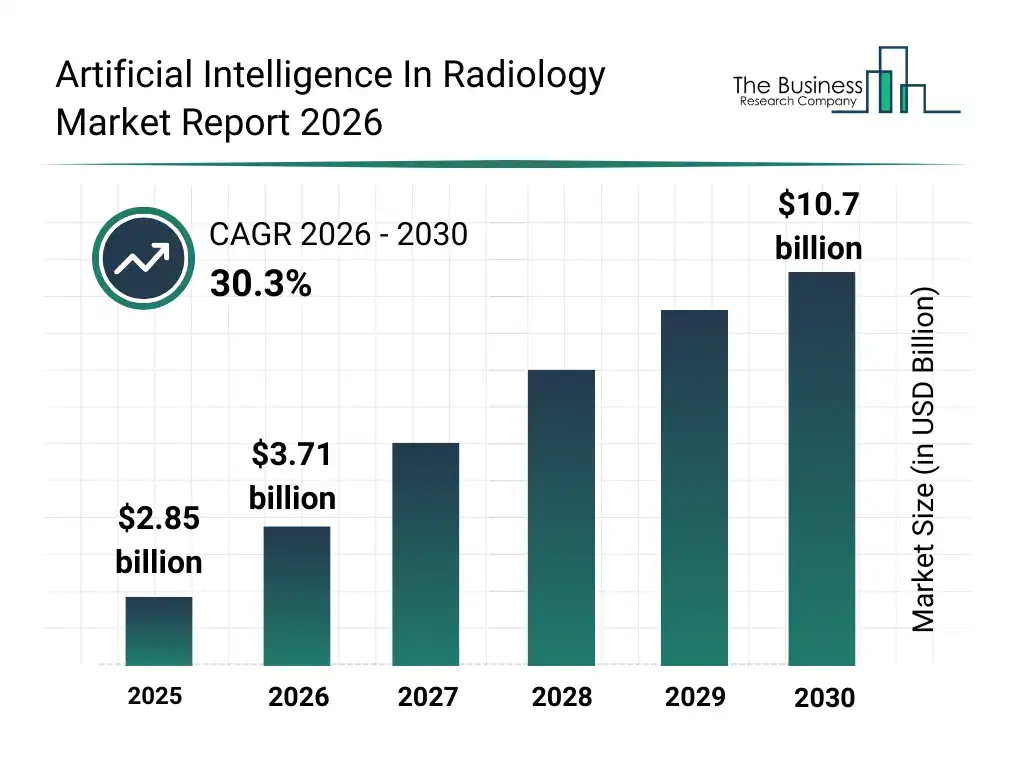
- The global AI in radiology market reached $2.85 billion in 2025, highlighting an early but rapidly expanding adoption phase.
- The market will grow to $3.71 billion in 2026, reflecting strong investment and increasing clinical integration.
- The industry will grow at a robust CAGR of 30.3% from 2026 to 2030, signaling sustained high growth momentum.
- In 2027, the market will reach around $4.8 billion, driven by wider deployment of AI-powered diagnostic tools.
- By 2028, the market size will surpass $6.2 billion, supported by rising demand for workflow automation and faster diagnostics.
- The market will climb to approximately $8.3 billion in 2029, as hospitals and imaging centers scale AI adoption.
- By 2030, the AI in radiology market will reach $10.7 billion, marking nearly a 4x increase from 2025 levels.
- Overall, the market will expand rapidly, fueled by rising imaging volumes, radiologist shortages, and advancements in AI technology.
Adoption of AI Tools in Radiology and Imaging Departments
- An additional 25% of radiologists reported plans to adopt AI tools within the next few years, signaling strong near‑term uptake.
- Healthcare AI adoption reached 85% of organizations globally by late 2024, with imaging among the most‑deployed specialties.
- Over 1,000 AI‑enabled imaging tools are now cleared or commercially available, with radiology applications dominating the portfolio.
- Hospitals and diagnostic centers account for roughly 41–60% of AI‑imaging deployments, driven by high scan volumes and workflow pressures.
- AI‑assisted workflows have been shown to reduce report times by about 15–20%, enabling radiologists to handle 10–20% more scans without quality loss.
- Enterprise‑scale AI deployments in radiology departments have grown from <10% of large health systems in 2020 to >40% by 2025–2026.
- Around 70–90% of U.S. hospitals now report using some form of predictive or image‑analysis AI in radiology, though the depth of use varies.
- AI‑augmented detection tools in radiology achieve false‑negative reductions of roughly 10–20% in lung‑nodule and breast‑cancer screening settings.

AI Adoption by Imaging Modality (X-ray, CT, MRI, Ultrasound, PET)
- CT‑based AI accounts for 41.6% of AI‑enabled imaging modality revenue in 2026, the largest share.
- X‑ray AI solutions are projected to grow at around 25–30% CAGR through 2030, among the fastest‑growing modalities.
- CT‑focused AI tools handle roughly 32% of all AI‑radiology market value in 2026, dominated by emergency and oncology workflows.
- MRI‑based AI adoption is expanding at about 20–30% CAGR, led by neurology and musculoskeletal imaging.
- Ultrasound AI adoption in point‑of‑care and prenatal settings has increased by over 15% in penetration since 2022.
- PET imaging AI tools now support 60–70% of major nuclear‑medicine centers for lesion quantification and therapy monitoring.
- Around 70–80% of large health systems deploy at least one modality‑specific AI tool for CT, MRI, or X‑ray in radiology.
- Multi‑modality AI platforms integrating CT, MRI, and X‑ray have grown to cover nearly 40% of enterprise imaging departments.
- AI‑augmented CT workflows reduce false‑negative rates by roughly 10–15% in acute‑care settings.
- Over 90% of AI‑imaging tools clear regulatory pathways for use across two or more clinical modalities.
Regional Market Breakdown for AI in Medical Imaging
- North America held the largest share of the global AI radiology market at 44.45% in 2025.
- Europe will grow at a 22.4% CAGR, driven by screening programs and interoperability initiatives.
- The Asia-Pacific market will reach $132.8 million by 2026, fueled by expanding imaging infrastructure.
- China’s AI imaging market will reach $32.9 million in 2026, reflecting rapid digital health adoption.
- India’s market will grow to $21.6 million in 2026, supported by private imaging networks.
- The UK AI imaging market will reach $32.1 million in 2026, driven by national health system initiatives.
- Asia-Pacific will remain the fastest-growing region through 2030 due to high patient volumes.
- North America will continue to lead the market, supported by strong reimbursement models and advanced infrastructure.

Clinical Application Area (Oncology, Cardiology, Neurology, Others)
- Oncology accounts for 35–40% of AI imaging applications in 2026, the largest clinical segment.
- AI‑assisted breast cancer detection improves sensitivity by up to 9.4% compared with radiologists alone.
- AI algorithms detect coronary artery disease with accuracy rates exceeding 90% in cardiology.
- AI‑enabled stroke detection in neurology reduces diagnosis time by up to 50% in emergency settings.
- Oncology imaging AI reduces false positives in lung cancer screening by 11–15%.
- Cardiovascular imaging AI is projected to grow at around 32% CAGR through 2030.
- Neurology‑focused AI imaging tools represent roughly 15–20% of FDA‑cleared AI devices.
- Musculoskeletal AI improves fracture detection rates by up to 10%, especially in emergency departments.
- Multi‑specialty AI platforms now cover >70% of large health systems across oncology, cardiology, and neurology.
- Over 90% of enterprise‑scale AI imaging deployments support at least three major clinical areas.
Investment, Funding, and M&A Activity in AI Medical Imaging
- AI imaging startups raised over $3.5 billion in funding in 2025, reflecting strong investor interest.
- Venture capital funding for radiology AI companies increased by over 25% between 2023 and 2025.
- The average deal size in AI imaging startups reached $35 million in 2025, up from $22 million in 2022.
- Strategic partnerships between hospitals and AI vendors have increased by over 40% since 2023.
- Private equity firms invested multi‑billion‑dollar amounts in imaging AI platforms, with several deals above $1 billion in 2025.
- U.S.‑based companies account for over 50% of global AI imaging funding rounds.
- Government funding for AI healthcare initiatives rose by 30% globally between 2022 and 2025.
- Over 70% of top imaging AI firms now operate in at least three major markets due to cross‑border M&A and partnerships.
Healthcare Setting (Hospitals, Imaging Centers, Clinics)
- Hospitals account for over 60% of AI imaging deployments globally, due to high patient throughput.
- Imaging centers represent 25%–30% of AI adoption, particularly in outpatient diagnostics.
- Clinics are emerging adopters, with AI usage growing at over 28% annually.
- Large hospital systems report up to 30% efficiency gains after implementing AI imaging workflows.
- AI reduces radiologist workload in hospitals by 20%–40%, depending on modality.
- Outpatient imaging centers use AI to reduce scan backlogs by up to 25%.
- Rural clinics benefit from AI by enabling remote interpretation and tele-radiology support.
- Academic medical centers lead AI adoption, contributing to over 50% of AI imaging research output.

Regulatory Approvals for AI-Based Imaging Devices and Algorithms
- The FDA authorized over 1,451 AI/ML-enabled medical devices by 2025, with imaging dominating approvals.
- Radiology accounts for approximately 76% of all FDA-cleared AI devices.
- The FDA approved 295 AI/ML devices in 2025 alone, marking a record year.
- Around 97% of AI imaging devices are cleared via the 510(k) pathway, enabling faster commercialization.
- Only 29% of approved AI imaging tools include clinical validation data, raising transparency concerns.
- The European CE marking process approved over 500 AI imaging solutions by 2025.
- Regulatory frameworks for adaptive AI (continuous learning systems) are still evolving globally.
- The FDA introduced new guidance in 2024 for AI lifecycle management and post-market monitoring.
- Japan and South Korea accelerated approvals, contributing to the Asia-Pacific’s rapid AI imaging growth.
Scan Time, Throughput, and Patient Wait Times
- AI reduces MRI scan time by up to 30%, improving patient comfort and throughput.
- CT scan workflows see throughput improvements of 20%–25% with AI-assisted prioritization.
- Hospitals report up to 35% reduction in patient wait times after AI implementation.
- AI-powered scheduling systems improve imaging department utilization rates by over 20%.
- Automated image analysis reduces reporting time by 40%–50%, accelerating diagnosis.
- AI triage systems prioritize critical cases, reducing emergency delays by up to 60%.
- Imaging centers using AI report higher patient throughput without increasing staffing levels.
- Workflow automation reduces administrative burden by up to 25%, freeing staff for clinical tasks.
- AI-enabled imaging systems improve resource allocation, reducing idle machine time by 15%–20%.
Impact of AI on Diagnostic Accuracy and Sensitivity
- AI improves diagnostic accuracy in radiology by up to 20% in certain use cases, such as lung cancer detection.
- AI-assisted mammography increases cancer detection rates by 5%–9% while reducing false positives.
- Stroke detection AI reduces missed diagnoses by up to 30%, improving patient outcomes.
- AI algorithms match or exceed radiologist performance in over 60% of imaging tasks.
- Combining AI with radiologists improves overall sensitivity by 10%–15% compared to either alone.
- AI reduces inter-observer variability in imaging interpretation by up to 25%.
- In emergency imaging, AI reduces diagnostic turnaround time by 30%–50%, enabling faster care.
- AI-assisted workflows improve early disease detection rates across modalities by up to 15%.
- Clinical studies show AI can maintain consistent accuracy across large imaging datasets, improving scalability.

AI for Early Disease Detection and Screening Programs
- AI-assisted screening improves early cancer detection rates by up to 20%, particularly in lung and breast cancer.
- In lung cancer screening, AI reduces missed nodules by up to 26% compared to traditional methods.
- AI-enabled mammography reduces false-negative rates by 9%–10%, improving early-stage diagnosis.
- Screening programs using AI report 30% faster image interpretation, enabling quicker follow-ups.
- AI improves colorectal cancer detection in imaging and colonography by up to 14%.
- Population-wide screening initiatives using AI show higher participation rates, increasing screening uptake by 10%–15%.
- AI-based triage tools help prioritize high-risk patients, reducing diagnostic delays by up to 40%.
- Early disease detection using AI reduces treatment costs by up to 25%, due to earlier intervention.
AI in Oncology Imaging (Breast, Lung, Prostate, and Other Cancers)
- AI in breast cancer imaging increases detection sensitivity by up to 9.4%, particularly in dense breast tissue.
- Lung cancer AI tools reduce false positives by 11%–15%, improving diagnostic confidence.
- Prostate cancer detection using AI MRI analysis improves accuracy by up to 20%.
- AI models can detect tumors at earlier stages, improving survival rates by up to 15%.
- Oncology imaging accounts for over one-third of AI imaging applications globally.
- AI reduces radiologist reading time for cancer imaging by 30%–50%, improving efficiency.
- Multi-cancer detection algorithms using imaging and AI show accuracy rates above 85%.
- AI-assisted radiomics enables personalized cancer treatment planning, improving therapy outcomes.
- Clinical trials using AI imaging biomarkers increased by over 40% between 2022 and 2025.
Cardiovascular Imaging and Risk Stratification
- AI algorithms detect coronary artery disease with over 90% accuracy, improving early diagnosis.
- AI-based cardiac imaging reduces diagnostic time by up to 50%, especially in emergency care.
- AI improves risk prediction for heart disease by analyzing imaging and clinical data with higher precision than traditional models.
- Automated cardiac MRI analysis reduces interpretation time by up to 70%, enhancing workflow efficiency.
- AI tools can predict major cardiac events with accuracy rates above 85%.
- Integration of imaging AI with wearable data improves real-time cardiovascular monitoring.
- AI-assisted echocardiography improves measurement accuracy by up to 15%, reducing variability.
- Hospitals using AI for cardiac imaging report better patient stratification and treatment planning outcomes.
Neurology and Brain Imaging
- AI improves stroke detection accuracy by up to 30%, reducing missed diagnoses.
- Brain hemorrhage detection using AI achieves accuracy rates exceeding 95%.
- AI reduces time to stroke diagnosis by up to 50%, enabling faster intervention.
- Alzheimer’s disease detection using AI imaging models improves early diagnosis by up to 20%.
- AI-powered brain MRI analysis reduces interpretation time by 30%–40%.
- Neurology AI imaging tools represent 15%–20% of FDA-cleared AI devices, showing growing adoption.
- AI enables automated lesion segmentation, improving accuracy in multiple sclerosis diagnosis.
- Brain imaging AI supports personalized treatment planning, especially in neurodegenerative diseases.
- AI integration in emergency neurology workflows improves patient outcomes by reducing treatment delays.
Frequently Asked Questions (FAQs)
CT imaging leads with about 37%–41.6% market share among modalities.
Software accounts for roughly 57%–77% of the total market share.
Hospitals and clinics contribute around 63%–70% of the total market revenue share.
Cloud-based AI imaging solutions account for approximately 44.7% of deployments in 2026.
Conclusion
AI continues to redefine medical imaging by delivering measurable improvements in diagnostic accuracy, speed, and scalability. From early disease detection in national screening programs to advanced oncology and cardiovascular imaging, AI enables clinicians to act faster and with greater precision. Moreover, healthcare systems benefit from reduced workloads, improved throughput, and better patient outcomes. As regulatory frameworks mature and investments grow, AI will play an even larger role in shaping the future of imaging-driven care.