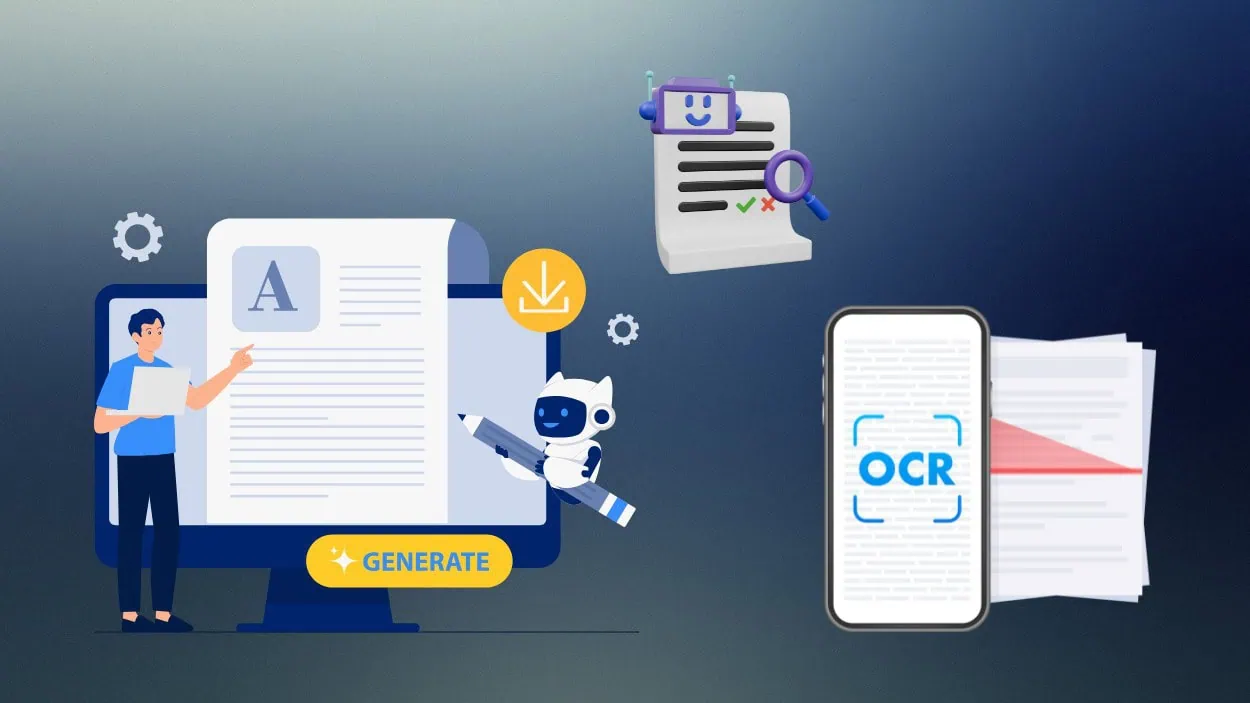






Document automation has become one of the fastest-growing AI adoption areas in 2026, with enterprises increasingly relying on intelligent systems to classify, extract, and route business documents at scale. Recent industry reports show that more than half of companies with complex document workflows have implemented AI-powered solutions to reduce manual processing time and eliminate repetitive errors.
This shift is not just about efficiency; it now directly impacts financial performance, operational agility, and regulatory compliance across industries such as finance, healthcare, logistics, and manufacturing. Many enterprises are now deploying an AI document management platform to automatically classify, extract, and route business documents, cutting manual processing time by more than half.
Document AI Adoption Surges in 2026
The pace of adoption has accelerated dramatically since 2024, as generative AI models have matured and become more reliable for structured document processing. Companies no longer treat document AI as an experimental pilot; they now integrate it into core operational workflows such as invoice processing, contract management, and compliance reporting.
Key adoption statistics for 2026 include:
- Over 53% of companies reported measurable productivity improvements after implementing AI document solutions.
- More than 60% of large enterprises now use AI to automate at least one major document workflow.
- In regulated sectors like banking and insurance, document AI adoption has grown by more than 35% in the last year alone.
- Mid-sized companies increasingly deploy cloud-based document AI tools to avoid heavy upfront infrastructure investments.
- The average ROI for document automation projects is now realized within 10–14 months, compared to 18–24 months in earlier years.
These figures indicate that document AI has moved from a promising technology to a mainstream operational necessity.
Where Businesses Apply Document AI
Organizations do not use document AI for a single purpose; they apply it across multiple domains depending on their core processes and regulatory requirements. The most common use cases include automated invoice processing, contract lifecycle management, and compliance document handling.
Typical document AI applications include:
- Invoice and order automation – AI extracts key fields such as amounts, dates, and supplier information, then routes them to accounting systems.
- Contract management – Intelligent systems classify contracts, identify critical clauses, and track expiration or renewal dates.
- Compliance and audit workflows – Automated extraction of data from regulatory forms, risk reports, and audit documentation.
- Customer onboarding – AI validates identity documents, extracts personal data, and pre-fills CRM systems.
- Healthcare records processing – Structured extraction of patient data from medical forms, lab reports, and insurance paperwork.
Each of these applications reduces manual workload and increases processing accuracy, which directly impacts cost and compliance.
How Document AI Improves Efficiency and Accuracy
Document AI solutions combine OCR, machine learning, and natural language processing to analyze unstructured documents in ways that mimic human review. This allows organizations to reduce the time spent on repetitive tasks such as data entry, classification, and routing.
The main efficiency benefits include:
- Faster processing times – Tasks that previously took hours or days are now completed in minutes.
- Reduced error rates – Automated extraction minimizes human mistakes in data entry and classification.
- Lower operational costs – Organizations can process more documents with fewer staff, reducing labor expenses.
- Scalability – AI systems scale easily as document volumes increase, without requiring additional hiring.
- Improved compliance – Automated workflows ensure consistent application of rules and reduce the risk of regulatory violations.
These benefits are especially valuable in industries where document volumes are high and accuracy is critical, such as finance and healthcare.
Challenges and Risks in Document AI Adoption
Despite the clear advantages, organizations still face challenges when implementing document AI at scale. Data quality, model training, and integration with legacy systems remain the most common hurdles, especially in highly regulated environments.
Key challenges include:
- Data variability – Documents come in many formats, languages, and structures, making it difficult to train accurate models.
- Integration complexity – Connecting AI systems with existing ERP, CRM, or document management platforms can require significant customization.
- Model governance – Ensuring that AI models remain accurate over time and do not degrade as document formats change.
- Security and privacy – Protecting sensitive document data from unauthorized access and ensuring compliance with data protection regulations.
- Change management – Employees need training and support to adapt to AI-driven workflows and avoid resistance to new technology.
Addressing these challenges is essential for organizations that want to achieve sustainable document AI adoption beyond the pilot phase.

The Future of Document AI in 2026 and Beyond
Looking forward, document AI is expected to become even more integrated with enterprise workflows, as AI models continue to improve and become more specialized for industry-specific use cases. The next wave of innovation will likely focus on predictive analytics, automated decision-making, and multi-agent orchestration for complex document processes.
Emerging trends in document AI include:
- Predictive document routing – AI systems that anticipate document destinations and automatically route them based on historical patterns.
- Real-time document analysis – Instant extraction and validation of data as documents are uploaded or received.
- Multi-agent workflows – Coordination of multiple AI agents to handle end-to-end document lifecycles, from creation to archiving.
- Industry-specific models – Customized AI models trained on specific document types for sectors like insurance, healthcare, and logistics.
- Integration with generative AI – Combining document extraction with generative capabilities to draft responses, summaries, and recommendations automatically.
As these trends evolve, organizations that invest early in document AI will gain a significant competitive advantage in speed, accuracy, and operational agility.