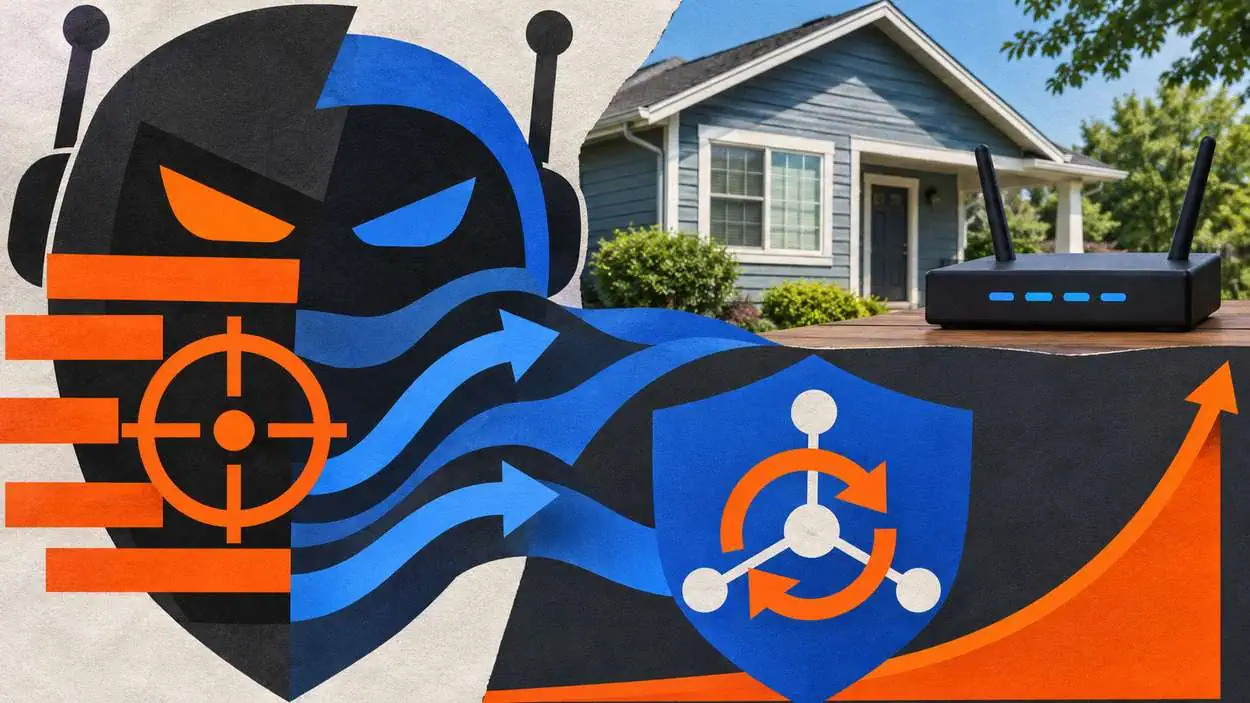


Most bot defences in production are still built from static rules that someone wrote by hand and rarely revisits. The bots hitting those sites rotate fingerprints, route requests through home IP addresses and adjust after every block.
Detection that retrains continuously at the network edge changes the cost structure of these attacks, because each evasion attempt ends up costing the bot operator more than the defender pays for the next adjustment. Over months, that price difference decides which side runs out of budget first.
Security engineers who audit these setups, including Cloudfresh’s Cloudflare Professional Services team, keep finding rule sets written for attacks that ended months ago. Thales’ 2026 Bad Bot Report puts automated traffic at more than 53% of all web requests in 2025, up from 51% the year before (SQ Magazine tracks the shift in its internet statistics), and records a 12.5x rise in AI-driven bot attacks over the same period.
Signature-based rules give attackers a fixed target
IP blocklists, user-agent filters and fixed rate limits all respond to the same input in the same way. Once an attacker learns where a threshold sits, they can stay just under it for as long as the rule exists. Cloudflare describes this weakness as deterministic detection and notes that attackers iterate in days, while conventional detection models can go months between releases.
Fingerprint rotation gives each request a new user agent or TLS signature, so every request looks like a first visit. Residential proxy networks spread one operation over thousands of home connections, and no single address sends enough requests to hit a rate limit. AI tools now handle much of the reconfiguration that used to take a skilled operator. It’s the same acceleration the UK’s NCSC warned about on 1 May 2026, when it told organisations to prepare for a patch wave of AI-discovered vulnerabilities.
What changes when detection retrains continuously at the edge?
Cloudflare’s Adaptive Intelligence, added to its Bot Management product on 31 August 2026, is the clearest example on the market so far. The part that is live today retrains the machine learning model behind each request’s bot score on live traffic, so the model no longer ships as a fixed version.
It draws on JA4 TLS fingerprints, request structure, session behaviour, network reputation and browser telemetry, which are hard to fake consistently at the same time. Traffic is analysed over several time windows at once, so a slow credential-stuffing campaign that sends only a handful of requests per address still shows up as a pattern. New model versions run in shadow mode first, scoring real traffic without acting on it, and are rolled out only if they don’t misclassify more genuine visitors than the version they replace.
Two further components have been announced but aren’t live yet: short-lived rules that are deployed and retired at random intervals, and training on misclassifications reported by customers. Vendor comparisons should separate what runs in production from what sits on a roadmap.
The economics of a bot attack
Bot operators pay for proxy bandwidth and engineering time, and they lose accounts and infrastructure every time they’re caught. One useful measure is cost per successful request, meaning everything spent on getting past the defence divided by the number of requests that get through before the defence adjusts.
Against a static rule, the attacker works out the bypass once and uses it across millions of requests until somebody on the defending side notices. Failed probes cost next to nothing, and each one shows whether the latest tweak worked.
With a model that retrains on live traffic, a bypass that might have lasted weeks may hold for only hours, so each round of engineering pays off over far fewer requests. Scoring is also statistical, which means a failed probe tells the attacker much less about why it failed. On the defender’s side, the cost of each adjustment is spread across the whole network and handled by automated training.
Bot traffic also distorts performance and data
Job search platform Jooble, which handles more than 125 million requests a day, found that nearly half of its inbound traffic came from scrapers and malicious bots, according to a Cloudflare case study. Once filtering moved to the edge, its WAF began blocking over 7 million malicious requests daily and caching took roughly half the load off its origin servers. The error margin in the traffic metrics Jooble reports to partners fell from 6% to under 2%.
Maksym Shapoval, Director of Security Architecture & Security Alliances at Cloudfresh, says the first audit usually turns up the same thing. “Almost every company has a pile of bot rules somebody wrote during an incident two years ago. Nobody wants to delete them, because nobody remembers why they’re there. Meanwhile the bots worked those rules out long ago. So we start somewhere much more boring: how much of the traffic hitting your login page is actually human? Once you know that, you can let the bot score make most of the calls, and your team stops rewriting rules every time something new shows up.”

Where to start with a bot defence audit
A bot defence audit usually begins with the existing rule set. Pull a list of active bot rules with their creation dates and last matches. Rules that still fire months after the incident that prompted them have probably been mapped already, and rules that never fire only add noise. Site-wide averages hide a lot too, because a pricing page, a password reset form and a search box attract different bots for different reasons and each needs its own baseline.
Comparing raw and filtered traffic in your analytics shows how far bots have already skewed the numbers you report, often before any security alert fires.
How detection models get updated is the other thing to settle. Cloudflare Enterprise customers can switch on continuous retraining with the Auto Update Machine Learning setting in Bot Management. Timing how long blocked traffic takes to return after a few rule changes gives a rough picture of how quickly attackers are adapting to your defences.