


• Skip to primary navigation
  • Skip to main content
  • Skip to primary sidebar
  • Skip to footer
Sq Magazine LogoSQ Magazine

Smarter Insights for a Fast-Moving Digital World

  • Latest News
  • Statistics
  • About
  • Contact
Subscribe
Sq Magazine Logo
  • Latest News
  • Statistics
  • About
  • Contact
Subscribe
Home » Cryptocurrency

Insurance Fraud Statistics 2026: Real Numbers, Big Impact

Published on: December 29, 2025
Barry Elad
Written By
Barry Elad
Barry Elad
Founder & Senior Journalist • 754 Articles
Barry Elad is a seasoned journalist and analyst specializing in finance, technology, AI, and founder of SQ Magazine. He explores the world o...
LATEST POSTS:
ChatGPT vs Claude vs Gemini vs Perplexity Statistics 2026: Users, Revenue & Market Share
Anthropic Gives Verified K-12 Teachers Free Claude Access
OpenAI Shows Kalshi’s World Cup Odds in ChatGPT
Robert A. Lee
Reviewed By
Robert A. Lee
Robert A. Lee
Senior Editor • 408 Articles
Robert A. Lee is a journalist at SQ Magazine who unpacks the fast-moving worlds of gaming and internet trends. He tracks everything from maj...
LATEST POSTS:
Social Media Demographics by Platform Statistics 2026: A Definitive Guide
Amazon Music Statistics 2026: Subscribers, Share and Revenue
Document AI Statistics 2026: How Businesses Are Automating Paperwork
Insurance Fraud Statistics
As Featured In
The New York Times LogoForbes LogoWired LogoDeloitte LogoResearch.com Logo
Share on LinkedIn ChatGPT Perplexity Share on X Share on Facebook

Insurance fraud continues to drain money from the U.S. economy and push up costs for consumers, businesses, and government programs. Today, fraud losses are estimated at more than $308.6 billion annually, affecting policyholders through higher premiums and slower claims processing. These losses touch every type of coverage, auto, health, property, life, and workers’ compensation, and show how fraud undermines trust in the insurance system.

Auto accident staging and health care billing scams are among the schemes that illustrate the impact on both insurers and individuals. Read on for detailed, up‑to‑date statistics and trends shaping the insurance fraud landscape.

Editor’s Choice

  • $308.6 billion: Estimated annual cost of insurance fraud in the U.S. across all lines in 2025.
  • Average policyholders pay about $900 more per year in premiums due to fraud losses.
  • 10% of property and casualty claims are estimated to be fraudulent, driving major losses.
  • Over 324 defendants were charged in the 2025 National Health Care Fraud Takedown.
  • Workers’ compensation fraud losses range between $34 billion and $44 billion.

Recent Developments

  • Insurance fraud costs the U.S. economy around $1 trillion annually.​
  • Total U.S. insurance fraud reaches $308.6 billion per year, raising premiums by $900 for consumers.​
  • AI-driven fraud detection tools reduce fraudulent claims by up to 60%.​
  • Automated claims systems cut fraudulent claims by 22%.​
  • Cyber insurance claims rose nearly 50% globally due to ransomware and breaches.​
  • Identity theft surged to record levels, enabling fake policies and claims.​
  • Insurers using AI tools achieve 20-40% fraud reductions.

Average Cost of Insurance Frauds in the U.S.

  • Healthcare fraud, including Medicare and Medicaid, is the largest category, costing about $105 billion annually.
  • Life insurance fraud follows, with losses of around $74.4 billion per year.
  • Property and casualty fraud contributes approximately $45 billion annually.
  • Auto premium fraud accounts for roughly $35.1 billion each year.
  • Workers’ compensation fraud adds about $34 billion annually.
  • Auto theft fraud results in losses of nearly $7.4 billion per year.
  • Disability fraud also costs close to $7.4 billion annually.
  • Total insurance fraud losses drain an estimated $308.6 billion every year from the U.S. economy.
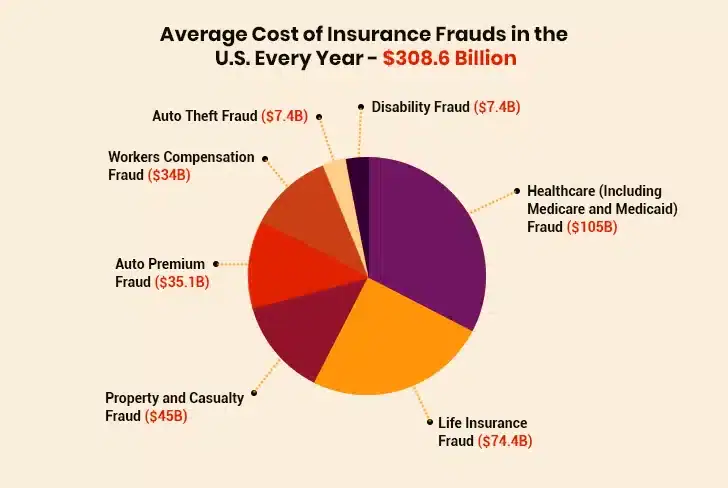
Average Cost of Insurance Frauds in the U.S.
(Reference: Damco Solutions)

Auto Insurance Fraud Statistics

  • Auto fraud surged 19% worldwide, driven by staged accidents.​
  • 10% of property and casualty claims, including auto, are fraudulent.​
  • Staged vehicle accidents exceeded 15,000 globally, causing $2.6 billion in losses.​
  • U.S. auto insurance premiums rose 13.6% partly due to fraud.​
  • Florida leads in staged-crash incidents from the no-fault PIP structure.​
  • 15 states and DC enacted laws targeting organized auto fraud networks.​
  • Fraudulent auto claims inflate consumer premiums by $900 yearly.
Newsletter
Don’t chase tech news. We track it for you.

One weekly briefing with the launches, AI developments, and breaches that matter. No filler.

Health Insurance Fraud Statistics

  • Health care fraud schemes cost insurers and taxpayers tens of billions yearly.
  • In 2025, the National Health Care Fraud Takedown charged 324 individuals, including medical professionals.
  • Major operations like Operation Gold Rush uncovered over $10.6 billion in false Medicare claims.
  • CMS prevented over $4 billion in fraudulent Medicare and Medicaid payments.
  • False billing and unnecessary medical supply claims remain the leading scam types.
  • Health fraud comprises a significant share of federal investigations and settlements.
  • Healthcare fraud may represent 3%–10% of total healthcare expenditures.
  • Every $1 spent on fraud prevention can yield multiple dollars in recoveries.

Most Used Anti-Fraud Technologies

  • Automated red flags lead adoption, used by 88% of insurers to quickly identify suspicious activity.
  • Predictive modeling is widely implemented, with 80% of insurers using it to forecast and detect fraud risks.
  • Reporting capabilities support fraud detection for 64% of organizations, improving transparency and tracking.
  • Case management systems are applied by 61% of insurers to streamline fraud investigations.
  • Exception reporting is leveraged by 51% of insurers to flag irregular or abnormal claims.
  • Data visualization and link analysis are also used by 51% of insurers to uncover deeper fraud patterns.
Most Used Anti-Fraud Technologies
(Reference: HelpNet Security)

Property and Casualty Fraud

  • P&C fraud losses include inflated dwelling damage claims, staged property incidents, and organized arson schemes.
  • Soft fraud, such as exaggerated claims after minor events, remains a leading contributor to P&C abuse.
  • P&C insurers report increased fraud detection costs as they invest in analytic tools to identify anomalous claims patterns.
  • States with higher property and auto claim rates often report elevated levels of fraud activity.
  • P&C fraud contributes to slower claims processing times, affecting consumer satisfaction.

Life Insurance Fraud

  • Synthetic identity fraud accounts for $30 billion in life insurance losses, up to 85% of identity-related cases.​
  • Children’s SSNs are 51 times more likely to be used in synthetic identity theft for life policies.​
  • Identity-theft-linked insurance fraud, including life, is projected to rise 49% by year-end.​
  • Fraud rings use complicit agents and false identities for multiple policies worth millions.​
  • 85% of synthetic fraud cases evade initial underwriting but activate at the claims stage.​
  • Deepfakes and AI-driven impersonation fuel 82% of emerging life insurance fraud attempts.​
  • Independent verifications detect 20-40% more suspicious life policy applications.

Insurance Fraud by Type

  • Life insurance fraud leads all categories, generating about $74.7 billion in annual losses.
  • Medicare and Medicaid fraud costs roughly $68.7 billion each year.
  • Auto, home, and business insurance fraud combined result in around $45 billion annually.
  • Health care fraud, excluding Medicare, accounts for approximately $36.3 billion per year.
  • Property and casualty fraud represents about 10% of industry losses, totaling nearly $122 billion annually.
  • Workers’ compensation fraud causes losses estimated between $35 billion and $44 billion per year.
Insurance Fraud By Type

Workers’ Compensation Fraud

  • Of these losses, about $9 billion stems from premium fraud and $25 billion from false claims.
  • Soft fraud, such as exaggerating injury severity, drives a large share of total claim abuse.
  • Organized rings that stage workplace injury events contribute to inflated claims volumes.
  • Small business employers often see disproportionate claim severity due to insufficient fraud controls.
  • Enhanced analytics are helping carriers flag inconsistent medical reporting in injury claims.
  • Some states report that aggressive benefit expansion during economic downturns correlates with upticks in fraud.
  • Workers’ comp fraud increases administrative costs, ultimately raising premiums for employers.

Demographic Trends in Insurance Fraud

  • Consumers in their 20s and 30s are 25% more likely to report losing money to fraud than those 40+.​
  • Two out of five respondents aged 25-34 consider committing insurance fraud to save money.​
  • Millennials are 77% more likely than other groups to lose money to email scams.​
  • Adults aged 25-34 are most likely to lie on application forms (8%) and claims (7%).​
  • Younger adults under 34 show a higher propensity for misleading insurers on claims.​
  • Londoners admit the highest rates of lying on applications (7%) and claims (6%).​
  • 32% of alleged fraud victims never report suspicions, underreporting demographics.​
  • Older Americans exploited by fraud suffer average losses of $34,200 per victim.

Consumer Awareness and Reporting

  • Insurance fraud adds $900 to average policyholder annual premiums.​
  • 32% of people believe they’ve been victims of insurance fraud.​
  • 29% of suspected fraud victims never report incidents.​
  • 68% of consumers are unaware of common auto fraud schemes.​
  • 90% of Americans accept that anyone can fall victim to fraud.​
  • 75% in Japan view fraudulent claims as unacceptable.​
  • Nearly 60% unaware insurers actively combat fraud.​
  • Over 10% believe fraudulent claims have no victims.​
  • NICB receives over 300 tips monthly via hotline.
Consumer Awareness And Attitudes Toward Insurance Fraud

Geographic Trends in Insurance Fraud

  • Florida leads U.S. states in staged auto crash fraud due to no-fault PIP laws.​
  • Nevada ranks highest for auto-related fraud at 346 cases per million residents.​
  • New York staged crashes and inflated claims comprise 75% of all insurance fraud cases.​
  • Ohio tops states for healthcare, Medicare, and Medicaid scams.​
  • Connecticut reports the highest per-capita claims fraud rate nationwide.​
  • Arizona handles 10% of U.S. auto glass claims despite a smaller population.​
  • Urban areas like Birmingham dominate crash-for-cash insurance scams.​
  • Memphis led cities with 56 reported COVID-19-related scams.​
  • Identity theft-linked insurance fraud projected to rise 49% nationally.

Law Enforcement and Legal Actions

  • Enforcement actions seized over $245 million in cash, vehicles, and cryptocurrency assets.​
  • CMS prevented $4 billion in fraudulent Medicare and Medicaid payments pre-takedown.​
  • Federal False Claims Act settlements recovered $1.257 billion from January to May.​
  • Fewer than 2% of identified insurance fraud incidents result in prosecution.​
  • Operation Gold Rush exposed $10.6 billion Medicare scam with unnecessary equipment billing.​
  • California charged 5 defendants in $1.4 million life insurance commission fraud scheme.​
  • NYC’s Operation Bright Eyes targets $1 billion staged accident fraud network with taxi cameras.​
  • Inland Empire task force charged 16 individuals with $217,000 in vehicle-hostage scams.

Economic Impact of Insurance Fraud

  • Insurance fraud costs the U.S. economy $308.6 billion annually, raising premiums $900 per family.​
  • Total fraud losses reach $1 trillion, stressing growth and trust.​
  • Medicare and Medicaid fraud losses hit $68.7 billion annually.​
  • Healthcare fraud consumes 3-10% of total expenditures.​
  • Fraud detection market projected at $6.46 billion.​
  • Every $1 in fraud prevention yields $3.35 in recoveries.​
  • Fraud inflates family premiums $400-$900 yearly.

Impact on Policyholders

  • Fraud adds $900 annually to average U.S. policyholder premiums.​
  • 20% of insurance claims are fraudulent, inflating costs for honest customers.​
  • High-fraud states see premiums 13.6% above national averages.​
  • Fraud investigations delay legitimate claims by 25-30% on average.​
  • Honest claimants face 16% higher denial rates from heightened scrutiny.​
  • Small businesses pay $5,000-$10,000 extra yearly in commercial premiums.​
  • 68% of policyholders report longer processing times due to fraud checks.​
  • High-fraud areas like Florida impose $1,200 average premium hikes.​
  • Consumer trust drops 22% after exposure to fraud-related claim disputes.

Frequently Asked Questions (FAQs)

How much do U.S. consumers lose annually to insurance fraud?

Americans lose about $308.6 billion each year due to insurance fraud.

What percentage of property and casualty insurance claims are fraudulent?

About 10% of property and casualty insurance claims are estimated to be fraudulent.

By what percentage is identity theft‑linked insurance fraud expected to rise by the end of 2025?

Identity theft‑linked insurance fraud is projected to rise by 49% by the end of 2025.

How much more do average U.S. policyholders pay due to insurance fraud?

Insurance fraud adds roughly $900 per year in premium costs per policyholder.

Conclusion

Insurance fraud today remains a major burden on the U.S. insurance ecosystem, draining hundreds of billions of dollars in economic value and disrupting the claims process for legitimate policyholders. While enforcement efforts are expanding, the gap between fraud identification and prosecution underscores the need for stronger legal tools and public awareness.

Consumers are learning to spot and report scams, but ongoing education and robust industry collaboration will be essential to slow the growing tide of fraud. As fraud detection technologies and legislative frameworks evolve, policyholders and insurers alike must stay informed and engaged to protect themselves and the broader insurance marketplace.


This article has been reviewed and fact-checked by Robert A. Lee. SQ Magazine follows strict Publishing Principles and a documented Fact-Check Policy to ensure accuracy, transparency, and editorial independence across all content. Our statistics are verified using a documented Research Process.

Add SQ Magazine as a Preferred Source on Google for updates! Follow on Google News
Share ChatGPT Perplexity

References

  • Nature
  • Risk & Insurance
  • Insurance Asia
  • Statista
  • USI Insurance Services
  • Statista
  • Statista
Barry Elad

Barry Elad

Founder & Senior Journalist


Barry Elad is a seasoned journalist and analyst specializing in finance, technology, AI, and founder of SQ Magazine. He explores the world of artificial intelligence, uncovering trends, data, and real-world impacts for readers. When he’s off the page, you’ll find him cooking healthy meals, practicing yoga, or exploring nature with his family.

Related Posts

AI Voice Cloning Fraud Statistics
Cybersecurity

AI Voice Cloning Fraud Statistics 2026: Alarming Trends You Must Know Now

Deepfake Statistics
Cybersecurity

Deepfake Statistics 2026: The Hidden Cyber Threat

Data Breach Statistics
Cybersecurity

Data Breach Statistics 2026: Key Trends, Costs & Risks Revealed

Disclaimer: The content published on SQ Magazine is for informational and educational purposes only. Please verify details independently before making any important decisions based on our content.

Reader Interactions

Leave a Comment Cancel reply

Primary Sidebar

Connect With Us

facebook x linkedin google-news telegram pinterest whatsapp email
google-preferred-source-badge Add as a preferred source on Google

You Should Also Read

Identity Theft Statistics 2026: Key Fraud Data and Trends
Online Payment Fraud Statistics 2026: What You See
Blockchain in Healthcare Finance Statistics 2026: Hidden Trends Exposed

Table of Contents

  • Editor’s Choice
  • Recent Developments
  • Average Cost of Insurance Frauds in the U.S.
  • Auto Insurance Fraud Statistics
  • Health Insurance Fraud Statistics
  • Most Used Anti-Fraud Technologies
  • Property and Casualty Fraud
  • Life Insurance Fraud
  • Insurance Fraud by Type
  • Workers’ Compensation Fraud
  • Demographic Trends in Insurance Fraud
  • Consumer Awareness and Reporting
  • Geographic Trends in Insurance Fraud
  • Law Enforcement and Legal Actions
  • Economic Impact of Insurance Fraud
  • Impact on Policyholders
  • Frequently Asked Questions (FAQs)
  • Conclusion
Connect on Telegram

Footer

SQ Magazine Logo

Smarter Insights for a Fast-Moving Digital World

Connect With Us

Follow Us on Google News

Editorial & Trust

  • About
  • Publishing Principles
  • Fact-Check Policy
  • Corrections Policy
  • Ethics Policy
  • Disclaimer

Worth Checking

  • Social Media Attention Span Stats
  • Gen Z Social Media Statistics
  • TikTok vs. Instagram Statistics
  • LLM Hallucination Statistics
  • Spotify User Statistics
  • Apple Customer Loyalty Statistics
Contact Us
13570 Grove Dr #189,
Maple Grove, MN 55311,
United States
10 a.m. to 6 p.m. | Every day

Copyright © 2022–2026 SQ Magazine. All Rights Reserved. Powered by the Neural Stack.

  • Privacy Policy
  • Terms
  • Accessibility Statement
Company
  • About Us
  • Our Team
  • Our Mission
  • Core Values
Discover
  • Brand Assets
    Brand Assets
  • Stats Methodology
    Stats Research Process
  • Glossary
    Glossary
Categories
  • Internet
  • Technology
  • Artificial Intelligence
  • Gaming
  • Cybersecurity
Internet
Social Media Demographics By Platform
Social Media Demographics by Platform Statistics 2026: A Definitive Guide
Amazon Music Statistics
Amazon Music Statistics 2026: Subscribers, Share and Revenue
How Many People Use YouTube
How Many People Use YouTube 2026: Users by Country
How Many People Work At Amazon
How Many People Work At Amazon 2026: Headcount, Layoffs, Productivity
Hulu Statistics
Hulu Statistics 2026: Subscribers, Revenue and Market Share
Spotify vs Apple Music Statistics
Spotify vs Apple Music Statistics 2026: Subscribers, Revenue, Market Share
Technology
Google Cloud Platform Statistics
Google Cloud Platform Statistics 2026: Market Growth
Asana Statistics
Asana Statistics 2026: Revenue, Customers, AI ARR and Market Share
AWS Statistics
AWS Statistics 2026: Revenue, Market Share and AI Growth
Adobe Creative Cloud Statistics
Adobe Creative Cloud Statistics 2026: Subscribers, Revenue and Market Share
Adobe Statistics
Adobe Statistics 2026: Revenue, ARR, and Workforce Data
Employee Productivity Statistics
Employee Productivity Statistics 2026: Engagement, Costs & Trends
Artificial Intelligence
ChatGPT vs Claude vs Gemini vs Perplexity Statistics
ChatGPT vs Claude vs Gemini vs Perplexity Statistics 2026: Users, Revenue & Market Share
How Many People Work At Midjourney
How Many People Work At Midjourney 2026: Lean Team, Big Revenue
Grammarly AI Statistics
Grammarly AI Statistics 2026: Users, Revenue, Funding, Rebrand
Copilot Statistics
Copilot Statistics 2026: Users, Adoption, Revenue and Market Share
AI Image Generation Statistics
AI Image Generation Statistics 2026: Market Size, Adoption & Risks
Machine Learning Adoption
Machine Learning Adoption in 2026: What Businesses Need to Know
Gaming
Online Gambling Regulations Statistics
Online Gambling Regulations Statistics 2026: Global Compliance and Enforcement Data
Fantasy Sports Statistics
Fantasy Sports Statistics 2026: Users, Revenue & Trends
Apex Legends Statistics
Apex Legends Statistics 2026: Players, Revenue, and Esports
Fortnite Statistics
Fortnite Statistics 2026: Players, Revenue, Esports, and Engagement
Gamers Statistics
Gamers Statistics 2026: Players, Habits & Global Data
Minecraft Statistics
Minecraft Statistics 2026: 300 Million Copies Sold & 212M Monthly Players
Cybersecurity
Password Statistics
Password Statistics 2026: Credential Theft, MFA, and the Passkey Tipping Point
Identity Theft Statistics
Identity Theft Statistics 2026: Key Fraud Data and Trends
CVE Statistics
CVE Statistics 2026: Severity Distribution and Top Affected Vendors
Dark Web AI Tool Marketplace Statistics
Dark Web AI Tool Marketplace Statistics 2026: Explosive Market Growth
API Security Breach Statistics
API Security Breach Statistics 2026: Hidden Threats
AI Voice Cloning Fraud Statistics
AI Voice Cloning Fraud Statistics 2026: Alarming Trends You Must Know Now
Categories
  • Cybersecurity
  • Artificial Intelligence
  • Internet
  • Technology
  • Gaming
Cybersecurity
Telegram S T Me Domain Suspended Amid Ofac Sanctions Link
Telegram’s t.me Domain Suspended Amid OFAC Sanctions Link
Shinyhunters Abuses Salesforce Oauth To Bypass Mfa
ShinyHunters Abuses Salesforce OAuth to Bypass MFA
Lidl Confirmed Data Breach Of Online Store
Lidl Confirms Data Breach at Third-Party IT Provider
Ghostcommit Attack Hides Prompt Injection Inside Images
GhostCommit Attack Hides Prompt Injection Inside Images
Tangem Wallet Cards Vulnerable To Laser Fault Attack
Tangem Wallet Cards Vulnerable to Laser Fault Attack
Microsoft Patches Rogueplanet Zero Day In Defender
Microsoft Patches RoguePlanet Zero-Day in Defender
Artificial Intelligence
Openai S First Hardware Device Is Reportedly A Screenless Speaker
OpenAI’s First Hardware Device Is Reportedly a Screenless Speaker
Claude For Teachers Launched
Anthropic Gives Verified K-12 Teachers Free Claude Access
Kalshi S World Cup Odds In Chatgpt
OpenAI Shows Kalshi’s World Cup Odds in ChatGPT
Anthropic Extends Claude Fable 5 Access Again
Openai Launches Chatgpt Work With Gpt 5 6 Agents
OpenAI Launches ChatGPT Work With GPT-5.6 Agents
Openai Shuts Down Standalone Atlas Browser
OpenAI Shuts Down Standalone Atlas Browser
Internet
Whatsapp Launches Username Reservation Feature
WhatsApp Opens Username Reservations for Its 3 Billion Users
Chrome 149 Update Fixes Serious Vulnerabilities
Google Chrome 149 Fixes 18 Serious Security Flaws
Meta Hands Whatsapp Reins To Cred Founder Kunal Shah
Meta Hands WhatsApp Reins to CRED Founder Kunal Shah
Major X Outage Disrupts Users Worldwide
Major X Outage Disrupts Users Worldwide, Service Restored
Meta Adds 13 Plus Age Verification For Teen Safety
Meta Adds 13+ Content Settings and AI Age Checks for Teens
Telegram Restricted In India Temporarily
Telegram Restricted in India as NEET Fraud Crackdown Grows
Technology
Apple S Foldable Iphone Ultra Battery Capacity Allegedly Leaks
Apple’s Foldable iPhone Ultra Battery Capacity Allegedly Leaks
Microsoft Lays Off 4800 Employees
Microsoft Cuts 4,800 Jobs, Resets Xbox Strategy
Chrome Update Fixes 382 Vulnerabilities
Chrome 150 Patches 382 Security Fixes, 15 Critical
Apple Leak Reveals Six New Iphones For 2027
Massive Apple Leak Reveals Six New iPhones for 2027
Google Finance Comes Out Of Beta With Android App
Google Finance Gets Major AI Upgrade and New Android App
Windows Recycle Bin Bug Confirmed After June Security Update
Gaming
Gta Vi Official Cover Art
GTA 6 Pre-Orders Start June 25, New Cover Art Unveiled
Epic Games Teases Unreal Engine 6 For Rocket League
Epic Games Teases Unreal Engine 6 for Rocket League
Stardew Valley Launched For Nintendo Switch 2 Edition
Stardew Valley Switch 2 Edition Arrives with Online Co-op
Hogwarts Legacy Game Crosses 40m Downloads
Hogwarts Legacy Crosses 40M Sales, Beating Industry Giants
Pubg Black Budget Closed Alpha Launched
PUBG: Black Budget Launches Closed Alpha Test With a Bold PvPvE Twist
Counter Strike 2 Skin Market Crashes After Valve Update
Counter-Strike 2’s $5.9 Billion Skin Economy Just Got Shattered
Newsletter

Too much tech noise?

We respect your time. One high-signal briefing a week — tech, AI, and security. Nothing else.

Newsletter

The SQ Briefing

We track tech, AI, and security 24/7. You get a 5-minute weekly summary.