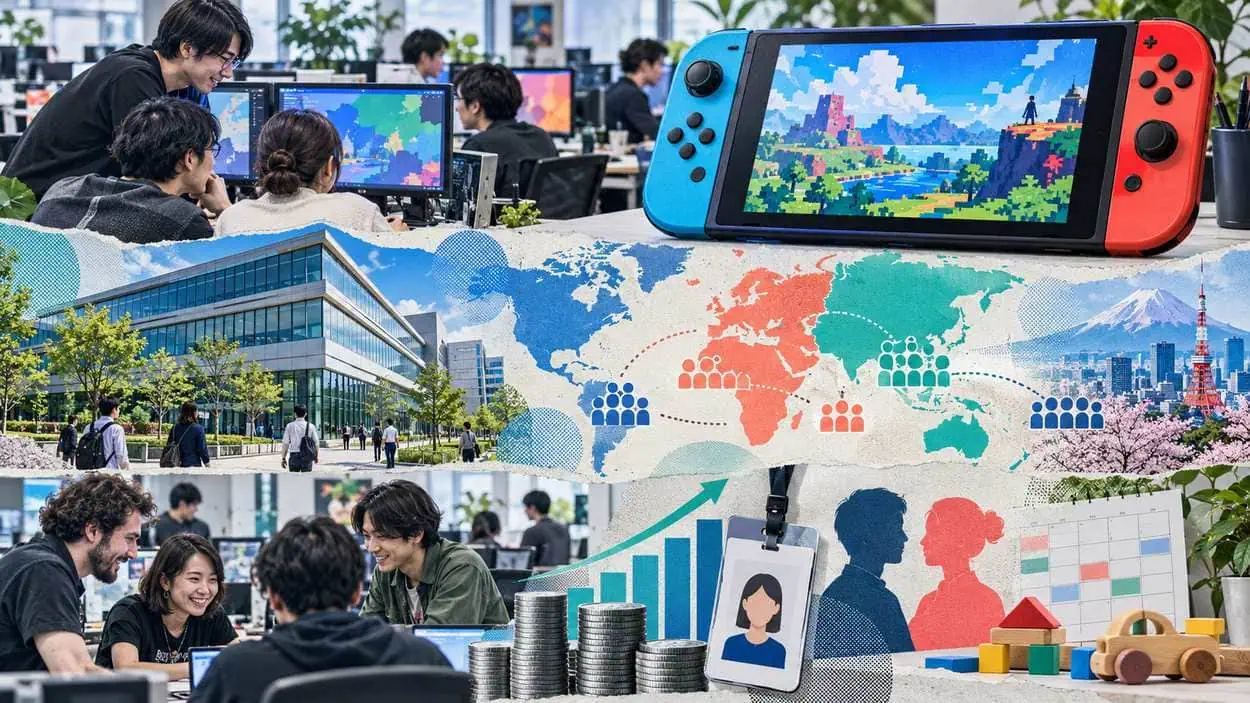






Nintendo had 8,666 employees on a global consolidated basis as of the end of March 2026, including 3,084 at Nintendo Co., Ltd. only, according to Nintendo’s Company Profile. The group count was 8,205 a year earlier, at March 31, 2025, per its Annual Report, so Nintendo added a net 461 employees in twelve months. Those filings give the most direct answer to how many people work at Nintendo.
Nintendo reported 5,166 employees for the year ended March 2017. The workforce has grown 67.8% since then. Every figure below comes from Nintendo’s own publications: annual reports, ESG data sheets, earnings materials, a news release, the company profile and a shareholder meeting Q&A. That lets readers check the staff numbers line by line.
Key Takeaways
- Nintendo has added 2,092 employees since March 2021, a rise of 31.8%.
- Nintendo Co., Ltd. holds 35.6% of the group’s 8,666 employees.
- Women make up 32.3% of the permanent staff reported by gender at Nintendo’s four regional companies.
- Average pay at Nintendo Co., Ltd. rose 1.18% in yen between the years ended March 2021 and March 2026, while its dollar conversion fell 30.0%.
- Net sales per employee reached ¥266.9 million in the year ended March 2026, up from ¥142.0 million a year earlier.
- Women held 5.8% of management positions at Nintendo Co., Ltd. as of March 31, 2026, up from 4.2% in 2023.
Editor’s Choice: How Many People Work at Nintendo
- Group employees, end of March 2026: 8,666.
- Nintendo Co., Ltd. employees, end of March 2026: 3,084.
- Nintendo of America permanent employees, March 2026: 1,603.
- Nintendo of Europe permanent employees, March 2026: 1,152.
- Permanent new hires at four regional companies, year to March 2026: 460.
- Average age at Nintendo Co., Ltd., March 31, 2026: 40.5 years.
Nintendo Employee Count in 2026
- As of March 31, 2026, Nintendo had 8,666 employees across the group, according to Nintendo’s annual report for the year ended March 2026.
- The count includes part-time workers hired on a regular basis and excludes persons seconded outside the group, as defined in the Annual Securities Report.
- Nintendo Co., Ltd., the parent company, holds 35.6% of those employees, based on Company Profile figures.
- That puts 5,582 group employees outside Nintendo Co., Ltd.
- Group headcount grew 5.6% in the year to March 2026.
| Measure | Employees |
|---|---|
| Nintendo group, March 31, 2026 | 8,666 |
| Nintendo group, March 31, 2025 | 8,205 |
| Nintendo group, March 31, 2021 | 6,574 |
| Nintendo parent company, March 31, 2026 | 3,084 |
| Nintendo parent company, March 31, 2021 | 2,498 |
Source: Annual Reports for the years ended March 2021 and 2026, Company Profile 2026
About This Data
- Compiled from 13 sources, all published by Nintendo: six annual reports, two earnings documents and two employee data sheets.
- The rest are a shareholder meeting Q&A, a news release, and the company profile.
- They cover fiscal years from March 2017 to the quarter ended June 2026, and figures are updated when Nintendo publishes new editions.

Nintendo Employees by Year
- Nintendo reported 5,166 employees for the fiscal year ended March 2017 and 6,574 for the year ended March 2021, per Nintendo’s Annual Securities Report.
- The count reached 8,666 for the fiscal year ended March 2026, a rise of 67.8% from 2017.
- The group has added 2,092 employees since March 2021, an increase of 31.8%.
- Growth slowed to 143 employees in the year to March 2022, then rose to 600 a year later.
- The year to March 2025 added 481 employees, and the year to March 2026 added 461.
- The series shows a net gain in every year from 2018 to 2026, a record to compare with Google’s headcount history.
View the data
Recent Developments
- August 6, 2026: Nintendo reported net sales of ¥517,813 million for the three months ended June 30, 2026, down 9.5%.
- August 6, 2026: Operating profit for the same three months rose 150.5% to ¥142,596 million.
- August 6, 2026: Nintendo Switch 2 hardware sales totaled 3.82 million units in the first quarter, with software at 9.46 million units, according to the quarterly earnings release. Volumes like these decide Nintendo’s console market share against PlayStation and Xbox.
- August 6, 2026: Digital sales totaled ¥132.7 billion, up 90.0%, while sales outside Japan made up 77.9% of total first-quarter sales of ¥517.8 billion.
- August 6, 2026: The Super Mario Galaxy Movie’s cumulative global box-office revenue has exceeded $1 billion, according to Nintendo’s Financial Results Explanatory Material.
- September 1, 2026: The US price of Nintendo Switch 2 rose from $449.99 to $499.99, according to a Nintendo news release.
Nintendo Employees by Region
- Nintendo Co., Ltd. in Japan had 3,084 permanent employees covered by the occupational health and safety policy.
- Together, the four companies count 5,939 permanent employees.
- That leaves 2,727 of the 8,666 group employees outside these four counts. They sit at other subsidiaries or in categories the data sheet does not cover.
- At the end of March 2025, the same measure stood at 2,962 in Japan and 1,446 at Nintendo of America.
- Nintendo of America added 157 permanent employees in a year, against 122 in Japan.
View the data
By the numbers: Staff outside Japan make up 48.1% of the permanent employees at Nintendo’s four regional companies, based on Nintendo’s 2026 data sheet. The Kyoto parent remains the single largest block, but the overseas sales and support companies now employ nearly as many people combined.
Nintendo Employees by Gender
- Women are 23.9% of permanent staff at Nintendo Co., Ltd. in Japan, which reported 2,348 men and 736 women as permanent employees.
- At Nintendo of America, the share is 40.4%, and at Nintendo of Europe it is 41.7%.
- Nintendo Australia reported 53 women and 47 men among its permanent employees.
- A year earlier, Nintendo Co., Ltd. reported 692 women among permanent employees, so Japan added 44 women.
- Across the four companies, women make up 32.3% of permanent staff reported by gender.
- The figures cover employees who reported their gender as male or female, so the sum of women and men may not equal the total.
View the data
Nintendo Co., Ltd. Employees in Japan
- Nintendo Co., Ltd. had 3,084 employees at March 31, 2026, with an average age of 40.5 and average service of 14.6 years.
- As of March 31, 2021, it had 2,498 employees, an average age of 39.6, and 14.2 years of service.
- That is 586 more employees in five years, a gain of 23.5%.
- Average service was 13.9 years at March 31, 2024, and 14.4 years at March 31, 2025.
- Labor unions do not exist in Nintendo Co., Ltd., but have been formed at some of its consolidated subsidiaries.
View the data
Nintendo Average Salary
- Nintendo Co., Ltd. paid an average annual salary of ¥9,824,708 in the fiscal year ended March 31, 2026, up 1.64% year over year.
- The average is the amount paid inclusive of tax and includes extra wages and bonuses.
- For the fiscal year ended March 31, 2022, the average was ¥9,886,405, against ¥9,626,857 for the year ended March 31, 2024.
- Shuntaro Furukawa (President and Representative Director) told shareholders that Nintendo raised base salaries in Japan by 10% in April 2023.
- He said Nintendo raised employee compensation again in April 2026, including starting salaries.
View the data
Each annual report also converts the average into US dollars, and that view moves very differently. The 2021 report converted the average to $88,276, while the 2026 report converted it to $61,790 at a rate of ¥159 to the dollar. That is a drop of 30.0% in dollar terms, while the yen average rose 1.18%.
| Fiscal year ended March | Dollar conversion in Nintendo’s report ($) |
|---|---|
| 2021 | 88,276 |
| 2022 | 81,705 |
| 2023 | 74,110 |
| 2024 | 63,754 |
| 2025 | 64,874 |
| 2026 | 61,790 |
Source: Nintendo annual filings, years ended March 2021 to 2026
Why it matters: Nintendo’s 2026 report states that its US dollar amounts are included solely for convenience and are unaudited. For anyone comparing Kyoto pay with studio salaries elsewhere, the yen series is the cleaner measure, because the falling dollar figure mostly reflects exchange rates rather than smaller paychecks.
Women in Management and Gender Pay Gap at Nintendo
- Women held 5.8% of management positions at Nintendo Co., Ltd. as of March 31, 2026.
- The share was 4.2% as of March 31, 2023.
View the data
Nintendo calculates its pay gap between male and female workers under the Act on Promotion of Women’s Participation and Advancement in the Workplace. The pay gap figure between male and female workers was 72.7% for all workers, 73.6% for regular employees, and 84.2% for part-time and temporary workers as of March 31, 2026. Nintendo says the gap is mainly due to differences in length of service and average age.
| As of March 31 | All workers (%) | Regular employees (%) | Part-time and temporary workers (%) |
|---|---|---|---|
| 2023 | 70.1 | 72.0 | 91.3 |
| 2024 | 69.2 | 70.2 | 92.5 |
| 2025 | 69.2 | 70.1 | 91.8 |
| 2026 | 72.7 | 73.6 | 84.2 |
Source: Nintendo gender pay disclosures, 2023 to 2026
Nintendo Hiring and Employee Turnover
- Nintendo’s four regional companies hired 460 permanent employees in the year to March 2026, against 455 a year earlier.
- Turnover was 2.3% at Nintendo Co., Ltd. and 4.0% at Nintendo of America, against 5.7% at Nintendo of Europe and 16.2% at Nintendo Australia.
- In the year to March 2025, turnover at Nintendo Co., Ltd. was 1.9%.
- Permanent staff at Nintendo of America averaged 9.4 years of continuous employment.
| Regional company | New hires, year to March 2025 | New hires, year to March 2026 | Turnover, year to March 2026 (%) |
|---|---|---|---|
| Japan: Nintendo Co., Ltd. | 182 | 168 | 2.3 |
| Nintendo of America | 237 | 250 | 4.0 |
| Nintendo of Europe | 28 | 32 | 5.7 |
| Nintendo Australia | 8 | 10 | 16.2 |
Source: ESG Data Sheet 2026, CSR Data Sheet 2025
Is it hard to get hired at Nintendo?
Nintendo Co., Ltd. hired 168 permanent employees in the year to March 2026, equal to 5.4% of its permanent workforce. Its employee turnover rate was 2.3%. Modest hiring and low turnover mean relatively few openings at Nintendo Co., Ltd. each year, though Nintendo does not publish how many people apply for them.
Nintendo Childcare and Paid Leave
- The rate of annual paid leave taken was 85.8% at Nintendo Co., Ltd. in the year to March 2026.
- The rate was 84.3% at Nintendo of America and 73.4% at Nintendo Australia.
- In Japan, 78 employees took childcare leave, and the rate of reinstatement after childcare leave was 100.0%.
- The rate of childcare leave taken among male workers at Nintendo Co., Ltd. was 82% in 2026, down from 91% in 2025.
- Nintendo of America’s rate of childcare leave taken was 130.0%. The rate can exceed 100.0% because it is the ratio of employees who began taking childcare leave during the fiscal year to those with a child born during the same fiscal year.
| Regional company | Childcare leave taken (%) | Reinstatement after childcare leave (%) | Annual paid leave taken (%) |
|---|---|---|---|
| Japan: Nintendo Co., Ltd. | 86.7 | 100.0 | 85.8 |
| Nintendo of America | 130.0 | 97.0 | 84.3 |
| Nintendo of Europe | 78.6 | 54.5 | 85.7 |
| Nintendo Australia | 100.0 | 100.0 | 73.4 |
Source: ESG Data Sheet published by Nintendo, 2026
Nintendo Revenue per Employee
- Nintendo’s net sales reached ¥2,313,051 million in the fiscal year ended March 2026, against ¥1,164,922 million a year earlier.
- That works out to ¥266.9 million of net sales per employee, up from ¥142.0 million in the year to March 2025.
- The figure was ¥252.4 million in the year to March 2022, ¥218.9 million in 2023 and ¥216.5 million in 2024.
- The 2026 report converts net sales to $14,547 million, or $1.68 million per employee.
- The swing tracks the hardware cycle far more than staffing, a pattern that also runs through Nintendo’s sales and revenue statistics.
View the data
Nintendo Subsidiaries and Development Studios
- Nintendo’s group comprised 32 subsidiaries and four associates as of March 31, 2026.
- Development companies listed in the annual report include Retro Studios, Next Level Games, Shiver Entertainment and MONOLITH SOFTWARE.
- Nintendo Pictures, Nintendo Systems and Nintendo European Research and Development also appear on the development list.
- Furukawa told shareholders: “In recent years, Nintendo and its subsidiaries have been increasing headcount mainly to strengthen development capabilities in hardware, software, and the system software that supports our hardware.”
- The employee survey at Nintendo Co., Ltd. drew a 91% response rate against a target of 90% or higher.
- Nintendo’s board had 13 directors at the end of June 2026, 4 of them women.
- Those studios supply the first-party games Nintendo sells across the wider video game industry, where its own titles anchor each hardware generation.
Nintendo Workforce Timeline
- Nintendo’s group count reached 6,200 for the fiscal year ended March 2020.
- It reached 7,317 for the year ended March 2023 and 8,205 for the year ended March 2025.
- Base salaries in Japan rose 10% in April 2023.
View the data
How much money does Nintendo make?
Nintendo reported net sales of ¥2,313,051 million for the fiscal year ended March 31, 2026. Operating profit was ¥360,117 million, and profit attributable to owners of the parent was ¥424,056 million. In the three months ended June 30, 2026, net sales were ¥517,813 million.
Is Nintendo losing profit?
No. Operating profit for the three months ended June 30, 2026 rose 150.5% to ¥142,596 million, even as net sales fell 9.5%. Profit attributable to owners of the parent was ¥424,056 million for the year ended March 2026, against ¥278,806 million a year earlier.
Conclusion
Nintendo counted 8,666 employees at the end of March 2026, the clearest answer to how many people work at Nintendo. The workforce is 67.8% larger than in the year ended March 2017. Growth has been steady rather than explosive, and by Nintendo’s own account it has gone mainly into development.
The report for the year to March 2027 will show whether a full Switch 2 sales year lifts hiring above its recent pace.