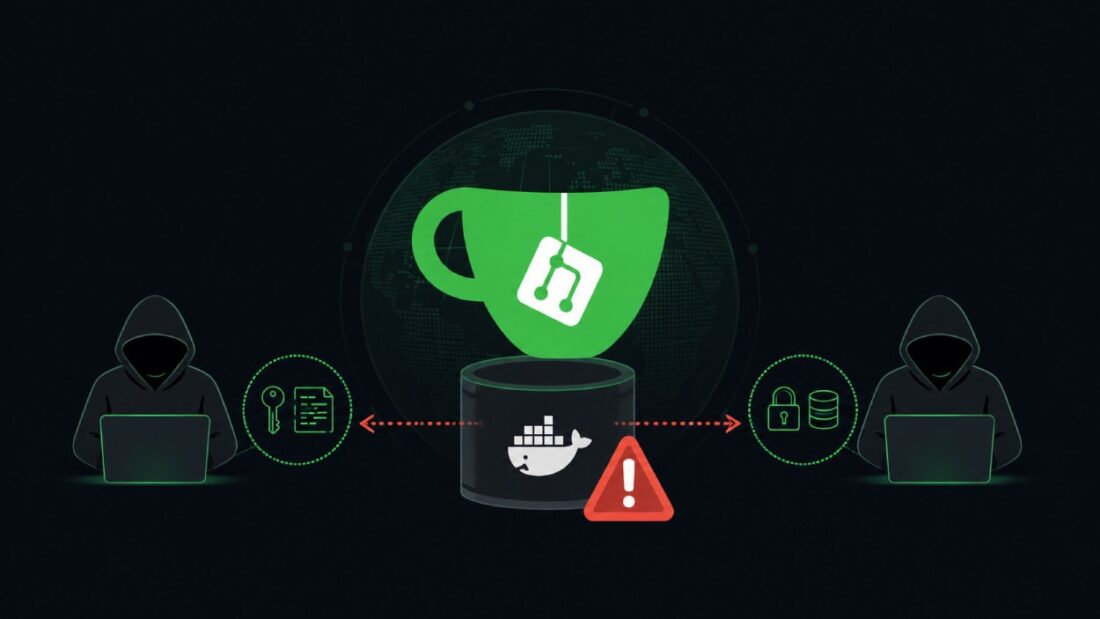






A newly disclosed Gitea vulnerability exposed thousands of private container registries to unauthenticated access, potentially leaking sensitive source code, secrets, and infrastructure data from organizations worldwide.
Quick Summary – TLDR:
- CVE-2026-27771 allowed attackers to pull private container images without authentication.
- More than 30,000 internet facing Gitea deployments were potentially exposed.
- The flaw affected all Gitea versions before 1.26.2 and also impacted Forgejo.
- Security researchers warn the bug could expose API keys, database credentials, and internal infrastructure configurations.
What Happened?
A critical security flaw in Gitea’s built-in container registry allowed anyone on the internet to access private container images without needing credentials or prior authorization. The vulnerability, tracked as CVE-2026-27771, existed in the platform for nearly four years before researchers discovered and reported it.
The issue was identified by AI pentesting firm NoScope, which said the flaw affected tens of thousands of exposed deployments across multiple industries and countries.
A quick update on the Gitea vulnerability.
— The Hacker News (@TheHackersNews) May 28, 2026
Over 30,000 instances may still be exposed. The flaw (CVE-2026-27771) lets anyone pull private container images without authentication.
Many organizations have not patched yet. If you run Gitea, check your version immediately and… https://t.co/w6ofOIIlGE
How the Vulnerability Worked?
The security issue originated from a flaw in Gitea’s access control system for container registries. Normally, repositories marked as private should require authentication before users can pull container images.
However, researchers discovered that the registry endpoint continued serving image manifests and layers even when requests came from anonymous users. Attackers could simply send standard Docker or OCI pull requests to the API and retrieve private images as if they were public.
According to NoScope, no authentication, user account, or special access was needed to exploit the vulnerability.
The flaw impacted all versions of Gitea prior to 1.26.2. It also affected Forgejo, a popular community fork that uses the same registry implementation. Other forks derived from Gitea may also be vulnerable.
Why This Bug Is Serious?
Container images often contain highly sensitive information that organizations never expect outsiders to access. Researchers warned that attackers exploiting the flaw could potentially obtain:
- Proprietary application source code
- API keys and authentication tokens
- Database usernames and passwords
- Cloud provider credentials
- Deployment manifests and infrastructure details
- Internal configuration files
Security experts say this type of information could help attackers move deeper into company networks, launch supply chain attacks, or compromise production systems.
NoScope stated that the flaw made private images behave “as if they were public,” creating a major risk for companies relying on self-hosted development infrastructure.

Over 30,000 Deployments Were Potentially Exposed
Researchers used internet scanning data to estimate the scale of exposure. According to NoScope, more than 34,000 internet facing Gitea instances were identified online, with roughly 31,750 deployments likely vulnerable.
The exposed systems were spread across more than 30 countries, including large concentrations in:
- United States
- China
- Germany
More than half of the affected deployments were hosted on major cloud platforms and VPS providers. Researchers also noted that thousands of exposed instances appeared to be production environments rather than hobby projects.
Impacted sectors reportedly included:
- Healthcare
- Aerospace
- Retail infrastructure
- Internet service providers
- Enterprise software companies
No Active Exploitation Confirmed Yet
At the time of publication, there were no confirmed reports of active attacks exploiting CVE-2026-27771 in the wild. No public proof of concept exploit has been released either.
Still, security researchers warned that exploitation is extremely easy because attackers only need to send standard registry pull requests. With public awareness of the flaw increasing, unpatched systems could quickly become targets.
The vulnerability was responsibly disclosed to the Gitea maintainers after being discovered in April 2026. The project later released a fix in Gitea version 1.26.2.
Patch and Mitigation Steps
Organizations using Gitea are strongly advised to update immediately to version 1.26.2 or later.
For teams unable to patch right away, researchers recommended enabling the following temporary configuration:
[service].REQUIRE_SIGNIN_VIEW=true
This setting blocks all anonymous access to the instance, including public repositories and images. However, administrators should carefully evaluate the impact before enabling it because it may disrupt workflows that depend on public access.
Security teams are also advised to:
- Audit registry access logs for suspicious pull activity.
- Rotate exposed secrets and credentials immediately.
- Review infrastructure configurations for sensitive data exposure.
- Increase monitoring for unusual registry access patterns.
SQ Magazine Takeaway
I think this incident is another reminder that misconfigured or broken access controls remain one of the biggest security risks in modern infrastructure. What makes this bug especially dangerous is how simple the attack was. Attackers did not need malware, phishing, or advanced hacking techniques. They only needed internet access.
The bigger concern is that many organizations store sensitive credentials inside containers without expecting those images to ever become public. That assumption clearly failed here. Companies using self-hosted development tools should treat this as a wake up call to audit what secrets are stored inside their containers and how access controls are enforced.