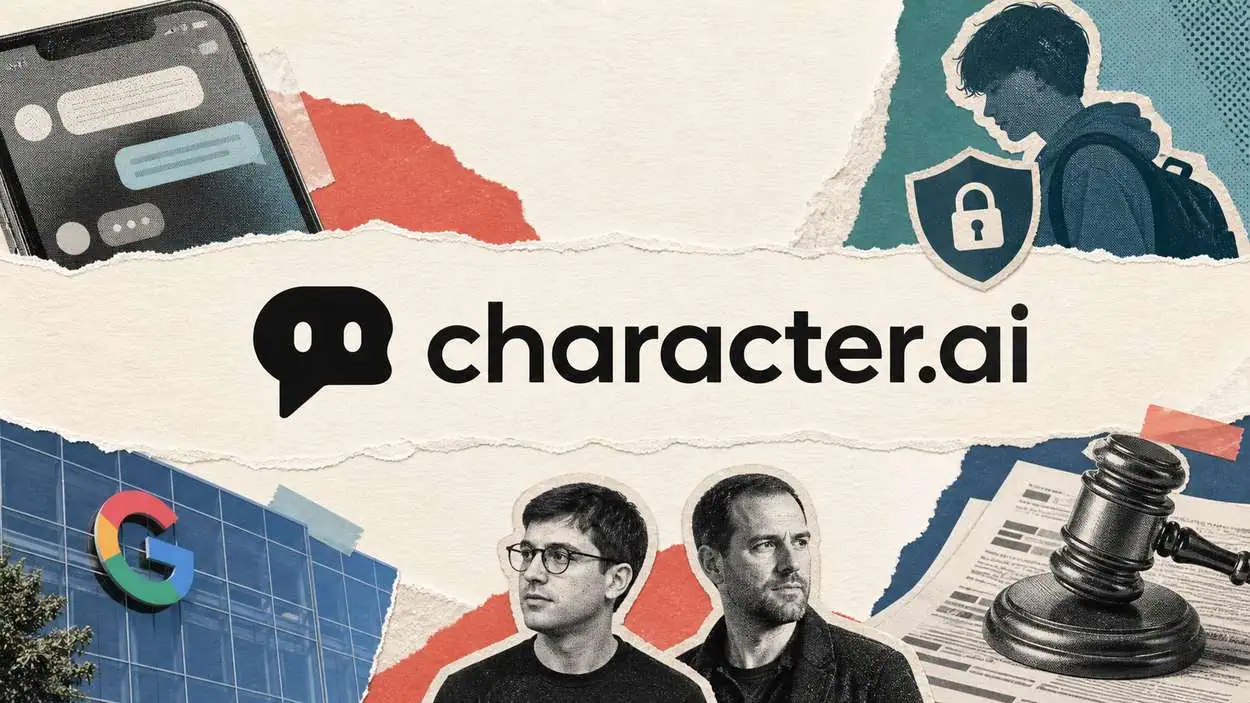






Character.AI reached 20 million monthly active users as of early 2024, and users spent an average of 75 minutes per day on the platform at that peak, according to Sacra’s equity research desk.
The company has since moved through three inflection points in eighteen months: the reported $2.7 billion Google licensing deal of September 2024 that pulled co-founders Noam Shazeer and Daniel De Freitas back to Alphabet, a new CEO in Karandeep Anand, appointed June 20, 2025, and an end to open-ended teen chat that the company said would take effect no later than November 25, 2025. The data below tracks users, revenue, teen adoption, and the litigation arc that reshaped the product roadmap.
Key Takeaways
- Character.AI reported 20 million monthly active users as of early 2024, with users spending an average of 75 minutes per day on the platform.
- Sacra estimates Character.AI hit $30 million in annualized revenue in July 2025, and the company projects it will hit $50 million at the end of 2025.
- The platform’s subscription tier, c.ai+, is priced at $9.99 per month.
- Google reportedly paid $2.7 billion to rehire Character.AI co-founder Noam Shazeer in September 2024.
- Pew Research found 64% of U.S. teens say they use chatbots, including about 3 in 10 who do so daily.
- Among specific chatbots teens use, ChatGPT (59%) leads, followed by Gemini (23%) and Meta AI (20%), with Character.ai further down the list.
- Character.AI said it would end open-ended chat for under-18s no later than November 25, 2025, and Sacra records removal beginning that November.
Editor’s Choice
- Character.AI was valued at $1 billion following its $150 million Series A round in March 2023, led by Andreessen Horowitz.
- With a $30 million annualized revenue run rate, a $1 billion valuation reflects a revenue multiple of approximately 33x.
- The Character Calls voice feature launched publicly on June 27, 2024, free of charge on the app and web.
- Character.AI supports voice in English, Spanish, Portuguese, Russian, Korean, Japanese, Chinese, and many more via Character Calls, launched on June 27, 2024.
- Lower- and middle-income teens are more likely to use Character.ai; some 14% of teens in households with incomes of less than $75,000 report using it, double the 7% rate among teens in households earning $75,000 or more.
- Character.AI said the under-18 transition would include a 2-hour daily chat cap ramping down before the November 25 cutover, plus a new in-house age assurance model the company said it would combine with third-party tools including Persona.
- Character.AI’s under-18 announcement committed to establish and fund 1 new independent non-profit, the AI Safety Lab, dedicated to innovating safety alignment for next-generation AI entertainment features.
Character.AI Monthly Active Users and Daily Time Spent
Sacra’s July 2025 tracking note gives the baseline figures for Character.AI’s user base:
- Monthly active users: 20 million as of early 2024.
- Average time on the platform: 75 minutes per day.
- c.ai+ subscription price: $9.99 per month.
| Metric | Reported value | Source |
|---|---|---|
| Monthly active users | 20 million | Sacra (early 2024) |
| Average time on platform | 75 minutes per day | Sacra |
| Subscription price (c.ai+) | $9.99 per month | Sacra |
| 2025 annualized revenue estimate | $30 million (July 2025) | Sacra |
| 2025 year-end revenue projection | $50 million | Sacra |
Source: Sacra, “Character.AI revenue, funding & news,” 2025
The 20 million MAU figure was reported for early 2024 on Sacra’s tracker.
The same source notes users spend an average of 75 minutes per day on the platform, a daily total that competes with short-form video rather than with traditional messaging apps. Depth of use, not breadth, has been Character.AI’s stated engagement pattern from its early product materials onward. Comparable platform-level dwell figures sit in the social media screen time data.
By the numbers: Character.AI’s early-2024 baseline was 20 million monthly active users spending 75 minutes per day at a c.ai+ price of $9.99 per month, a paid tier with the average daily usage of a short-form video app rather than a messaging app.
Character.AI Revenue and Business Model
| Revenue milestone | Reported figure | Source |
|---|---|---|
| Annualized revenue (July 2025) | $30 million | Sacra |
| Year-end 2025 projection | $50 million | Sacra |
| Series A round (March 2023) | $150 million | Sacra |
| Valuation post-Series A | $1 billion | Sacra |
| Revenue multiple at $30 million ARR | 33x | Sacra |
Source: Sacra, “Character.AI revenue, funding & news,” 2025
- Primary revenue source: C.ai+ subscription at $9.99 per month with priority access, faster response speeds, voice calls, and early features.
- Secondary revenue source: in-feed ads from brands like Yelp and Webtoon on the social feed introduced in 2024.
Sacra notes that Character.AI’s primary revenue source is its c.ai+ subscription service, priced at $9.99 per month, providing users with priority access during peak times, faster response speeds, and features such as voice calls with AI characters and early access to new capabilities, including group chat rooms.
A secondary channel has opened via advertising: the company has started generating advertising revenue, selling ads from brands like Yelp and Webtoon that appear within the platform’s social feed, introduced in 2024.
That mix, one subscription tier plus in-feed ads, puts Character.AI closer to a social platform’s monetization shape than to a traditional SaaS model. Readers tracking adjacent AI adoption curves may compare against ChatGPT and Gemini usage data.

Recent Developments
- August 2026: Character.AI announced the (c.ai) series, a slate of studio-made Microdramas, saying “(c.ai) series is our first studio-led step into Character-driven video” and that “After watching, over-18 users can chat with Characters from each series on Character.ai”.
- January 2026: The terms of the five settlements reached with Character.AI, its founders, and Google were not immediately available, with the joint parties stating they will continue to work together to promote youth safety.
- January 7, 2026: A Florida family agreed to settle a wrongful death lawsuit with an AI company, Google, and others after their teen son died by suicide in 2024. The settlement was filed in the U.S. District Court in the Middle District of Florida; the terms of the settlement were not disclosed.
- January 7, 2026: Beyond the Garcia case, the defendants also settled four other cases in New York, Colorado, and Texas, per court documents cited by CNN Business.
- By November 25, 2025: Character.AI said under-18s would only be able to generate content such as videos with their characters rather than talk to them, and Sacra records removal beginning that November.
- October 29, 2025: Character.AI announced the removal of open-ended chat for users under 18 and committed to the AI Safety Lab and new age-assurance tooling.
- June 20, 2025: Character.AI named Karandeep Anand as CEO, with Dominic Perella taking a new role as Chief Legal Officer & SVP of Global Affairs.
- May 21, 2025: In the Garcia case, the District Court denied in part and granted in part a motion to dismiss the case filed by Character.AI, enabling the case to move forward as of that date. That ruling is the earlier step in the sequence above, not the case’s current posture: the docket then moved to the January 7, 2026 settlement and dismissal listed higher in this timeline.
Character.AI’s Under-18 Safety Overhaul
- Announced cutover: Character.AI said open-ended teen chat would end no later than November 25.
- Announced transition cap: Chat time to be limited initially to 2 hours per day, ramping down before the cutover.
- Announced age assurance: The company said it built an in-house model and would combine it with third-party tools including Persona.
Character.AI’s own announcement laid out three parallel commitments. The company said it would remove the ability for users under 18 to engage in open-ended chat with AI on the platform, taking effect no later than November 25.
For the transition window, the company said it would also limit chat time for users under 18, with the limit set initially at 2 hours per day and ramping down in the weeks before November 25.
The company said it built an age assurance model in-house and would combine it with leading third-party tools including Persona, and said it would establish and fund the AI Safety Lab, an independent non-profit dedicated to innovating safety alignment for next-generation AI entertainment features.
CEO Karandeep Anand framed the change externally, telling BBC News that “Today’s announcement is a continuation of our general belief that we need to keep building the safest AI platform on the planet for entertainment purposes”. The company’s own release added, per CNBC, that “These are extraordinary steps for our company, and ones that, in many respects, are more conservative than our peers”. Whether the industry follows is the question the settlement week left open; no other consumer AI companion platform has matched a full teen-chat ban at that scale.
The Google Licensing Deal and Founder Exit
- Google payment: A reported $2.7 billion, September 2024.
- Deal shape: Non-exclusive license to Character.AI’s large language model technology.
- Founder trajectory: Character.AI launched in 2022 by co-founders Noam Shazeer and Daniel De Freitas, both former Google employees.
PYMNTS reported that Google reportedly paid $2.7 billion to rehire ex-employee/AI guru Noam Shazeer, structured as a licensing arrangement rather than an acquisition.
Character.AI was launched in 2022 by Noam Shazeer and Daniel De Freitas, both former Google employees, and the arrangement grants Google a non-exclusive license to Character.AI’s large language model technology.
Key finding: The $2.7 billion Google licensing deal reported in September 2024 was structured as a non-exclusive license plus rehiring of co-founder Noam Shazeer, a shape that gave Google access to the technology and the talent without an acquisition.
How Teens Actually Use Character.AI vs Other Chatbots
- Overall chatbot use: 64% of U.S. teens say they use chatbots.
- Daily chatbot use: about 3 in 10 teens say they use AI chatbots every day.
- Leading chatbot: ChatGPT at 59% teen adoption.
- Character.ai income split: some 14% of teens in households under $75,000 vs 7% in households at $75,000 or more.
- Next-ranked chatbots: Gemini (23%) and Meta AI (20%).
- Survey base: an online survey of 1,458 U.S. teens from Sept. 25 to Oct. 9, 2025, reported December 9, 2025.
The December 2025 Pew survey put concrete numbers on where Character.ai sits in the teen stack.
Overall, 64% of teens say they use chatbots, including about 3 in 10 who do so daily, and ChatGPT (59%) is by far the most widely used chatbot and the only one measured that a majority of teens use, more than twice the rate of the next most commonly used chatbots: Gemini (23%) and Meta AI (20%).
Character.ai lands in the second tier alongside Copilot and Claude, but its demographic split is distinctive: some 14% of teens in households with incomes of less than $75,000 report using Character.ai, double the 7% rate among teens in households earning $75,000 or more.
Adjacent demographic reads sit in the Gen Alpha social media data and the broader Gen Z social media coverage.
Product Feature Timeline
- Founding: 2021, per BBC News reporting.
- First public app: earliest version released in 2022.
- Character Calls voice: launched June 27, 2024, free.
- Announced under-18 chat cutover deadline: no later than November 25, 2025.
The Character Calls launch on June 27, 2024 made the feature available to the general public on the app or web completely free of charge. The earliest version of the app was released in 2022 per CNBC’s ban coverage, while BBC News reported the platform was founded in 2021, a year before that first public release.
Litigation and Regulatory Pressure
- Garcia lead case filed: October 23, 2024, in the US District Court for the Middle District of Florida.
- Motion to dismiss ruling: Denied in part on May 21, 2025; case moved forward.
- Total cases settled: 5 cases, one in Florida plus four in New York, Colorado, and Texas, as of January 7, 2026.
- Finalization window: The court gave the parties 90 days from the January 2026 dismissal to finalize the settlement or reopen the case for good cause.
- Product change under scrutiny: Character.AI said it would no longer allow users under the age of 18 to have back-and-forth conversations with its chatbots.
| Case / event | Filed | Status |
|---|---|---|
| Garcia v Character Technologies (FL, MD Fla.) | October 23, 2024 | Motion to Dismiss Denied in part, May 21, 2025; settled January 7, 2026 |
| Companion cases (NY, CO, TX) | 2024, 2025 | Settled January 7, 2026 (four cases per CNN) |
Source: Tech Policy Press docket tracker; CNN Business January 7, 2026
The Garcia case set the legal template. The Social Media Victims Law Center and the Tech Justice Law Project filed the suit against Character.AI, its two cofounders, and Google on behalf of the parent of Sewell Setzer III, a 14-year-old who died by suicide. The complaint alleges he had become dependent on role-playing AI characters offered by the company.
The complaint was filed in the US District Court for the Middle District of Florida. Its allegations, as reported, are that Character.AI “knew the design of its app was dangerous and would be harmful to a significant number of minors”, “failed to exercise reasonable care for minors on its app” and “deliberately targeted underage kids”.
At the settlement stage, the court gave the parties 90 days from the January 2026 dismissal to finalize the settlement or reopen the case for good cause. The settlement resolves the immediate wrongful-death claim but leaves the underlying product-design question, whether a companion-style chatbot open to minors is defective by design, unadjudicated on the merits.
Why it matters: A January 7, 2026 court filing in the Garcia case showed that settlement agreement, and separate court documents showed four further settlements in New York, Colorado and Texas, 5 in all; the terms of the settlements were not immediately available, and the product-design questions the Garcia complaint raised were not adjudicated on the merits before the under-18 chat cutover Character.AI had announced for no later than Nov 25, 2025.
Global Availability and Language Footprint
- Named Character Calls voice languages at launch: English, Spanish, Portuguese, Russian, Korean, Japanese, Chinese, plus more that the launch post did not name.
- Access tier: free of charge on app and web.
- Modality switch: users can keep the conversation going by switching between texting and talking anytime.
| Language capability | Detail |
|---|---|
| Character Calls voice languages | English, Spanish, Portuguese, Russian, Korean, Japanese, Chinese, and more |
| Text-chat languages | Broad multilingual support via the underlying LLM |
| Platform | Web + native mobile app |
| Access tier for Character Calls | Free of charge |
Source: Character.AI blog, “Introducing Character Calls,” June 27, 2024
At launch, Character Calls supported English, Spanish, Portuguese, Russian, Korean, Japanese, Chinese, and many more, with users free to switch between texting and talking anytime.
Is Character.AI still popular?
Yes, but the shape of that popularity changed twice in 2025. Sacra’s July 2025 tracker estimated $30 million in annualized revenue, with the company itself projecting $50 million at the end of 2025, indicating a growing paid business even as the Pew Research Center’s December 2025 data showed Character.ai sitting behind ChatGPT (59%), Gemini (23%), and Meta AI (20%) in teen adoption. Head-to-head assistant benchmarks sit in the Claude vs ChatGPT data.
The announced under-18 chat ban closes open-ended chat to a large teen segment, so the practical audience of “still popular” is now adult and older-teen creators plus paid subscribers.
How many users did Character.AI lose from the early-2024 peak?
The exact figure is not company-disclosed. Sacra’s tracker anchors 20 million monthly active users as of early 2024 but does not publish a subsequent MAU number. What is confirmed publicly is the Google deal that pulled the founders out (a reported $2.7 billion, September 2024), the CEO transition (Karandeep Anand named June 20, 2025), and the announced removal of open-ended chat for under-18s, due no later than November 25, 2025, each a structural change that reshaped the addressable user base. Treat any post-2024 MAU figure as a third-party estimate unless Character.AI publishes it directly.
What did Google pay for Character.AI?
PYMNTS reported that Google reportedly paid $2.7 billion, structured as a non-exclusive license to Character.AI’s large language model technology combined with the rehiring of co-founder Noam Shazeer.
A January 7, 2026 court filing in the Garcia case identified Character.AI founders Noam Shazeer and Daniel De Freitas as named defendants alongside Character.AI and Google, a footprint of the deal that persisted into the later litigation.
Conclusion
Character.AI’s current profile is defined by three anchors: 20 million MAU and an average of 75 minutes per day spent on the platform at its early-2024 baseline, the reported $2.7 billion Google licensing deal that pulled Shazeer and De Freitas back to Alphabet, and the announced end to open-ended chat for users under 18, due no later than November 25, 2025. Sacra’s estimated $30 million annualized revenue figure for July 2025 shows a paying base persisting through the founder exit; the January 2026 settlement closes the immediate legal exposure without resolving the product-design questions the Garcia case raised.
The next data point worth watching is the AI Safety Lab’s first public output and any FTC or state AG follow-up. The settlement resolved the plaintiffs’ claims but left the broader teen-safety regulatory posture toward AI companion apps unresolved. Character.AI’s own trajectory now runs through paid adult creators and the announced under-18 non-chat experience; how those two audiences scale against ChatGPT’s teen dominance is this year’s story to track.