





WhatsApp serves, according to Meta, more than 3 billion users a month. By contrast, Telegram passed over 1 billion monthly active users in March 2025, a gap that frames almost every difference between the two apps. The choice between them rarely comes down to size, though. It comes down to what each app does with your messages once you hit send. The comparison below covers users, encryption, privacy, group size, and file limits, with a verdict for each kind of user.
Key Takeaways
- WhatsApp reaches, per Meta, more than 3 billion monthly active users, roughly three times Telegram’s base.
- Telegram crossed over 1 billion monthly active users in March 2025 and reported $547 million in profit the prior year, per founder Pavel Durov.
- WhatsApp applies, per WhatsApp, end-to-end encryption by default across its base of more than two billion users, while Telegram reserves that protection for opt-in Secret Chats.
- Telegram supports groups for up to 200,000 people, far above WhatsApp’s group ceiling.
- Both apps share files up to 2GB each, with Telegram Premium raising that to 4 GB per file.
- Telegram users open the app an average of 21 times a day and spend 41 minutes a day in it, per Pavel Durov.
Editor’s Choice
- WhatsApp’s user base, per Meta, over 3 billion, makes it the default messenger in more than 100 countries.
- Telegram’s, per Pavel Durov, over 1 billion users make it the second most popular messaging app worldwide, excluding WeChat.
- WhatsApp secures all messages and calls across its more than two billion users so that no one in between can read them, not even WhatsApp, per WhatsApp.
- Telegram’s default Cloud Chats use, per Telegram, server-client encryption and are stored encrypted in the Telegram Cloud, a model that as of 2026 leaves them readable by Telegram’s servers.
- Telegram channels broadcast to unlimited audiences, while its groups scale to 200,000 members, features WhatsApp matches only partially.
WhatsApp at a Glance
Per WhatsApp, every private message sent using WhatsApp is secured with end-to-end encryption by default, and the company states that no one in between can read your messages or listen to your calls, not even us. That default posture anchors WhatsApp’s entire pitch. The app reached more than 2 billion users in 2020 and has since tripled to over 3 billion.
That single design choice, encryption that is always on rather than something you switch on, is the clearest line separating WhatsApp from Telegram.
WhatsApp runs on the open Signal Protocol, the same cryptography Signal uses, which security researchers can audit independently. For most readers, the practical takeaway is simple: you do not have to know any of this to be covered, because the protection is the default state, not a setting buried three menus deep.
 Pros
Pros End-to-end encryption on by default for all personal chats and calls
- Runs on the audited Signal Protocol
- The largest reach of any messenger at over 3 billion users
- Files up to 2GB
- Tight integration across Meta’s apps
 Cons
Cons Owned by Meta, a company whose business is advertising data; metadata (who you message and when) is still collected
- Group size capped far below Telegram
- Default backups need separate encryption to stay protected
Telegram at a Glance
Telegram passed over 1 billion monthly active users in March 2025, built on scale and speed rather than default secrecy, and per founder Pavel Durov, it also registered $547 million in profit the prior year. The platform reads less like a private messenger and more like a content network with chat attached.
That positioning shapes every design decision Telegram makes, from giant public groups to a cloud that follows you across devices.
Telegram’s encryption is layered. Server-client encryption is used in Cloud Chats, which cover private and group chats, while Secret Chats add a layer of client-client encryption. ESET’s security team notes the gap plainly: only Secret Chats are end-to-end encrypted, and they must be manually enabled.
Pros- Massive groups up to 200,000 members; unlimited-audience channels
- 2GB files (4 GB on Premium)
- Fast multi-device sync
- Rich bot and automation ecosystem
- Cloud history searchable across devices
Cons- Default chats are not end-to-end encrypted
- Secret Chats are opt-in and one-to-one only
- The MTProto protocol is custom and not open to full independent audit
- Cloud storage means Telegram’s servers can access default chat content
Default encryption gap: Telegram’s standard Cloud Chats, including all group chats, are not end-to-end encrypted. ESET notes that Telegram’s servers can access the contents of your cloud chats if needed, and warns the hybrid model can create a false sense of safety. Anyone treating a normal Telegram chat as private should switch to a Secret Chat or use a default-encrypted app.

Head-to-Head: WhatsApp vs Telegram at a Glance
WhatsApp leads on default security and its reach of more than 3 billion users, while Telegram leads on group scale with groups of up to 200,000 members and broadcast channels. The table below sets the headline numbers side by side, and the sections after it explain what each one means in practice.
| Dimension | Telegram | |
|---|---|---|
| Monthly active users | Over 3 billion | Over 1 billion |
| Default encryption | End-to-end, all chats | Server-client (cloud) |
| End-to-end option | Always on | Secret Chats only (opt-in) |
| Encryption protocol | Signal Protocol (open) | MTProto (custom) |
| Max group size | 1,024 members | 200,000 members |
| Max file size | 2GB | 2GB (4 GB Premium) |
| Owner | Meta Platforms | Telegram FZ-LLC |
Source: WhatsApp blog, Telegram FAQ, Meta Q1 2025 earnings
User Base and Global Reach
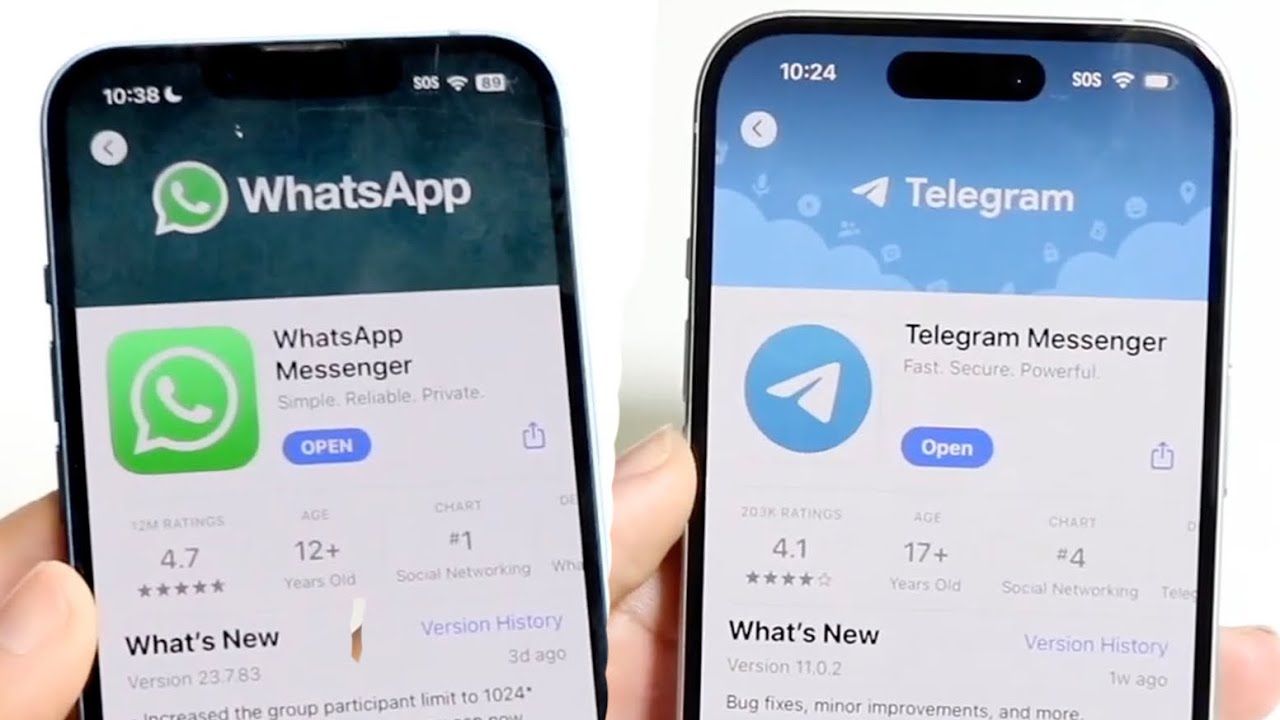
WhatsApp dominates raw reach with more than 3 billion monthly active users, confirmed by Meta during its first-quarter 2025 earnings call, roughly three times the over 1 billion monthly active users Telegram reported in March 2025. Scale matters in messaging because the app most of your contacts already use wins by default, and WhatsApp holds that position across Europe, Latin America, India, and much of Africa.
- WhatsApp: More than 3 billion monthly active users, confirmed by Meta Q1 2025 earnings.
- Telegram: Over 1 billion monthly active users as of March 2025, making it the second most popular messaging app globally (excluding WeChat).
- Telegram users open the app an average of 21 times a day, per founder Pavel Durov.
| App | Monthly active users |
|---|---|
| 3 billion | |
| Telegram | 1 billion |
Source: Meta Q1 2025 earnings; Pavel Durov, March 2025
Telegram’s growth tells a different story. The platform became the second most popular messaging app in the world, excluding the China-specific WeChat, on the strength of public channels and communities rather than one-to-one chat. Telegram users are unusually engaged, opening the app 21 times a day on average.
Encryption and Default Security
WhatsApp wins this dimension decisively because protection is automatic: every private message is secured with end-to-end encryption by default, and the company states no one in between can read your messages or listen to your calls, not even us. The app uses the open Signal Protocol, which independent cryptographers can audit.
Telegram takes a layered approach that puts the burden on the user. Cloud Chats, covering private and group chats, use server-client encryption and are stored encrypted in the Telegram Cloud, while only Secret Chats add end-to-end encryption.
ESET states the practical limit clearly: Only Secret Chats are end-to-end encrypted, and they must be manually enabled, and MTProto is Telegram’s custom encryption protocol that has faced criticism because it is not open for full independent audits. This is the encryption-parity myth in one line: both apps say they are encrypted, but only one encrypts everything you send without asking you to opt in.
By the numbers: WhatsApp applies end-to-end encryption to 100% of personal chats by default across its 3 billion-user base, per WhatsApp. Telegram limits that protection to manually enabled Secret Chats, leaving default Cloud Chats readable on its servers, per ESET. The gap is one of defaults, not capability.
Is WhatsApp end-to-end encrypted by default?
Yes. WhatsApp confirms that every private message sent using WhatsApp is secured with end-to-end encryption by default, covering both text and calls. The protection runs on the Signal Protocol and applies without any setting change, which helps reduce the risk that messages are read in transit or on WhatsApp’s own servers.
Is Telegram more secure than WhatsApp?
For default chats, no. Telegram only end-to-end encrypts Secret Chats, which must be manually enabled and work one-to-one rather than in groups. A correctly configured Secret Chat is strong, but the everyday Telegram experience leaves messages encrypted only between client and server, so the default posture is weaker than WhatsApp’s. Readers weighing the strongest privacy option should add Signal to the comparison, since it pairs default end-to-end encryption with minimal metadata collection.
Privacy and the Data Model
WhatsApp stores messages on your device rather than its servers, which keeps content unreadable to itself, and the company states no one in between can read your messages or listen to your calls, not even WhatsApp. The trade-off is metadata. Meta still records who you message and when, and the app belongs to an advertising company.
Telegram’s privacy model flows from one architectural decision. Its default Cloud Chats are stored encrypted in the Telegram Cloud, which is what makes seamless multi-device sync, cloud search, and giant groups possible. The same choice that makes Telegram convenient is the one that keeps default chats readable on its servers, so convenience and the privacy gap come from the same design, not from carelessness. Readers weighing this should also review broader cybersecurity threat data before deciding which model fits their risk tolerance.
Why it matters: Telegram’s cloud-first design powers features WhatsApp cannot match, like 200,000-member groups and searchable history across devices, per Telegram. That same server-side storage is why default chats are not end-to-end encrypted. Choosing Telegram means accepting that trade, not overlooking it.
Group Size, Channels and Communities
Telegram supports groups for up to 200,000 people and channels for broadcasting to unlimited audiences, winning community scale by a wide margin and built for public communities rather than private chats alone. WhatsApp caps standard groups at 1,024 members and routes larger gatherings through Communities, which bundle subgroups under one umbrella.
- Telegram: groups for up to 200,000 people and channels for broadcasting to unlimited audiences.
- WhatsApp: standard groups capped at 1,024 members; larger gatherings use the Communities product.
| Feature | Telegram | |
|---|---|---|
| Max group members | 1,024 | 200,000 |
| Channel audience | Channels product | Unlimited |
Source: WhatsApp Help Center 2026, Telegram FAQ 2026
This is where the two apps stop competing and start serving different needs. WhatsApp optimises for the private group of friends, family, or a small team; Telegram optimises for the broadcast audience and the public community. Anyone running a large public group or newsletter-style channel will find Telegram’s ceiling far more generous.
Can Telegram groups be bigger than WhatsApp groups?
Yes, by a large margin. Telegram allows groups for up to 200,000 people, while WhatsApp caps standard groups at 1,024 members. Telegram also offers channels for broadcasting to unlimited audiences, making it the stronger choice for public communities, creators, and large-scale announcements.
File Sharing and Media Limits
WhatsApp lets you send files up to 2GB in size at a time, protected by end-to-end encryption, a jump from its earlier 100MB limit, making this dimension closer than most. Telegram matches the 2 GB per-file limit for all users and raises it to 4 GB per file for Premium subscribers.
The real difference shows up after the file lands. On WhatsApp, the transfer stays end-to-end encrypted. On Telegram, a file sent in a normal Cloud Chat sits encrypted on Telegram’s servers, not end-to-end between you and the recipient. For heavy media sharers, Telegram’s cloud keeps files accessible across devices without re-uploading, a genuine convenience win.
Verdict by Use Case
WhatsApp and Telegram split the four dimensions cleanly, so no single app wins outright, and the right pick depends on what you value most, whether that is WhatsApp’s default encryption and reach or Telegram’s group scale and broadcast channels. The verdicts below match each app to the user it serves best.
- Best for everyday private messaging: WhatsApp, because end-to-end encryption is on by default for every personal message and almost everyone you know already uses it. The protection requires no setup, which helps reduce the risk of mistakes.
- Best for large communities and broadcasting: Telegram, because it supports groups for up to 200,000 people and unlimited-audience channels. Creators, public groups, and large announcements outgrow WhatsApp quickly.
- Best for maximum default privacy: WhatsApp over Telegram, since Telegram’s secret chats must be manually enabled and do not cover groups. Readers who want the strongest privacy posture should treat any default Telegram chat as readable on its servers and switch to a Secret Chat for sensitive conversations.
- Best for cross-device power users: Telegram, because cloud storage gives seamless sync, searchable history, and a deep bot ecosystem that WhatsApp’s device-bound model cannot match.
Is Telegram safer than WhatsApp for privacy?
For most people using default settings, WhatsApp offers stronger privacy because it applies end-to-end encryption to every message by default, whereas Telegram only end-to-end encrypts manually enabled Secret Chats. Telegram’s broader feature set comes from storing chats in its cloud, which means default conversations are not protected end-to-end. A privacy-focused Telegram user can close much of the gap by using Secret Chats, but that requires deliberate action on every conversation.
What about scams and account safety?
Social-engineering attacks, not encryption breaks, are the real risk on both WhatsApp and Telegram. Most messaging fraud relies on tricking users into handing over codes or clicking malicious links, the same pattern documented in our guide to how phishing works. Telegram’s open channels and bots create more surface area for scam outreach, while WhatsApp scams often arrive through hijacked contacts, so the threat profile differs even though the underlying trick is the same.
Conclusion
WhatsApp and Telegram answer different questions. WhatsApp, with more than 3 billion monthly active users and end-to-end encryption on by default, is the safer everyday choice for private one-to-one and small-group messaging. Telegram, having passed over 1 billion monthly active users in March 2025, wins on community scale with groups for up to 200,000 people and unlimited-audience channels.
The deciding factor is what you want from a messenger this year: default privacy with the broadest reach, or the most powerful tools for public communities and cross-device sharing. Readers who prioritise security should weigh WhatsApp’s always-on encryption against Telegram’s opt-in model and decide which default they can live with.