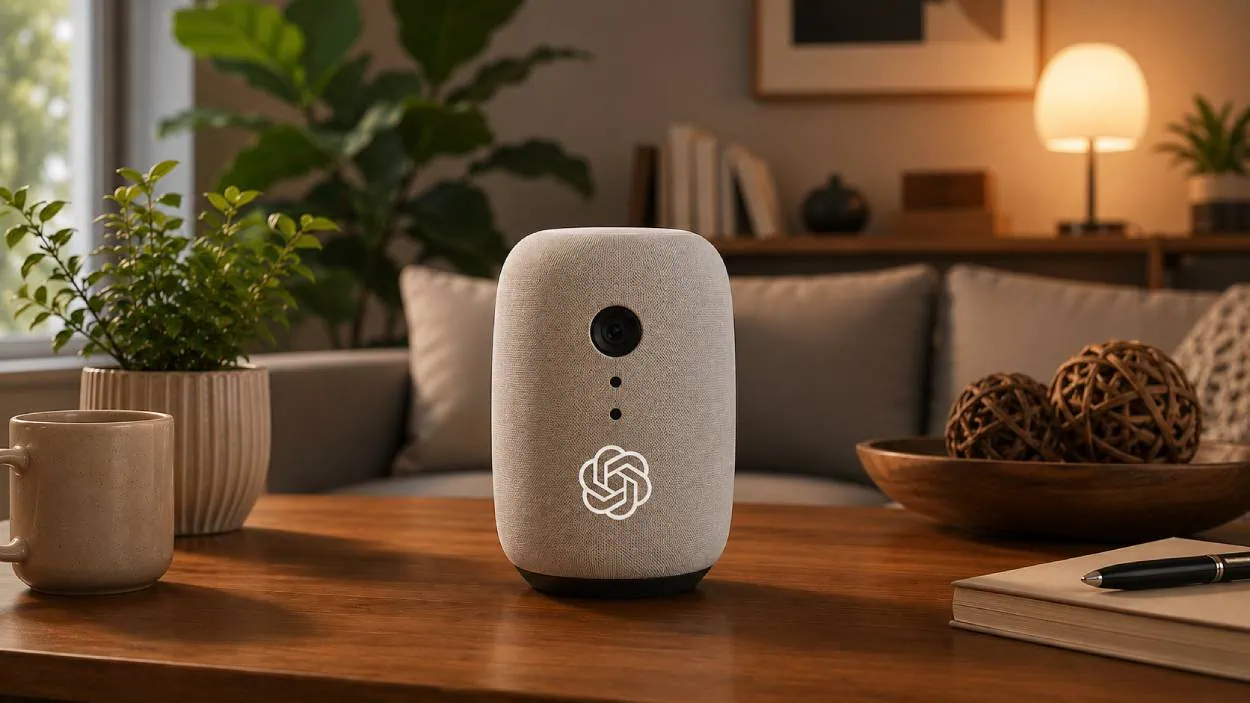






OpenAI is reportedly developing its first hardware product, a movable, screen-free AI speaker, according to Bloomberg’s reporting, which cites people familiar with the matter.
Quick Summary – TLDR:
- OpenAI is developing a mobile, screen-free speaker designed as a “humanlike AI companion” for the home, according to Bloomberg.
- The device reportedly has a “personality” and learns about its owner over time, drawing on emails and other personal data.
- Former Apple engineers who helped build the iPhone and Mac reportedly worked on the project, adding to OpenAI’s hardware push.
- Apple sued OpenAI last week over alleged trade-secret theft, a dispute OpenAI has denied.
- Hark, a rival AI hardware startup, raised over $700 million at a $6 billion valuation in May, underscoring investor appetite for the category.
What Happened?
OpenAI has never shipped a consumer hardware product. Recent OpenAI Workforce Statistics show a company that has scaled well beyond its research roots, part of why a hardware device from the ChatGPT maker is plausible now. Apple Customer Loyalty also help explain why OpenAI recruited from Cupertino: Jony Ive began collaborating with Sam Altman and the OpenAI team, then founded io with a team of hardware and software engineers before it merged into OpenAI, according to OpenAI’s own account of the deal.
The unannounced device reportedly has a “personality” and can proactively learn about its owner over time to provide more personalized service, people who described it to Bloomberg said. It would draw on a user’s digital life, including emails, to do so. Unlike a stationary smart speaker, it reportedly includes mechanical elements that can move on their own, designed to “feel like a companion and become a physical manifestation of OpenAI’s ChatGPT.“
Many of the engineers building it previously worked at Apple on products including the iPhone and Mac, per Bloomberg’s sourcing. That detail matters given what happened next: Apple sued OpenAI last week, accusing it of stealing trade secrets and calling the allegations only “the tip of the iceberg.” OpenAI has denied wrongdoing, and people familiar with its plans told Bloomberg the company feels its product “veers significantly” from anything Apple currently sells.
NEW: OpenAI’s first product is a mobile, screen-free home smart speaker that a user can build a connection with like an AI companion. Amid Apple’s trade secret lawsuit, the iPhone maker has nothing like it on the market. https://t.co/U40biVBKNo
— Mark Gurman (@markgurman) July 14, 2026
Privacy and Security Stakes
An always-on, movable speaker that learns a household’s routines is a different privacy proposition than a static smart speaker. The reported design would draw on a user’s emails and other personal data to personalize its responses over time, the kind of access that concentrates a household’s digital life inside a single vendor’s hardware.
That concentration, not the moving parts, is the real security question. A microphone equipped, mobile device with access to personal data widens what a household must defend if any part of the chain is ever compromised.
OpenAI has not announced the device, and the people who described it to Bloomberg asked not to be identified because the project hasn’t been announced. That silence means none of the security or data-handling safeguards it might ship with are yet public.
The Apple Rift and the AI Hardware Race
Apple integrated ChatGPT directly into Siri and its Writing Tools, letting iPhone, iPad, and Mac users tap OpenAI’s model for free, according to Apple’s own announcement of the feature. That partnership predates the lawsuit by about two years, from integrating each other’s technology to accusing each other of stealing it.
Hark, the AI lab founded by Brett Adcock, raised over $700 million in a Series A at a $6 billion valuation in May to build what it calls personal intelligence, AI models paired with dedicated hardware. This funding helps us put that in people’s hands quickly and at scale. said Brett Adcock, Founder & CEO of Hark.
OpenAI, Hark, and Apple are all betting the next computing interface will not be a screen. A trade secrets fight over stolen designs could slow down whichever company is furthest along.

SQ Magazine’s Takeaway
This reads as OpenAI trying to define a new hardware category rather than compete directly with the iPhone. A speaker that moves, remembers, and pulls context from a user’s email is a bet that people will trust one company with far more of their daily data than a phone app ever asked for.
The reported use of former Apple engineers suggests OpenAI is building for that ambition with real product-design experience, not just a research demo. The Apple lawsuit is the immediate complication. If discovery turns up evidence that OpenAI’s design choices trace back to Apple’s own unreleased work, the device’s timeline, or its engineering team, could be disrupted regardless of how the underlying product performs.
OpenAI has not confirmed the device exists, so the near-term signal to watch is whether the company addresses it directly, and how, once this reporting forces the question. The Apple lawsuit’s discovery process is the other clock running in parallel.
Whatever it surfaces about the hardware team’s origins will shape how the device is received if OpenAI does eventually ship it. Buyers weighing an eventual purchase should watch for whatever OpenAI publishes about data handling and always-listening controls well before launch, not after.