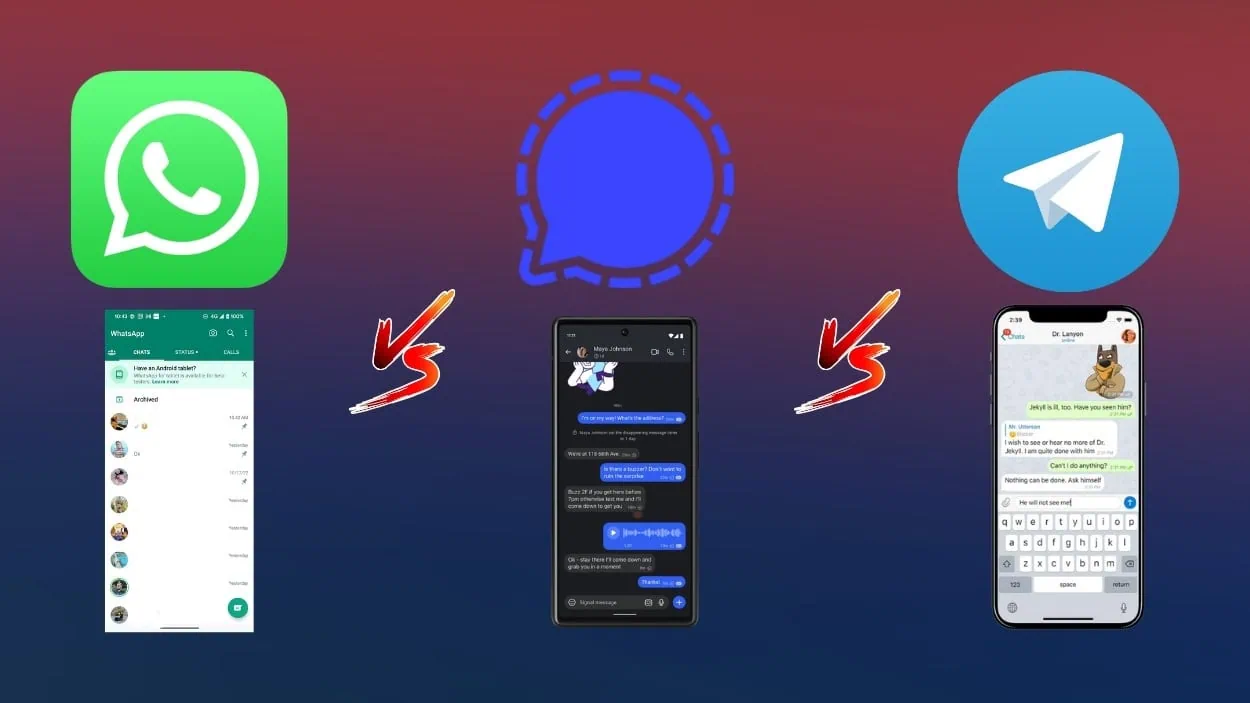






Signal encrypts every message and call by default, while Telegram leaves its most-used chat type readable on its own servers unless users opt in. Signal’s encryption is powered by the open-source Signal Protocol, applying end-to-end protection to every message and every call with no mode to switch on.
That one design choice, on-by-default versus opt-in, separates the three contenders more sharply than any marketing claim. Encryption is never optional according to Signal, and per Telegram, its default chats are encrypted to its servers rather than end-to-end. The comparison below weighs encryption defaults, metadata exposure, protocol scrutiny, and group-chat coverage so the “most secure” verdict rests on evidence.
Key Takeaways
- Signal encrypts all 3 of its chat types (one-to-one, group, and calls) end-to-end by default using the open source Signal Protocol, with no setting to enable.
- WhatsApp protects all 3 chat types (one-to-one, group, and calls) with the same Signal encryption protocol on by default, but parent company Meta still collects metadata around those messages.
- Telegram applies E2EE to only 1 chat type, the opt-in one-to-one Secret Chat; its default Cloud Chats sit on Telegram’s servers.
- Telegram group chats and channels number 0 options for E2EE, since that protection exists only in one-to-one Secret Chats.
- The Signal Protocol underwent a peer-reviewed formal security analysis by researchers from 3 universities, while Telegram’s MTProto was designed in-house.
- Telegram’s encryption is based on 256-bit symmetric AES, 2048-bit RSA, and Diffie-Hellman key exchange, with Secret Chats adding an extra layer of client-client encryption.
Editor’s Choice
- Encryption is always on across 100% of chats according to Signal, making it the most secure by default on an open source protocol.
- WhatsApp matches Signal on content encryption across all 3 chat types per WhatsApp’s own Help Center, using the same Signal Protocol, with metadata collection by Meta as the trade-off.
- Per Telegram, Secret Chats limit readership to the 2 participants via client-client encryption, while default Cloud Chats use client-server encryption.
- Telegram’s MTProto 2.0 has powered major clients since version 4.6, replacing the deprecated MTProto 1.0.
- Signal’s design provides forward secrecy and post-compromise security, validated by a peer-reviewed analysis from 3 universities.
- Only 2 of the 3 apps, Signal and WhatsApp, extend default encryption to group chats.
How the Three Apps Encrypt Your Messages
Signal and WhatsApp both encrypt every personal message end-to-end by default, while Telegram reserves that protection for opt-in Secret Chats. According to WhatsApp’s Help Center, every WhatsApp message is protected by the same Signal encryption protocol that secures messages before they leave the device, and treats qualifying chats as end-to-end encrypted by default.
- Signal and WhatsApp apply end-to-end encryption to all chats by default using the open source Signal Protocol; no setting is required.
- Telegram’s default Cloud Chats use client-server/server-client encryption and are stored encrypted on Telegram’s servers, meaning Telegram holds the decryption keys.
- Telegram’s Secret Chats apply client-client end-to-end encryption, but users must start them manually, and they are limited to one-on-one conversations.
| Dimension | Signal | Telegram | |
|---|---|---|---|
| Encryption protocol | Signal Protocol (open source) | Signal Protocol | MTProto 2.0 (in-house) |
| E2EE on by default | Yes, all chats | Yes, all personal chats | No, only opt-in Secret Chats |
| Group chats E2EE | Yes | Yes | No |
| Default chat storage | On-device, not on servers | On-device, not on servers | Encrypted on Telegram servers |
| Owner | Signal Foundation (non-profit) | Meta Platforms | Telegram |
| Peer-reviewed protocol analysis | Yes | Yes (shared protocol) | Limited |
Source: Signal, WhatsApp Help Center, Telegram FAQ, 2026
Telegram, by contrast, says messages in Secret Chats use client-client encryption while Cloud Chats use client-server/server-client encryption and are stored encrypted in the Telegram Cloud. Its default chats stay readable to Telegram’s own servers.
Reading down the “E2EE on by default” row tells most of the story before any deeper analysis: two apps say yes for everything, one says yes only for a chat type most users never open.
Signal: Encryption by Default
Signal encrypts every message, call, group, and reaction by default, and the Signal Foundation states the service is built so it cannot read that content. Signal says it is designed to never collect or store any sensitive information, and that Signal messages and calls cannot be accessed by Signal or other third parties because they are always end-to-end encrypted, private, and secure. The non-profit ownership model matters here, because Signal has no advertising business that depends on harvesting user behavior.
The Signal Protocol that does the work is open source, which lets independent cryptographers inspect it directly. On Signal, privacy is not an optional mode, and end-to-end encryption powered by the open source Signal Protocol applies to every message and every call. That open design is why the same protocol now secures messages on competing platforms.
 Pros
Pros Encryption is always on, with no setting to misconfigure.
- Open source protocol that independent researchers can audit.
- Non-profit ownership with minimal data collection.
 Cons
Cons Smallest user base of the three, so contacts may not be on it.
- Requires a phone number to register (though usernames now reduce exposure).
- Fewer cloud-convenience features such as multi-device chat history sync.

WhatsApp: Signal Protocol Plus Meta Metadata
WhatsApp turns encryption on by default for every personal message and uses the same cryptographic core that Signal does. WhatsApp states that every WhatsApp message is protected by the same Signal encryption protocol that secures messages before they leave the device. For the content of a one-to-one or group message, that puts WhatsApp on equal footing with Signal: the message body is unreadable in transit and on WhatsApp’s servers.
The difference sits around the message rather than inside it. WhatsApp is owned by Meta, and metadata such as who you contact, when, and how often is not shielded by message encryption. The reframe worth holding onto: message encryption protects what you say, not the fact that you said it to a particular person at a particular time.
Pros- Default encryption on the same protocol Signal uses.
- Largest user base, so contacts are almost always reachable.
- Encrypted backups and multi-device support widely available.
Cons- Meta collects metadata around messages even though content stays encrypted.
- Closed-source client, so users trust Meta’s implementation of the protocol.
- Business chats may be handled under a business’s own data practices once received.
Telegram: Powerful Cloud, Optional Encryption
Telegram applies E2EE only to Secret Chats, which two users start manually, and leaves its default Cloud Chats encrypted between client and server with Telegram holding the keys. Telegram describes Secret Chats as one-on-one chats in which messages are encrypted with a key held only by the chat’s participants, and notes the schema for these end-to-end encrypted Secret Chats differs from what is used for cloud chats. Telegram says all messages in secret chats use end-to-end encryption, so only you and the recipient can read those messages, and messages cannot be forwarded from secret chats.
Default chats are still encrypted, but under a different trust model. Telegram’s encryption is based on 256-bit symmetric AES encryption, 2048-bit RSA encryption, and Diffie-Hellman secure key exchange, with Secret Chats adding an extra layer of client-client encryption on top. Because Telegram retains the decryption keys for Cloud Chats, it stores those keys carefully. Telegram says cloud chat data is stored in multiple data centers controlled by different legal entities across jurisdictions, with decryption keys split into parts kept separately, so several court orders from different jurisdictions are required to force it to give up any data.
Default chats are not end-to-end encrypted: On Telegram, regular one-to-one chats, all group chats, and all channels use client-server encryption, which means Telegram can technically access that content. Only opt-in Secret Chats use E2EE, and they are limited to two participants on a single device pair.
Pros- Strong cloud convenience: chat history syncs instantly across devices.
- Secret Chats offer genuine E2EE with self-destruct timers.
- Distributed key storage raises the legal bar for compelled disclosure.
Cons- Default Cloud Chats are not end-to-end encrypted and sit on Telegram servers.
- Group chats and channels cannot be E2EE at all.
- In-house MTProto protocol has had less independent academic review.
Default vs Optional End-to-End Encryption
The single most important security difference between these apps is whether E2EE is the default or an opt-in feature most users never enable. Telegram says all its messages are always securely encrypted, but distinguishes Secret Chats using client-client encryption from Cloud Chats using client-server/server-client encryption that are stored encrypted in the Telegram Cloud. On Signal and WhatsApp, there is no equivalent toggle: the strongest protection applies to every chat without a decision from the user.
Why it matters: Telegram’s default chats use strong ciphers, yet because Telegram holds the keys, the protection model differs from zero-knowledge end-to-end encryption. A chat can be “encrypted” and still readable by the provider, which is exactly the gap that default E2EE closes on Signal and WhatsApp.
This is also why the convenience features cut both ways. The same server-side storage that lets Telegram restore your full chat history on a new phone is what keeps its servers able to decrypt those chats. The Telegram CEO has publicly criticized WhatsApp’s encryption, but the structural fact remains that WhatsApp encrypts by default while Telegram’s default does not lock the provider out.
What Each App Knows About You
Message content and message metadata are two different security questions, and the three apps diverge sharply on the second. Signal states it is designed to never collect or store any sensitive information, the strongest metadata-minimization posture of the three. WhatsApp encrypts content with the Signal Protocol but, as a Meta service, gathers metadata around messages, which can build a detailed picture of contact patterns without exposing message text.
- Signal states it is designed to never collect or store any sensitive information, the leanest data posture of the three apps.
- WhatsApp encrypts content on the Signal Protocol yet, as a Meta service, retains metadata including contact patterns and message frequency.
- Telegram holds both metadata and content for default Cloud Chats, stored on its own servers, because those chats are not end-to-end encrypted.
| Data type | Signal | Telegram | |
|---|---|---|---|
| Message content readable by provider | No | No | Yes (Cloud Chats) |
| Metadata collected | Minimal | Yes (Meta) | Yes (Cloud Chats) |
| Default chats stored on servers | No | No | Yes |
| Owner data-collection incentive | None (non-profit) | Advertising (Meta) | Limited |
Source: Signal legal, WhatsApp Help Center, Telegram FAQ, 2026
Telegram occupies a middle position. Default Cloud Chats are stored on Telegram servers, so Telegram holds more than metadata for those chats. Telegram says it uses a distributed infrastructure to protect data that is not covered by end-to-end encryption, storing cloud chat messages, photos, videos, and documents on its servers so users can access them from any device. Readers comparing privacy postures across services can see the broader pattern in our consumer data privacy statistics, where metadata exposure consistently outlasts content protection.
Protocol Scrutiny: Signal Protocol vs MTProto
How thoroughly a protocol has been examined by outside cryptographers is a security signal in its own right, and here the Signal Protocol holds a clear lead. University researchers conducted a formal security analysis of Signal’s X3DH key agreement and Double Ratchet protocols and found the security properties hold under standard cryptographic assumptions, including forward secrecy and post-compromise security, with no major design flaws. That peer-reviewed work covers the same cryptographic core WhatsApp uses, so its assurances extend to WhatsApp’s content encryption.
- The Signal Protocol has a formal peer-reviewed security analysis (IEEE EuroS&P 2017) confirming forward secrecy and post-compromise security with no major design flaws.
- Telegram’s MTProto 2.0 has powered major Telegram clients since version 4.6, with MTProto 1.0 deprecated and being phased out; it was designed in-house with less independent academic review.
- An arXiv study examining the desktop clients of six widely used end-to-end-encrypted messaging applications illustrates how open academic scrutiny helps surface and fix known weaknesses.
| Protocol attribute | Signal Protocol | MTProto 2.0 |
|---|---|---|
| Designed by | Open Whisper Systems / Signal | Telegram (in-house) |
| Source availability | Open source | Client open, server closed |
| Peer-reviewed formal analysis | Yes | Limited |
| Forward secrecy | Yes | Secret Chats only |
| Used by | Signal, WhatsApp | Telegram |
Source: Signal documentation, Telegram FAQ, IEEE EuroS&P 2017
Telegram’s MTProto sits on weaker external footing. Telegram’s MTProto 2.0 has powered major Telegram clients since version 4.6, with MTProto 1.0 deprecated and being phased out. The protocol was designed in-house and has drawn less peer-reviewed academic analysis than the Signal Protocol.
Independent academic work, such as an arXiv study examining the desktop clients of six widely used end-to-end-encrypted messaging applications, continues to probe how real-world clients hold up as threats evolve. Open scrutiny does not guarantee safety, but it does mean known weaknesses surface and get fixed in public, which helps reduce the risk of silent flaws.
Group Chats, Channels, and Backups
Group security is where Telegram’s model shows its sharpest limit. On Signal and WhatsApp, group chats inherit the same default encryption that one-to-one chats use, so a 50-person group is protected the same way a single conversation is. On Telegram, groups and channels are Cloud Chats by definition and cannot be made end-to-end encrypted, because Secret Chats are restricted to one-on-one conversations.
Backups deserve the same scrutiny as live chats, since an unencrypted backup undoes encryption in transit. Telegram’s cloud storage means chat history persists on its servers by design. The same encrypted-by-default question shows up across the wider ecosystem, from Apple’s encrypted RCS messaging tests to Google’s end-to-end encrypted Gmail rollout, where the headline feature is moving encryption from optional to on-by-default.
Verdict by Use Case
Signal wins the overall security verdict because it encrypts every chat by default and the Signal Foundation states it cannot read message content, but the best app depends on the use case. WhatsApp suits scale, Telegram suits cloud convenience, and the verdicts below map the evidence onto common situations.
- Best for maximum default privacy: Signal is the strongest choice when message content and metadata both matter, because encryption is always on and Signal states it does not collect sensitive information. Journalists, activists, and privacy-focused users get the tightest default posture.
- Best for everyday secure messaging at scale: WhatsApp fits most people who want default encryption without asking contacts to switch apps, since it uses the same Signal Protocol and has the largest user base. The trade-off is Meta’s metadata collection.
- Best for large communities and cloud convenience: Telegram suits broadcasting to channels and syncing big chat histories across devices, but users wanting private conversations must remember to start a Secret Chat, and group chats stay outside its encrypted tier.
For anyone weighing WhatsApp specifically, our coverage of WhatsApp’s incognito chat privacy features and the username-based system WhatsApp is rolling out covers practical privacy controls beyond the encryption layer.
Is Telegram end-to-end encrypted?
Telegram is end-to-end encrypted only for Secret Chats, which two users start manually. Its default Cloud Chats, all group chats, and all channels use client-server encryption, meaning Telegram can technically access that content. Telegram states Secret Chat messages are encrypted with a key held only by the participants, so the protection depends on whether users opt in.
Which is more secure, Signal or WhatsApp?
Signal and WhatsApp both encrypt message content with the Signal Protocol by default, so they are comparable on content security. Signal edges ahead overall because it is open source, non-profit, and states it collects almost no metadata, while WhatsApp’s owner Meta gathers metadata around messages even though message text stays encrypted.
Conclusion
Encryption defaults, not protocol branding, decide the security ranking among these three apps. Signal encrypts every message and call by default on an open, peer-reviewed protocol and states it cannot read user content; WhatsApp matches that content protection with the same Signal encryption protocol but trades metadata to Meta; and Telegram secures default chats with 256-bit AES while holding the keys, reserving true end-to-end encryption for opt-in Secret Chats that exclude groups and channels.
For readers ranking the three on security alone, the evidence points to Signal as the most secure by default, WhatsApp as the strong mainstream option, and Telegram as a powerful cloud platform whose privacy depends on a setting most users never change. The wider industry shift toward on-by-default encryption suggests the gap will keep narrowing on content, even as metadata remains the harder problem to solve.