It began in a garage, as so many tech revolutions do. Not the one you’re thinking of, though. This was in Nairobi, where a startup engineered an AI-powered soil sensor that transformed farming yields across East Africa. It didn’t make global headlines. But in its quiet brilliance, it captured what tech growth today really looks like: global, practical, and deeply integrated into daily life.
Technology today is less about shiny gadgets and more about interconnected systems that solve real problems. Whether it’s AI models transforming medicine, 5G driving real-time logistics, or green tech reshaping how we power our lives, the pace and purpose of innovation have shifted. Below, we unpack the data behind this accelerating momentum.
Editor’s Choice
- The global technology market will reach $5.6 trillion, up from $5.2 trillion last year.
- The cloud computing industry is projected to grow to $905 billion.
- 5G networks will serve over 2.6 billion connections worldwide.
- Cybersecurity spending is anticipated to surpass $308 billion.
- More than 92% of enterprises are undergoing digital transformation.
- The number of tech startups in the US has climbed to over 30,000.
Recent Developments
- Enterprises rapidly adopt open-source AI frameworks, accelerating adoption across industries.
- 45% of financial institutions use digital ID and biometric authentication.
- Global space tech investment reached $124 billion.
- 72% of new smart devices include voice AI assistants.
- Tech giants funded $10.5 billion in university R&D initiatives.
- Wearable health technology has grown into a $22.57 billion industry.
- Neuromorphic computing prototypes have tripled, reaching new commercial milestones.
- 80% of low-code platform users come from non-IT backgrounds, highlighting broader adoption.
- 35 countries reimburse digital therapeutics.
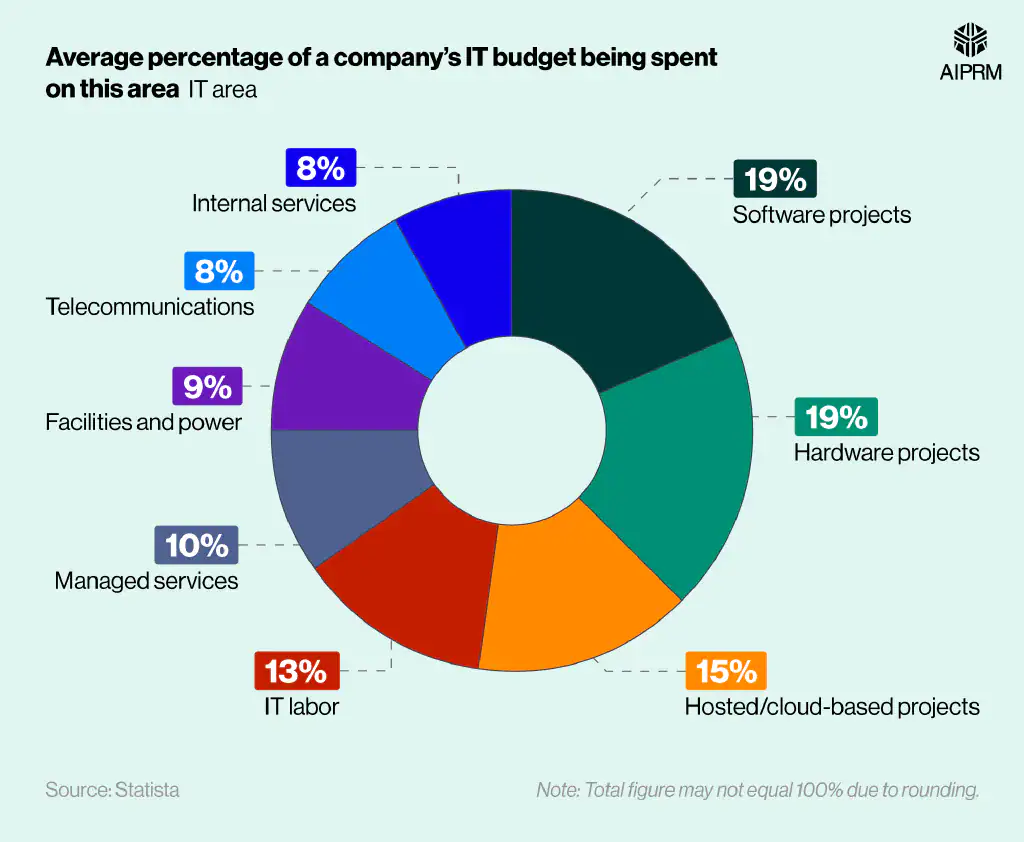
Average IT Budget Spending by Category
- Software projects take the largest share of IT budgets, accounting for about 19% of total spending.
- Hardware projects also represent 19% of IT budgets, showing strong investment in physical technology infrastructure.
- Companies spend around 15% of their IT budgets on hosted and cloud-based projects to support scalable digital services.
- IT labor absorbs roughly 13% of IT budgets as businesses invest in skilled technology professionals.
- Managed services make up about 10% of total IT spending as firms outsource certain IT operations.
- Businesses allocate around 9% of their IT budgets to facilities and power to maintain data centers and equipment.
- Telecommunications account for approximately 8% of IT spending for connectivity and network services.
- Internal IT services also represent 8% of total budgets, supporting internal operations and systems.
Key Drivers of Technological Advancement
- 88% of companies use AI in at least one business function.
- Collaboration platforms form a $30 billion industry.
- Venture capital investment in automation technologies rose 38% year over year.
- Global semiconductor manufacturing will reach $976 billion.
- Government funding for tech R&D in G20 nations exceeds $330 billion.
- 72% of CTOs prioritize a shift to cloud-native application development.
- Global funding for quantum computing research surpassed $7.2 billion.
- 25% of manufacturing firms adopt digital twin technologies.
- Public-private tech partnerships reached a record high with 251 new alliances.

Cloud Computing Market Expansion
- The global cloud computing market is set to reach $905 billion.
- Hybrid cloud adoption is at an all-time high, with 76% of enterprises using combinations.
- Infrastructure as a Service (IaaS) grows at 23.3% year-over-year.
- AWS, Microsoft Azure, and Google Cloud hold 63% of the global market share.
- Cloud-native applications account for 65.87% of large enterprise deployments.
- Data storage services in the cloud generate $439 billion in revenue.
- Serverless computing has expanded significantly for agile development.
- Edge computing has grown to a $25.63 billion industry.
- In the US, government cloud spending reaches $15.4 billion.
- Cloud security solutions are adopted by 93% of cloud-first enterprises.
Regional IT Spending Growth Highlights
- Asia-Pacific leads with the highest IT spending growth rate of 12.1%.
- North America follows with a growth rate of 10.2%.
- Middle East & Africa shows expansion with a 9.4% growth rate.
- Latin America posts solid growth of 8.5%.
- Western Europe grows at 7.8%.

Internet of Things (IoT) Growth
- The number of active IoT devices worldwide has surpassed 22 billion.
- IoT in healthcare sees over 50% of hospitals using connected devices.
- The industrial IoT (IIoT) segment represents 29% of total deployments, valued at $293 billion.
- Smart homes account for 26% of total IoT installations.
- IoT-enabled vehicles are estimated at 87% of new car models sold.
- IoT in agriculture contributes $18 billion in global value.
- IoT-generated data accounts for 27% of all digital data created.
- Asia-Pacific leads with 38% share of new IoT deployments.
Regional Breakdown of the Green Technology and Sustainability Market
- North America leads with 33% of the global market share.
- Europe follows with 22% market share.
- Asia-Pacific captures 24% of the market.
- LAMEA contributes 20% to the market.
- Latin America holds 5% share, indicating room for growth.
Technology Funding Changes
- Generative AI (GenAI) leads technology investment growth, with 91% of organizations increasing funding and an average spending rise of +38%.
- Artificial intelligence (AI) follows closely, as 88% of companies increase funding, driving a mean spending increase of +36%.
- Cyber and information security receives strong support, with 84% of organizations boosting budgets and an average increase of +26%.
- Business intelligence and data analytics see major investment, with 79% of firms increasing funding and spending rising by +25% on average.
- Cloud platforms continue to grow, as 72% of companies expand funding, resulting in a +21% mean spending increase.
- Intelligent automation attracts higher budgets, with 70% of organizations raising funding, and average spending increasing by +18%.
- Application modernization also gains momentum, with 69% of businesses increasing budgets and a mean spending change of +19%.
- Integration technologies and APIs see rising adoption, with 65% of companies increasing funding and budgets growing by +17%.
- Customer relationship management (CRM) investments rise as 61% of organizations boost spending, with an average increase of +16%.
- Digital workplace technologies gain traction, with 59% of companies raising budgets and funding growing by +14%.
- Low-code and no-code platforms expand steadily, as 58% of organizations increase funding, resulting in an average increase of +13%.

5G Deployment and Usage
- 5G networks cover 55% of the world population.
- The number of 5G connections has surpassed 2.6 billion.
- In the US, 5G availability spans 98% of metropolitan areas.
- 5G-enabled devices account for 76% of all new smartphone sales globally.
- 5G private networks are deployed in 46% of Fortune 100 companies.
- 5G-based IoT in smart factories reduced downtime by 29%.
- Latency improvements enable over 50% reduction in telemedicine diagnostic lag.
- In Europe, 5G adoption increased to 30% of mobile users.
- Rural 5G initiatives in the US cover over 120 million residents.
Cybersecurity Spending and Threat Trends
- Global cybersecurity spending surpasses $308 billion.
- Ransomware attacks increased by 17%, with an average breach cost of $6.2 million per incident.
- Zero-trust architecture is deployed by 60% of large organizations.
- Phishing attacks account for 90% of all breaches.
- AI-driven cybersecurity tools are used by 58% of IT departments.
- Cloud-specific security incidents have risen by 22%.
- US federal cybersecurity funding increased to $14.5 billion.
- Healthcare and finance comprise 27% of breach reports each.
- Security as a Service (SECaaS) is projected to grow to $16.61 billion.
Top Supply Chain Technology Trend
- Process standardization ranks highest for major impact at 45%, with 27% seeing minor impact.
- Cloud services follow with a major impact for 41% and a minor impact for 25%.
- Big data and analytics are expected to have 38% major and 40% minor impact.
- Digitalization of the supply chain is tied with 37% major and 38% minor impact.
- Sustainability sees a balanced impact with 32% major and 29% minor.
- Artificial intelligence shows 28% major and 34% minor influence.
- Robotic Process Automation gets 19% major but 42% minor rating.
- Blockchain lags with 18% major and 27% minor impact perception.

Emotional Impact of Social Media on US Teenagers
- 48% of US teens say social media has a mostly negative effect on people their age.
- 41% of highest-use teens rate their mental health as poor or very poor vs 23% of lowest-use teens.
- 58% of US teens say social media makes them feel anxious.
- 31% of teens feel excluded by friends because of what they see on social media.
- 32% of US teens report being cyberbullied at least once.
- 46% of US teens aged 13–17 experienced at least one cyberbullying behavior.
- Teens spending more than 10 hours per week on social media are 56% more likely to report feeling unhappy.
Digital Transformation in Enterprises
- 90% of companies are working on digital transformation initiatives.
- The global installed base of industrial robots will reach 5.5 million units.
- 42% of SAP-focused companies plan high or medium investments in S/4HANA on-premises.
- Customer data platforms for marketing are growing at a forecast 18% CAGR.
- The digital twins market will grow from $29.63 billion to $42.04 billion.
- 88% of employees want training in hard skills, and 84% prioritize soft skills.
- 63% of executives report a positive profitability impact from digital transformation.
- Most organizations see 5–15% revenue increases from well-executed transformations.
- Boards continue to appoint Chief Digital Officers as digital remains a top concern.
Age-Based Risk Distribution of Internet Addiction
- Teens aged 13–17 face the highest internet addiction risk at 73%.
- Young adults aged 18–24 follow with a risk rate of 71%.
- Individuals aged 25–34 show a 59% internet addiction risk.
- Adults aged 35–44 report a 38% addiction risk.
- Those aged 45–54 have an estimated 33% risk level.
- Individuals aged 55–64 show around 28% addiction risk.
- Older people, 65+ individuals, still represent roughly 20% of internet addiction cases.
Green and Sustainable Tech Adoption Rates
- Green technology and energy-transition investments globally exceed $2.3 trillion.
- Solar, wind, grids, and related clean power attracted about $1.2 trillion in capital.
- Electrified transportation, including EVs and charging, drew $893 billion in investment.
- The green technology and sustainability market will reach $31.05 billion, up from $25.44 billion.
- The green data center market expands from $194.09 billion to $239.85 billion.
- The circular economy market grows from $517.79 billion to $578.09 billion.
- Nearly 2 trillion in annual climate and clean-tech capital is flowing into low-emission technologies.
Frequently Asked Questions (FAQs)
Global 5G connections are forecast to hit 3.2 billion by 2026, with over 60% of these in the Asia-Pacific region.
Global cybersecurity spending is projected to reach $308 billion in 2026, growing 11.8% year over year and potentially climbing to $430 billion by 2029.
The global AI market is projected to grow from $58.3 billion in 2021 to $309.6 billion by 2026, at a 39.7% CAGR.
Conclusion
From cloud platforms scaling faster than ever to AI reshaping every layer of business, this year is a pivotal year in technology’s evolution. What makes this year stand out isn’t just the pace, but the direction. Growth is no longer about gadgets alone. It’s about systems that empower, connect, and regenerate.
Innovation now comes with impact: smarter energy, broader access, sharper tools, and safer networks. Whether you’re a startup founder in San Francisco, a farmer using IoT in South Africa, or a patient accessing AI-enabled care in New York, technology today is closer, faster, and more relevant than ever.