





NVIDIA’s upcoming Vera server CPU is already showing impressive benchmark numbers, beating some of the latest Intel Xeon and AMD EPYC processors in early Linux tests.
Quick Summary – TLDR:
- NVIDIA Vera uses 88 custom Olympus ARM cores designed for AI and data center workloads.
- Early benchmarks show Vera outperforming Intel Xeon Granite Rapids and AMD EPYC Turin chips.
- Vera reportedly delivers up to 63% better performance than NVIDIA’s previous Grace CPU.
- NVIDIA is preparing Vera for both AI systems and standalone server CPU deployments.
What Happened?
NVIDIA’s next generation Vera CPU has appeared in its first public benchmark tests, and the results are already creating serious competition for Intel and AMD in the server market. The ARM based processor uses NVIDIA’s in house Olympus CPU cores and is designed specifically for modern AI, inference, and agentic AI workloads.
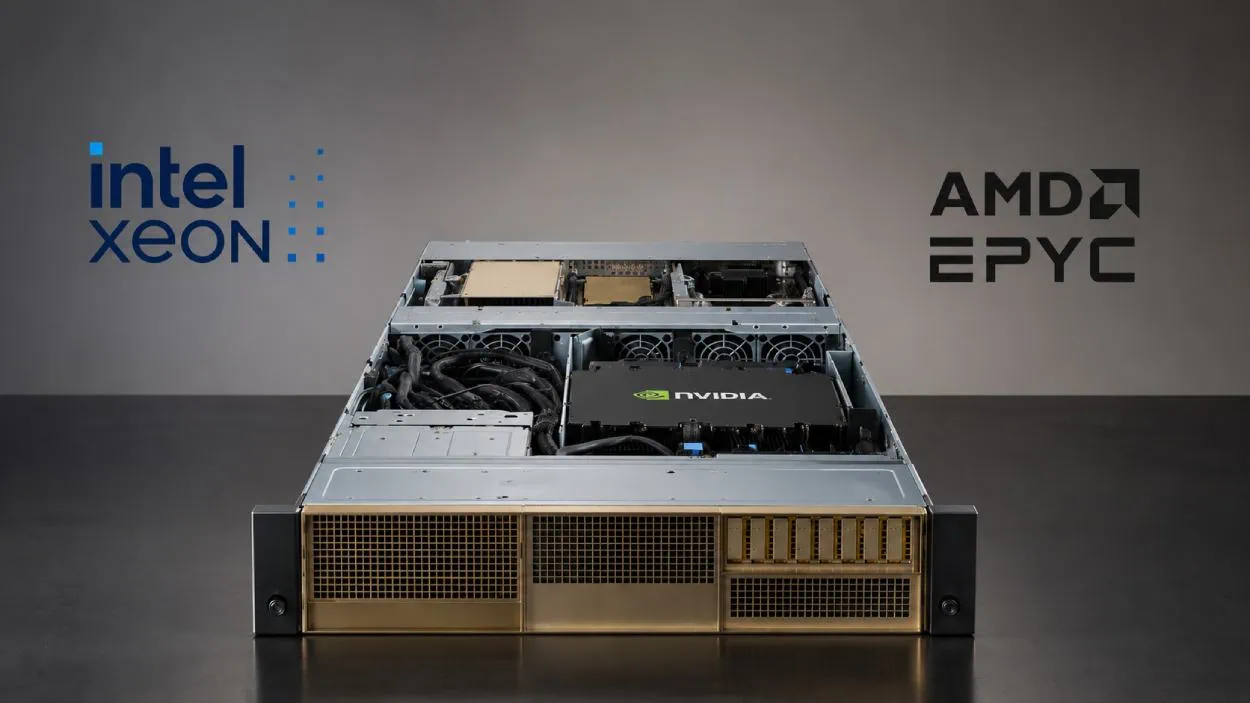
The benchmarks, published by Phoronix after testing at NVIDIA’s Santa Clara headquarters, showed Vera outperforming several high end Intel Xeon and AMD EPYC server processors across multiple workloads.
We built the NVIDIA Vera CPU for agentic AI, and the latest benchmarks from @Phoronix confirm it delivers.
— NVIDIA (@nvidia) May 26, 2026
⚡1.5x overall performance vs. leading x86 processors
⚡2x faster Linux kernel compilation
⚡4x greater STREAM TRIAD memory bandwidth
Vera achieves the performance that AI… pic.twitter.com/HP35T4Ek6H
NVIDIA’s Big CPU Push Is Becoming Serious
For years, NVIDIA dominated the AI accelerator market through its GPUs. Now the company is moving deeper into the CPU business with Vera, which is expected to power the upcoming Rubin AI platform while also launching as a standalone server processor.
The Vera CPU features 88 Olympus ARM cores with support for 176 threads through spatial multi threading. NVIDIA says the chip delivers major upgrades compared to its Grace CPU architecture, including:
- Up to 63% higher performance than Grace in benchmark averages.
- Double the L2 cache per core at 2MB.
- A larger 164MB unified L3 cache.
- LPDDR5X memory support with up to 1.2TB/s memory bandwidth.
- PCIe Gen 6 and CXL 3.1 connectivity support.
The processor is built around the Armv9.2 ISA and also supports FP8 precision, which is increasingly important for AI inference workloads.
Vera Beats Intel Xeon and AMD EPYC
The most talked about part of the benchmark results is how Vera compares against current x86 server chips from Intel and AMD.
According to the tests, Vera was:
- Around 10% faster than AMD’s EPYC 9575F processor.
- Up to 55% faster than Intel’s Xeon 6980P Granite Rapids chip in some workloads.
- Significantly ahead of NVIDIA’s own 72 core Grace CPU.
Phoronix tested Vera against several server configurations, including dual socket Intel Xeon Granite Rapids systems and AMD EPYC Turin and Turin Dense processors.
These results are especially notable because ARM based server CPUs have historically struggled to consistently outperform top x86 chips in broader enterprise workloads. Vera appears to be changing that conversation.

Linux Support Already Looks Strong
Another important detail from the testing is that Linux support for Vera already appears mature even before launch.
The benchmarks were conducted using Ubuntu 24.04 LTS paired with a patched Linux 6.18 LTS kernel and GCC 16.1 compiler support. NVIDIA has already upstreamed Olympus optimization support into GCC and LLVM compilers, something usually seen much later in CPU launches.
Vera is also compliant with Arm’s Server Base System Architecture, making it easier to support across enterprise Linux distributions without relying on custom workarounds or device tree complications.
Some Important Details Are Still Missing
While the performance numbers are impressive, the testing did come with limitations.
Phoronix noted that NVIDIA restricted power consumption and CPU frequency monitoring during the benchmark sessions because the hardware was still pre-production. As a result, key efficiency metrics such as performance per watt were not available.
That is important because NVIDIA has heavily promoted Vera’s energy efficiency advantages, claiming up to twice the performance per watt compared to previous designs.
The testing was also limited to workloads NVIDIA considered most relevant for AI and modern data center environments.
SQ Magazine Takeaway
I think this is one of the biggest warning signs yet for Intel and AMD in the data center CPU market. NVIDIA is no longer just building GPUs for AI servers. The company is now building a complete AI infrastructure stack from CPUs to networking to accelerators.
What stands out most here is not just the raw performance. It is how quickly NVIDIA has matured its ARM server ecosystem. Strong Linux support, compiler readiness, and competitive benchmarks before launch show this is not an experimental project anymore. If Vera delivers strong efficiency numbers later, NVIDIA could seriously disrupt the server CPU industry over the next few years.