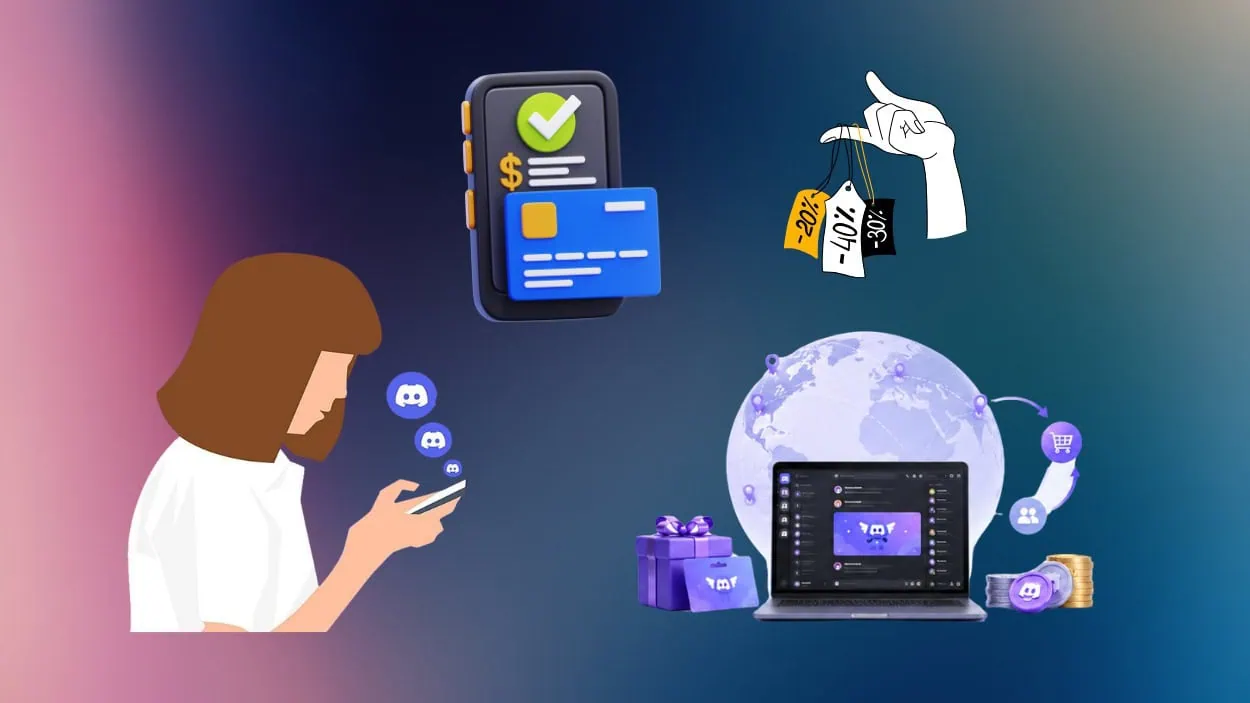






Discord has become close to the default infrastructure for online community, gaming, and a surprising amount of professional collaboration. The platform’s core service is free, and most users will go their entire Discord lifetime without ever paying for it. The premium tier, Nitro, sits on top of this free foundation as a paid upgrade that adds custom emoji, larger upload sizes, higher quality video, animated profile features, and a handful of other quality-of-life improvements. By the standards of subscription products, it is unusual in how clearly optional it is. None of what Nitro adds is required for the core experience.
That optionality has produced an interesting market dynamic. Nitro is widely desired but not strictly necessary, which means users are highly price-sensitive to it. A subscription you genuinely need will be paid at almost any reasonable price. A subscription you mostly want is a different calculation. Discord has positioned Nitro at a price point that works in mature markets where the headline price feels fair, but that price translates less well in markets where local purchasing power is lower or where users are accustomed to paying for digital subscriptions through alternative channels.
The Geography of Subscription Pricing
One of the more visible features of the Nitro secondary market is geographic. Subscription pricing for digital services has historically been less regionalised than it should be. Streaming platforms have moved further toward regional pricing than most software services have, partly because the alternative is widespread account sharing across borders. Discord has implemented some regional pricing, but the differentials are smaller than the actual purchasing power differences across its user base would suggest.
What follows from this is predictable. Users in lower-cost regions find ways to obtain Nitro at prices closer to what local digital services charge. Some of this happens through legitimate gifting from friends or family in higher-cost regions. Some happen through marketplaces such as Eldorado, where Nitro gift codes are listed by sellers across multiple regions at varying prices. The market behaviour is essentially identical to what happened with software licences in the 2000s and with streaming subscriptions in the 2010s. Users will route around pricing that does not match their local economic reality, regardless of what the publisher would prefer.
Why the Secondary Market Persists
Several structural factors keep this kind of market durable rather than transient:
- Digital goods have zero marginal cost of duplication for the seller, which means a gift purchased in one region carries no actual cost to redeem in another. The pricing differential is pure margin compression rather than real cost arbitrage.
- Gift codes are designed to be transferable. That is the entire point of the gifting feature. Any restriction on transferability would damage the legitimate use case more than it would reduce the secondary market.
- Enforcement against secondary market activity is expensive relative to the revenue it would recover. Most platforms quietly tolerate it because the alternative is a worse customer experience for legitimate buyers.
- Payment friction across borders remains real. A user who cannot easily pay in their preferred currency through the official channel will find another channel, and the secondary market fills that role.
What This Means for Subscription Strategy More Broadly
The Discord Nitro example is useful because it sits in the middle of a broader debate about how digital subscriptions should be priced. The optimistic version of regional pricing is that it expands the addressable market and produces more total revenue at slightly lower per-user prices in specific regions. The pessimistic version is that regional pricing creates arbitrage opportunities that erode pricing in higher-cost regions over time.
Discord’s middle path, with limited regional differentiation, has tried to balance these concerns but ends up tolerating a meaningful secondary market as a consequence. Whether that is the right strategic choice is genuinely debatable. The competing approaches each have visible failure modes. Streaming services that priced too low regionally found their subscriber growth coming heavily from lower-revenue regions while higher-revenue markets stalled. Services that are priced too uniformly globally lost the addressable market entirely in regions where the headline price was simply unaffordable.
For a UK reader looking at this from the relatively expensive end of the global pricing distribution, the practical implication is that the cheaper Nitro listings you see on third-party marketplaces are not evidence of fraud. They are evidence of the same regional pricing reality that exists for many other digital services. The transaction itself can be entirely legitimate, assuming you are using a marketplace with proper buyer protection and a clear track record.
The Broader Pattern Worth Watching
Discord Nitro is one specific case in a much larger pattern. As more consumer spending shifts toward digital subscriptions, the pricing strategy decisions that platforms make are going to attract more scrutiny than they have historically received. The secondary markets that develop around these subscriptions are not anomalies. They are signals about where the headline pricing has drifted away from what users in particular markets actually consider reasonable.
The visibility of listings offering Discord Nitro cheaply relative to regional retail prices is, in that sense, useful market information rather than something to be suppressed. Treating these markets as straightforward fraud problems misses the point. They are pricing problems in disguise, and the platforms that figure out how to address them at the source are going to be in a stronger position than those still trying to suppress the symptoms.